
Poblat talaiòtic Els Antigors near Ses Salines
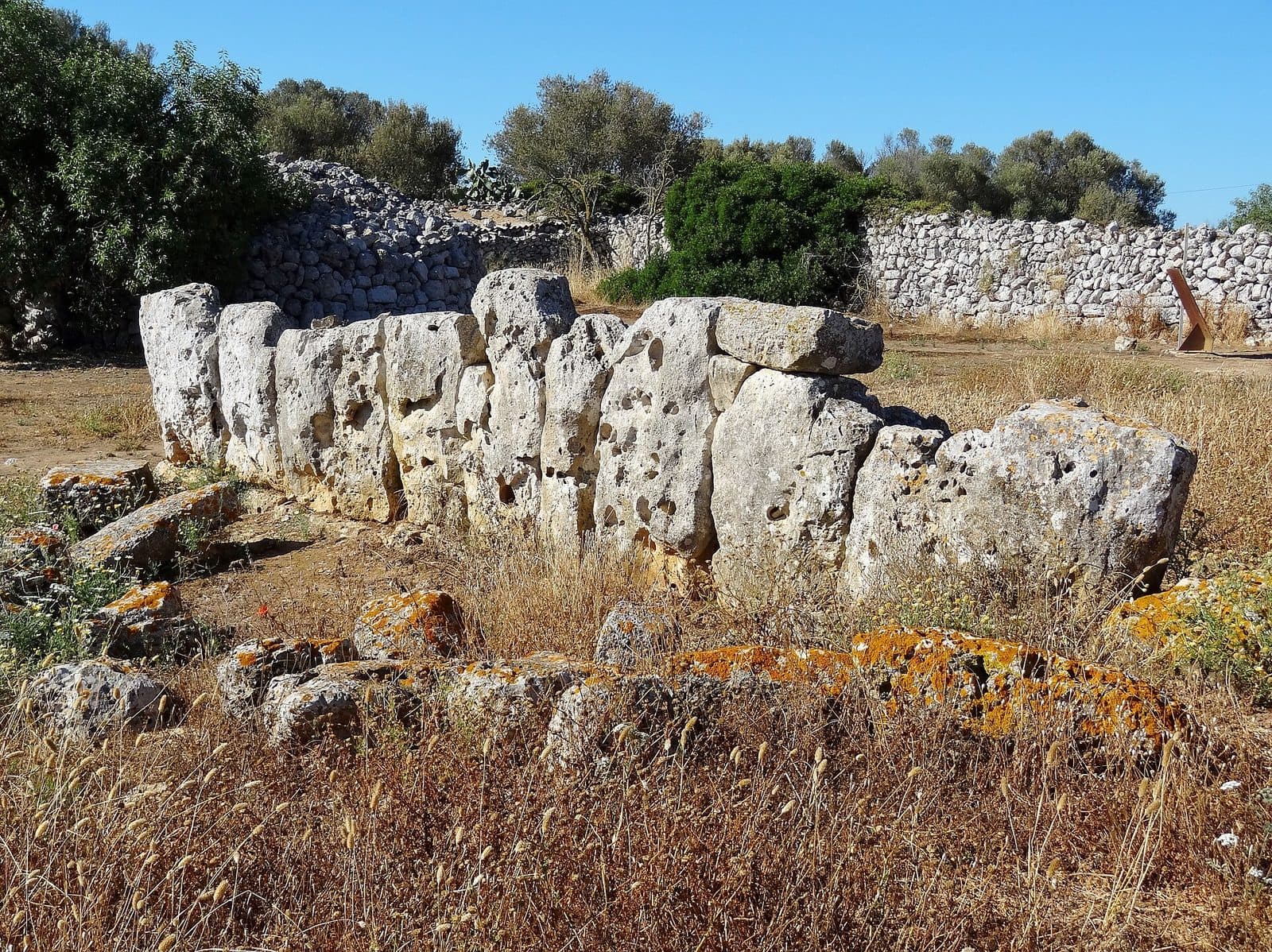

Massive stone blocks, a preserved entrance, and the remains of a central pillar: Poblat talaiòtic Els Antigors offers a direct encounter with Mallorca’s prehistory. The archaeological site lies just outside Ses Salines in the south of the island. Rather than a reconstructed backdrop, visitors find a genuine excavation site whose walls, passages, and buried structures only become legible on closer inspection.
The juxtaposition of two talaiots is especially impressive. The large structure known as Sa Talaia Joana preserves its entrance, a corridor, and parts of the former central pillar. A second excavated talaiot stands inside the settlement area. There is also a section of the perimeter wall, an ancient gate, and the more difficult-to-interpret traces of further buildings.
The site is particularly rewarding for anyone who wants Mallorca’s history to begin before the Romans, Arabs, or medieval churches. Families with children interested in history will also find vivid material here: the size of the stones and the narrow passages convey more than an abstract timeline. However, visitors should expect an open archaeological site with uneven ground and visible remains, some of which have been covered over again, rather than a museum with fully restored rooms.
Els Antigors also provides a welcome contrast to a beach day in the south. The site requires no elaborate expedition but rewards patience and close attention. Walking slowly along the walls reveals thresholds, wall cores, pillar remains, and distinct building units—clues to a settlement whose monumental architecture must once have been far more striking than it is today.
History and significance
Long before Ses Salines became associated with salt production along the coast, stone settlements shaped southern Mallorca. Els Antigors belongs to this Talaiotic world. Its characteristic monumental structures, the talaiots, were built from massive stones and were more than simple dwellings. Researchers interpret such tower-like buildings as communally used and highly visible places; their precise significance may have varied according to the settlement and period.
The Talaiotic settlement
At Els Antigors, it is possible to distinguish monumental talaiots, a defensive settlement wall, a gate, and further buildings in the interior. This layout alone shows that there was no isolated watchtower standing in the landscape. It was an organized settlement area in which access was directed, interior spaces were separated, and buildings of communal importance were constructed with particular care.
The architecture was designed for visibility. Recent research into Talaiotic sites on Mallorca therefore examines not only the function of individual rooms but also the interplay between location, building height, and perception within the landscape. Sa Talaia Joana illustrates this idea particularly well: even as a ruin, its preserved height makes it one of Mallorca’s large talaiots. In its original state, it must have dominated the appearance of the settlement far more strongly than it does today.
The excavations by Colomines
Els Antigors owes much of its prominence in archaeological literature to the investigations conducted by Colomines in the 1920s. The excavations carried out at that time exposed central parts of the site and documented structures that are no longer visible in the same form today. Historical plans are therefore especially important for understanding the site: what now looks like an inconspicuous pile of stones may mark the location of a monument that was once excavated and later covered over again.
One example is the sanctuary recorded in a drawing by Colomines, which subsequently disappeared beneath stones or deposits again. The site thus tells not only the story of the Talaiotic population but also that of archaeology itself. Earlier excavations exposed and documented structures while also leaving behind a site whose legibility changed once again over time.
Protected cultural heritage
Today, Poblat talaiòtic Els Antigors has the status of a Bien de Interés Cultural. This classification recognizes the site as protected cultural heritage. It is important because archaeological information is carried not only by the prominent talaiots but also by low wall lines, thresholds, buried building remains, and the positions of individual structures in relation to one another.
This is precisely what gives the site its significance: Els Antigors preserves not a single spectacular find but a section of the physical organization of a prehistoric community. Monument, settlement boundary, and interior development can be considered together. This makes the site a key destination for anyone seeking to understand how Talaiotic architecture shaped the social space of a settlement.
What to see
Your first look should focus not on the site as a whole but on the construction of its walls. The internal structure of the wall is clearly visible at the gate, while the gates and corridors show particularly well how deliberately the builders placed openings within these massive structures. Els Antigors is therefore best explored one architectural element at a time.
Sa Talaia Joana
Sa Talaia Joana is the settlement’s most monumental talaiot. It preserves its entrance and the corridor beyond it. Looking at the structure, you can still recognize the original direction of movement: access did not lead inside arbitrarily through an open break but through an architecturally defined passage into the interior.
Several drums of the central pillar survive there. One element remains in place, while another has collapsed. These stones are remnants of the central pillar.
The surviving height distinguishes Sa Talaia Joana among Mallorca’s talaiots. At the same time, this part is more difficult to visit than the structures within the site that appear more freely accessible. Property boundaries and the condition of the access should be respected; a good view of the entrance, corridor, and masonry is more valuable than attempting to enter every ruin.
The settlement wall
Near Sa Talaia Joana, a roughly 25-meter-long section of the settlement wall extends to one of the ancient gates. This stretch of wall helps convey the scale of the site because it does not mark the wall of an individual house but part of the settlement area’s outer boundary.
The façade of large stones is not its only interesting feature. The internal construction of the wall is also clearly visible at the gate. The structure had volume and depth; it was designed as a massive body. Looking at the preserved section from the side reveals this distinction more clearly than viewing it only from the front.
The settlement gate
The gate is one of the most vivid details at Els Antigors. Its threshold survives, so the historic passage does not merely have to be inferred. Here, residents and visitors once crossed a clearly defined boundary between the outside and the settlement interior.
The doorway also demonstrates how effective just a few surviving architectural elements can be. The threshold draws the eye downward, the walls on either side reveal the strength of the fortification, and the internal structure shows how it was built. Approaching the gate from both sides gives a better sense of how carefully access was controlled.
The inner talaiot
A second excavated talaiot stands inside the settlement. It does not have the monumental impact of Sa Talaia Joana, but it is particularly informative for understanding the construction. Its interior has been cleared, while the entrance corridor survives and is now open above.
The base of the central pillar lies inside. Together with the corridor, it provides a clear basic layout: entrance, enclosed space, and central pillar. Because the upper structural elements are missing, the arrangement can be viewed like an archaeological floor plan. Rather than a reconstructed surface, the surviving elements of the original design are directly visible.
Further rooms and clapers
Remains of individual rooms lie between the large monuments. Not every wall line is equally easy to interpret, and some structures appear only as low arrangements of stones. This is where walking slowly is particularly rewarding: corners, parallel wall lines, and enclosed areas show that further buildings once stood within the perimeter.
Part of the site is characterized by structures known as clapers, or gathered piles of stones. Some cover older monuments. To an untrained eye, they may look like ordinary collections of fieldstones, but they form part of the later transformation of the archaeological landscape. Beneath and between them are traces that were more visible during earlier investigations.
The covered sanctuary
The site of a once-documented sanctuary is particularly unobtrusive. A historical drawing by Colomines records the structure, but its location is now barely discernible on the ground. There is no towering temple building to visit here. Instead, its appeal lies in comparing the archaeological documentation with the site’s present condition.
This invisible monument sharpens your perception of the entire site. Archaeological places consist not only of what rises high above the ground, because covered remains also belong to their history. Els Antigors therefore requires imagination—and rewards it with a more nuanced picture than a completely polished reconstruction could provide.
Visiting the site
At first, the site appears manageable. Then the passage in the large talaiot, the threshold of the settlement gate, and the pillar base in the inner structure draw the eye in succession. A visit works best as a quiet circuit, first examining the monumental structures and then considering how the lower wall lines relate to one another.
A practical route
Sa Talaia Joana makes a useful point of orientation. From there, the view leads to the preserved section of the perimeter wall and onward to the settlement gate. This sequence first conveys the site’s outer form: dominant talaiot, massive boundary, and controlled access.
The second talaiot inside the settlement should come next. Its open corridor and the base of the central pillar often explain the construction more clearly than the more imposing but less accessible Sa Talaia Joana. Finally, you can examine the individual rooms, clapers, and the sanctuary site, which is now recognizable only indirectly.
How much time is worthwhile?
There is no universally suitable length of time for visiting Els Antigors. Anyone who simply wants to see the two talaiots and the gate can experience it as a compact archaeological stop. Those who want to compare masonry techniques, thresholds, pillar remains, and the positions of further rooms should allow considerably more time. The site reveals its value not through quickly checking off features but through repeated observation from different directions.
Extra time is advisable when visiting on foot from Ses Salines. A documented circular walk connects the town with the excavation site and shows that Els Antigors works well as a short cultural and historical walk. The time spent at the site itself and the journey there should be considered separately when planning.
Time of day and weather
The exposed stones and uneven ground are particularly easy to read in clear light. During the hot months, the cooler hours of the day are more pleasant. There is no reliable information about typical visitor numbers. Els Antigors, however, is not a staged major museum with a fixed route. Anyone wishing to take photographs carefully or study the wall lines in peace will generally benefit from visiting at a time when heat does not distract from the site.
Getting there and parking
The journey from farther away initially leads to Ses Salines. Only there does the short final stretch to the archaeological site outside the town center begin. Navigation destinations should therefore be checked for the full name Poblat talaiòtic Els Antigors: a general destination in Ses Salines will not automatically lead to the appropriate access point for the archaeological site.
From Palma Airport
The road distance from Palma Airport to Ses Salines is 47 kilometers. The journey takes around 41 minutes and follows the Ma-19, then the Ma-6030 and the Ma-6014. These figures apply specifically to Ses Salines, not directly to the ruins. From the town, the final stretch leads into the surrounding rural landscape. Els Antigors is close enough to make the visit possible as a walk from Ses Salines.
From Palma
The road distance from central Palma to Ses Salines is 53 kilometers. The journey takes around 51 minutes. This route also follows the Ma-19, the Ma-6030, and the Ma-6014. From Ses Salines, local navigation to the archaeological site is required; the stated distance and journey time end in the town. The main connection via the Ma-6014 then leads back toward the Ma-6030 and Ma-19.
By bus and on foot
In Ses Salines, buses serve stops including Maria Antònia Salvà and Ses Creus. From there, visiting the site involves walking out of town. Unlike an urban museum, the excavation site is not directly beside a central bus stop, so sturdy footwear is advisable.
A recorded circular route leads from Ses Salines to the Talaiotic settlement and back. It is described as easy and has only minor differences in elevation. This makes the route particularly suitable for visitors who deliberately want to turn the archaeological stop into a walk through the countryside around Ses Salines.
Bus lines to Poblat talaiòtic Els Antigors at a glance
| Line | Route | Departures/day | First | Last |
|---|---|---|---|---|
| 517 | Santanyí - Colònia de Sant Jordi - Campos | 76 | 05:55 | 23:08 |
From the official GTFS feeds (TIB/SFM), no real-time data. The figures cover all stops in the town; weekend and holiday services differ — check with the operator before travelling.
Getting there by bus
Maria Antònia Salvà 2 (59012) · 1.1 km as the crow flies
- 517Santanyí - Colònia de Sant Jordi - Campos · Daily
Maria Antònia Salvà 1 (59011) · 1.1 km as the crow flies
- 517Santanyí - Colònia de Sant Jordi - Campos · Daily
Ses Creus 2 (59001) · 1.2 km as the crow flies
- 517Santanyí - Colònia de Sant Jordi - Campos · Daily
Ses Creus 1 (59002) · 1.2 km as the crow flies
- 517Santanyí - Colònia de Sant Jordi - Campos · Daily
Timetable data: official GTFS feeds (TIB/EMT), no real-time — check with the operator before travelling.
Nearby
Ses Salines is more than the starting point for the final leg of the journey. The town’s name refers to the coastal salt landscape, whose use shaped the municipality’s history over many eras. A walk through the town and a visit to Els Antigors therefore tell two very different chapters of southern Mallorca: the monumental stone structures of prehistory on one hand, and a community whose identity is closely linked to salt on the other.
Ses Salines
The compact town is suitable for a break before or after visiting the excavation. Walking to Els Antigors lets you experience the transition from the built-up town to the rural surroundings directly. This change is particularly helpful for placing the archaeological site in context: the Talaiotic settlement was not a museum object but part of an inhabited and perceived landscape.
Els Antigors should not be confused with a single talaiot. The site includes several monuments, wall lines, and settlement areas. The name Sa Talaia Joana also refers only to the large talaiot within or at the edge of the overall complex, not to the entire Poblat talaiòtic Els Antigors.
Colònia de Sant Jordi and the salt landscape
Colònia de Sant Jordi lies south of Ses Salines. The coastal town is a natural addition if you want to follow the archaeological visit with the sea, harbor, or beach. The saltworks landscape of Sa Vall is also part of the municipality’s history. Salt production there dates back to antiquity and was continued by different cultures over the centuries.
Combining both themes is particularly appealing: Els Antigors represents the prehistoric settlement of southern Mallorca, while the saltworks reflect a later, more tangible use of the coastal landscape that continues to the present day. For a day trip, it is enough to treat both places as separate stops rather than overloading the archaeological visit with an extensive coastal itinerary.
Beaches in the south
The beaches around Colònia de Sant Jordi can easily be planned after a cultural morning. Enough attention should still be reserved for Els Antigors: anyone who treats the site merely as a brief stop on the way to the sea can easily overlook the gate, wall construction, and pillar remains.
Santanyí and other destinations in the southeast can also be combined with Ses Salines. For understanding Els Antigors, however, nearby Ses Salines is the most useful addition. It offers orientation, a starting point for the walk, and the region’s historical context without distracting from the archaeological site itself.
The place it belongs to
Ses Salines in the place guidePractical information for your visit
The main subject of the visit is often directly beneath your feet: thresholds, low walls, and loose stones. Anyone who looks only at Sa Talaia Joana will miss a large part of the site. At the same time, the terrain requires more attention than a paved museum path.
Footwear and terrain
Sturdy, closed shoes are recommended. The ground is uneven, and loose stones may lie between the wall lines. Sandals with little support make it especially difficult to view the walls from the side and carefully cross irregular surfaces. Much of the site can best be understood from ground level: gate width, wall thickness, corridors, and pillar remains are clearer from angled viewpoints than from above.
Sun and equipment
During the hot months, the cooler hours of the day are more pleasant. Anyone with historical plans or images of the excavation at hand will also be better able to identify the now barely visible location of the covered sanctuary.
With children
The large stone blocks, gate area, and preserved corridors are likely to be the most vivid features for children. The inner talaiot is well suited to explaining the entrance, room, and central pillar together. Younger children should be closely supervised because of the uneven ground and fragile walls.
A small search activity can structure the visit: where is the preserved threshold, where does the corridor begin, and which stone base belonged to the central pillar? This keeps attention focused on documented architectural elements without turning the ruins into an invented story.
What not to expect
Els Antigors is not a fully reconstructed village. There are no roofs, complete house walls, or furnished interiors. The once-documented sanctuary is also no longer visible as a free-standing structure. The value of the site lies in its original remains and their spatial relationships, not in spectacular presentation.
Nor should every pile of stones automatically be interpreted as an identifiable building. Later clapers partly cover older structures. A cautious view is more accurate here than a hasty interpretation. Anyone who distinguishes between clearly recognizable architectural elements and merely suspected remains will experience Els Antigors for what it is: a complex archaeological site, not a finished model of the past.