
Camp de sa Batalla near Llucmajor
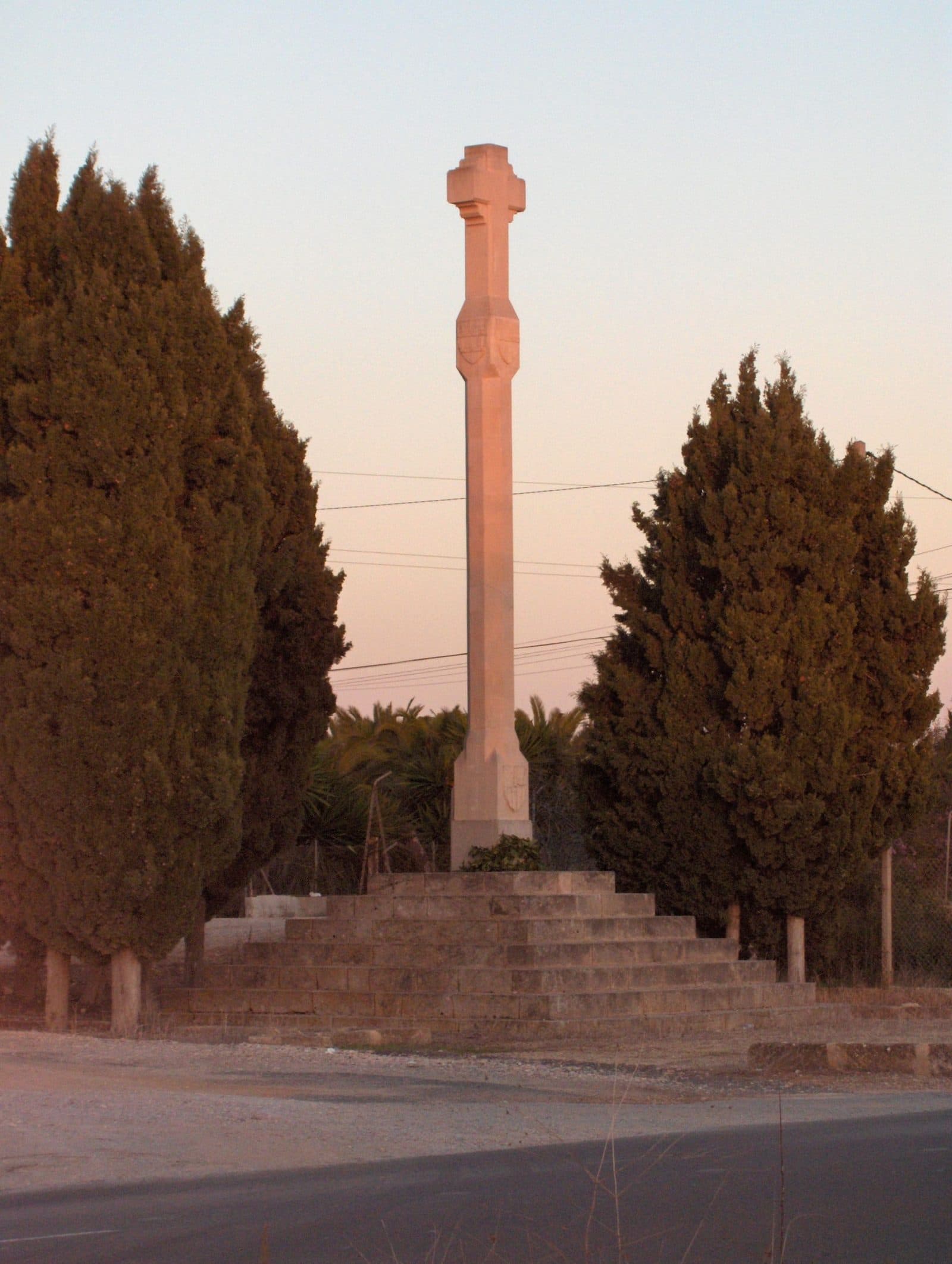

Camp de sa Batalla on the outskirts of Llucmajor is a quiet memorial site of great historical significance. It commemorates the Battle of Llucmajor, in which King Jaume III. of Mallorca lost his life and his kingdom lost its political independence. A commemorative cross marks the place where the king is said to have fallen, revealing that a decisive episode in Mallorcan history unfolded at this now unassuming site.
A visit is especially worthwhile for travelers who want to discover more than Llucmajor’s markets and rural character. Camp de sa Batalla also works well as a short historical stop on a journey through southern Mallorca. With some prior knowledge, this memorial focused on a single historical site becomes a key to understanding the island’s medieval history.
History and significance
On 25 October 1349, the troops of the Kingdom of Mallorca met the army of the Crown of Aragón near Llucmajor. Jaume III. led the Mallorcan side, while the forces of Peter IV. of Aragón fought on the Aragonese side. The battle ended in an Aragonese victory; Jaume III. was killed in combat. Camp de sa Batalla commemorates the site of this military decision.
The Battle of Llucmajor
The conflict involved more than a local power struggle. The outcome of the battle led to the incorporation of the Kingdom of Mallorca into the Crown of Aragón and is regarded as the end of its independence. This is precisely why the battle remains particularly prominent in Llucmajor to this day.
The death of a king and the end of an independent kingdom converge here in one specific place. Camp de sa Batalla is therefore not a general war memorial but is tied to a clearly identified event and its political consequences.
Jaume III. of Mallorca
Jaume III. stands at the heart of the commemoration. According to local tradition, the commemorative cross marks the place where the king fell. Another monument in Llucmajor itself also commemorates him and his son Jaume IV. Camp de sa Batalla, however, remains the site directly associated with the king’s death.
The memory is not merely preserved as history: an annual floral tribute honoring Jaume III. takes place at Camp de sa Batalla. The fact that residents gather at the memorial demonstrates its continuing importance to local identity. The site connects medieval history with a culture of remembrance maintained into the present day.
What to see
A single cross carries the weight of a lost kingdom here. Camp de sa Batalla is designated as a historic site, with the Creu del Camp de sa Batalla forming its visible centerpiece. The impression is defined not by the size of a structure but by the connection between landscape, event, and memory.
Creu del Camp de sa Batalla
The commemorative cross marks the place where Jaume III. is said to have fallen during the battle. It therefore serves both as a landmark and a memorial. Those standing before it are not looking at an anonymous symbol but at a marker of a specific turning point in Mallorcan history.
The cross is also the focal point of the annual commemoration. During the floral tribute, the historic site briefly becomes a public gathering place once again. At other times, the monument is best understood as a quiet marker of history.
The historic site
Camp de sa Batalla includes not only the cross but also the site itself. Its name preserves the memory of the battlefield of 1349. The key is to connect the present-day location with the events handed down through history, even if its understated character requires a little imagination.
The contrast between the surroundings today and the magnitude of what happened here shapes the experience. Anyone already familiar with the roles of Jaume III. and Peter IV. will recognize the cross as the endpoint of a dynastic conflict and the landscape as a political memorial of island-wide significance.
Visiting Camp de sa Batalla
The most meaningful approach begins with the history. Knowing beforehand that a king fell here on 25 October 1349 and that the independence of the Kingdom of Mallorca came to an end changes how the cross is perceived. Without this context, it can easily seem like a solitary monument; with it, the cross becomes a marker of political upheaval.
At the commemorative cross
At the site, attention first turns to the Creu del Camp de sa Batalla. It is then worth considering the location in relation to Llucmajor. Its proximity to the town explains why the battle is so closely linked to Llucmajor’s name and collective memory.
The length of a visit therefore depends on your interest in history. Anyone who only wants to see the cross can keep the stop brief. Those who want to understand the events of 1349, contemplate the site, and then visit other memorials in Llucmajor should treat Camp de sa Batalla as the starting point for a more extensive tour of the town.
Quiet visits and the commemoration
During the year, the floral tribute to Jaume III. is the main exception to the site’s otherwise subdued character. Residents gather at Camp de sa Batalla for this annual event. Anyone wishing to experience the site as a living place of remembrance can check the current date in advance. For quiet contemplation, however, a visit outside the commemoration is recommended.
Reliable opening hours and admission details have not been recorded. As access and local regulations may change, current information should be checked before traveling. The focus is on the historic site, the commemorative cross, and the significance passed down through history.
Getting there and parking
From Palma, the journey first leads to Llucmajor. From the center of the island’s capital, it is around 28 kilometers by road via the Ma-19; the drive to Llucmajor takes approximately 32 minutes. From Palma Airport, the town is around 22 kilometers by road and approximately 21 minutes away. These figures apply to the journey to Llucmajor, not directly to the commemorative cross.
The final stretch in Llucmajor
Camp de sa Batalla lies on the edge of the urban area beside the Guardia Civil site. This location detail is helpful for finding the memorial. The exact position of the cross should therefore be used for the final stage of the journey.
Visitors arriving by car should follow local signage and observe the applicable parking regulations. It may be practical to combine the stop with time in Llucmajor and visit the historic site as part of a tour of the town.
Arriving by bus
Llucmajor is served by several bus stops in the western and central parts of town. The stops are within the town rather than directly at the commemorative cross. For the onward journey or subsequent walk to Camp de sa Batalla, use its location beside the Guardia Civil as a point of reference. Before departure, it is advisable to check the current service and the most suitable stop in Llucmajor.
Bus lines to Camp de sa Batalla at a glance
| Line | Route | Departures/day | First | Last |
|---|---|---|---|---|
| 501 | Manacor - Campos - Palma | 517 | 00:20 | 23:29 |
| 508 | Sa Ràpita - Palma | 101 | 06:45 | 22:40 |
| A51 | Campos - Aeroport | 95 | 00:03 | 23:07 |
| 431d | Algaida - Llucmajor | 20 | 08:52 | 17:50 |
From the official GTFS feeds (TIB/SFM), no real-time data. The figures cover all stops in the town; weekend and holiday services differ — check with the operator before travelling.
Getting there by bus
Llucmajor oest 1 (31063) · 1.4 km as the crow flies
- 431dAlgaida - Llucmajor · Mon-Fri
- 501Manacor - Campos - Palma · Daily
- 508Sa Ràpita - Palma · Daily
- A51Campos - Aeroport · Daily
Llucmajor oest 2 (31062) · 1.4 km as the crow flies
- 431dAlgaida - Llucmajor · Mon-Fri
- 501Manacor - Campos - Palma · Daily
- 508Sa Ràpita - Palma · Daily
- A51Campos - Aeroport · Daily
Llucmajor centre 1 (31057) · 1.8 km as the crow flies
- 431dAlgaida - Llucmajor · Mon-Fri
- 501Manacor - Campos - Palma · Daily
- 508Sa Ràpita - Palma · Daily
- A51Campos - Aeroport · Daily
Llucmajor centre 2 (31058) · 1.8 km as the crow flies
- 431dAlgaida - Llucmajor · Mon-Fri
- 501Manacor - Campos - Palma · Daily
- 508Sa Ràpita - Palma · Daily
- A51Campos - Aeroport · Daily
Llucmajor est 2 (31055) · 2.2 km as the crow flies
- 431dAlgaida - Llucmajor · Mon-Fri
- 501Manacor - Campos - Palma · Daily
- 508Sa Ràpita - Palma · Daily
- A51Campos - Aeroport · Daily
Timetable data: official GTFS feeds (TIB/EMT), no real-time — check with the operator before travelling.
Nearby places to visit
Llucmajor preserves the memory of the battle beyond Camp de sa Batalla. In the town, a monument commemorates King Jaume III. and his son Jaume IV., who raises the banner of the Kingdom of Mallorca. The two memorials complement each other well: the cross marks the king’s traditional place of death, while the monument in town focuses more closely on the individuals and their dynastic legacy.
Llucmajor
After the medieval turning point, Llucmajor continued to develop as an agricultural, artisanal, and commercial center. Almonds, figs, carob, and wine shaped the surrounding countryside; the town later also became known for shoemaking. A walk through Llucmajor therefore broadens the perspective beyond the battle. The historical event is a decisive part of local identity, but not the only layer of the town’s history.
Camp de sa Batalla is particularly suitable as an introduction to this broader context. From the site on the edge of town, the historical thread leads to the Jaume-III. monument and onward into a Llucmajor that found new economic and social roles after the end of the medieval kingdom.
Capocorb Vell
Anyone wishing to explore the historical perspective more deeply can combine the visit with Capocorb Vell in the municipality of Llucmajor. The Talayotic settlement reaches far back beyond the Middle Ages and demonstrates that organized communities already shaped the region during the Bronze Age. Camp de sa Batalla and Capocorb Vell tell different chapters: the political upheaval of 1349 here and the prehistoric settlement of southern Mallorca there.
Such a combination reveals the municipality’s broad historical span without conflating the sites. Camp de sa Batalla remains the memorial to the medieval battle, while Capocorb Vell represents a much earlier period of the island’s history.