
Estàtua de s’Espigolera in Llucmajor
.jpg)
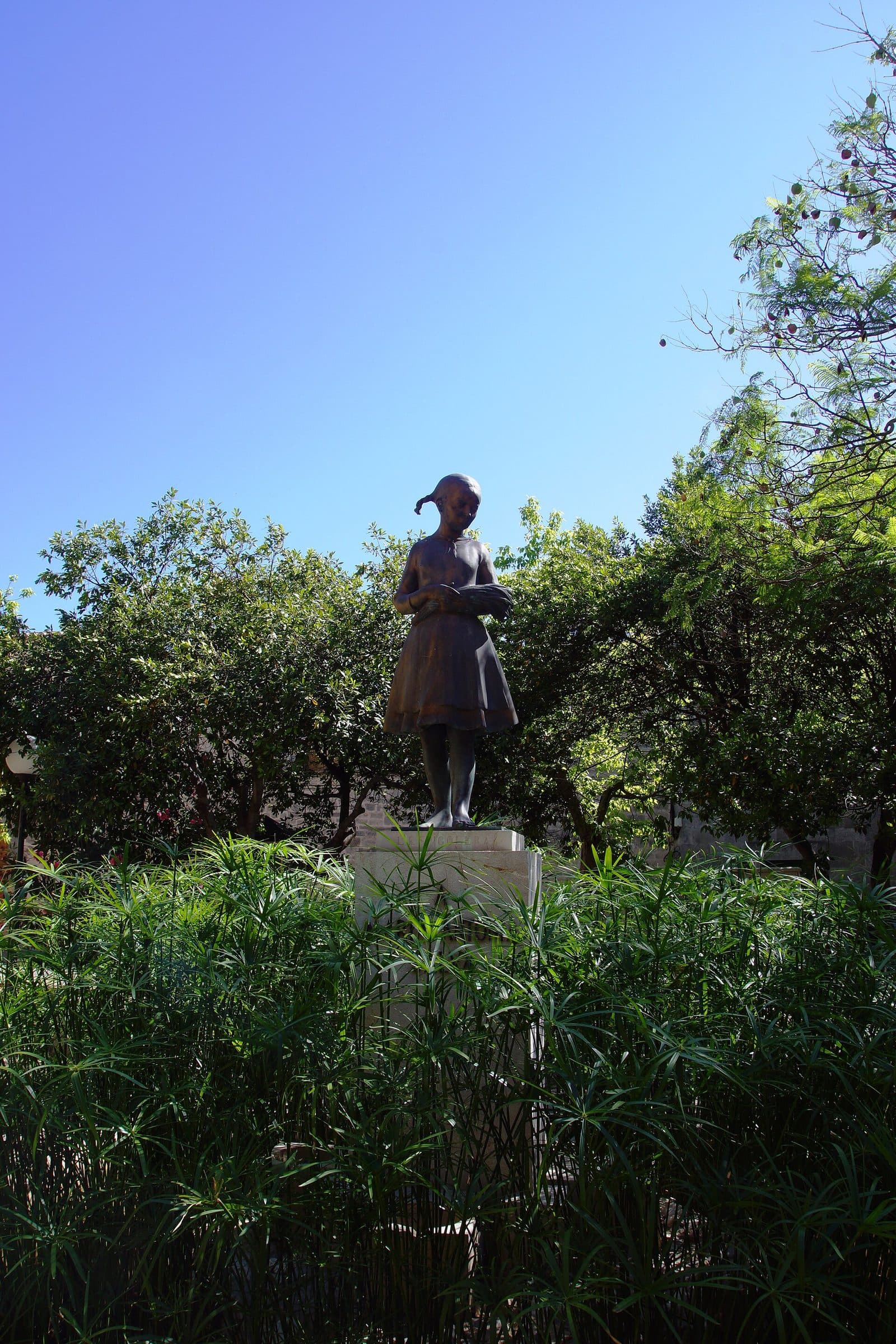
With braided hair, traditional Mallorcan clothing, and a bundle of grain ears in her arms, the estàtua de s’Espigolera stands in Llucmajor. The bronze figure depicts neither a ruler nor a saint, but a girl performing a simple task in the countryside. It is precisely this unspectacular activity that makes the monument remarkable: it preserves an everyday scene that became part of Llucmajor’s cultural memory through a poem.
The sculpture is dedicated to the Llucmajor-born poet Maria Antònia Salvà i Ripoll. Her poem “Espigolera” gave the work its name. It evokes a rural world in which girls crossed the fields after the threshers and gathered the grain ears left behind. The figure translates this literary motif into bronze.
A visit is especially worthwhile for travelers who see Llucmajor as more than a starting point for trips to southern Mallorca. The statue can be understood without a guide or prior knowledge of art history, but it becomes much more meaningful once the story behind the grain ears is known. It is not a major attraction with interiors or an exhibition, but a concentrated place of remembrance—ideal as a stop on a walk through the town center.
History and significance
The monument began not with a political event, but with an observation from rural life. When individual ears of grain remained after threshing, girls followed the workers and gathered these remnants. The term “Espigolera” derives from this activity. Maria Antònia Salvà took up the motif in one of her poems and gave poetic voice to a task that had received little attention.
Maria Antònia Salvà
The dedication to Maria Antònia Salvà closely connects the statue with Llucmajor. The monument does not simply commemorate Mallorcan agriculture in general, but a local poet and a specifically named work. This is the source of its distinctive message: literature does not appear as something remote, but as something born from careful observation—from clothing, work, landscape, and the gestures of daily life.
The depicted gleaner is therefore both a literary figure and a symbol of a vanished rural practice. The focus is not on the harvest itself, but on what remained in the field after the main work had been completed. Gathering the grain ears points to care, frugality, and the importance of every part of the harvest. Salvà’s poem made this quiet activity worthy of remembrance; the sculpture later gave it a permanent form in public space.
Horacio de Eguía
The bronze sculpture was created in 1965 by Horacio de Eguía. The sculptor chose not to make a portrait of the honored author, instead depicting the central motif of her poem. This is essential to understanding the monument: anyone standing before the figure is not looking directly at Maria Antònia Salvà. She is honored through her imagery and through the people whose daily lives she preserved in literature.
The estàtua de s’Espigolera thus has several layers of meaning. It honors a poet from Llucmajor, recalls a poem, and simultaneously preserves a scene from Mallorcan agricultural culture. A single young farmworker becomes a monument to poetry’s ability to make the seemingly incidental visible.
What to see
The grain ears immediately catch the eye. The young woman carries the gathered grain in her arms; the harvest is not merely an accompanying symbol, but the key to the entire depiction. Without this bundle, she would be a generalized figure in traditional dress. With it, she becomes the “Espigolera,” the gleaner from Salvà’s poem.
The gleaner
Horacio de Eguía depicts a “pagesa,” a young woman from Mallorca’s rural world. Her posture is shaped by the harvest she carries. Instead of a ceremonial pose, viewers encounter a figure whose identity emerges from her work. The monument therefore tells its story not through dramatic movement, but through a few clearly legible features: person, clothing, and grain.
The choice of age is particularly revealing. The figure is not a stately matriarch, but a girl or young countrywoman. This corresponds to the traditional scene in which young girls followed the threshers and collected the ears of grain left behind. Anyone studying the face and posture should therefore not look for an individual portrait of Salvà. Instead, the figure embodies the person from the poem.
Braids and Mallorcan clothing
The braided hair and traditional Mallorcan clothing visibly place the scene on the island. These details are more than folkloric decoration. They connect the literary motif with the rural society from which it came and make the figure recognizable as a “pagesa” even without an explanatory text.
It is worth walking around the sculpture, provided conditions on site allow it. From the front, the figure and grain ears form a unified motif; from the side, the position of the arms, the mass of grain, and the lines of the clothing become more distinct. The rear view draws greater attention to the braids and the sculptural detailing of the traditional dress. In this way, visitors can see how the sculptor transformed a brief poetic scene into a form that can be experienced from every angle.
Bronze as a material
The use of bronze gives the everyday motif permanence and weight. This creates an appealing contrast: the subject is the gathering of light grain ears left behind, yet the scene is preserved in durable metal. The work does not elevate this modest gleaning into a heroic deed. Instead, it ensures that an inconspicuous activity and the poem describing it remain present in Llucmajor’s townscape.
The statue should therefore not be regarded merely as a decorative figure in traditional dress. Grain ears, braids, clothing, and posture are all part of a precise narrative. By connecting these individual details, viewers can read the sculpture almost like the condensed illustration of a poem.
Visiting the statue
An encounter with s’Espigolera usually begins casually. There is no long museum route, no sequence of galleries, and no monumental site. A single work of art stands before the viewer, and its impact depends on pausing briefly to connect its visible details with the story of the poem.
First the figure, then the story
A simple sequence makes for a rewarding visit: first, view the statue without any prior knowledge. What do the grain ears, braids, and clothing reveal about the person depicted? Learning about the poem afterward changes the perspective. The bundle of grain shifts from an agricultural attribute to a reference to the girls who followed the threshers and gathered the ears left behind.
The statue is better suited to a thoughtful stop than to a long trip on its own. Anyone who merely takes a photo will finish quickly. Those who compare different views, decipher the visual symbols, and consider the connection with Maria Antònia Salvà will experience a small but thematically complete monument. Including it in a walk through Llucmajor is worthwhile, as its location makes clear that a local poet is being honored through a motif from rural Mallorca.
Timing and planning your visit
There is no reliably documented time when crowds are especially small. Because this is an individual sculpture rather than an exhibition designed to manage visitor flows, it can be flexibly incorporated into a walk through town. For photographs, the main consideration is having enough time to explore different angles rather than remaining directly in front of the figure.
Current access conditions should be checked before visiting; it is also advisable to seek up-to-date information on whether admission is charged. Fixed hours or a specific price should not be assumed. Regardless of these details, the quality of a visit depends less on organizational planning than on understanding the statue’s literary background.
Getting there and parking
From Palma, the journey first leads to Llucmajor and then through the town to the statue. From central Palma, the route follows the Ma-19. The road distance to Llucmajor is 28 kilometers, and the journey takes around 32 minutes. These details explicitly refer to travel as far as Llucmajor, not to a parking space immediately beside the monument.
From Palma Airport, the road distance to Llucmajor is 22 kilometers, with a journey time of around 21 minutes. Here too, the measured route ends in the town. Reaching the estàtua de s’Espigolera for the final part of the journey requires navigating the local streets. The sculpture is located on Carrer des Convent and is best approached as a stop on a walk through the center rather than by attempting to end the drive directly in front of the artwork.
By bus
Llucmajor has stops both on the eastern edge of town and in the center. When visiting the statue, it is therefore important to know which stop your chosen service terminates at and how the subsequent walk through town proceeds. Visiting the monument does not require further travel to an outlying site: the destination is a monument within Llucmajor, not a landscape with the same name or a remote historical area.
By car
When choosing a parking space, consider the destination as part of a walk through town. Available visitor information does not describe a dedicated facility for the statue. It is therefore more practical to follow the local traffic and parking regulations in effect at the time and cover the remaining distance on foot. This also makes it easier to combine s’Espigolera with other stops in the historic center.
Bus lines to estàtua de s’Espigolera at a glance
| Line | Route | Departures/day | First | Last |
|---|---|---|---|---|
| 501 | Manacor - Campos - Palma | 621 | 00:20 | 23:29 |
| 508 | Sa Ràpita - Palma | 150 | 06:43 | 22:42 |
| A51 | Campos - Aeroport | 114 | 00:03 | 23:07 |
| 431d | Algaida - Llucmajor | 24 | 08:50 | 17:50 |
From the official GTFS feeds (TIB/SFM), no real-time data. The figures cover all stops in the town; weekend and holiday services differ — check with the operator before travelling.
Getting there by bus
Llucmajor est 1 (31056) · 0.4 km as the crow flies
- 431dAlgaida - Llucmajor · Mon-Fri
- 501Manacor - Campos - Palma · Daily
- 508Sa Ràpita - Palma · Daily
- A51Campos - Aeroport · Daily
Llucmajor est 2 (31055) · 0.4 km as the crow flies
- 431dAlgaida - Llucmajor · Mon-Fri
- 501Manacor - Campos - Palma · Daily
- 508Sa Ràpita - Palma · Daily
- A51Campos - Aeroport · Daily
Llucmajor centre 1 (31057) · 0.7 km as the crow flies
- 431dAlgaida - Llucmajor · Mon-Fri
- 501Manacor - Campos - Palma · Daily
- 508Sa Ràpita - Palma · Daily
- A51Campos - Aeroport · Daily
Llucmajor centre 2 (31058) · 0.7 km as the crow flies
- 431dAlgaida - Llucmajor · Mon-Fri
- 501Manacor - Campos - Palma · Daily
- 508Sa Ràpita - Palma · Daily
- A51Campos - Aeroport · Daily
Llucmajor oest 1 (31063) · 1.1 km as the crow flies
- 431dAlgaida - Llucmajor · Mon-Fri
- 501Manacor - Campos - Palma · Daily
- 508Sa Ràpita - Palma · Daily
- A51Campos - Aeroport · Daily
Llucmajor oest 2 (31062) · 1.1 km as the crow flies
- 431dAlgaida - Llucmajor · Mon-Fri
- 501Manacor - Campos - Palma · Daily
- 508Sa Ràpita - Palma · Daily
- A51Campos - Aeroport · Daily
Timetable data: official GTFS feeds (TIB/EMT), no real-time — check with the operator before travelling.
Nearby attractions
After seeing the statue, the most rewarding route leads not straight back to the car, but onward through Llucmajor. The town contains several reminders of its religious, artisanal, and political history. S’Espigolera adds a literary perspective to this walk: among churches, squares, and other monuments, it recalls that local history consists not only of major events, but also of work, language, and observations of daily life.
Llucmajor town center
In the center, the statue and the story associated with Maria Antònia Salvà can be combined with a walk to Plaça d’Espanya, the church of Sant Miquel, and the Sant Bonaventura complex. Other monuments around town also address people, professions, and historical memories. The result is not a unified sculpture park, but a sequence of varied references to Llucmajor’s identity.
In this context, s’Espigolera appears particularly understated. Other monuments may commemorate kings, battles, or traditional trades; here, a girl carries grain ears. It is precisely the contrast between major historical themes and this quiet rural scene that makes a walk so revealing. The statue serves as a literary marker of remembrance.
Excursions around the municipality
Anyone wishing to extend the visit beyond the town will find very different destinations throughout the municipality. Capocorb Vell represents the prehistoric past, while the Santuari de Gràcia reflects the religious landscape near Randa. The coast and Sa Marina de Llucmajor, in turn, reveal the broad agricultural surroundings that make the gleaner motif easier to understand.
These destinations should not be mistaken for parts of the statue. Instead, they provide a broader framework for a day in Llucmajor: in the town center, literature encounters local memory, while farther afield archaeology, cultural landscapes, and the coast change the perspective on southern Mallorca. S’Espigolera remains a small monument—but one that makes the transition from lived daily experience to poetry unusually clear.
Local insider tips
Look at the grain ears first
The bundle of grain is the key to the figure: it identifies the girl as the gleaner from Maria Antònia Salvà’s poem and distinguishes the work from a generalized statue in traditional dress.
View the back as well
Do not stop after taking a frontal photo. From the side and rear, the position of the arms, the braided hair, and the sculptural detailing of the traditional Mallorcan clothing become more distinct.
Read the monument like a poem
The statue is not a portrait of Maria Antònia Salvà. Instead, Horacio de Eguía translated the motif of her poem into bronze. With this knowledge, the figure, clothing, and grain ears emerge as parts of a unified narrative.
Include it in a walk through town
S’Espigolera is a concentrated stop, not an extensive museum. It is best combined with a walk through central Llucmajor, perhaps toward Plaça d’Espanya and Sant Bonaventura.