
s'Hort del Rei: Palma's Royal Garden
.jpg)
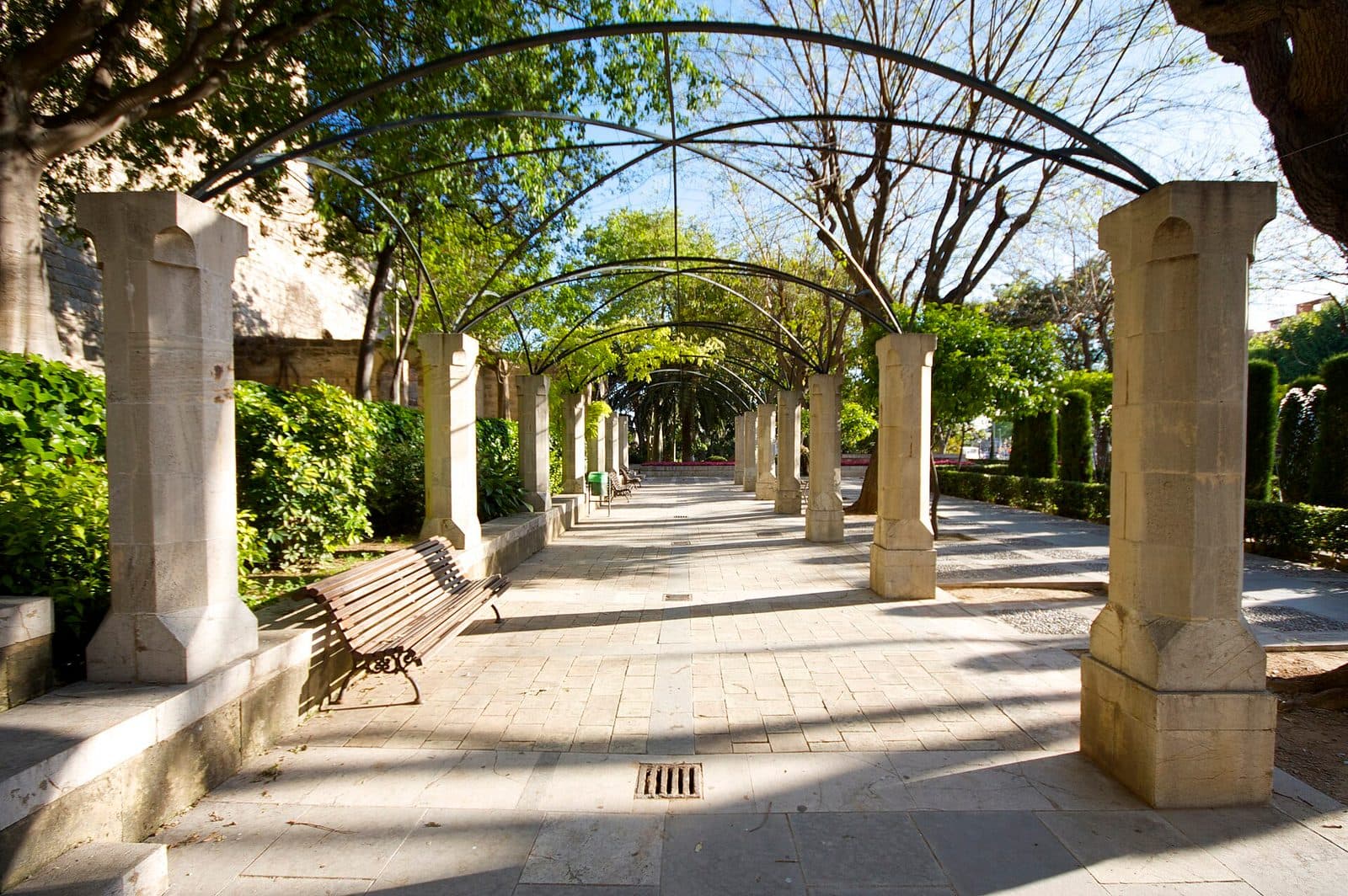
Between the mighty walls of the Almudaina Palace and the busy streets of the Old Town, s'Hort del Rei opens like a green entrance hall to Palma's history. Pools reflect palms and stone arches, narrow channels run alongside the paths, and beneath the long pergola, a city walk becomes a moment of rest. The name means royal garden or royal orchard and recalls the site's original purpose.
The garden is worth visiting not because of its size, but because of its unusual density: medieval urban history, historicist garden design, Mediterranean plants, and artworks stand close together here. Its relationship with the surroundings is particularly impressive. The stone flank of the Almudaina rises above the flower beds, while the Arc de sa Drassana recalls a time when the water reached much closer to Palma's fortifications.
s'Hort del Rei suits travelers exploring Palma on foot, families taking a break between sights, and anyone who prefers to read historic places through small details rather than lengthy information boards. The garden can be crossed quickly, but it rewards a slower pace: those who take only the direct route can easily miss the sculptures, the lines of the water channels, and the old arch by the pond.
History and significance
This was not originally a public city park. The land at the foot of the Almudaina belonged to the royal domain and was closely connected with the palace's supplies and daily life. However, its present appearance is not an unchanged medieval garden. It is precisely this divide between a historic site and a modern reconstruction that makes s'Hort del Rei particularly revealing for understanding Palma's urban history.
The garden of the kings of Mallorca
At the beginning of the 14th century, the kings of Mallorca had the royal castle's most important garden created here. Under Jaume II, the grounds underwent a formative phase. Fruit trees, flowers, and vegetable beds were not only ornamental but also supplied the palace; records also mention the keeping of rabbits. The name therefore refers less to a purely representative pleasure garden than to a cultivated royal garden where beauty and utility existed side by side.
The garden lay outside the walls of the Almudaina Palace and was a private domain of the rulers. Its location explains why it now appears so closely connected with the fortress architecture: the high stone wall is not a decorative backdrop but the boundary of the center of power to which the garden once belonged. Anyone walking through the present grounds is therefore moving along the edge of the medieval palace precinct, not through an arbitrarily designed green space.
Changes up to the 19th century
The grounds changed over the centuries. The medieval garden survived into the 19th century, after which the growing city increasingly encroached on the area. Buildings and new traffic routes reshaped the old site; parts were opened and incorporated into urban life. The court's former enclosed space for cultivation and retreat lost its original form in the process.
This development is important for understanding today's garden because there is no uninterrupted continuity of design between the medieval beds and the visible grounds. s'Hort del Rei preserves the historic site and its memory, but not a fully intact garden plan from the era of the kings of Mallorca.
Gabriel Alomar's redesign
In the 1960s, the surroundings of the Almudaina were fundamentally reorganized. Buildings on the former garden grounds were demolished, and the Mallorcan architect Gabriel Alomar designed a new layout in a historicist style. His concept combined traditional elements of Mallorcan gardens, including the pergola, with pools and fountains whose design evokes Andalusian and Islamic garden art.
Alomar did not attempt to reconstruct the medieval garden plot by plot. Instead, he created a modern image of historic garden culture intended to complement the palace wall and Palma's monumental center. Today's atmosphere is therefore the result of deliberate staging: the site is old, individual components and references are historic, but the visible overall composition dates from the 20th century.
What to see
Water sets the direction in s'Hort del Rei. It appears in narrow channels, fountains, and tranquil pools, traces axes through the planting, and captures the changing light between palms and walls. Together with the pergola, sculptures, and Arc de sa Drassana, it creates not an expansive park landscape but a sequence of clearly defined garden spaces.
Pools and fountains
The pools and fountains are among the strongest motifs of the present design. Their long lines recall Andalusian gardens and form a deliberate contrast with the heavy, enclosed architecture of the Almudaina. Where the palace shuts itself off behind high walls, the expanses of water create depth, movement, and reflections.
A walk therefore feels different depending on the direction of view. Along a pool, plants, stone borders, and fountains align into a strict perspective; to the side, flower beds and treetops loosen this order again. At the same time, the gentle sound of the water provides a counterpoint to the traffic and the hum of voices from the nearby Old Town. For photography, it is therefore worth capturing not only broad views but also reflections of the palms and pale stone architecture.
The pergola
The long, plant-covered pergola draws on a traditional element of Mallorcan gardens. It spans a path and is lined with benches. From the open garden, it leads into a more enclosed, shaded space where leaves and climbing plants filter the light.
The pergola serves more than a practical purpose: it directs the eye, establishes a straight axis, and connects several parts of the grounds. The contrasts are particularly easy to appreciate from the benches—the lush vegetation on one side and the old walls of the palace precinct on the other. Anyone simply passing through the garden should at least pause here briefly and look back through the sequence of arches.
Arc de sa Drassana
The Arc de sa Drassana opens in the old wall beside the small pond. The arch is probably of Arab origin and is associated with an entrance to a private harbor belonging to the palace. At that time, the sea extended into this part of the old city; waterways and the Riera shaped the surroundings differently than they do today.
The arch is therefore more than a picturesque garden detail, as it makes a vanished topography visible. Where paths, flower beds, and streets now lie, there was once a direct relationship between the fortress and the water. The view through the opening across the pond is one of the places where Palma's history becomes clear without a lengthy explanation: wall, arch, and water lie along a single sightline.
Es Foner
The bronze figure Es Foner depicts a Balearic slinger. Llorenç Rosselló created the work in 1898 and received a silver medal for it at the art exhibition in Barcelona; the bronze casting was produced in 1970. The figure commemorates the Balearic warriors known for their skill with the sling, who were deployed in conflicts including the Punic Wars.
Rosselló does not depict a calmly posing hero. The body is twisted, the muscles are tense, and movement seems imminent. From the side in particular, it becomes clear how strongly the figure is defined by posture and rotation. The sculpture thus introduces another historical layer into the garden: alongside its royal and Islamic-influenced past appears the older tradition of the Balearic Islands.
Jònica and other artworks
Modern sculptures stand among the plants, so the walk repeatedly shifts from garden space to art. One of the specifically named works is Jònica by Josep Maria Subirachs, a marble sculpture from 1989. It depicts a woman and combines the human figure with a clear, stone-based formal language.
Those deliberately looking for art will also discover works associated with names such as Joan Miró and Alexander Calder. They should not be expected to form a self-contained open-air exhibition; instead, they appear individually among paths, flower beds, and historic walls. This casual coexistence is central to the garden's character: a sculpture emerges from behind plants, while just a few steps farther on, water and architecture reclaim the visitor's attention.
Mediterranean planting
Palms, orange trees, ornamental shrubs, and formal flower beds define the planting. The selection recalls the historic use without reconstructing the former kitchen garden. Fruit trees refer to the old royal garden, while palms and ornamental plants structure the present grounds and cast shade over individual paths.
The vegetation also changes the perception of the palace wall. Between tall trunks, the stone appears less forbidding; above low beds, its full height becomes apparent. s'Hort del Rei therefore does not depend on a single viewpoint. The most interesting scenes emerge when moving between open water axes, more densely planted areas, and the shaded pergola.
Visiting the garden
s'Hort del Rei is best experienced not as an attraction with a fixed route, but as a slow passage through different sightlines. From the bustle of the city, visitors enter a space of water, flower beds, and the palace wall, follow the paths to the pergola, and then seek out the Arc de sa Drassana and the sculptures. The grounds are manageable in size, yet they leave a stronger impression if you do not simply take the shortest route.
A short walk
For initial orientation, it makes sense to follow the lines of water first. From there, the overall composition and its relationship with the Almudaina are easy to understand. The route then leads beneath the pergola before reaching the area around the pond and the old arch. Es Foner deserves to be viewed from all sides, as the figure's tension is clearer from angled and lateral perspectives than from the front.
It is difficult to set a meaningful exact duration for a visit. As a passage between the Old Town, palace, and cathedral area, the garden can be a brief stop; those taking photographs, seeking out the artworks, or pausing on a bench will stay correspondingly longer. The key point for planning is that s'Hort del Rei is neither an expansive park nor a museum with a prescribed sequence of sights.
Light and crowds
Early morning and evening are particularly appealing because the light falls more softly through the trees and pergola. At these times of day, the expanses of water and stone walls can usually be viewed without the harsh contrasts of the midday sun. Around midday, by contrast, the garden can serve as a shaded break during a walk through the Old Town. The pergola, palms, and trees provide sheltered areas, while the water channels shape the atmosphere.
Because the garden lies directly in the monumental center, numerous passersby should be expected on busy days. Those wishing to take photographs will find softer light at the beginning or end of the day.
Check access in advance
Current opening hours and admission conditions are not included in the available visitor information, so checking for up-to-date details before setting out is recommended. Visitors should also not expect a conventional ticketed route or an extensive exhibition: the appeal lies in the freely experienced garden space, its historical associations, and the open-air artworks.
Getting there and parking
From Palma Airport, the documented route follows the Ma-19 to Palma. The distance to the city is 11 road kilometers, and the journey takes around 20 minutes. These details apply specifically to the journey as far as Palma, not to finding an available parking space directly beside the garden. The final section enters the densely built-up and heavily visited center around the Almudaina, cathedral, and Plaça de la Reina.
The final section in Palma
s'Hort del Rei lies at the foot of the Almudaina Palace and close to Avinguda d'Antoni Maura. The garden itself is explored on foot. Anyone arriving by car should therefore not treat the historic center like a destination with direct vehicle access. It is more practical to end the drive at a suitable parking facility in Palma and walk the final section through the cathedral and palace quarter.
The location helps with orientation: the high Almudaina wall and the monumental surroundings are much easier to recognize than a single garden entrance within the street network. From Plaça de la Reina, the area is reached by a short walk through the city center; from Parc de la Mar, the route leads uphill to the ensemble of garden, palace, and cathedral.
Parking in the center
Parking is available near s'Hort del Rei. The site's specific parking information can be used to select a current parking option; the remaining walk leads into the Old Town. When planning the journey, allow for the approximately 20 minutes from the airport to Palma. The documented route follows the Ma-19 toward Palma.
Arriving by bus
Several stops are located in the Plaça de la Reina–Catedral area; another is near Parc de la Mar–Catedral. Both directions provide suitable access on foot. From Plaça de la Reina, visitors approach through the Old Town, while Parc de la Mar lies below the monumental ensemble. The stop information displayed on the page provides the relevant route and departure details, without requiring the garden itself to be searched for as a separate transport hub.
Bus lines to s'Hort del Rei at a glance
| Line | Route | Departures/day | First | Last |
|---|---|---|---|---|
| 35 | Aquàrium - Pl. Reina | Catedral | 8 | 07:10 | 13:50 |
| 3 | Pont d'Inca / Joan Carles I | 6 | 07:37 | 09:46 |
| 25 | s'Arenal - Pl. Reina | Catedral | 6 | 09:35 | 12:41 |
| 20 | Portopí - Son Espases | 4 | 07:17 | 07:31 |
From the official GTFS feeds (TIB/SFM), no real-time data. The figures cover all stops in the town; weekend and holiday services differ — check with the operator before travelling.
Getting there by bus
453-pl. de la Reina - Catedral · 0.1 km as the crow flies
- 25s'Arenal - Pl. Reina | Catedral · 06:36–21:01 · Daily
7-pl. de la Reina - Catedral · 0.1 km as the crow flies
- 35Aquàrium - Pl. Reina | Catedral · 06:21–22:41 · Daily
1982-Parc de la Mar - Catedral · 0.2 km as the crow flies
- 25s'Arenal - Pl. Reina | Catedral · 06:36–21:01 · Daily
- 30Marivent-Palau de Congressos · 08:00–08:00 · Daily
986-pl. de la Reina - Catedral · 0.2 km as the crow flies
- 35Aquàrium - Pl. Reina | Catedral · 06:21–22:41 · Daily
- CCCircular Centre Ciutat · 08:00–08:00 · Daily
929-Parc de la Mar-Catedral · 0.3 km as the crow flies
- 30Marivent-Palau de Congressos · 08:00–08:00 · Daily
985-pl. de Joan Carles I · 0.4 km as the crow flies
- CCCircular Centre Ciutat · 08:00–08:00 · Daily
1048-pl. de Joan Carles I · 0.4 km as the crow flies
- 25s'Arenal - Pl. Reina | Catedral · 06:36–21:01 · Daily
- 35Aquàrium - Pl. Reina | Catedral · 06:21–22:41 · Daily
662-pl. de Cort · 0.4 km as the crow flies
- CCCircular Centre Ciutat · 08:00–08:00 · Daily
105-pl. de Joan Carles I - Catedral · 0.4 km as the crow flies
- 3Pont d'Inca / Joan Carles I · 08:00–08:00 · Daily
- 4Ses Illetes - Pl. Columnes · 08:00–08:00 · Daily
- 7Son Gotleu - Son Serra - Sa Vileta / Son Vida · 08:00–08:00 · Daily
- 20Portopí - Son Espases · 06:06–22:40 · Daily
53-pl. de Joan Carles I - Catedral · 0.4 km as the crow flies
- 4Ses Illetes - Pl. Columnes · 08:00–08:00 · Daily
- 7Son Gotleu - Son Serra - Sa Vileta / Son Vida · 08:00–08:00 · Daily
- 20Portopí - Son Espases · 06:06–22:40 · Daily
52-pl. del Mercat · 0.5 km as the crow flies
- 4Ses Illetes - Pl. Columnes · 08:00–08:00 · Daily
- 7Son Gotleu - Son Serra - Sa Vileta / Son Vida · 08:00–08:00 · Daily
- 20Portopí - Son Espases · 06:06–22:40 · Daily
- 35Aquàrium - Pl. Reina | Catedral · 06:21–22:41 · Daily
106-pl. del Mercat · 0.5 km as the crow flies
- 3Pont d'Inca / Joan Carles I · 08:00–08:00 · Daily
- 4Ses Illetes - Pl. Columnes · 08:00–08:00 · Daily
- 7Son Gotleu - Son Serra - Sa Vileta / Son Vida · 08:00–08:00 · Daily
- 20Portopí - Son Espases · 06:06–22:40 · Daily
Timetable data: official GTFS feeds (TIB/EMT), no real-time — check with the operator before travelling.
Nearby attractions
Monumental Palma begins immediately above the treetops and flower beds of s'Hort del Rei. The garden is not an isolated park but lies at a junction between the palace, cathedral, Old Town, and the lower area around Parc de la Mar. This makes it easy to incorporate into a walk without losing its distinctive character as a tranquil garden space.
Almudaina and the cathedral quarter
The Royal Palace of La Almudaina is the most immediate connection. Its walls form the garden's historic backdrop, and the origins of s'Hort del Rei are difficult to understand without the former royal palace precinct. Combining both places reveals first the representative and fortified side of royal power and then the former garden area at the foot of the walls.
The Cathedral of Palma also stands within the same monumental center. Between it, the Almudaina, and the garden, the scale changes unusually quickly: immense stone architecture, narrow Old Town lanes, and small garden spaces shaped by water follow directly one after another. s'Hort del Rei is therefore well suited as a place to rest before or after visiting the major monuments.
Parc de la Mar
Below the ensemble, Parc de la Mar opens out. From there, the elevated position of the cathedral and Almudaina is particularly easy to appreciate, while the garden itself remains closer to the palace walls. Connecting the two green spaces reveals two different sides of Palma: above, the enclosed, historicist royal garden with its pergola and fountains; below, the broader urban edge in front of the monumental skyline.
The route between the two areas also helps place the historical significance of the Arc de sa Drassana in context. Today's cityscape clearly separates the palace from the sea; the old arch recalls a time when water and fortifications met far more directly.
Palma's Old Town
From Plaça de la Reina, routes continue into the Old Town's network of lanes. Courtyards, historic façades, and smaller squares extend the walk without requiring a major detour specifically for s'Hort del Rei. The garden therefore works particularly well as a hinge within a walking route: it connects the representative waterfront side with the more densely built quarters behind the cathedral area.
Anyone with limited time in Palma can combine the garden with the Almudaina, the cathedral surroundings, and Parc de la Mar. During a longer stay, it is worth treating s'Hort del Rei as more than a shortcut and returning later in different light. The expanses of water, pergola, and palace wall feel different at the edges of the day than during the city's lively daytime activity.
The place it belongs to
Palma in the place guidePractical visitor information
The grounds require no special equipment, but expectations should be set appropriately in advance. s'Hort del Rei is a historic garden space in the city center, not a large botanical park or an authentically preserved medieval kitchen garden. The visit is defined by close observation, brief changes of perspective, and the connection with the surrounding architecture.
Paths, shade, and places to sit
Comfortable shoes suitable for Palma's Old Town are sufficient for the paved garden paths. There is shade and seating beneath the pergola and around the taller trees; open sections beside the flower beds and water axes remain more exposed to the sun. A walk can therefore easily be combined with a seated break, although visitors should not expect a dedicated picnic or recreation park.
The pergola is a pleasant place on bright days, but it is also one of the garden's most striking photographic subjects. Anyone lingering there should remain mindful of other visitors using the path. By the pools, it is worth changing perspective rather than photographing only from one end: just a few steps alter the reflections of palms, fountains, and masonry.
Visiting with children
For children, the water channels, fountains, palms, and powerful figure of the slinger provide easily recognizable points of interest. The history can also be told in simple terms: plants for the royal household once grew here, and at the old arch, the water formerly reached closer to the fortress. This turns a short garden walk into a small search for traces of different eras.
However, the site is not a large amusement park. The pools and artworks are part of the design and require appropriate care and attention. s'Hort del Rei is most suitable as a peaceful break during a longer city walk, not as an all-day destination for children.
Details that are easy to miss
The Arc de sa Drassana stands out less because of its size than because of its position above the pond. Those following only the main axes may overlook it or mistake it for a decorative element of the redesign. Yet this arch is one of the most historically interesting details because it recalls the former connection between the palace and the water.
Es Foner also deserves more than a passing glance. The sling is the defining attribute, but the real effect comes from the rotation of the body and the tense musculature. With Jònica, meanwhile, the contrast between pale marble, plants, and the massive architecture in the background is particularly rewarding.
What the garden is not
The present grounds are not an unchanged legacy of the 14th century. Gabriel Alomar's design from the 1960s references Mallorcan and Andalusian-inspired garden motifs without precisely restoring the medieval state. Knowing this history allows visitors to experience the site more consciously: s'Hort del Rei is simultaneously a historic setting, an urban redesign, and a public garden.
Nor should visitors expect an extensive botanical collection or a self-contained art exhibition. The plants, fountains, and sculptures function as a shared ensemble whose quality lies less in the number of individual attractions than in the visual relationships between water, vegetation, art, and the old palace wall.
Local insider tips
View Es Foner from the side
The tension of the slinger figure is most apparent from the side: the twisted body and prominent musculature are clearer from an angled perspective than in a quick frontal view.
Look for the old harbor arch
The Arc de sa Drassana stands beside the pond. The probably Arab arch is associated with the palace's former private harbor entrance and is historically far more significant than its quiet location might suggest.
Take photos at the edges of the day
Early morning and evening bring softer light between the pergola, palms, and pools. Reflections then stand out more clearly.
Look back beneath the pergola
Do not simply walk through the plant-covered pergola: looking back through its straight sequence of arches reveals how Gabriel Alomar used Mallorcan garden tradition to structure the grounds.
Understand the palace and garden together
The visit becomes more meaningful after seeing the Almudaina. Above stands the fortified residence; below lay its royal garden for cultivation and retreat. Their direct proximity allows each place to explain the other.