
Castell de Capdepera: Mallorca’s Medieval Fortified Village
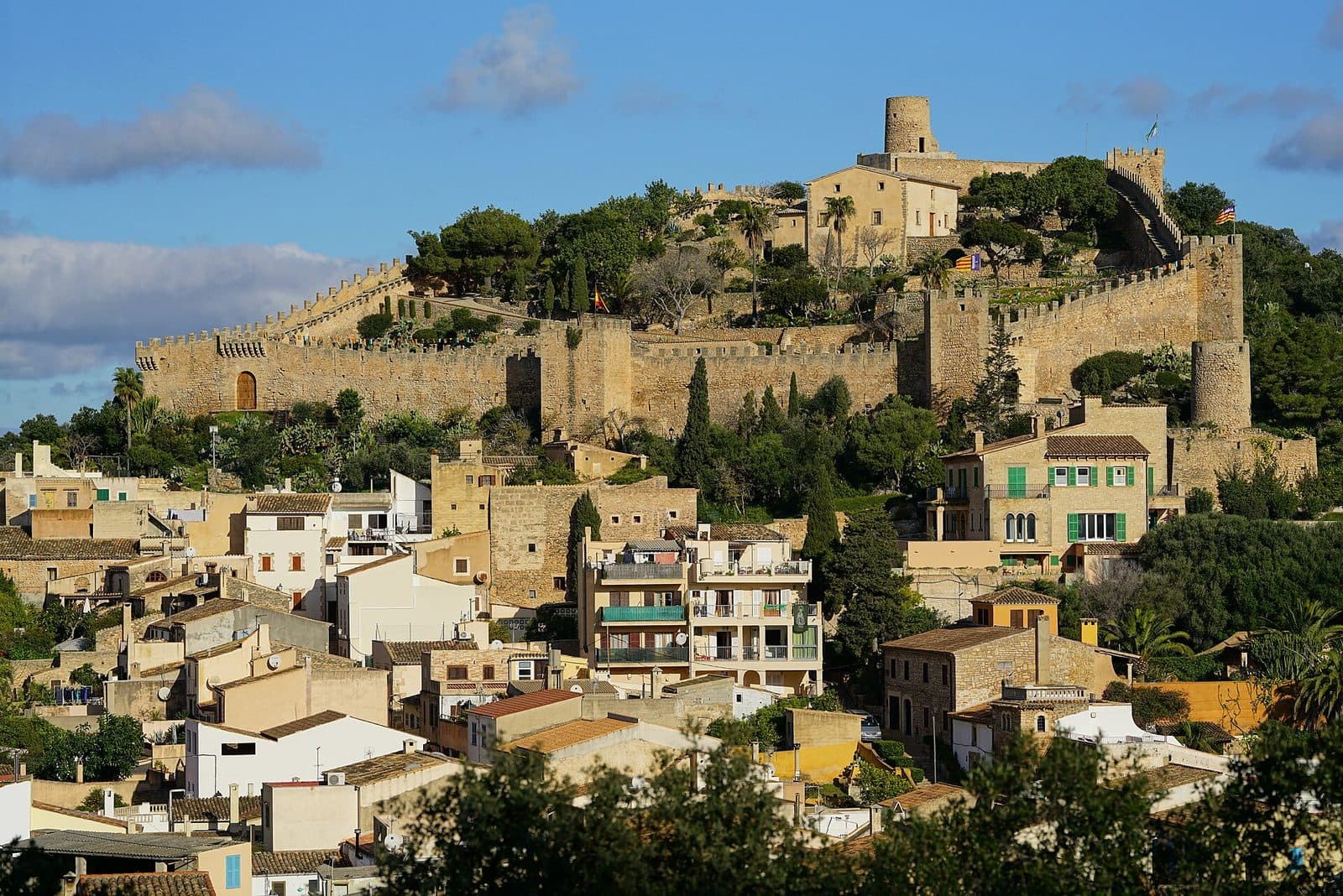

High above the rooftops of the old town, Castell de Capdepera draws a sharply defined line of walls across the hill. Even from below, it is clear that this is no ordinary aristocratic castle. The complex was conceived as a fortified village: a protected place for the surrounding population to live and, at the same time, a lookout over the coast, the hinterland and the channel between Mallorca and Menorca.
The appeal of Castell de Capdepera therefore lies not only in its individual buildings. A walk around the site reveals an entire system of walls, paths, sacred spaces and former residential areas. Little remains of the houses that once stood within the ring. Yet the open spaces make the difference between a stately castle and this medieval refuge especially clear.
The changing perspectives are particularly impressive. One moment, your gaze follows the narrow streets of Capdepera; shortly afterwards, it extends across the northeastern interior and the coastline to the Menorca Channel. Torre de sa Boira, the Gothic Església de l’Esperança and the collections in Casa del Governador give the route clear focal points.
The fortress is worthwhile for history enthusiasts as well as families and travelers looking for an excursion with views. It does, however, require care: the visit involves ascending paths, steps and medieval terrain. Those who prepare for this and do not rush only to the first viewpoint will experience one of the clearest examples of how closely settlement, coastal surveillance and protection from attack were linked in Mallorca.
History and Significance
The Treaty of Capdepera
The history of the hill reaches further back than the ring wall visible today. One of its best-known episodes took place as early as 1231 and links Capdepera with Menorca’s submission to the overlordship of Jaume I. The resulting treaty initially allowed Muslim rule on the neighboring island to continue, but it recognized the authority of the king and his successors. This made the site on the Menorca Channel the setting for an event whose significance extended far beyond northeast Mallorca.
The location explains why negotiations took place and fortifications were later built here. From the hill, it was possible to survey the surrounding countryside, parts of the coast and the sea route toward Menorca. The view that defines a visit today was a strategic tool at the time. Movements on the water could be detected early, while the elevated position promised protection and control.
Jaume II’s Fortified Village
In 1300, King Jaume II commissioned the complex as a walled village. The region’s scattered population was intended to find protection within a fortified ring, especially during periods of frequent pirate attacks. Construction began at the start of the 14th century; the present form of Castell de Capdepera essentially emerged during that century on a site that had already been used earlier.
The term castle can therefore be misleading. Within the walls was not merely a military stronghold, but a settlement. Houses, paths, a church and defensive structures formed a single interconnected complex. In the 16th century, as many as 125 houses were counted within the Castell. Behind the line of walls that appears so quiet today was once a densely populated community whose daily life unfolded with constant awareness of possible attacks.
From Settlement to Military Post
Over time, life shifted from the walled area to the foot of the hill. The interior of the Castell was eventually depopulated; its houses largely disappeared or survive only as traces. In the 18th century, the complex’s purpose changed again. The fortified village became a military post under the supervision of a governor.
This military use continued until 1854. The Castell was then abandoned and purchased by Josep Quint Zaforteza at a public auction in 1856. The complex remained privately owned for more than a century. Only in 1983, following negotiations with the heirs, did it return to the ownership of the municipality of Capdepera. Today, it is managed by a board of trustees; according to the operator, revenue from visits is used to preserve the municipality’s cultural heritage.
A Protected Monument
Castell de Capdepera is designated a Bien de Interés Cultural, Spain’s highest category of protection for historic cultural heritage. This classification applies not only to individual walls or the church, but to the entire fortified area as a whole. The combination of defensive architecture, religious space, former settlement areas and the later governor’s residence makes the complex particularly easy to interpret historically.
Today, the Castell is neither a reconstructed medieval village nor a decoratively furnished palace. Its value lies in the surviving structures and visible breaks: here a mighty wall, there an open area, and elsewhere a building that continued to be used after the residential settlement had disappeared. The route therefore tells the story not only of a single era, but of the continuous transformation of a strategic place.
What to See
The Ring Wall
The wall is the defining structure of Castell de Capdepera. It encloses the hill and makes the character of a self-contained fortified village visible even from outside. Inside, the route follows sections of the medieval fortifications. New sightlines continually open up: toward the tightly layered rooftops of Capdepera, across the hilly hinterland and out to the coast.
The logic of the complex is also easiest to understand from the wall. The ring did not merely protect a tower or palace, but the living space of an entire community. The largely open areas within the fortifications were once occupied by houses. Anyone standing there is therefore not looking at an empty castle courtyard in the conventional sense, but at the site of a vanished village.
The route along the fortifications is also one of the most impressive parts of the visit. Battlements, stretches of wall and the elevated location frame the landscape in stone. The terrain does, however, require care. Medieval paths and exposed sections cannot be compared with a level viewing terrace, and the operator expressly warns of hazardous areas within the grounds.
Torre de sa Boira
Torre de sa Boira forms the fortress’s highest viewpoint. From here, a panoramic view opens over the town, the island’s interior and the coast. The Menorca Channel is also visible, and the view can extend as far as the neighboring island. This makes it especially easy to understand why the hill served as a lookout and control point for centuries.
The climb is worthwhile less for an elaborately furnished tower room than for the spatial experience. Below, Capdepera appears as a dense network of streets and houses, while beyond the town the landscape fans out. The coastline and hinterland can be seen at the same time. The view is therefore not merely an extra, but a key to understanding the history of the Castell.
Església de l’Esperança
Near the upper part of the grounds stands the Gothic Església de l’Esperança from the 14th century. Its restrained architecture provides a clear contrast to the open battlements and walls. Inside, the Mare de Déu is venerated, and her image is central to the Castell’s best-known legend. The church is a reminder that the fortified village was not only a refuge, but also a religious and social place to live.
After the bright, largely open grounds, the church interior feels focused and understated. It is one of the few places where the visit actually enters a historic interior. Those interested only in the views can easily overlook the fact that this building makes the daily lives of the former inhabitants more tangible than many defensive walls: where people lived permanently, they needed not only protection, but also a place of worship.
Casa del Governador
Casa del Governador represents the Castell’s later phase, when the depopulated fortified village served as a military post. Today, the building houses exhibitions and gives the route a museum-focused centerpiece. A permanent presentation is devoted to the history of the fortress and the municipality of Capdepera. It helps visitors place the open spaces and various structures in their historical context.
Unlike a fully furnished palace, the focus here is not on princely domestic culture. Instead, the exhibition explains how the fortified site changed: from a medieval settlement to a guarded military position and finally a protected monument. Casa del Governador thus serves as a bridge between the visible remains and the ways of life that have long since disappeared.
Museu de la Llata
Museu de la Llata is also located in Casa del Governador. It preserves the tradition of weaving palm leaves, a craft that shaped Capdepera far beyond the fortifications. The focus is on the working process, the history of the trade and the objects produced from it.
Particular attention is given to the dones de sa llata, the women whose weaving contributed significantly to the town’s reputation. The collection adds an economic and everyday dimension to Capdepera’s past. After walls, towers and royal plans, visitors encounter a story of material knowledge, manual work and skills passed down through generations.
Col·lecció d’Art Sacre
The collection of sacred art comprises more than 120 works. It includes religious sculptures, goldwork and silverwork, textiles and paintings. The selection ranges chronologically from the Romanesque period to the present day. The pieces were donated to the municipality and are also displayed in Casa del Governador.
This broad chronological range makes it clear that Capdepera’s religious history did not end with the medieval fortified village. The collection does not simply follow the architectural history of the Castell, but presents different forms of local faith and artistic practice. For visitors expecting only a brief scenic walk behind the walls, it is one of the most surprising stops in terms of content.
Visiting Castell de Capdepera
From the Gate into the Former Village
Beyond the entrance, there is no fixed route through furnished halls. The visit leads mainly through open terrain and reveals the complex gradually. Walls and former settlement areas dominate at first, after which the church, viewpoints and Casa del Governador become natural stops. It is worth avoiding a route determined solely by elevation: anyone who skips the exhibitions misses an important part of the town’s history.
There is therefore no useful standard duration for a visit. A walk focused on the views will be considerably shorter than a visit that takes time to explore the historical exhibition, Museu de la Llata and the sacred art collection. The ascending paths also discourage rushing. It is advisable to allow enough time for breaks by the wall and for the interiors.
Views and Exhibitions
The strongest visitor experience comes from alternating between outdoors and indoors. On the open paths, the landscape, the course of the walls and the position above Capdepera dominate. In the church and Casa del Governador, individual objects, craftsmanship and historical contexts instead come to the fore. This keeps the route varied even though large parts of the former residential buildings have not survived.
Torre de sa Boira should not be regarded as the only viewpoint. The direction of view and spatial impression change several times along the walls. From one point, the old town occupies the foreground; from another, the coast and hinterland stand out. The highest point eventually brings these perspectives together into a panoramic view.
A Quieter Visit
During the main travel season, the limited parking spaces in town are particularly likely to fill early. Arriving early therefore improves the chances of finding a space and leaves more time for an unhurried ascent. However, this does not establish any reliably quiet period within the fortress; weather, season and tour groups all affect visitor numbers.
As opening hours and admission fees are not included in the editorial facts and may change, the latest information should be checked before visiting. This is also advisable if the trip is to include an exhibition or guided tour. Guided visits are available with advance reservation.
Getting There and Parking
From Palma Airport
From Palma Airport, the drive initially follows the Ma-15 toward Manacor and then continues via the Ma-4030 and Ma-4040 to Capdepera. The distance to the town is 77 road kilometers, and the journey takes around 65 minutes. These figures expressly end in Capdepera rather than at an arbitrary parking space directly outside the castle gate.
The final section leads into the historic town and uphill toward the Castell. The streets become narrower there, and the medieval settlement pattern is clearly noticeable. Those who do not want to drive specifically to the upper access roads can park in town and continue the ascent on foot. The walls repeatedly remain visible above the rooftops as a point of orientation.
From Central Palma
From central Palma, the route also follows the Ma-15 and then the Ma-4030 and Ma-4040. The distance to Capdepera is 79 road kilometers, and the journey takes around 72 minutes. Most of the route is a straightforward cross-country drive; only in the town does the slower search for the right access road or a parking space begin.
The stated time should not be mistaken for a guaranteed arrival directly at the entrance. The final section also includes driving through Capdepera, parking and, where necessary, walking uphill. Particularly when attending a guided tour at a fixed time, it makes sense to allow an additional buffer rather than relying on being able to drive right up to the wall.
Parking in Capdepera
According to the operator, free parking is available by the Castell. However, the number of spaces is limited, and they can fill quickly at busy times. Another practical starting point is the car park on Carrer del Sol. From there, both the town center and the path to the fortress are within convenient walking distance.
Parking farther downhill has a pleasant side effect: the route leads through Capdepera, and the fortress repeatedly appears from new perspectives between the houses and streets. The final section does, however, climb uphill. Anyone with limited mobility should plan the parking situation and remaining route especially carefully in advance, without assuming a continuously level connection.
By Bus
Several public bus stops are located in the center and on the eastern and western edges of Capdepera. From there, the visit continues on foot through the town, followed by an uphill walk to the Castell. Visitors should not expect to arrive directly at the level of the wall walks.
Planning should therefore take into account not only the bus connection to Capdepera, but also enough time for the final section. The central stops are convenient if the castle visit is to be combined with a walk through the old town. The stop and timetable information shown on the page provides the current basis for selecting a specific connection.
Bus lines to Castell de Capdepera at a glance
| Line | Route | Departures/day | First | Last |
|---|---|---|---|---|
| 423 | Font de sa Cala - Cala Rajada | 126 | 08:03 | 21:48 |
| 411 | Cala Rajada - Manacor | 124 | 05:45 | 23:25 |
| 424 | Cala Rajada - Portocristo | 105 | 08:03 | 23:29 |
| 325 | Alcúdia - Cala Rajada | 78 | 09:18 | 21:49 |
| 411e | Cala Rajada - Palma | 48 | 08:40 | 23:53 |
| 422 | Cala Mesquida - Cala Rajada | 41 | 08:29 | 21:32 |
From the official GTFS feeds (TIB/SFM), no real-time data. The figures cover all stops in the town; weekend and holiday services differ — check with the operator before travelling.
Getting there by bus
Capdepera centre 1 (14033) · 0.3 km as the crow flies
- 325Alcúdia - Cala Rajada · Daily
- 411Cala Rajada - Manacor · Daily
- 411eCala Rajada - Palma · Daily
- 424Cala Rajada - Portocristo · Daily
Capdepera centre 2 (14043) · 0.3 km as the crow flies
- 325Alcúdia - Cala Rajada · Daily
- 411Cala Rajada - Manacor · Daily
- 411eCala Rajada - Palma · Daily
- 424Cala Rajada - Portocristo · Daily
Capdepera oest (14003) · 0.7 km as the crow flies
- 325Alcúdia - Cala Rajada · Daily
- 411Cala Rajada - Manacor · Daily
- 411eCala Rajada - Palma · Daily
Capdepera est 1 (14028) · 1.0 km as the crow flies
- 325Alcúdia - Cala Rajada · Daily
- 411Cala Rajada - Manacor · Daily
- 411eCala Rajada - Palma · Daily
- 422Cala Mesquida - Cala Rajada · Daily
- 423Font de sa Cala - Cala Rajada · Daily
- 424Cala Rajada - Portocristo · Daily
Capdepera est 2 (14027) · 1.0 km as the crow flies
- 325Alcúdia - Cala Rajada · Daily
- 411Cala Rajada - Manacor · Daily
- 411eCala Rajada - Palma · Daily
- 422Cala Mesquida - Cala Rajada · Daily
- 423Font de sa Cala - Cala Rajada · Daily
- 424Cala Rajada - Portocristo · Daily
Sa Pedruscada 2 (14042) · 1.9 km as the crow flies
- 423Font de sa Cala - Cala Rajada · Daily
Sa Pedruscada 1 (14041) · 1.9 km as the crow flies
- 423Font de sa Cala - Cala Rajada · Daily
Son Moll (14011) · 2.0 km as the crow flies
- 325Alcúdia - Cala Rajada · Daily
- 411Cala Rajada - Manacor · Daily
- 411eCala Rajada - Palma · Daily
- 422Cala Mesquida - Cala Rajada · Daily
- 423Font de sa Cala - Cala Rajada · Daily
- 424Cala Rajada - Portocristo · Daily
N'Aguait 2 (14037) · 2.1 km as the crow flies
- 423Font de sa Cala - Cala Rajada · Daily
N'Aguait 1 (14010) · 2.1 km as the crow flies
- 423Font de sa Cala - Cala Rajada · Daily
Na Taconera 2 (14006) · 2.5 km as the crow flies
- 423Font de sa Cala - Cala Rajada · Daily
Na Taconera 1 (14005) · 2.5 km as the crow flies
- 423Font de sa Cala - Cala Rajada · Daily
Timetable data: official GTFS feeds (TIB/EMT), no real-time — check with the operator before travelling.
Nearby Places
Capdepera
Below the fortress, the history of the fortified village continues in present-day Capdepera. As the inhabitants gradually left the interior of the walls, the settlement developed at the foot of the hill. Narrow streets, natural-stone houses and the constant view up toward the Castell define the old town. A walk before or after the visit makes this shift from the protected hilltop site to the open town easy to understand.
Capdepera is also a good place for a break without requiring an additional excursion destination. Anyone parking below will already pass through part of the town. Instead of driving away immediately after descending, it is worth looking back once more: up close, the wall appeared as a structure to walk along; from below, it once again becomes a solid silhouette above the houses.
Cala Ratjada and the Coast
Cala Ratjada lies on the coast of the municipality of Capdepera and combines well with the Castell. The harbor town presents another side of the northeast: while the fortress marks a historic place of protection and observation, Cala Ratjada faces directly toward the sea. Far de Capdepera can also be included in an excursion as another prominent landmark in the landscape.
For a beach finish, coastal locations such as Cala Agulla, Cala Mesquida or Canyamel are suitable options. They should not be viewed as part of the castle visit, but as a separate activity after the historical tour. Anyone combining both in one day will first experience the coast from above and later at sea level.
Artà and the Northeast
Artà can also be included in a route through the northeast. Both towns have distinctly historic centers, but their emphasis differs. At Castell de Capdepera, the focus is on the walled fortified village and its strategic view across the Menorca Channel.
For a combined itinerary, clear priorities are preferable to hurriedly checking off destinations. The fortress deserves time for its walls, church and collections; the town or a coastal stop afterwards can then broaden the scenic context. This allows the Castell to remain the historical centerpiece of the excursion rather than reducing it to a brief photo stop.
The place it belongs to
Capdepera in the place guidePractical Information for Your Visit
Paths and Footwear
The route crosses historic, partly steep terrain with steps and uneven sections. Shoes with reliable grip are therefore more suitable than smooth soles or beachwear alone. This applies especially to the uphill approach, the areas beside the fortifications and the climb to the higher viewpoints.
A steady pace is more pleasant than heading straight for Torre de sa Boira. There is already much to see along the wall, and the spatial structure of the former village becomes clearer when there is time between stops. Anyone focused only on the highest point can easily overlook the connection between the settlement area, church and defensive ring.
Sun and Weather
Large parts of the visit take place outdoors. The walls and open spaces provide expansive views, but they do not offer protection from the sun everywhere. Sun protection and drinking water are therefore sensible preparations, especially on bright, warm days. Casa del Governador and the church are indoor stops, but they do not replace a continuously shaded route.
The view as far as the Menorca Channel and the neighboring island is a highlight, but it should not be the only reason to visit. Even when long-distance visibility is less clear, the course of the walls, the church and the museums remain accessible and understandable. Conversely, good weather should not tempt visitors to skip the exhibitions in favor of a purely panoramic walk.
Visiting with Children
The Castell can be particularly vivid for children because its walls, towers and former fortified village can be experienced without lengthy abstract explanations. The paths are not, however, a protected playground. The operator expressly points out hazardous areas inside and asks visitors to take particular care with children.
Close supervision is important in exposed places and on uneven ground. The visit can be made more engaging for children by focusing on individual tasks: following the course of the ring wall, finding the church or comparing the present-day town below with the former settlement site. This encourages attention without turning the fortress into an invented adventure setting.
What Not to Expect
Castell de Capdepera is neither a fully furnished palace nor a comprehensively reconstructed medieval town. Little remains visible of the fortified village’s numerous houses. The route therefore depends not on grand halls, furniture or staged living quarters, but on the walls, terrain, views and accompanying collections.
This openness is precisely what makes the site credible. Between the surviving buildings, there is room to interpret its former use: the church marks the religious center, the ring wall represents protection, and Casa del Governador reflects the later military history. Visitors who arrive with these expectations will see not merely a castle ruin, but the development of an entire fortified community.