
Far de Capdepera – Lighthouse and Viewpoint near Cala Rajada
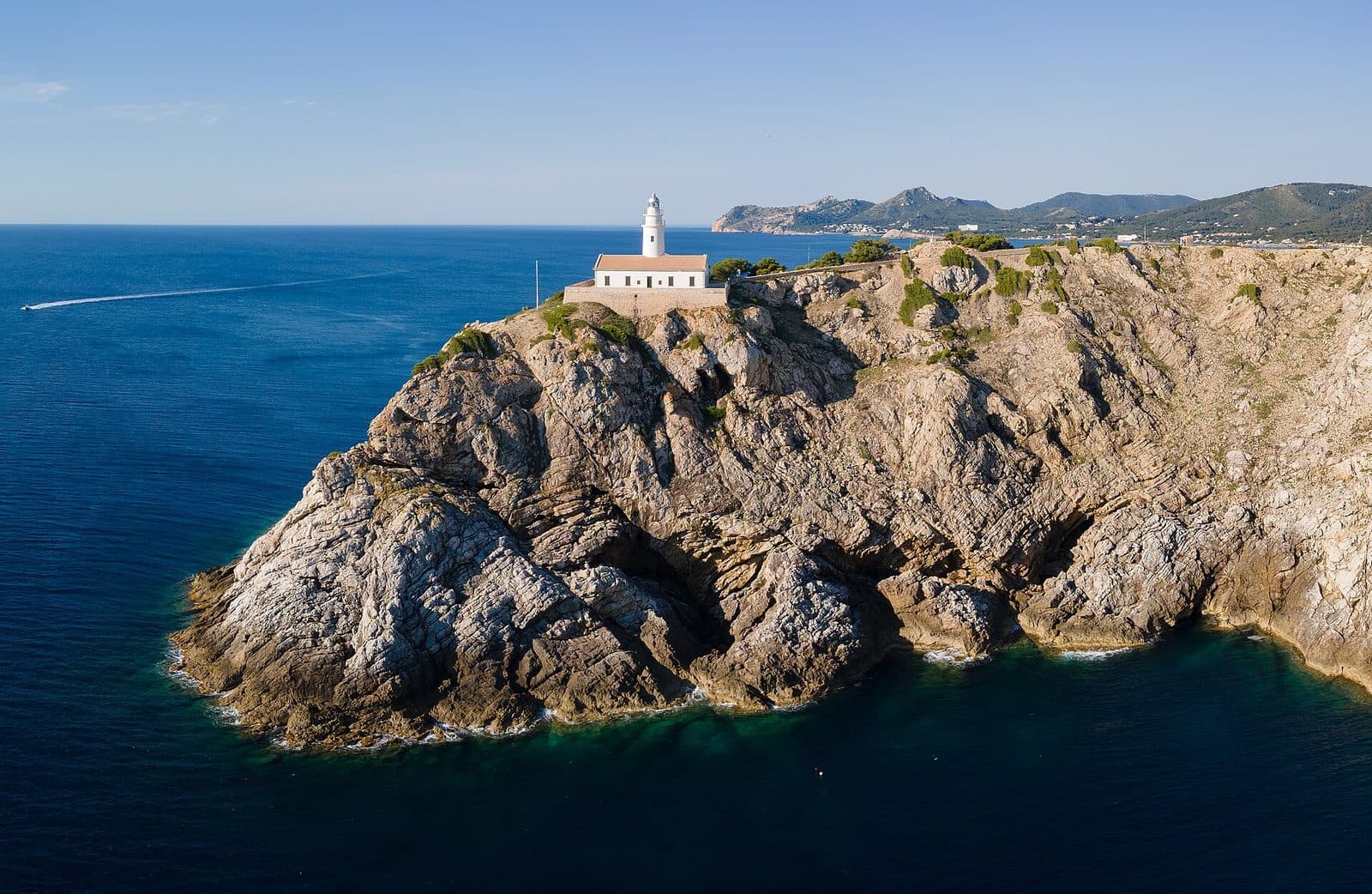

Far de Capdepera stands where Mallorca extends eastward into the open Mediterranean. On the rocky Punta de Capdepera, the white lighthouse rises above the coast near Cala Rajada. The destination is worthwhile less for a conventional tour than for its setting: In front of the structure, the view opens across the sea, cliffs, and the narrow channel between Mallorca and Menorca.
Those who enjoy lighthouses as solitary landmarks will find a particularly striking scene here. The round tower and low service buildings stand above the water without any elaborate presentation. In good visibility, Menorca appears on the horizon; in the opposite direction, the view extends across parts of the coast near Cala Rajada. Wind and changing light shape the experience more strongly than any exhibition could.
The excursion suits walkers, photographers, and anyone seeking a quieter contrast between the beach and harbor. Far de Capdepera is also possible as a short detour by car. However, the final stretch follows a narrow road, and there is only limited space immediately beside the lighthouse. It is also important to understand that Far de Capdepera remains an active maritime facility. Visitors come primarily for the exterior view and the landscape. The tower itself is not a regularly accessible observation tower that can be climbed, and the experience takes place mostly outdoors.
History and Significance
The Legend of Jaume I
Long before a beacon stood here, Punta de Capdepera was already a strategic observation point. A locally preserved story dates back to 1231: King Jaume I, known as the Conqueror, is said to have waited at this eastern end of Mallorca for his messengers to return. They had been sent to Menorca to demand the surrender of the Moors there.
The story clearly illustrates why this headland attracted attention for centuries. From the elevated coast, the view extends into the strait between the two islands. What was a place for observation and communication in the Middle Ages became the site of a permanent navigational aid in the age of modern navigation. The lighthouse therefore follows the old significance of Punta de Capdepera through its location, if not through its architecture.
The Year 1861
Far de Capdepera was built in 1861 and entered service that same year. Its construction formed part of the systematic effort to make shipping routes around Mallorca safer. A reliable signal was particularly important at this location: Together with the Artrutx lighthouse on Menorca, Far de Capdepera marks the channel separating Mallorca and Menorca at their narrowest point.
The setting is therefore not merely scenic. It marks an important stretch of sea for traffic between the islands and along their coasts. The lighthouse made the exposed headland clearly recognizable to ships in darkness and poor visibility. Its history is characterized not by changing uses but by remarkable continuity: The structure was created as a navigational aid and continues to fulfill that role.
An Active Navigational Beacon
Of Mallorca’s total of 15 lighthouses, five are still operational; Far de Capdepera is one of them. It is registered internationally as E-0308 and nationally under the identifier 33350. Its light covers a defined sector from 148 to 10 degrees. Behind the quiet, almost timeless appearance lies precise maritime infrastructure.
This continuing function also shapes the nature of a visit. Far de Capdepera is not a decommissioned monument that has been completely converted for tourism. The service buildings, tower, and lighting system still form a functional complex. This contrast is precisely what makes the place interesting: A vast, seemingly empty sea lies off the coast, while the lighthouse operates according to a precisely regulated system.
What to See
The Round Lighthouse Tower
Up close, Far de Capdepera appears more understated than it does from a distance. The round, white-painted tower rises directly beside its service buildings and looks particularly prominent from the sea because of its position on the cliff. Its clean shape was designed for visibility, not decorative effect. Anyone expecting the architectural details of a grand historic landmark has come to the wrong place. What makes it worth seeing is the coherence of a complex whose design arose directly from its purpose.
The best overall impression is gained not directly beside the masonry but from a little farther away. From there, the tower, service buildings, rocky ground, and horizon appear together in one view. Depending on the viewing direction, the lighthouse appears either as a bright accent against the sea or as a striking silhouette above the coast.
The Service Buildings
Low, white-painted service buildings adjoin the round tower. They show that historic lighthouses did not consist solely of the widely visible structure carrying the light. Their operation required working and supply areas, which were combined here into a compact ensemble.
From the outside, this creates a contrast characteristic of Mallorca’s coast: simple, pale structures set against darker rock and blue sea. The buildings are not exhibition scenery but part of the lighthouse complex that remains in use. A tour through furnished keepers’ rooms or technical collections is therefore not part of the usual visit. The essential features are found outside—in the proportions of the ensemble and its placement on the headland.
This restrained appearance is historically revealing. Far de Capdepera was built to be recognized from a great distance and to operate reliably. Decoration would not have improved that purpose. The architecture focuses on clear shapes, highly visible coloring, and the close connection between the tower and functional buildings.
Punta de Capdepera
The headland itself is the real setting. Punta de Capdepera projects into the Mediterranean as a rocky promontory and, according to the local tourism organization, forms Mallorca’s easternmost point. From the lighthouse area, the terrain drops toward the rugged coast. More clearly than any map, the open sightlines across the water reveal how far Cala Rajada extends toward the edge of the island.
On clear days, Menorca can be seen on the horizon. The view follows the very channel marked by the lighthouses of Capdepera and Artrutx. This gives the panorama a specific geographical meaning: The land opposite is not just any distant coast but Mallorca’s neighboring Balearic island. In hazy weather, however, it disappears completely, leaving the view focused on the sea, sky, and nearby rocky coast.
The scene changes in the direction of Cala Rajada. Instead of the open strait, the coastline, town, and harbor move into the foreground. Depending on the vantage point, the wooded and developed parts of the surrounding area are also visible. Photographers should therefore do more than approach the tower directly and should deliberately explore different viewing directions.
The Beacon
During the day, the lantern room is the most visible feature. After dark, the light takes center stage. According to the local tourism organization, it reaches up to 20 nautical miles. Its technical effect is best understood from a distance: The signal is intended for ships, not as a light show for visitors.
Far de Capdepera illuminates a defined sector and therefore remains part of a larger system of coastlines, nautical charts, and other beacons. Those standing in front of the tower during the day see only the architectural shell of this work. Knowing that it remains operational, however, changes how the ensemble is perceived. It is not merely a photogenic remnant of the 19th century but a historic structure with a present-day purpose.
Visiting Far de Capdepera
Arriving at the Cape
The approach is already part of the excursion. From Cala Rajada, the route leaves the built-up area and heads toward the rocky headland. On foot, the transition unfolds slowly: Houses and streets recede, the view of the sea becomes wider, and the lighthouse complex eventually appears above the coast. Those arriving by car experience the same transition in a compressed form and reach the area immediately in front of the Far via the narrow access road.
There is no prescribed route on site. It is worth beginning with a view of the entire ensemble. After that, just a few changes of position produce very different scenes: first the white tower dominates, then the cliffs, and finally the open sea toward Menorca. Since the interior and tower are not part of a regular visit, the duration depends primarily on how much time is allowed for views and photography.
A simple exterior stop can be brief. Those who reach Far de Capdepera on foot from Cala Rajada, seek out the different viewing directions, and combine their visit with a coastal walk should allow considerably more time. A universal visit duration would therefore be misleading: The lighthouse itself can be viewed quickly, but the appeal of its location reveals itself more slowly.
Morning Light and Clear Views
The headland is particularly suitable for an early visit. Far de Capdepera lies on Mallorca’s eastern side and is expressly recommended by the local tourism organization as a place to watch the sunrise. In the morning, light falls from the sea across the coast and lighthouse complex.
For views of Menorca, clear atmospheric conditions matter more than any particular hour. Haze over the water can hide the neighboring island even in pleasant weather. When the horizon is sharply defined, it is worth looking not only eastward but slightly across the channel. The distant coast appears more as a low line than a dominant panorama.
Sunset is also described as an atmospheric time to visit. Here, however, the sun does not descend in front of the open sea horizon to the east. Instead, warm evening light strikes the lighthouse, rocks, and areas facing the island’s interior. Those seeking the classic sunrise over the water should therefore choose the morning; those who prefer softer colors on the structure will find different subjects in the evening.
Access and Time on Site
Space in front of the lighthouse is limited, and the scarce parking options can particularly shape the visit. Careful driving is required along the final narrow section. Even so, this remains a rocky coastal landscape rather than a developed urban park. For a peaceful experience, it makes more sense to change viewpoints than to remain directly beside the arrival area for a long time. Consideration is especially necessary where vehicles must turn or pass one another in confined spaces.
As no reliable visiting hours or admission details are available, current regulations should be checked before setting out. Regardless of those rules, it is important to have the right expectations: The excursion focuses on the lighthouse exterior and its views, not on climbing the tower or visiting an extensive indoor exhibition.
Getting There and Parking
From Palma and the Airport to Cala Rajada
From Palma Airport, the road route follows the Ma-15, then the Ma-4030 and Ma-4040 to Cala Rajada. The town is 80 road kilometers away, and the drive takes around 69 minutes. These details apply specifically to Cala Rajada, not to the area immediately in front of the lighthouse. The final, slower stretch through the town and up toward the coast must be added to reach Punta de Capdepera.
From central Palma, the route also follows Ma-15, Ma-4030, and Ma-4040. Cala Rajada is 83 road kilometers away, and the drive takes around 76 minutes. Here too, the measured route ends in the town. Those continuing to Far de Capdepera should follow signs within Cala Rajada toward the northeastern headland.
The Ma-15 covers the long section across eastern Mallorca. Ma-4030 and Ma-4040 then lead into the Capdepera area and onward to Cala Rajada. Only after that does the local access road to the lighthouse begin. This distinction should be considered when planning the journey, particularly if the visit is timed for specific lighting conditions.
The Final Stretch to the Lighthouse
The road to Punta de Capdepera becomes narrow along its final section and winds through open pine woodland. Oncoming vehicles may require careful maneuvering. This is not a place to rush, especially because drivers must also expect people approaching the lighthouse on foot.
There are only a few places to leave a vehicle directly beside the Far, and space along the access road is also limited. Anyone relying on finding a free spot immediately beside the structure may be disappointed. Vehicles should be parked only where they do not block either the narrow roadway or areas needed for turning.
A pleasant alternative is to walk from Cala Rajada. This turns the viewpoint into a small coastal excursion and avoids the search for parking at the cape. The duration of the walk depends heavily on the starting point within the sprawling resort town. The center, harbor, and Cala Agulla area offer different approaches, so a single general walking time would be of little help.
By Bus to Cala Rajada
Public buses take visitors to Cala Rajada, not directly to the lighthouse. Possible stops include Cala Rajada centre, Cala Agulla 1, Cala Agulla 2, and Magallanes. From there, the journey to Punta de Capdepera continues on foot.
The most convenient stop depends on the chosen walking route and the current service. Before traveling, visitors should therefore check not only the connection to Cala Rajada but also the onward route to the cape. It is sensible to allow extra time for the return journey: The Far lies outside the actual town center, and the walk back to the bus stop should not be confused with the time spent at the lighthouse when planning the excursion.
Bus lines to Far de Capdepera at a glance
| Line | Route | Departures/day | First | Last |
|---|---|---|---|---|
| 424 | Cala Rajada - Portocristo | 105 | 08:00 | 23:40 |
| 411 | Cala Rajada - Manacor | 103 | 05:40 | 23:20 |
| 423 | Font de sa Cala - Cala Rajada | 98 | 08:07 | 21:43 |
| 422 | Cala Mesquida - Cala Rajada | 68 | 08:25 | 21:29 |
| 325 | Alcúdia - Cala Rajada | 65 | 09:26 | 21:40 |
| 411e | Cala Rajada - Palma | 39 | 08:35 | 23:57 |
From the official GTFS feeds (TIB/SFM), no real-time data. The figures cover all stops in the town; weekend and holiday services differ — check with the operator before travelling.
Getting there by bus
Cala Rajada centre (14032) · 1.6 km as the crow flies
- 325Alcúdia - Cala Rajada · Daily
- 411Cala Rajada - Manacor · Daily
- 411eCala Rajada - Palma · Daily
- 422Cala Mesquida - Cala Rajada · Daily
- 423Font de sa Cala - Cala Rajada · Daily
- 424Cala Rajada - Portocristo · Daily
Cala Agulla 2 (14014) · 1.7 km as the crow flies
- 325Alcúdia - Cala Rajada · Daily
- 423Font de sa Cala - Cala Rajada · Daily
Cala Agulla 1 (14036) · 1.7 km as the crow flies
- 411Cala Rajada - Manacor · Daily
- 411eCala Rajada - Palma · Daily
- 422Cala Mesquida - Cala Rajada · Daily
- 424Cala Rajada - Portocristo · Daily
Magallanes (14034) · 1.9 km as the crow flies
- 325Alcúdia - Cala Rajada · Daily
- 411Cala Rajada - Manacor · Daily
- 411eCala Rajada - Palma · Daily
- 422Cala Mesquida - Cala Rajada · Daily
- 423Font de sa Cala - Cala Rajada · Daily
- 424Cala Rajada - Portocristo · Daily
Son Moll (14011) · 2.1 km as the crow flies
- 325Alcúdia - Cala Rajada · Daily
- 411Cala Rajada - Manacor · Daily
- 411eCala Rajada - Palma · Daily
- 422Cala Mesquida - Cala Rajada · Daily
- 423Font de sa Cala - Cala Rajada · Daily
- 424Cala Rajada - Portocristo · Daily
Sa Pedruscada 1 (14041) · 2.6 km as the crow flies
- 423Font de sa Cala - Cala Rajada · Daily
Sa Pedruscada 2 (14042) · 2.7 km as the crow flies
- 423Font de sa Cala - Cala Rajada · Daily
Timetable data: official GTFS feeds (TIB/EMT), no real-time — check with the operator before travelling.
Nearby Places to Visit
Cala Rajada
Far de Capdepera is best combined with Cala Rajada. The coastal town developed from a fishing village and still has a harbor with fishing boats, excursion vessels, and leisure traffic. After the quiet, open setting of Punta de Capdepera, the lively harbor promenade provides a deliberate contrast. Its cafés and restaurants make it a suitable destination before or after the walk.
The lighthouse provides a clear sense of the town’s location. Cala Rajada occupies a peninsula extending far to the east, with its harbor, coves, and rocky stretches of coast close together. A visit to the Far is therefore not an isolated excursion into the hinterland but a continuation of the town toward its outermost coastal point.
Those traveling on foot can use the harbor as their starting or finishing point. This connects Cala Rajada’s maritime working environment with the navigational beacon that guides shipping from the cape. The two places tell different sides of the same coast: boats and promenade below, lighthouse and open channel toward Menorca above.
Cala Gat and Cala Agulla
For a beach day, the lighthouse can be combined with Cala Gat or Cala Agulla. Cala Gat lies close to the coast between the urban area and the surroundings of the headland, making it particularly suitable for combining with a walk. Cala Agulla is north of Cala Rajada and opens onto a larger bay framed by pine scenery.
The beaches should not be treated merely as additions to the lighthouse. Conditions and daily rhythms differ considerably, especially in summer: At the Far, sun, wind, and rock shape the experience, while the coves are defined by water and beach activity. Those planning both on the same day can visit the lighthouse during the cooler part of the day and keep the beach visit separate.
Torre Esbucada and Capdepera
Northwest of the lighthouse stands the ruin of Torre Esbucada, a former coastal watchtower. It can be added to a longer walk but should not be confused with the lighthouse complex. The path leads through rocky terrain, with Far de Capdepera remaining the clearest landmark on the headland.
Farther inland, the town of Capdepera and its Castell make a worthwhile separate continuation. The medieval fortress tells a much older story of defense than the lighthouse. Both attractions use elevated positions, but for different reasons: The Castell watched over and protected the settlement, while the Far has served maritime navigation since the 19th century.
For a varied day, it is enough to keep these destinations clearly separate. The lighthouse represents the coast, light, and modern shipping; Capdepera represents historic walls and views across the land. Cala Rajada connects the two through its road network, harbor, and location between rocky coves and beaches.
The place it belongs to
Cala Rajada in the place guidePractical Visitor Information
Rock, Sun, and Wind
A visit to Far de Capdepera takes place mostly outdoors. Its exposed location frequently brings wind, which can make the air feel considerably cooler even in warm weather and alter conditions near the edge of the rocks. Loose items should therefore be secured. Sturdy footwear with good grip is advisable for anyone moving beyond the immediate arrival area because the coast consists of uneven rock; smooth summer sandals are less suitable there.
Visiting with Children
Children can discover plenty at the lighthouse: the tower, lantern room, ships at sea, and, in clear visibility, the distant coast of Menorca. However, the excursion remains a visit to a rocky, exposed headland. Continuous supervision is more important around cliffs and uneven ground than on a secured viewing terrace in town.
For a longer family excursion, the Far can be combined with Cala Gat, Cala Agulla, or the harbor of Cala Rajada. This allows the focused time at the viewpoint to be followed by a destination in a different setting. A regular interior or tower tour is not part of the usual lighthouse visit.
Setting the Right Expectations
Far de Capdepera is first and foremost an operational lighthouse in a dramatic location. Visitors can expect an exterior view of the complex, an expansive coastal panorama, and, when visibility is suitable, Menorca on the horizon. They should not expect regular access to climb the tower, developed visitor interiors, or a major exhibition about lighthouse history.
This simplicity is precisely part of its appeal. There is no prescribed visitor route and no long sequence of exhibits. The experience comes from observation: how the tower connects with the low service buildings, how abruptly the rock drops toward the sea, and how the view changes with the weather and daylight.
Current regulations should be checked before setting out because no reliable opening hours or admission information are available. Anyone traveling solely for an interior tour risks arriving with the wrong expectations. Those wishing to experience a striking coastal landscape and a navigational beacon that remains active will find Far de Capdepera one of northeastern Mallorca’s characteristic destinations.
Local insider tips
Come for Sunrise
Punta de Capdepera lies on Mallorca’s eastern side and is expressly recommended by the local tourism organization for sunrise. Arriving early also usually brings more peace and quiet along the narrow access road and at the viewpoint.
Look for Menorca
In clear air, Menorca can be seen across the channel between the islands. Its coast appears more as a low line on the horizon. It quickly disappears in haze, so an exceptionally clear morning matters more than merely sunny weather.
Step Away from the Tower
Far de Capdepera looks most impressive from a little distance. Changing viewpoints makes it possible to frame the round tower, low service buildings, rocks, and sea horizon together.
Avoid the Search for Parking
There are only a few places to leave a vehicle immediately beside the lighthouse, and the final road is narrow. Those with enough time can make the Far the destination of a walk from Cala Rajada and experience the transition from the town to the open coast.
Combine It with the Harbor
After the quiet headland, the harbor of Cala Rajada provides a contrasting destination. The lighthouse and fishing harbor tell two sides of the same coast: the active navigational beacon outside and the boats, promenade, and restaurants in town.