
Cova des Pas de Vallgornera: Mallorca’s Hidden Cave World
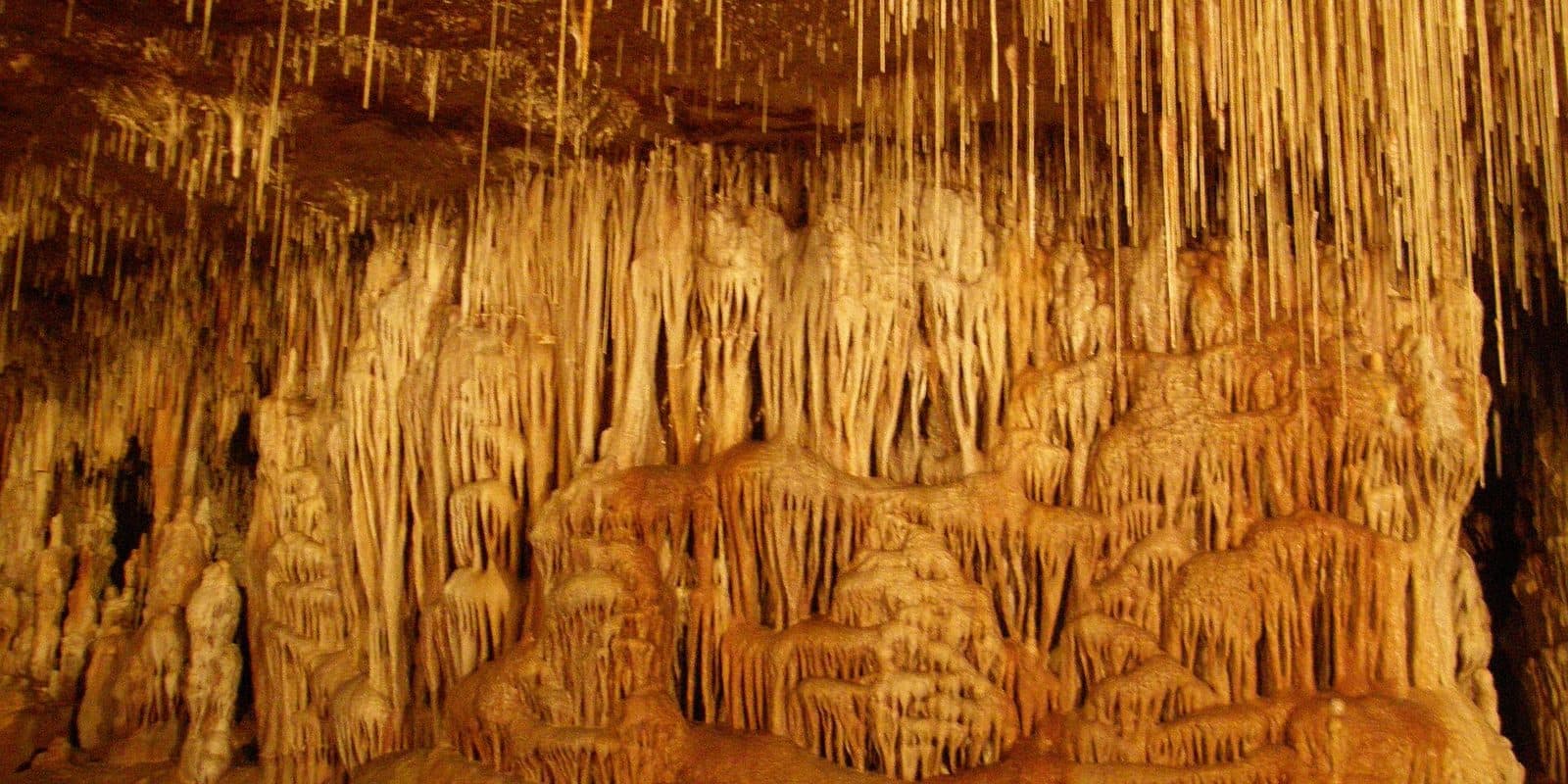

Beneath an unassuming stretch of coastline lies a labyrinth whose dimensions are almost impossible to imagine from the surface. Cova des Pas de Vallgornera near S’Estanyol is the longest known cave in the Balearic Islands and ranks among Europe’s major coastal caves. More than 74 kilometres of explored passages run through the limestone of the Llucmajor platform, with chambers, narrow passages, underground lakes and an unusual variety of speleothems.
The most important information for travellers, however, should be made clear from the outset: the cave is not a publicly accessible show cave. There is no illuminated circuit, no regular guided tour and no option for an impromptu descent. Access is restricted to protect the sensitive system and reserved for scientific and speleological work. Anyone travelling to S’Estanyol is therefore visiting primarily the scenic and geological setting of a natural site that lies largely invisible beneath the coastal plain.
That is precisely what makes it so compelling. Cova des Pas de Vallgornera is not a story of tourist staging but of research: an accidental breakthrough, decades of surveying, an air current that served as a guide and fossils preserving an early chapter of Mallorca’s wildlife. It is worthwhile for geology enthusiasts, cave lovers and travellers who want to understand what lies beneath Mallorca’s seemingly tranquil surface. As a conventional attraction with a clearly defined sightseeing programme, however, the cave is unsuitable. The journey makes sense when the visit is planned as a deliberate stop in S’Estanyol and combined with the coastal landscape. The experience comes from knowing about the hidden space beneath your feet, not from entering the cave.
History and significance
A construction worker, a planned sewage shaft and a tool that suddenly disappeared underground: the discovery of Cova des Pas de Vallgornera began not with a scientific expedition but with construction work. In 1968, a sewage shaft was being built near what was then a hotel. During the work, the builders broke through into a previously unknown cavity. This artificial entrance opened the way into a system whose true extent was initially unknown.
The accidental discovery in 1968
The first breakthrough revealed only a fraction of the underground world. What initially appeared to be a single cave proved, as exploration continued, to be a widely branching network. Early ideas about developing the find for tourism did not result in the creation of a show cave. Instead, a lengthy programme of speleological work began: passages had to be investigated, bodies of water crossed, branches documented and new sections surveyed.
The nature of the discovery also explains why visitors should not expect a natural, widely visible cave entrance at the site. The known access point was created by the construction work. The fact that animals could enter the system in earlier geological ages suggests that natural connections once existed, but this does not imply the presence of a visitor-accessible entrance chamber.
Decades of exploration
Exploration proceeded in stages. An important surveying phase began in 1994 and was completed in 1999. By then, the documented route extended for 6.4 kilometres and included extensive bodies of water. Yet this was not the end: from 2002 onwards, cavers investigated a weak air current in a remote area, often an indication in caves that additional spaces lie beyond a constriction.
The decisive breakthrough came in 2004. Beyond a draughty crevice, a route opened into new extensions and what was then the largest known chamber in the system. The episode illustrates how the cave was explored: not through one spectacular advance, but through patience, close observation and collaboration among Mallorcan caving groups. With every new passage, the understanding of Cova des Pas de Vallgornera shifted once again.
Natural archive and research site
Today, more than 74 kilometres of cave passages are known. This makes Cova des Pas de Vallgornera the longest cave in the Balearic Islands and one of Europe’s major coastal caves. Its significance, however, is not based on length alone. The system formed in the Miocene reef limestone of the Llucmajor platform and follows faults and interconnected fissures. Its features provide evidence of the development of coastal karst and changes in the groundwater level during the Quaternary.
The cave also contains an exceptionally well-preserved site of fossil vertebrates from the early Pleistocene. Mammals, birds, a reptile and an amphibian have been identified. The finds include animal forms typical of or endemic to Mallorca, among them members of the Myotragus fauna. The cave is therefore not merely a spatial labyrinth but an archive of the island’s natural history.
Protection of the system is a direct consequence of this sensitivity. Speleothems grow very slowly, sediments preserve geological information, and fossil deposits irretrievably lose their scientific context through uncontrolled entry. The absence of public access is therefore not a tourism oversight but part of preserving what makes this place valuable.
What there is to see
The defining image of Cova des Pas de Vallgornera does not come from a viewpoint but from scientific documentation: an apparently multi-level network of narrow fissures, low passages, larger chambers and water-filled sections. Because the cave is not accessible as a show cave, these areas cannot be viewed on a tour. Their physical form nevertheless explains why the system has such an exceptional reputation among specialists.
The old sector
The first known part is described by cavers as the old sector. It includes the areas explored from the entrance created in 1968. Even this section demonstrated that the cave does not consist of a single chamber. Passages alternate with narrower connections, while extensive bodies of water appear in deeper sections.
These lakes and flooded sections are not decorative additions like those in a developed show cave, but part of the hydrological system, making exploration considerably more difficult. Where a visitor route would require railings, steps and lighting, scientific exploration demands specialist equipment, local knowledge and permits. The old sector is therefore primarily the starting point of the research story, not a historic visitor area.
The new extensions
The air current that researchers began following in 2002 led into a previously unknown section in 2004. Beyond the narrow connection lay new galleries and what was then the cave’s largest known chamber. This discovery fundamentally changed estimates of the system’s scale. It was now clear that the previously mapped passages represented only part of a much larger network.
The extensions illustrate particularly clearly how completely a cave can remain hidden from perception above ground. A barely noticeable crevice can separate two vast areas, while a weak air current becomes the only sign of spaces beyond the constriction. Continued exploration eventually expanded the mapped route to more than 74 kilometres. Even this figure describes only the documented passages, not a conveniently comprehensible sequence of spaces.
Speleothems and mineral formations
Among the cave’s scientifically notable characteristics is the abundance and diversity of its speleothems. The term covers mineral cave formations, including stalactites, stalagmites and other types of deposits. They occur in numerous forms throughout Cova des Pas de Vallgornera. Their shapes reflect the different conditions under which mineral-rich water seeped through cracks, dripped or evaporated on cave surfaces.
Such formations are particularly sensitive to touch, dirt and changes in the cave climate. Opening the cave to the public would require not only paths and lighting but also a regular flow of people into areas that are currently controlled. The fact that these underground formations cannot be viewed freely is therefore inseparable from their preservation.
Lakes, fissures and traces of groundwater
The cave developed along normal faults and associated fracture systems in the limestone. These created preferred channels through which water could penetrate and dissolve the rock. The passages are therefore not distributed randomly but are closely related to the geological structure of the coastal platform.
Water remains a defining element today. In addition to lakes and flooded passages, researchers found evidence of deep-seated hypogenic recharge. Deposits and cave formations have also been used to study fluctuations in the groundwater level during the Quaternary. Cova des Pas de Vallgornera thus preserves traces of earlier water levels, effectively marking a coastal history that extends over immense periods of time.
The vertebrate fossil site
An exceptionally well-preserved assemblage of fossil vertebrate remains was discovered in one gallery. The documented range includes up to five mammal species, at least 14 bird species, as well as one reptile and one amphibian. Identified finds include Myotragus aff. kopperi, the dormouse Hypnomys onicensis and the shrew Nesiotites aff. ponsi.
Endemic bird forms such as Pica mourerae and Athene vallgornerensis are particularly remarkable. Such finds help reconstruct Mallorca’s early Pleistocene fauna and allow comparisons with other sites on the island. What matters is not only each individual bone but also its position in the sediment and its relationship to the other remains. This is precisely why uncontrolled access would be so problematic for the site.
Visiting Cova des Pas de Vallgornera
Before travelling, expectations should be clear: a visit to Cova des Pas de Vallgornera is not a cave tour. The protected underground system is not open to the public, and there is neither a ticket office nor an illuminated visitor area on the surface. Admission is free, but that does not mean the cave may be entered freely. There is simply no regular tourist access for which a ticket could be sold.
What a visit actually involves
Travellers experience the cave indirectly through its location and the coastal landscape near S’Estanyol. The essential moment is a shift in perspective: beneath the low, initially tranquil-looking limestone platform lies a system with more than 74 kilometres of explored passages. Anyone familiar with this scale and the story of its discovery will see the landscape differently from someone making an ordinary coastal stop.
There is no fixed duration for such a visit. Someone who merely wants to understand the geological setting will need considerably less time than someone combining the stop with a coastal walk. No duration can be given for a cave tour because no such tour is offered. Time planning should therefore be based on S’Estanyol and the intended stretch of coastline, not on an assumed guided visit.
Crowds and time of day
Queues outside a cave entrance are not to be expected because there is no public admission. The question of the best time of day therefore concerns coastal conditions rather than crowds inside the cave. S’Estanyol is a small coastal village, not a major cave centre with tour buses, guided groups or fixed admission slots.
Current opening hours are not recorded. As protection rules and access regulations may change, checking the current status before travelling is recommended. Any information promising freely accessible cave visits should be treated with particular caution: documented visitor practice explicitly states that Cova des Pas de Vallgornera is not a show cave.
Respecting the protected site
The known entrance must not be sought out or entered independently. This also applies to experienced hikers who merely want to take a quick look inside. Underground lakes, constrictions and a complex network of passages make the cave a specialist area of speleology, while the access restrictions also protect fossils, mineral formations and sediments.
A responsible visit therefore remains above ground. This does not diminish the cave’s scientific importance; quite the opposite. Cova des Pas de Vallgornera is an example of how an attraction can be valuable without being developed for large numbers of visitors. Anyone expecting stalactite chambers, lighting and a guided circuit should choose a regularly developed show cave for that experience.
Getting there and parking
The specified routes lead to S’Estanyol, not to a publicly accessible cave entrance. This distinction is important. For navigation purposes, S’Estanyol should therefore be understood as the destination for the scenic and geological stop.
From Palma Airport
The road distance from Palma Airport to S’Estanyol is 37 kilometres. The journey takes around 32 minutes via the MA-6015 and then the Ma-6014. The final section leads into the coastal area of S’Estanyol. From there, the remainder of the visit depends on whether you simply want to see the location or also plan to take a coastal walk.
The stated journey time explicitly ends in S’Estanyol and must not be interpreted as the travel time to an accessible cave entrance. No such tourist destination exists. Navigation directions to remote or unofficial access points should not be treated as an invitation to enter.
From central Palma
The road distance from central Palma to S’Estanyol is 43 kilometres. The journey takes around 43 minutes via the Ma-19, followed by the MA-6015 and the Ma-6014. The route is particularly suitable for travellers with a rental car or their own vehicle who want to incorporate the stop into a drive through the coastal region.
Here too, the distance and journey time refer exclusively to S’Estanyol. Cova des Pas de Vallgornera has no regular visitor entrance reached by a signposted cave road. The final section is therefore not a conventional approach to a ticket office but a matter of finding your way around the coastal village and its surroundings.
Parking and public transport
Vehicles should be parked only where permitted under local traffic regulations in S’Estanyol. Private driveways and unmarked areas should be kept clear. Searching for an assumed entrance does not justify driving along unpaved private access roads or leaving a vehicle outside authorised areas.
No bus stop is recorded in the immediate vicinity. A private vehicle is therefore the most practical option for reliable planning. Anyone wishing to use public transport should check current connections and the remaining distance in advance rather than assuming there is a direct cave bus.
Nearby attractions
Above ground, S’Estanyol almost appears to be the cave’s opposite: a sea horizon, flat coastal landscape and a small village, while beneath it lies an extensive network in the limestone. This proximity makes S’Estanyol a suitable starting point for understanding Cova des Pas de Vallgornera within its landscape, even though the cave itself remains hidden.
S’Estanyol
S’Estanyol is a small coastal and fishing village, far quieter in scale than major holiday resorts. For understanding the cave, its location on the coastal platform matters more than any individual visible attraction. What appears compact and manageable on the surface continues underground as an extensive karst landscape.
The village is therefore suitable for a break and orientation, not as the centre of an organised cave visit. Anyone travelling solely for an underground tour will not find the expected experience here. Travellers who consider the coast, geology and history of exploration together, however, gain an unusual perspective on this part of Mallorca.
The coast between S’Estanyol and Vallgornera
A walking route follows the coast from S’Estanyol towards Vallgornera. It is described as flat, with clearly recognisable paths and sections through a largely undeveloped coastal landscape. Several above-ground landmarks can be seen along the way, including Sa Punta Plana, the s’Estalella lighthouse, the s’Estalella defence tower and small historic boathouses.
This route is a worthwhile addition because it reveals the visible counterpart to the cave: the coastal platform in whose rock the underground labyrinth formed. It does not, however, pass through Cova des Pas de Vallgornera and should not be mistaken for a search route to an entrance. Coastal hiking and cave exploration remain two clearly separate activities.
A stop with a broader context
Cova des Pas de Vallgornera is best understood as a theme within a coastal drive. S’Estanyol provides the geographical context, the walking landscape reveals the limestone at the surface, and the research findings open an imagined view into the depths. In this way, an excursion takes shape even though the natural site itself remains closed.
Enough time should be allowed for additional stops rather than treating the cave as a place to be visited quickly. There is no fixed tour departure and no circuit whose conclusion determines when the onward journey begins. This flexibility in planning is an advantage, provided the lack of access has been taken into account from the outset.
The place it belongs to
S'Estanyol in the place guidePractical visitor information
The most important piece of equipment is not a headlamp but realistic expectations. Travellers remain above ground; a caving helmet, wetsuit or speleological equipment does not make private entry permissible. The water passages and constrictions described in specialist reports instead demonstrate why Cova des Pas de Vallgornera is reserved for professional teams.
Clothing and footwear
For a simple stop in S’Estanyol, clothing appropriate for the current weather is sufficient. If the visit is combined with the coastal path, sturdy footwear is advisable because the route includes sandy and natural sections. The specialist equipment used by cavers for bodies of water and underground passages is irrelevant to visitors: it does not grant access and should never be interpreted as encouragement to make an independent attempt.
On the exposed coast, the need for sun protection, water and suitable clothing depends on the season and weather. These considerations do not apply underground for travellers because entering the cave is not part of the visit.
Visiting with children
For families, the site is suitable only when Cova des Pas de Vallgornera is presented as a topic of nature and scientific research. Children can easily imagine an enormous system of passages beneath the landscape and how a weak air current led researchers towards new spaces. The stop does not, however, offer a cave adventure tour, an illuminated circuit or visible speleothems.
If the visit includes a coastal walk, the usual requirements of an independently planned hike apply. It is essential not to give children the impression that a hidden or restricted entrance may be explored. Protecting the cave begins at the surface.
What not to expect
There are no staged tourist chambers, no musical performance on an underground lake and no regular guided tour. Nor is there a freely accessible entrance portal from which the scale of the cave can be imagined. Photographs of the interior come from research and exploration contexts and do not represent an activity that can be booked by the general public.
Making this distinction prevents disappointment. Cova des Pas de Vallgornera is not a substitute for Mallorca’s show caves but a strictly protected research site. Anyone who accepts this can understand it as a rare example of an attraction whose greatest quality lies hidden from view.
Local insider tips
Enter S’Estanyol as your destination
The stated journey times end in S’Estanyol, not at a tourist cave entrance. S’Estanyol is therefore the destination for this scenic and geological stop.
Remember the air current
One of the most fascinating episodes in the research began with a weak air current in a remote chamber. In 2004, it led through a narrow passage into new sections and what was then the cave’s largest known chamber.
Choose the coast, not the cave entrance
The worthwhile addition is the flat coastal path from S’Estanyol towards Vallgornera. It reveals the limestone landscape above the cave system but explicitly does not pass through the protected Cova des Pas de Vallgornera.
Think of the natural archive
Speleothems and lakes are not the only features beneath the coastal plain. One gallery preserved exceptionally well-preserved vertebrate fossils from the early Pleistocene, a key reason to respect the access restrictions consistently.
Do not expect a show cave
A headlamp and a sense of adventure will not help here: the cave is not open to the public. Anyone wishing to see stalactite chambers along a developed circuit should also plan a visit to a regularly accessible show cave.