
es Drac de na Coca near Son Serralta
.jpg)
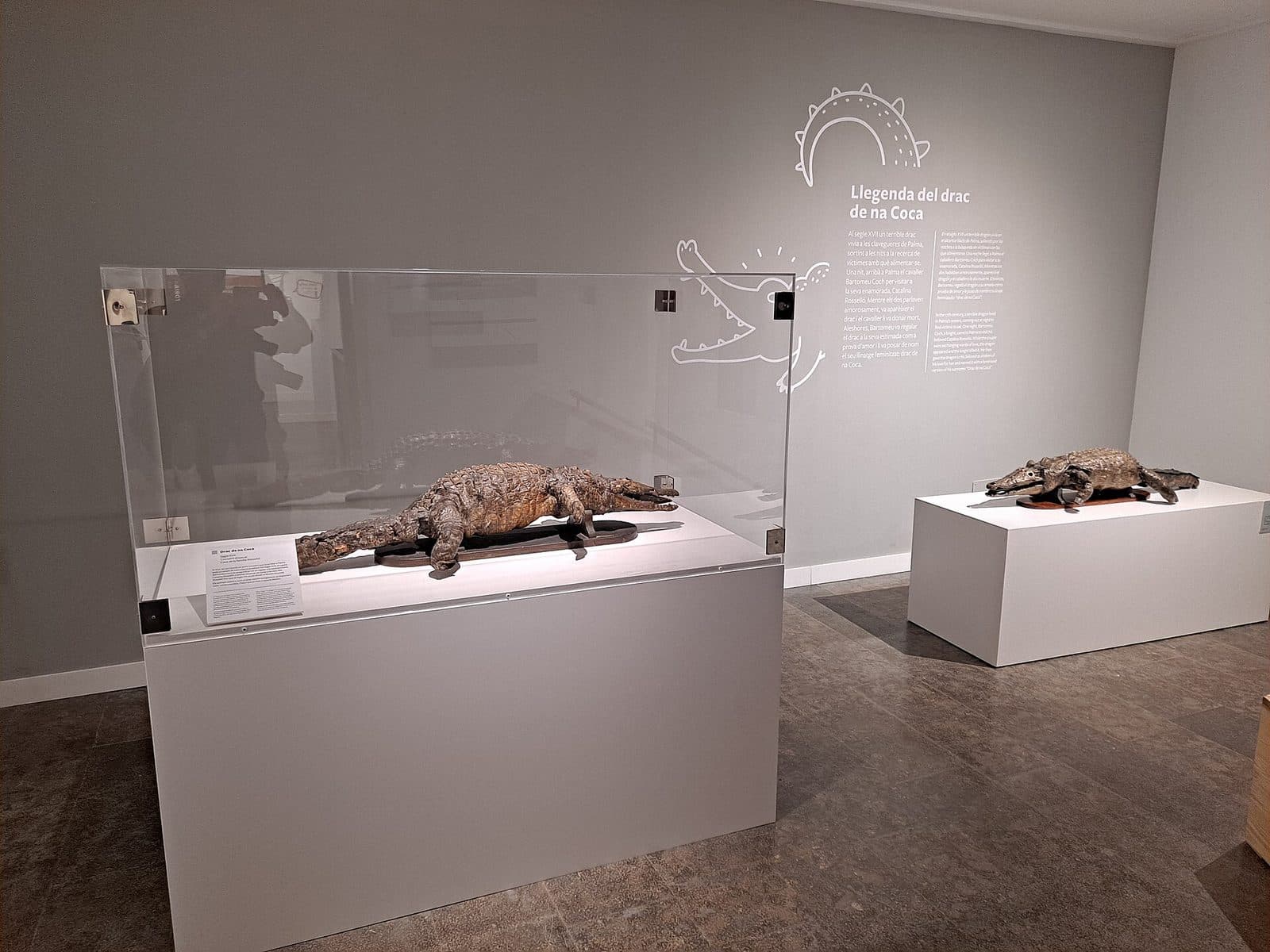
At es Drac de na Coca, Mallorca's world of legends is encountered not in a large museum but in the form of a stone dragon figure. The attraction near Son Serralta recalls the tale of a dragon said to have lived in the nearby sewers. It is precisely the combination of an unassuming setting and a dark tradition that makes it so intriguing.
A visit is especially worthwhile for people interested in local legends, unusual stonework, and small discoveries away from the well-known monuments. Instead of halls filled with exhibits, a single motif awaits here, whose significance becomes clear only through the story associated with it.
The exact identity of the location is important: this is the stone attraction near Son Serralta.
History and significance
It begins with an unsettling idea: a dragon is said to have lived in the sewers beneath the surrounding paths and houses. The stone figure of es Drac de na Coca captures precisely this image. It does not depict a historically documented animal but translates a locally rooted tale into a permanent, visible symbol.
The dragon in the sewers
Sewers and underground passages are ideal settings for legends. They remain hidden from view, lead through darkness, and produce sounds whose cause is difficult to identify from above. In the legend of es Drac de na Coca, this concealed space becomes a dragon's lair. The mythical creature therefore belongs not in a distant cave or on a mountain but directly beneath the world inhabited by people.
The tale gains its impact precisely from this proximity. The dragon is not a creature from some undefined fairy-tale land but is said to have lived in the nearby sewers. Anyone looking at the stone figure therefore sees more than a decorative animal: it is the visible counterpart to a creature that, according to legend, dwelled out of sight.
From mythical creature to stone image
The stonework gives the legendary figure a solid body. The legend thus gains a permanent, visible motif. This is the attraction's true cultural significance. It preserves no major political episode and commemorates no ruler, but instead recalls the imagination with which people interpreted their surroundings.
The legend should also be understood as a legend. The figure is not evidence that a dragon actually lived in the sewers. Its value lies instead in vividly conveying a local tale of terror. Such motifs open up an aspect of Mallorca that is easily overlooked alongside churches, palaces, and landscapes: the island as a realm of stories, mythical creatures, and fears passed down through generations.
The attraction near Son Serralta
The attraction near Son Serralta should be treated as a destination in its own right: the stone depiction of the legendary sewer dweller is the central focus here.
Es Drac de na Coca near Son Serralta offers a concentrated encounter with a single stone testament to the legend. Anyone who keeps this in mind will immediately understand the character of the place.
What to see
The first thing that stands out is the material. The legendary dragon appears as a work of stone craftsmanship. The hard material does nothing to diminish the creature's narrative power; on the contrary, it makes the dragon seem as though it emerged from the surroundings themselves and was permanently captured there.
The stone dragon figure
The figure is the central and defining object to see. It makes sense to begin by viewing it as a whole. This reveals how the form can immediately be recognized as a dragon.
The appeal lies not in an extensive collection but in its concentration. A single mythical creature carries the entire story of the place. Without the legend, it would be an unusual depiction of an animal; with it, the figure becomes an inhabitant of an invisible underground world. This shift in perception is an essential part of the visitor experience.
The motif of the hidden inhabitant
The relationship between the figure and the tale is particularly interesting. The dragon is said to have lived in the nearby sewers, yet here it is made visible above ground. The stonework thus reverses the principle of the legend: what supposedly hid from view can now be observed.
The motif works differently for children and adults. Younger visitors usually notice the mythical creature first and imagine a dragon underground. Adults can also consider how an everyday part of human infrastructure—a sewer—is transformed by a story into a mysterious setting. On a small scale, the place demonstrates how legends can change familiar spaces.
What the attraction is not
Es Drac de na Coca near Son Serralta is neither a dragon cave nor an extensive exhibition about Mallorcan mythology. Making this distinction prevents false expectations and allows the attraction's strength to emerge more clearly.
What visitors see is a stone interpretation of a local legend. The experience depends on looking closely, knowing about the alleged inhabitant of the sewers, and asking why this particular motif was permanently preserved in stone. Anyone seeking monumental architecture will not find it here. Those who appreciate small details with strong stories, however, will discover an unusual gateway to the island's culture.
Visiting es Drac de na Coca
The first look may be quick, but the attraction is easier to appreciate if the dragon's story is already known. The stone figure then becomes a starting point: where exactly is the boundary between local memory, a tale of terror, and artistic representation? This question makes the visit more interesting than simply taking a souvenir photo.
First the figure, then the legend
A good approach is to view the object first without a lengthy explanation. Which features suggest a dragon, and how does the mythical creature appear in stone? It is then worth adding the legend of the inhabitant of the nearby sewers. On a second look, the figure usually seems less decorative and more like a symbol of something hidden.
No definitive visit duration can be derived from this. Es Drac de na Coca is a single sight rather than an extensive site with a fixed route. The appropriate amount of time therefore depends mainly on whether visitors merely look at the figure or also explore the story behind it in detail.
No fixed visitor route
The visit follows no documented sequence of spaces and no known exhibition design. This provides freedom but also requires some initiative. Anyone who simply arrives, takes a picture, and moves on will have seen the visible object but barely grasped its meaning. Taking a brief moment to consider the legend significantly changes the experience.
Restraint is particularly appropriate at small sights. The stonework should be viewed from a suitable distance and not treated as something to climb on. This applies especially when visiting with children: the dragon story provides an engaging narrative introduction, but the specific conditions at the site should be assessed by the accompanying adults when they arrive.
Visiting times and crowds
There is no documented, reliably quiet time of day for this attraction. Unlike large museums or well-known viewpoints, it is therefore impossible to recommend a credible time slot when the place is consistently less busy. Anyone hoping to view the figure in peace should leave enough flexibility in the day's schedule rather than squeezing the stop tightly between two appointments.
Current opening or access times and any possible admission charge have not been recorded. Before making a dedicated journey, it is therefore advisable to check current access. This is especially important if es Drac de na Coca is planned not merely as a spontaneous stop but as the main destination of an excursion.
Directions and parking
The documented route from Palma Airport initially leads to Son Serralta. The distance there is 9 road kilometres, and the journey takes around 13 minutes. These figures explicitly apply only as far as Son Serralta, not directly to the stone dragon figure.
From the airport to Son Serralta
Son Serralta should be used as the initial navigation destination. No road number is specified for the measured route, so a supposedly precise itinerary should not be added here. The exact route may vary depending on the navigation service and current traffic conditions, while the recorded 9 kilometres and 13 minutes refer to Son Serralta as the destination.
The final section to the attraction should be checked separately before departure.
Parking at the destination
A documented dedicated visitor car park is not among the attraction's recorded features. It is therefore advisable to follow local signs and park only in clearly permitted areas. Access points and paths should remain clear, even during a brief photo stop.
Anyone planning the route only as far as Son Serralta should allow additional time to find the actual Drac. The measured driving time ends at the locality and should not be interpreted as a guaranteed arrival time directly at the stone figure. This is a small distinction, but it helps prevent unnecessary searching by car.
Bus lines to es Drac de na Coca at a glance
| Line | Route | Departures/day | First | Last |
|---|---|---|---|---|
| 35 | Aquàrium - Pl. Reina | Catedral | 8 | 07:10 | 13:50 |
| 3 | Pont d'Inca / Joan Carles I | 6 | 07:37 | 09:46 |
| 25 | s'Arenal - Pl. Reina | Catedral | 6 | 09:35 | 12:41 |
| 20 | Portopí - Son Espases | 2 | 07:17 | 07:19 |
From the official GTFS feeds (TIB/SFM), no real-time data. The figures cover all stops in the town; weekend and holiday services differ — check with the operator before travelling.
Getting there by bus
662-pl. de Cort · 0.3 km as the crow flies
- CCCircular Centre Ciutat · 08:00–08:00 · Daily
453-pl. de la Reina - Catedral · 0.3 km as the crow flies
- 25s'Arenal - Pl. Reina | Catedral · 06:36–21:01 · Daily
1982-Parc de la Mar - Catedral · 0.3 km as the crow flies
- 25s'Arenal - Pl. Reina | Catedral · 06:36–21:01 · Daily
- 30Marivent-Palau de Congressos · 08:00–08:00 · Daily
7-pl. de la Reina - Catedral · 0.3 km as the crow flies
- 35Aquàrium - Pl. Reina | Catedral · 06:21–22:41 · Daily
986-pl. de la Reina - Catedral · 0.4 km as the crow flies
- 35Aquàrium - Pl. Reina | Catedral · 06:21–22:41 · Daily
- CCCircular Centre Ciutat · 08:00–08:00 · Daily
663-pl. d'en Coll · 0.5 km as the crow flies
- CCCircular Centre Ciutat · 08:00–08:00 · Daily
929-Parc de la Mar-Catedral · 0.5 km as the crow flies
- 30Marivent-Palau de Congressos · 08:00–08:00 · Daily
106-pl. del Mercat · 0.5 km as the crow flies
- 3Pont d'Inca / Joan Carles I · 08:00–08:00 · Daily
- 4Ses Illetes - Pl. Columnes · 08:00–08:00 · Daily
- 7Son Gotleu - Son Serra - Sa Vileta / Son Vida · 08:00–08:00 · Daily
- 20Portopí - Son Espases · 06:06–22:40 · Daily
52-pl. del Mercat · 0.5 km as the crow flies
- 4Ses Illetes - Pl. Columnes · 08:00–08:00 · Daily
- 7Son Gotleu - Son Serra - Sa Vileta / Son Vida · 08:00–08:00 · Daily
- 20Portopí - Son Espases · 06:06–22:40 · Daily
- 35Aquàrium - Pl. Reina | Catedral · 06:21–22:41 · Daily
1048-pl. de Joan Carles I · 0.5 km as the crow flies
- 25s'Arenal - Pl. Reina | Catedral · 06:36–21:01 · Daily
- 35Aquàrium - Pl. Reina | Catedral · 06:21–22:41 · Daily
985-pl. de Joan Carles I · 0.5 km as the crow flies
- CCCircular Centre Ciutat · 08:00–08:00 · Daily
105-pl. de Joan Carles I - Catedral · 0.5 km as the crow flies
- 3Pont d'Inca / Joan Carles I · 08:00–08:00 · Daily
- 4Ses Illetes - Pl. Columnes · 08:00–08:00 · Daily
- 7Son Gotleu - Son Serra - Sa Vileta / Son Vida · 08:00–08:00 · Daily
- 20Portopí - Son Espases · 06:06–22:40 · Daily
Timetable data: official GTFS feeds (TIB/EMT), no real-time — check with the operator before travelling.
Practical visitor information
Es Drac de na Coca requires no conventional museum strategy. There is no documented route, no large collection of exhibits, and no confirmed visit duration. A clear expectation is more helpful: the focus is a single work of stone craftsmanship whose value arises from the interplay between material and legend.
Check the location
Before starting navigation, confirm the addition Son Serralta.
Visiting with children
The idea of a dragon in underground sewers gives children an immediate point of access. Instead of beginning with lengthy historical explanations, visitors can first look at the stone dragon figure together. However, statements about stroller access, barriers, or other local conditions should be made only after assessing the actual situation at the destination.
Do not expect a monumental site
The sight is better suited to a small, purposeful discovery than to a full-day destination on its own. Its impact comes not from size but from the surprising connection between a stone mythical creature and an ordinary, normally invisible place: the nearby sewers. Those who appreciate precisely this concentration will perceive the dragon differently from someone merely passing by.
Before travelling, check both the exact location and current access. Specific opening times and admission details have not been recorded and therefore cannot be stated reliably. Suitable footwear, shade conditions, and accessibility also cannot be assessed in general terms; decisions should be based on the current situation at the site.