
Parc de la Mar – Palma’s Waterfront Park Below the Cathedral
.jpg)
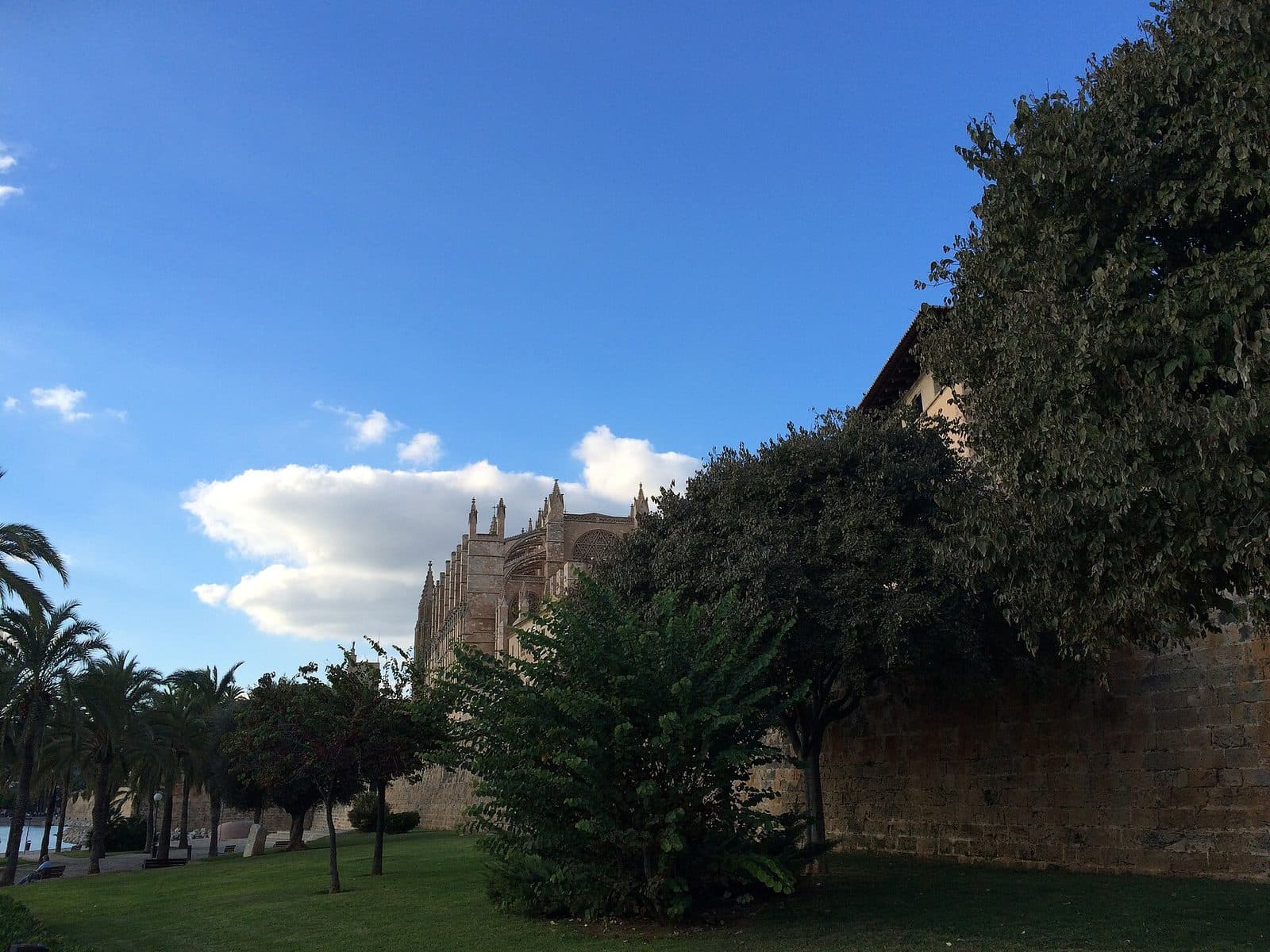
Below the mighty city wall, a broad open space unfolds, above which La Seu Cathedral seems almost to float. Parc de la Mar is Palma’s grand open-air stage by the water: a park, promenade, event venue and viewpoint all in one. Its artificial lake restores the reflection once created by the sea in front of the city’s southern façade.
It is precisely this change of perspective that makes a visit worthwhile. In the lanes of the old town, the cathedral appears only in fragments; down in the park, its entire south side, with flying buttresses and rose window, comes into view. Beside it stands La Almudaina Royal Palace, while on the other side of the park, modern maritime Palma reveals itself.
Parc de la Mar is neither a botanical garden nor an enclosed monumental park. Its appeal comes from open paths, water, walls and changing sightlines. Anyone interested in photography will find one of the island capital’s classic views here. Families can use their time here as a break between sightseeing stops, and few other locations offer such a revealing first impression of Palma’s historic skyline. At the same time, the park is part of everyday city life: locals and visitors meet here, events take over the open spaces, and the atmosphere of the entire ensemble changes in the evening. The water, city wall and illuminated monuments then stand out more strongly than the individual paths and green areas.
History and Significance
Long before walking paths crossed this area, Palma’s southern city front stood directly beside the sea. The water reached the fortifications below the cathedral and royal palace. Anyone approaching the city from the bay saw its monumental silhouette rising above the water; when the surface was calm, La Seu was reflected in it. This relationship between wall and sea shaped Palma’s appearance for centuries.
Separation from the Sea
The expansion of coastal infrastructure fundamentally changed the setting. In the 1960s, land was reclaimed in front of the historic city front and a new traffic artery was built. The Ma-19 now ran past the old town, but the sea no longer lay directly below the walls. A broad zone emerged between the medieval city and the relocated shoreline, and it required a new urban design.
This meant the loss not only of a stretch of waterfront but also of one of Palma’s characteristic views. The cathedral remained visible from afar above the bay, but its direct reflection in the sea had disappeared. The subsequent plans for the park responded to precisely this loss: the new grounds were intended to bridge the gap between the old town and the modern waterfront while recalling the former coastal landscape.
Creation of the Park
Parc de la Mar was developed on the newly created land over the following years. Its defining design element was the artificial lake. It is not a random decoration but a deliberately composed visual feature: the water restores the cathedral’s reflection at the foot of the wall, even though the actual coast now lies farther away.
The park thus recounts urban history not through display cases but through a staged landscape. Looking from the southern edge across the water toward the old town, visitors see, in a sense, a modern remembrance of old Palma. The lake symbolically marks where water and fortifications once met without precisely reconstructing the historic shoreline.
From In-Between Space to Urban Stage
What began as an area requiring a new purpose became a public meeting place. Concerts, film screenings, markets and festivals make use of the park’s open character; during Advent, an accessible Christmas tree has been installed here, among other attractions. The events change with the city calendar, but the role of the location remains the same: Parc de la Mar connects the representative Palma of its monuments with everyday outdoor life.
Its significance therefore lies in more than the view alone. The park resolves a difficult urban-planning challenge: between the old town wall, main traffic artery and present-day coast, it creates a space that is more than merely a passageway. The historic city front gains distance and visual impact, while below it a public place for walks, encounters and culture has emerged.
What to See
The strongest impression comes not from a single monument but from the interplay of several levels. Paths and water lie below, the old line of fortifications extends above them, and La Seu rises high over everything. Just a few steps alter the way the cathedral, palace, palms and lake overlap. It is therefore worth doing more than simply crossing the park: view it deliberately from several directions.
The Artificial Lake
The large expanse of water forms the visual center of Parc de la Mar. It is positioned so that the cathedral’s southern façade can be reflected in it when light and wind conditions are suitable. A fountain adds movement to the lake. Its spray may interrupt a mirror-smooth view, but it also makes clear that this is a designed urban body of water rather than a remnant of the old bay.
For the famous panoramic composition, the opposite side of the lake is particularly rewarding. From there, the view extends northward across the water. La Seu rises behind the city wall, while La Almudaina Royal Palace enters the historic silhouette on the left. Instead of showing individual façade details, this viewpoint reveals the monuments in their topographical setting: as the elevated edge of the old town above the former shore.
As you walk around the water, the composition shifts. Sometimes the cathedral dominates, sometimes the palace moves more prominently into the frame; elsewhere, the view opens toward the bay. This movement is an essential part of the visit, as a single photograph from the nearest edge conveys less than a slow walk around the lake.
La Seu Above the City Wall
From below, it becomes clear why the cathedral has such a powerful influence on the city skyline. Its tall southern façade and Gothic flying buttresses can be seen almost completely from the park. The rose window does not appear in isolation, but as part of an immense structure rising above the fortified edge. The park’s considerable distance is an advantage here: only from this position does the entire building fit within the view.
This perspective differs markedly from visiting the church interior or forecourt. Above, visitors experience portals, stonework and sacred space at close range; below, La Seu appears as the crown of the city. Combining both views offers a better understanding of how closely the cathedral, fortifications and former shoreline were connected.
The light also changes the architecture. Late in the day, the cathedral takes on warmer tones, while the water may appear darker. After nightfall, illuminated walls and structures stand out against the sky. The reflection always depends on movement in the water and visibility; even without a perfect reflection, however, the unobstructed view of the south side remains.
La Almudaina
La Almudaina Royal Palace stands to the left of the cathedral. From Parc de la Mar, it is especially easy to see that it forms part of the same fortified elevated edge. Its more austere, fortress-like appearance provides a counterpoint to the vertical Gothic architecture of La Seu. From a distance, the two buildings do not appear as separate sights but as components of a shared historic city front.
The park is therefore a good starting point for comparing Palma’s political and religious forms of representation. The palace points to secular rule, the cathedral to ecclesiastical power; the wall carries both above the former shore. This context requires no lengthy lecture, as the spatial arrangement already explains much through the view itself.
Walls, Arches and Exhibition Spaces
Below the old town runs Dalt Murada, the fortified edge in front of the monuments. Arches and vaults in this area are also used as exhibition and event spaces. They draw attention to a part of the park that many people overlook when photographing the cathedral: the modern open space stands directly in front of historic defensive structures.
Whether an exhibition is accessible depends on the current program. Parc de la Mar should therefore not be understood as a museum with permanently arranged galleries. Instead, the vaults are spaces used for changing purposes within a larger public complex. Even when closed, they remain architecturally interesting because they reveal the difference in elevation between the park and the old town.
Art and Open Spaces
The artistic features include a monumental mural by Joan Miró. It places contemporary art against the historic backdrop without competing with the cathedral and palace for the same visual effect. This contrast suits the character of the park perfectly: it does not reconstruct the lost shoreline but translates its memory into a modern urban landscape.
The open spaces also explain why such varied events can take place here. During concerts, film nights, markets or festivals, the visitor experience changes considerably. Where people normally stroll along the water, a large public event space then emerges. Anyone primarily seeking peace and unobstructed photographic perspectives should therefore check the current events calendar.
Visiting Parc de la Mar
The best way to begin a walk is not directly below the cathedral, but from a little distance on the southern side of the water. From there, the entire composition appears at once: lake, wall, La Seu and La Almudaina. The route then follows the water, while the two monuments shift in relation to each other and continually create new compositions.
Walking Around the Lake
For a focused walk with several photography stops, around 30 to 60 minutes is a useful guideline. Those simply crossing the park on their way to the old town will need less time; those waiting for the right reflection, attending an event or lingering on a terrace can stay considerably longer. The grounds require no fixed sightseeing itinerary and are easy to incorporate into a walk through the old town.
An appealing route begins on the side facing the monumental ensemble. This is where the classic panoramic view can be captured. Afterward, it is worth moving to the edge below the wall, where the scale of the fortifications and the difference in elevation up to the cathedral become more tangible. To finish, look once more toward the sea and the modern waterfront. This turns a photography stop into a short narrative about the shoreline’s relocation.
Light and Crowds
Late afternoon and the transition into evening are particularly suitable for enjoying the atmosphere by the water. The cathedral’s stone takes on warmer tones, and as daylight fades, the illuminated monuments gain definition. Sunset and evening, however, are also popular times to visit.
At midday, the open grounds can be heavily exposed to the sun. Although the considerable distance from the cathedral provides unobstructed views, it also means that not every photography spot offers shade. Events can further change the setting: stages, market stalls or larger crowds may temporarily shape the paths and sightlines. This is not a disadvantage if urban life is the focus, but it matters for carefully planned architectural photographs.
Opening Hours and Access
Individual exhibition spaces, events and temporarily restricted areas are subject to their respective access conditions. The park itself is used as a public urban space, but this does not imply unchanging access times for every part of the grounds. A simple walk through the park can be planned flexibly. This openness is precisely what makes Parc de la Mar a good beginning or end to a day in the old town.
Getting There and Parking
The route shown in the travel data to the locality identified as Son Serralta covers 9 road kilometers; the journey takes around 13 minutes. This measurement expressly ends in Son Serralta and not at a specific park entrance. Additional time should therefore be allowed for the final section to Parc de la Mar, including city traffic, finding parking and walking.
Driving to the Old Town Front
The park lies below La Seu on the southern edge of Palma’s old town. Although the coastal routes pass close by, one-way streets and access restrictions make spontaneous shortcuts through the historic center impractical. Carrer d’Antoni Maura in particular should not mistakenly be treated as a general through road, as access rules for residents may apply there.
Drivers are better off following the major roads by the water rather than taking a route through the narrow old-town lanes. From the east, a parking-garage entrance is located on Avenida de Gabriel Roca; from the north or west, an entrance via Avenida d’Antoni Maura is used. Because of possible events and dense traffic around the cathedral, checking live navigation immediately before arrival is advisable.
Parc de la Mar Parking Garage
The parking garage of the same name lies directly on the southern old town front and keeps the subsequent walk short. It is also suitable for combining the park with the cathedral, royal palace and old town. This convenient location, however, makes it highly sought after; occupancy can rise considerably from midday onward. Anyone who needs to arrive at a specific time should allow a buffer or choose an alternative outside the immediate cathedral area.
The name can briefly cause confusion: Parc de la Mar refers both to the public park and to the nearby parking garage. When navigating, it is therefore important to select the correct entrance. After parking, the final section is covered on foot to the water or the paths below the city wall.
Arriving by Bus
Several stops are located near the entrances to the southern old town. Parc de la Mar – Catedral is particularly convenient; the stops at Plaça de la Reina and Plaça de Cort are also suitable for a visit. From Plaça de la Reina, access descends from the old-town side to the park, while Parc de la Mar – Catedral is closer to the lower level.
The most suitable connection depends on the point of departure and current services. Public transport is convenient for the walk itself because there is no need to return to a distant parking space afterward. Visitors can enter the park on one side and leave through the old town on the other.
Bus lines to Parc de la Mar at a glance
| Line | Route | Departures/day | First | Last |
|---|---|---|---|---|
| 35 | Aquàrium - Pl. Reina | Catedral | 8 | 07:10 | 13:50 |
| 3 | Pont d'Inca / Joan Carles I | 6 | 07:37 | 09:46 |
| 25 | s'Arenal - Pl. Reina | Catedral | 6 | 09:35 | 12:41 |
| 20 | Portopí - Son Espases | 4 | 07:17 | 07:31 |
From the official GTFS feeds (TIB/SFM), no real-time data. The figures cover all stops in the town; weekend and holiday services differ — check with the operator before travelling.
Getting there by bus
453-pl. de la Reina - Catedral · 0.2 km as the crow flies
- 25s'Arenal - Pl. Reina | Catedral · 06:36–21:01 · Daily
7-pl. de la Reina - Catedral · 0.3 km as the crow flies
- 35Aquàrium - Pl. Reina | Catedral · 06:21–22:41 · Daily
1982-Parc de la Mar - Catedral · 0.3 km as the crow flies
- 25s'Arenal - Pl. Reina | Catedral · 06:36–21:01 · Daily
- 30Marivent-Palau de Congressos · 08:00–08:00 · Daily
662-pl. de Cort · 0.3 km as the crow flies
- CCCircular Centre Ciutat · 08:00–08:00 · Daily
986-pl. de la Reina - Catedral · 0.3 km as the crow flies
- 35Aquàrium - Pl. Reina | Catedral · 06:21–22:41 · Daily
- CCCircular Centre Ciutat · 08:00–08:00 · Daily
929-Parc de la Mar-Catedral · 0.4 km as the crow flies
- 30Marivent-Palau de Congressos · 08:00–08:00 · Daily
1048-pl. de Joan Carles I · 0.5 km as the crow flies
- 25s'Arenal - Pl. Reina | Catedral · 06:36–21:01 · Daily
- 35Aquàrium - Pl. Reina | Catedral · 06:21–22:41 · Daily
985-pl. de Joan Carles I · 0.5 km as the crow flies
- CCCircular Centre Ciutat · 08:00–08:00 · Daily
105-pl. de Joan Carles I - Catedral · 0.5 km as the crow flies
- 3Pont d'Inca / Joan Carles I · 08:00–08:00 · Daily
- 4Ses Illetes - Pl. Columnes · 08:00–08:00 · Daily
- 7Son Gotleu - Son Serra - Sa Vileta / Son Vida · 08:00–08:00 · Daily
- 20Portopí - Son Espases · 06:06–22:40 · Daily
106-pl. del Mercat · 0.5 km as the crow flies
- 3Pont d'Inca / Joan Carles I · 08:00–08:00 · Daily
- 4Ses Illetes - Pl. Columnes · 08:00–08:00 · Daily
- 7Son Gotleu - Son Serra - Sa Vileta / Son Vida · 08:00–08:00 · Daily
- 20Portopí - Son Espases · 06:06–22:40 · Daily
52-pl. del Mercat · 0.5 km as the crow flies
- 4Ses Illetes - Pl. Columnes · 08:00–08:00 · Daily
- 7Son Gotleu - Son Serra - Sa Vileta / Son Vida · 08:00–08:00 · Daily
- 20Portopí - Son Espases · 06:06–22:40 · Daily
- 35Aquàrium - Pl. Reina | Catedral · 06:21–22:41 · Daily
53-pl. de Joan Carles I - Catedral · 0.5 km as the crow flies
- 4Ses Illetes - Pl. Columnes · 08:00–08:00 · Daily
- 7Son Gotleu - Son Serra - Sa Vileta / Son Vida · 08:00–08:00 · Daily
- 20Portopí - Son Espases · 06:06–22:40 · Daily
Timetable data: official GTFS feeds (TIB/EMT), no real-time — check with the operator before travelling.
Nearby Attractions
Directly above the park stand the two buildings that define its view: La Seu Cathedral and La Almudaina Royal Palace. Both can easily be combined with the walk without a long change of location. It makes sense to take in the full view from below first and then walk up to the elevated old town front. At the top, the perspective is reversed: the view now extends from the historic center toward the park and bay.
Cathedral and Royal Palace
La Seu is more than a backdrop. The park makes its position in the cityscape understandable, while a visit to the building afterward reveals its architecture and interior at close range. La Almudaina stands immediately beside it, and its fortress-like appearance is especially clear from below. Anyone wishing to visit both monuments should check their current access conditions separately from those of the park.
Plaça de la Reina forms a practical transition between the monumental area and the city center. From there, routes continue to Passeig del Born and into the historic lanes. Parc de la Mar is therefore well suited as the southern starting point for a walk through the old town: first the open skyline, then increasingly narrow streets and squares.
Old Town and Banys Àrabs
A quieter part of the historic center begins east of the cathedral. Here lie Banys Àrabs, the Arab Baths, along with lanes containing courtyards and older buildings. The contrast with Parc de la Mar is appealing: below, open space, water and large structures dominate the scene; just a few minutes later, narrow paths lead through a dense urban fabric.
The park does not have to serve only as a starting point. After a longer walk through the old town, it provides an open conclusion where the monuments visited earlier can once again be placed in context from a distance. Later in the day, this creates a satisfying transition from detailed views to a panorama.
The place it belongs to
Son Serralta in the place guidePractical Information for Your Visit
Parc de la Mar is primarily an open urban space. Visitors should expect neither a traditional garden with a botanical collection nor an amusement park with a fixed route. Its appeal lies in the panorama, the memory of the former shoreline and the opportunity to view Palma’s monuments from sufficient distance.
Visiting with Children
For families, the park works well as an informal break between more structured sightseeing visits. There is room to walk and a variety of changing impressions without having to complete an entire exhibition program. The lake and fountain attract attention but also require supervision near the water. During events, large crowds and temporary structures can alter the park’s otherwise easy-to-navigate character.
A short walk can easily be adapted to the attention span of younger children. Instead of covering every side of the lake, the panoramic view, a look at the fountain and the subsequent climb toward the old town may be enough. Those wishing to stay longer can use the park as a resting phase between the cathedral, palace and old-town lanes.
Photography Without False Expectations
The famous reflection does not look the same at all times. Wind, fountain spray, movement in the water, light and events all influence the composition. A visit is still worthwhile, because the unobstructed view of the south sides of La Seu and La Almudaina remains the main experience. Anyone hoping exclusively for a perfectly smooth reflection may easily overlook the more interesting side perspectives along the wall.
For a balanced panoramic composition, distance matters more than proximity. Only from the other side of the water can the lake, fortifications and cathedral be captured together. Details of the flying buttresses or palace, by contrast, are more prominent while walking along the northern edge. The best route therefore combines panoramic and close-up views instead of heading for just one well-known photography spot.
Local insider tips
Step Back for the Best View
For the classic panoramic composition, do not stand directly below the cathedral. From the opposite side of the lake, the water, city wall, La Seu and La Almudaina all fit within the same view.
Wait for Two Kinds of Light
Late in the day, the cathedral takes on warmer tones; after nightfall, the illuminated monuments stand out more strongly. Stay a little longer to experience the same location with a markedly different atmosphere.
Look Beyond La Seu
Consciously include La Almudaina, to the left of the cathedral, in the composition. From the park, it becomes especially clear how the palace and church together dominate the fortified historic city front.
Do Not Miss Miró
Away from the famous cathedral view, look for the monumental mural by Joan Miró. This modern artistic feature is part of the park’s concept and is easily overlooked during a quick photography stop.
Reverse the Perspective Afterwards
After viewing the old town from below, walk up to it. From the elevated monumental area, Parc de la Mar can be seen toward the bay, making the former relationship between the city wall and sea easier to understand.