
La Seu – Palma’s Cathedral from Gothic to Modern
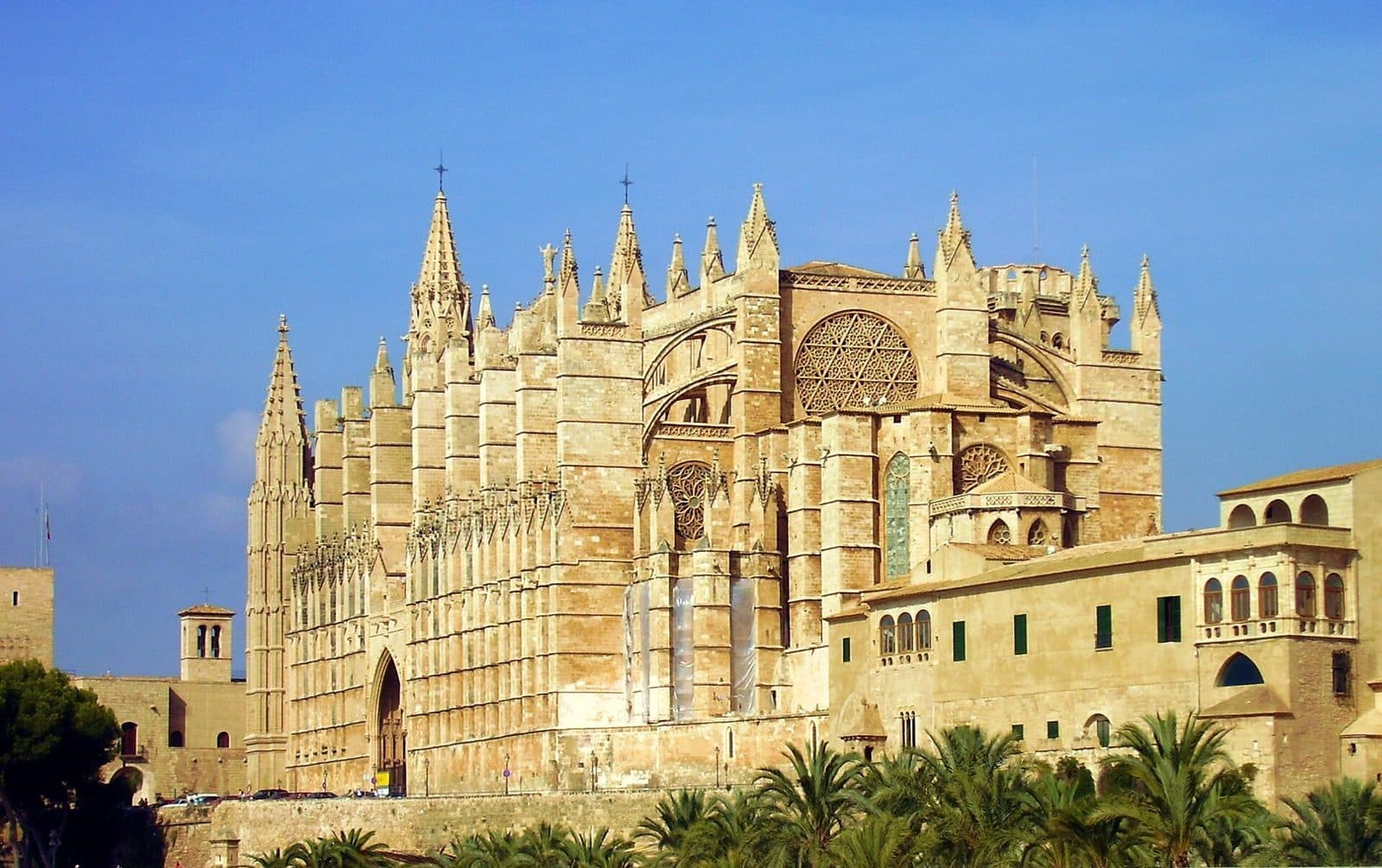

Above the palm trees and reflecting pool of the Parc de la Mar, La Seu rises into the sky like a stone city wall. The Cathedral of Palma not only defines the silhouette of Mallorca’s capital but also reveals how religious, political and artistic ideas accumulated on the same site over centuries. From the outside, it appears fortified; inside, the impression is shaped by height, coloured light and a surprising dialogue between Gothic architecture and modern art.
The visit is therefore worthwhile not only for enthusiasts of medieval architecture. In the early 20th century, Antoni Gaudí altered the interior without obscuring its fundamental Gothic concept. Later, Miquel Barceló created a contemporary counterpoint with his distinctive chapel design. Anyone who looks closely will encounter in La Seu not a completed monument, but a sacred space that remains in use today and has repeatedly been reinterpreted.
The location itself is part of the experience: on one side are the Royal Palace La Almudaina and the lanes of the old town, while on the other the view opens across the Parc de la Mar towards the bay. This allows the cathedral to be understood from several perspectives—as a landmark above the Parc de la Mar, as the centre of ecclesiastical Mallorca and as a monumental starting point for a tour of Palma. Enough time and quiet should be allowed for the interior and its artworks, because a brief look at the façade reveals only part of what defines La Seu.
History and significance
Beneath the present church floor lie traces of a much older city. Evidence at the site points to a settlement from Roman times and an early Christian basilica. During Muslim rule, the main mosque of Medina Mayurqa, as Palma was then called, stood here. The cathedral therefore does not occupy its prominent position above the sea by chance: long before it was built, this site was already a religious and urban centre.
The Christian conquest
When King Jaume I. conquered Mallorca in 1229, the reinterpretation of this site also began. A Christian church dedicated to the Virgin Mary was to be built on the grounds of the mosque. The construction was therefore more than a religious project: it made the transfer of power in the city visible and created a second monumental focal point opposite the Royal Palace.
Construction continued over several centuries. Different generations of builders, clergy and patrons worked on the building until the major historical construction process concluded in 1601. This long duration explains why, despite its coherent Gothic appearance, La Seu is not the work of a single design or period. Chapels, portals, windows and furnishings were added gradually and later altered again.
From a medieval building to a living cathedral
The story did not end with completion, as restorations and artistic interventions continued to accompany La Seu. Particularly influential was the work of Antoni Gaudí between 1904 and 1914. It changed the perception of the sanctuary and introduced forms of Catalan Modernisme into the medieval building. Gaudí’s contribution remained limited because his involvement ended after disagreements; this unfinished chapter, however, is part of the cathedral’s distinctive biography.
With Miquel Barceló’s design for a chapel, La Seu later acquired another, distinctly contemporary layer. Medieval architecture, Gaudí’s religiously inspired spatial art and Barceló’s expressive surfaces are not experienced separately today, but as parts of the same space during services, cultural visits and church events.
Significance for Palma
La Seu remains the cathedral of Mallorca and is not a church converted into a museum. The cathedral chapter continues the ecclesiastical tradition, while sightseeing visits make the building accessible to an international audience. This dual function shapes the visit: liturgy and contemplation remain its essential background, even though the architecture and art attract many visitors.
For Palma, the cathedral is also a point of orientation. Its south side dominates the view from the Parc de la Mar, while the dense fabric of the old town extends behind it. Hardly any other building makes the historic relationship between city, power and sea so immediately visible.
What to see
The strongest impression comes from moving from outside to inside. In front of the façade, buttresses, walls and stone surfaces appear almost fortress-like. Beyond the portal, however, a lofty interior opens up, articulated by slender supports and coloured light. La Seu has three naves; the central nave draws the eye towards the liturgical centre, while the side aisles provide access to the chapels.
The Gothic interior
The architecture is classified as Catalan Gothic. Its effect relies less on intricate decoration than on grand proportions, broad vaults and the clear rhythm of the pillars. Those who first pause at the rear of the central nave can best see how the lines converge towards the front. From different angles, the relationship between the naves changes: at times the interior appears like a single lofty hall, while at others the chapels and side passages become more prominent.
The cathedral is therefore best explored at a slow pace. Many details lie above the normal line of sight, including windows, vault ribs and parts of the liturgical furnishings.
The great rose window and stained glass
The great rose window is one of the defining elements. From outside, it appears as stone tracery in the façade; inside, it becomes a source of light. Together with the numerous other stained-glass windows, it colours the incoming daylight and, depending on the position of the sun, casts shifting fields of colour across pillars, walls and floor. This effect depends not only on the size of the window, but also on its relationship with the comparatively restrained stone architecture.
The cathedral contains 61 stained-glass windows. They should not be viewed only as individual images, because their true effect becomes apparent from some distance, when the colours reach into the entire interior. The light is especially interesting in the morning, although the atmosphere continues to change later with the position of the sun. An overcast day does not diminish the scale of the architecture, but the colours appear more subdued.
Gaudí’s interventions
Antoni Gaudí worked on reorganising the interior in the early 20th century. His most visible contribution hangs above the altar area: an illuminated canopy whose form recalls a crown of thorns. Visually, it seems to float between the Gothic vault and the liturgical activity below. Its light, almost linear construction forms a powerful contrast with the mass of the sandstone.
Gaudí’s work is best viewed not as an isolated exhibit, but from the central nave. From there, it becomes clear how he intended to connect sightlines with the liturgical focal point. Modernisme does not appear as foreign decoration, but translates religious symbols into a formal language substantially younger than the surrounding architecture.
The chapel by Miquel Barceló
The chapel designed by Miquel Barceló departs even more clearly from expectations of a purely Gothic interior. Its expressive clay reliefs cover the surfaces with sculptural forms. The surface appears animated, almost organic, and stands apart from the smooth or finely articulated stone sections of the historic cathedral. Strong colours intensify this contrast.
It is precisely the proximity between the medieval interior and contemporary art that makes the chapel interesting. Barceló does not attempt to imitate Gothic architecture. His work asserts its own visual world, thereby continuing what has shaped La Seu over centuries: every period left traces in the language of its own time. Anyone looking only for old tombs and traditional altars will overlook this essential part of the cathedral.
The terraces
The seasonally accessible terraces offer another perspective. The ascent leads up 136 steps and brings visitors closer to roofs, buttresses and upper structural elements that are difficult to appreciate from the ground. From there, the considerable engineering effort behind the high vaults becomes visible. At the same time, views open across the old town, the Parc de la Mar and the area around the bay.
Access to the terraces is a separate part of the visit and may be closed due to weather. It should therefore not be taken for granted, but checked in advance. Those who climb up experience La Seu less as a solemn interior and more as a complex structure of walls, supports, roofs and walkways. The change of perspective is particularly rewarding for architecture enthusiasts, but the many steps make it considerably more demanding than visiting the main level.
The exterior from the Parc de la Mar
For the complete picture, the Parc de la Mar is indispensable. From the lower waterside area, the gradation of heights, buttresses and the cathedral’s position above the Parc de la Mar can be clearly seen. The reflecting pool in the park mirrors the silhouette and creates the distance that is absent from the narrow lanes of the old town.
Afterwards, it is worth moving on to the surrounding squares and lanes. There, the portals, wall surfaces and connection with the neighbouring Almudaina Palace come closer into view. Only through this sequence of distant and close-up perspectives does it become clear that La Seu was not built as a freestanding monument on an empty site, but as part of a historic district of royal and ecclesiastical power.
Visiting La Seu
A visit is quietest when started as close as possible to the morning admission time. It can become busier later; larger crowds should be expected particularly between May and October. Those who visit the interior first and then explore the exterior views from the Parc de la Mar can make use of the morning light and later walk around the cathedral without time pressure.
Timing and route
Up to two hours can be allowed for a thorough visit. This is especially worthwhile if you want to take time to appreciate not only the central nave, but also the chapels, Gaudí’s interventions, Barceló’s work and the stained-glass windows. An additional visit to the terraces extends the tour and requires more time because of the climb.
Inside, a hurried circuit from one object to the next is not recommended. A good route begins with the overall impression from the central nave, then continues into the side aisles and chapels before returning to the central axis at the end. This makes it easier to place the modern interventions within the Gothic interior. For the rose window and coloured light, it is also worth viewing the same area from different distances.
Tourist visiting hours
From April to October, tourist visits are scheduled from 10:00 to 17:15 from Monday to Friday and from 10:00 to 14:15 on Saturdays. From November to March, the hours from Monday to Friday are 10:00 to 15:15; Saturdays remain 10:00 to 14:15. Because religious services and special dates may affect access, the current information should be checked before visiting.
Cathedral and place of worship
Throughout all tourist use, La Seu remains a religious site. Services, church festivals and pastoral events are not a decorative backdrop, but part of the building’s actual life. A visit may therefore proceed differently from one in an ordinary art museum. Individual areas may temporarily be reserved for the liturgy, and a quiet volume is more appropriate to the character of the space.
Families can visit the cathedral together; the operator explicitly provides options for individuals and families. For children, the tour becomes more engaging if there is no attempt to explain every furnishing. The rose window, coloured light, high vaults, Gaudí’s canopy and Barceló’s relief-like chapel provide clearly recognisable focal points. The climb to the terraces, however, should be assessed according to fitness and confidence on stairs.
Getting there and parking
From Palma Airport, the route initially follows the Ma-19 to Palma. The distance to the city is 11 kilometres by road, and the journey takes around 20 minutes. These figures expressly apply only as far as Palma; traffic on city streets and the search for parking can lengthen the final section. Near the centre, the route follows the southern edge of the old town, while the cathedral is already visible above the Parc de la Mar.
By car
There is no visitor parking directly at La Seu. Access for private vehicles is also restricted in the immediate surroundings, so the final metres are best covered on foot. A convenient choice is the underground Parc de la Mar car park. It can be accessed via the Avenida de Gabriel Roca and, depending on the direction of travel, via the area around the Avenida d’Antoni Maura.
The car park is conveniently located for the cathedral and old town, but it can become very busy from midday onwards. Visitors arriving by rental car can avoid unnecessary loops through narrow streets by choosing their parking destination before reaching the historic centre. It is particularly important not to drive accidentally into areas reserved for residents. From the Parc de la Mar, the route then leads up from the lower parking level to the cathedral.
By bus and on foot
Several city buses stop nearby. Convenient areas include Plaça de la Reina, Parc de la Mar and Plaça de Cort. From there, the final section leads through the historic centre or across the open spaces in front of the southern city frontage. The stops at Plaça de la Reina are also suitable for combining the visit with a tour of the old town, while Parc de la Mar provides a direct view of the south side.
Within Palma, La Seu is easy to reach on foot. The cathedral stands between the Almudaina Palace, the Bishop’s Palace and the edge of the old town. When approaching via the Parc de la Mar, the façade remains in view for a long time; from the old town, by contrast, visitors approach through narrow lanes and experience the building at its full scale only immediately before reaching the squares.
Bus lines to La Seu at a glance
| Line | Route | Departures/day | First | Last |
|---|---|---|---|---|
| 35 | Aquàrium - Pl. Reina | Catedral | 8 | 07:10 | 13:50 |
| 3 | Pont d'Inca / Joan Carles I | 6 | 07:37 | 09:46 |
| 25 | s'Arenal - Pl. Reina | Catedral | 6 | 09:35 | 12:41 |
| 20 | Portopí - Son Espases | 4 | 07:17 | 07:31 |
From the official GTFS feeds (TIB/SFM), no real-time data. The figures cover all stops in the town; weekend and holiday services differ — check with the operator before travelling.
Getting there by bus
453-pl. de la Reina - Catedral · 0.2 km as the crow flies
- 25s'Arenal - Pl. Reina | Catedral · 06:36–21:01 · Daily
7-pl. de la Reina - Catedral · 0.2 km as the crow flies
- 35Aquàrium - Pl. Reina | Catedral · 06:21–22:41 · Daily
1982-Parc de la Mar - Catedral · 0.3 km as the crow flies
- 25s'Arenal - Pl. Reina | Catedral · 06:36–21:01 · Daily
- 30Marivent-Palau de Congressos · 08:00–08:00 · Daily
662-pl. de Cort · 0.3 km as the crow flies
- CCCircular Centre Ciutat · 08:00–08:00 · Daily
986-pl. de la Reina - Catedral · 0.3 km as the crow flies
- 35Aquàrium - Pl. Reina | Catedral · 06:21–22:41 · Daily
- CCCircular Centre Ciutat · 08:00–08:00 · Daily
929-Parc de la Mar-Catedral · 0.4 km as the crow flies
- 30Marivent-Palau de Congressos · 08:00–08:00 · Daily
1048-pl. de Joan Carles I · 0.4 km as the crow flies
- 25s'Arenal - Pl. Reina | Catedral · 06:36–21:01 · Daily
- 35Aquàrium - Pl. Reina | Catedral · 06:21–22:41 · Daily
985-pl. de Joan Carles I · 0.4 km as the crow flies
- CCCircular Centre Ciutat · 08:00–08:00 · Daily
105-pl. de Joan Carles I - Catedral · 0.4 km as the crow flies
- 3Pont d'Inca / Joan Carles I · 08:00–08:00 · Daily
- 4Ses Illetes - Pl. Columnes · 08:00–08:00 · Daily
- 7Son Gotleu - Son Serra - Sa Vileta / Son Vida · 08:00–08:00 · Daily
- 20Portopí - Son Espases · 06:06–22:40 · Daily
106-pl. del Mercat · 0.5 km as the crow flies
- 3Pont d'Inca / Joan Carles I · 08:00–08:00 · Daily
- 4Ses Illetes - Pl. Columnes · 08:00–08:00 · Daily
- 7Son Gotleu - Son Serra - Sa Vileta / Son Vida · 08:00–08:00 · Daily
- 20Portopí - Son Espases · 06:06–22:40 · Daily
52-pl. del Mercat · 0.5 km as the crow flies
- 4Ses Illetes - Pl. Columnes · 08:00–08:00 · Daily
- 7Son Gotleu - Son Serra - Sa Vileta / Son Vida · 08:00–08:00 · Daily
- 20Portopí - Son Espases · 06:06–22:40 · Daily
- 35Aquàrium - Pl. Reina | Catedral · 06:21–22:41 · Daily
53-pl. de Joan Carles I - Catedral · 0.5 km as the crow flies
- 4Ses Illetes - Pl. Columnes · 08:00–08:00 · Daily
- 7Son Gotleu - Son Serra - Sa Vileta / Son Vida · 08:00–08:00 · Daily
- 20Portopí - Son Espases · 06:06–22:40 · Daily
Timetable data: official GTFS feeds (TIB/EMT), no real-time — check with the operator before travelling.
Nearby sights
After the subdued light of the interior, the open space by the Parc de la Mar feels almost like a second part of the visit. From here, the cathedral can be viewed from a distance, while paths beside the reflecting pool offer different perspectives on the buttresses, rose window and neighbouring palace complex. The park is therefore suitable not only for a break, but also for rediscovering on the outside the architectural elements previously seen inside.
Royal Palace La Almudaina
The Royal Palace La Almudaina stands immediately beside La Seu. Together, the two buildings form a historic ensemble, although they embody different functions: Palma’s ecclesiastical side here and its royal side there. Their proximity is ideal for a combined visit, but each building deserves individual attention. Anyone wishing to see both interiors should avoid packing the day too tightly with further sightseeing.
Palma’s old town
The network of lanes in the old town begins behind the cathedral. Squares, courtyards and narrow streets create a very different sense of scale from the monumental nave. Plaça de Cort and Plaça de la Reina are useful next points of orientation. From there, the walk can continue towards the shopping streets or deeper into the historic districts.
Waterfront and city views
Those who do not want to follow the cathedral with another interior visit can continue along the southern edge of the city. From changing distances, La Seu remains a fixed point above the walls. Looking back is particularly revealing: from the lanes, the cathedral appears as part of the densely built old town; from the water, by contrast, it appears as a dominant solitary form. Both perspectives belong together and explain why the building shapes the perception of Palma so powerfully.
The place it belongs to
Palma in the place guidePractical information for your visit
La Seu is not a place to walk through solely with a camera held in front of your face. Its grand spatial effects become apparent only when you change position several times. Comfortable shoes are useful for the cathedral floor and the subsequent routes through the old town. Anyone planning to visit the terraces should also keep the 136 steps in mind; confident stair climbing matters more there than completing the fullest possible sightseeing programme.
Light and time of day
Crowds are generally smaller in the morning, while the stained-glass windows also show their effect particularly well. The light nevertheless depends on the weather and the position of the sun. A specific display of colours cannot be guaranteed, and the Gothic spatial structure remains worth seeing even under a subdued sky. For exterior photographs, the Parc de la Mar provides the necessary distance, while the lanes of the old town offer close-up views of walls and portals.
Terraces and weather
Access to the terraces is seasonal and may be closed in unfavourable weather. Anyone considering it the highlight of the visit should check availability in advance. The ascent should not be confused with a level viewing platform: it leads up many steps through the upper parts of the building. In return, the buttresses and roofscape can be seen at a proximity impossible from the cathedral floor.
With children
For families, a visit works best with a few clear observation tasks. The great rose window, coloured windows, Gaudí’s suspended canopy and Barceló’s relief-like chapel differ clearly from one another and are more likely to hold children’s attention than a comprehensive art-historical explanation. Because La Seu is an active place of worship, children should be told in advance that running and shouting are not appropriate inside.
What La Seu is not
The cathedral is neither an unchanged medieval time capsule nor an ordinary art museum. Gaudí’s Modernisme and Barceló’s contemporary visual language belong to it just as much as the Gothic naves. Nor is every area always available to tourists, because liturgy and church events take priority. Those who accept this living use experience the building not as a collection of isolated sights, but as a space whose story has continued to be written for centuries.
Local insider tips
Step back for the best view
The Parc de la Mar offers the clearest overall view of the south side of La Seu. From the lower area, the gradation of heights, buttresses and proximity to the Almudaina Palace can be appreciated better than directly in front of the façade.
Go inside as early as possible
Visitor numbers are generally lower close to the morning admission time. It is also an especially rewarding time to view the rose window and stained glass, because the incoming daylight changes the effect of the otherwise restrained stone interior.
View Gaudí from the centre
Gaudí’s illuminated canopy has its strongest effect from the central nave. Only from some distance does it become apparent how the structure, reminiscent of a crown of thorns, mediates between the altar area and the Gothic vault.
Do not overlook Barceló
The chapel by Miquel Barceló is not a historicising addition. Its sculptural clay reliefs and strong colours deliberately form a contemporary counterpoint to the Gothic architecture and show that La Seu is not a completed architectural monument.
Check the terraces in advance
Seasonal terrace access leads up 136 steps to the roofscape and buttresses. Because the ascent may be closed due to weather, its availability should be checked before making it the fixed centrepiece of the visit.