
Fonts Ufanes near Campanet: Mallorca's Forest Springs
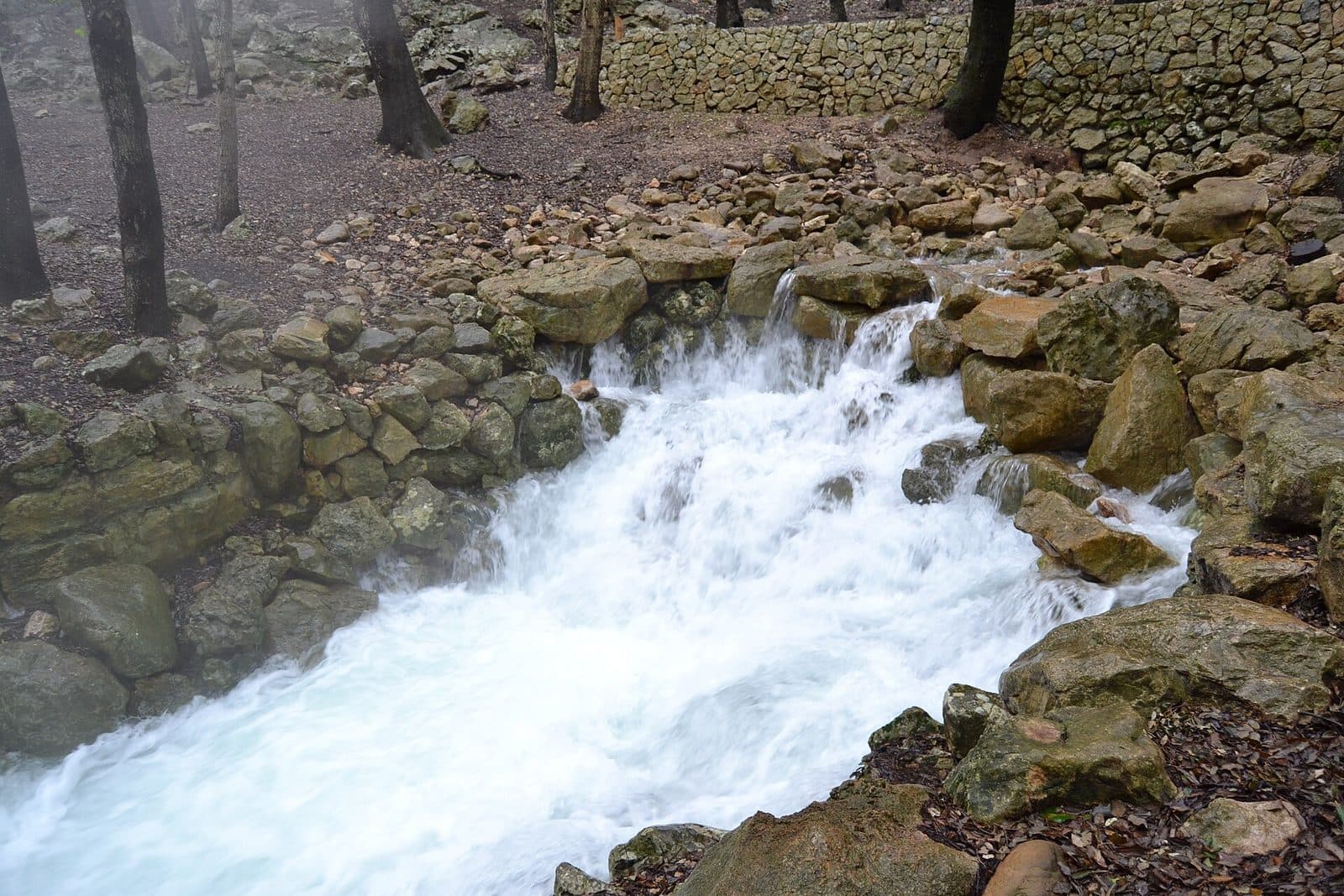

Deep in the holm oak forest, the ground begins to roar. Water pushes up between limestone rocks, roots, and tree trunks, gathers in channels, and transforms the previously quiet forest floor into a broad stream. Fonts Ufanes near Campanet is one of those Mallorca attractions whose great moment is determined entirely by the weather.
The spectacle begins only after enough rain has fallen in the Puig Tomir massif and its surroundings. Until then, almost nothing at the same spot hints at the forces beneath the ground. After intense, prolonged rainfall, however, the scene can sometimes change within minutes: an intermittent karst spring begins discharging diffusely and at several points at once.
This very unpredictability is part of its appeal. Fonts Ufanes is neither a staged waterfall nor a permanently flowing spring. Those who visit when it is dry experience a shady woodland walk on the public Gabellí Petit estate. Those who arrive at the right moment hear the water long before reaching the strongest outlets and see how a geological threshold can transform an entire landscape.
The excursion is suitable for nature lovers, families, and anyone who wants to discover northern Mallorca away from beaches and promenades. The walk itself does not require a long mountain hike. What matters more is a realistic assessment of the weather, shoes suitable for wet ground, and a willingness not to demand a fixed performance time from nature.
History and significance
Fonts Ufanes has been protected as a natural monument since 2001. The designated area covers 50.20 hectares and lies in the northeastern part of the Serra de Tramuntana, near the Ermita de Sant Miquel de Campanet. The protection applies not only to individual spring outlets but also to the land, the holm oak forest, and the underground system on which the visible spectacle depends.
An important step followed in 2005: with support from the European Union, the Government of the Balearic Islands acquired the Gabellí Petit estate. This secured public access to the springs while also ensuring their preservation as a protected natural area. Fonts Ufanes is therefore neither a private viewpoint nor an engineered water attraction today, but part of a public estate where access and nature conservation must be considered together.
A natural monument rather than a structure
Nothing was built at Fonts Ufanes to dam or display the water artificially. Its history is geological: rainwater seeps into the permeable limestone beneath the Puig Tomir massif and enters a karst aquifer. Less permeable rock layers contain this underground reservoir. During intense and prolonged rainfall, the water level rises until the aquifer exceeds its capacity. The water then finds its way to the surface along low-lying terrain and a fault zone.
This process explains why the springs can remain completely silent for long periods and then suddenly begin flowing. Under normal conditions, the discharge can rise within minutes from zero to 3 cubic metres per second; during exceptional events, it has reached up to 100 cubic metres per second. On average, the springs release 10 to 12 cubic hectometres of water annually. These figures make clear that this is not merely a case of a few puddles forming among the trees, but of a significant part of the regional water cycle becoming temporarily visible.
Water on its way to the lowlands
After emerging, the water does not immediately disappear again. It continues through the Torrent de Teló, joins water from other springs, and reaches the Torrent de Sant Miquel. From there, it travels towards the plain around Sa Pobla and the wetlands of northern Mallorca. The natural monument can therefore also be understood as the visible beginning of a longer connection between the Tramuntana, the cultivated landscape, and the wetlands.
On site, this broader hydrological story unfolds in an astonishingly immediate way. No exhibition or model is required: when the springs are active, the underground reservoir turns into a roaring outflow before visitors' eyes. When it is dry, the forest provides the explanation, revealing how completely the water can disappear from view between events.
What to see
The route first leads through the landscape of the Gabellí Petit estate. The spectacular section is not exposed beside a road but lies within a stand of holm oaks. In wet weather, the colours become more vivid, moss covers the rocks, and the ground bears clear traces of the rain. The closer you get to the active outlets, the more the roar of the water overwhelms the usual woodland sounds.
The holm oak forest
The forest is not merely a backdrop but the stage for the entire phenomenon. The springs do not emerge from a contained opening in a wall. Water pushes upward between rocks, roots, and the trunks of the holm oaks. During strong discharge, it flows across large areas of the ground, divides around obstacles, and reunites beyond them. As a result, the scene changes with every step: here water lies still in a hollow, there it rushes through a narrow channel, and a few metres farther on it flows broadly between the trees.
The diffuse nature of the outlets becomes particularly clear in the forest. Anyone looking only for a classic spring pool will miss the true character of Fonts Ufanes. The water has several paths. Its power is shown less by a single high cascade than by the way an entire section of the forest floor suddenly begins to flow.
Even without active springs, the contrast remains striking. The stones are then dry, the channels look inconspicuous, and the walk feels like a peaceful circuit through Mediterranean woodland. This state is not a disappointing substitute but the necessary other half of the natural phenomenon: only the dry phase makes it possible to understand how abrupt the change can be after sufficient rain.
Ufana Grossa
Ufana Grossa is one of the two most important outlet areas. Its name refers to the larger spring area, although here too no one should expect a neatly defined opening. When the aquifer overflows, water emerges along low-lying parts of the terrain, gathers quickly, and gains speed between the irregular limestone rocks.
The most impressive feature is not only the volume of water but the way it originates directly from the forest floor. There is no visible river approaching from higher ground. Instead, the current seems to begin between the stones. During strong activity, the roar can already be heard along the path; at the spring area itself, bubbling outlets blend with the sound of the water flowing away.
A low-level perspective is more revealing here than searching for an elevated panoramic viewpoint. Between the tree trunks, you can watch individual streams of water converge from the ground. Keeping your distance from the outlets also protects the sensitive terrain and prevents visitors from losing their footing on wet stones.
Ufana Petita
Ufana Petita forms the second main outlet within the holm oak forest. Together with Ufana Grossa, it marks the most important points where the filled karst aquifer discharges. During weaker flow, the visible water is more concentrated around these main points. As the discharge increases, however, this clear division into two areas is no longer sufficient to describe what happens.
Additional paths then open between the rocks. Water emerges beside the familiar areas, flows around tree trunks, and spreads across the forest. Ufana Grossa and Ufana Petita remain the named landmarks, but the real experience lies in observing the connection between them and the many smaller outlets.
Those who do not focus solely on the strongest current can recognise subtle signs of the event: hollows beginning to fill, initially narrow trickles, and places where the ground visibly releases water. Such details show that the spring is not a switch with only two states. It can swell, spread through the forest, and later recede again as the underground reservoir empties.
Torrent de Teló
After emerging, the discharge begins to organise itself. The water gathers in the Torrent de Teló and leaves the immediate spring area. This section reveals the transition from diffuse emergence to a recognisable watercourse. Between rocks and vegetation, the current gains direction before later joining other bodies of water.
The Torrent is therefore essential to understanding Fonts Ufanes. The springs are not an isolated basin in which water merely rises and remains. The water coming from the karst continues its journey and reaches the lower-lying landscape through the Torrent de Sant Miquel. Following its course with your eyes is like seeing the first stage of its journey from the mountains to the plain.
Visiting Fonts Ufanes
The walk begins without much drama and becomes more impressive only when the springs are actually active. From the estate entrance, the route crosses open areas before continuing into the holm oak forest. Allow around 40 minutes for the usual loop trail. Those who want to observe the water at leisure, take photographs, or wait at different outlets should plan additional time accordingly.
Choosing the right day
A brief shower over Campanet is not enough. What matters is intense and prolonged rainfall around Puig Tomir and its surroundings, because that is where the underground karst aquifer fills. The visible event can then last for several days, but it may also weaken again after only a few hours. There is therefore no guarantee, even after rain.
After major rainfall events, it is advisable to check current notices from the natural-area authorities and local news. The important question is not only whether the springs have begun flowing but also whether access or traffic arrangements are being managed because of wet conditions and high visitor numbers. Opening hours and admission conditions may change and should be checked before travelling.
When the water is flowing
As soon as news spreads that Fonts Ufanes is flowing, the event attracts many people from the surrounding area. It can become especially busy on weekends after heavy rain; in such situations, special measures have previously been introduced for access, parking, and traffic. Those wishing to avoid the largest crowds should, if possible, avoid a heavily publicised weekend date and arrive early within the access hours currently in effect.
A slow pace is worthwhile in the forest because the first strong current is not necessarily the only interesting point. Small outlets between rocks, the transition from Ufana Grossa and Ufana Petita into broader currents, and the beginning of the Torrent de Teló together reveal how the aquifer discharges. The strongest spot is also not automatically the safest place for photographs.
When the springs remain dry
A dry visit is quieter and easier to plan. The route through Gabellí Petit remains accessible when current conditions allow, and the holm oak forest reveals the geological stage without water. However, no one should expect a permanent waterfall, a spring pool, or an artificial display. Without a sufficiently full aquifer, there is no bubbling water.
This expectation is particularly important for visitors primarily hoping to see the natural event. Fonts Ufanes cannot be reserved or activated at the touch of a button. When dry, the excursion is worthwhile as a woodland walk, but the famous spectacle remains dependent on preceding heavy rainfall.
Getting there and parking
From Palma, the fastest main route follows the Ma-13 to Campanet. From central Palma, the road distance is 39 kilometres, and the drive to Campanet takes around 38 minutes. From Palma Airport, the road distance to Campanet is 42 kilometres, the journey takes around 34 minutes, and the route follows the Ma-30 and then the Ma-13.
These details expressly end in Campanet, not at the spring area. For the final section, leave the motorway and enter the rural road network near the Ermita de Sant Miquel and the Gabellí Petit estate. Exit 37 of the Ma-13 serves as a landmark; from there, signs point towards the Cuevas de Campanet. The estate entrance is near the Ermita de Sant Miquel, from where the route continues on foot.
Parking after heavy rain
Normal conditions and a day when the springs are surging are barely comparable in traffic terms. Once the event becomes known, many visitors arrive within a short period. Parking around the Ermita and the access road can then fill quickly. During particularly large crowds, the authorities sometimes regulate access, parking, and visitor movement. Current instructions on site take priority over the usual route.
Parking informally along the roadside is not a good alternative on the narrow access roads. It obstructs traffic, can block emergency and service routes, and places pressure on adjacent land. Anyone arriving on a busy weekend should therefore expect delays and, if necessary, accept that access may be temporarily controlled.
The final section on foot
From the area around the Ermita, the visit continues as a walk across the estate. After rain, this section is not merely damp but may also feature puddles and softened ground. Cars therefore do not take visitors directly to Ufana Grossa or Ufana Petita. This transition from cultivated land into the holm oak forest is itself part of the experience of the place.
No bus stop has been recorded in the immediate vicinity of Fonts Ufanes. Anyone travelling without a car should therefore plan the connection to Campanet and the onward journey to the entrance separately in advance; the route from the village to the natural monument should not be confused with the short loop on the estate.
Nearby places
Campanet lies at the transition between Mallorca's flatter north and the foothills of the Serra de Tramuntana. The village is a sensible base for treating a visit to Fonts Ufanes as more than an isolated photo stop. Before or after the woodland walk, a break in the village centre is a good option, especially when changeable weather requires some flexibility in the day's schedule.
Campanet
The village sits above the surrounding agricultural landscape and provides a clear contrast to the damp holm oak forest of Gabellí Petit. Visitors arriving from Palma or the northern coastal resorts can begin or end their excursion here. This is particularly practical when it remains unclear how strongly the springs are flowing or whether access is being managed because of large crowds.
Campanet should not be seen merely as a signpost on the Ma-13. Its position on the edge of the Tramuntana explains why the village is so closely connected to water from the Puig Tomir area. Fonts Ufanes is not located here by chance: the geology, gradient, and adjoining Torrents carry water from the mountains towards the Sa Pobla plain.
Ermita de Sant Miquel
The Ermita de Sant Miquel is the most important landmark in the immediate vicinity of the estate. It lies near the entrance and therefore forms a geographical link between Campanet's cultivated landscape and the protected natural area. A separate, extended sightseeing visit is not necessary to make use of its role in the directions; its position alone helps identify the beginning of the walking route.
On busy days, however, much of the traffic is also concentrated in this area. Anyone wishing to combine the Ermita with a visit to the springs should not treat the access roads and surrounding land as an unrestricted large car park. The setting remains rural, and its capacity does not increase simply because a natural event suddenly attracts many people.
Cuevas de Campanet
The Cuevas de Campanet can be included in the same day trip as an option that is less dependent on the weather. Signs to the caves also provide useful guidance along the final road section to Gabellí Petit. In terms of their subject, they reveal two sides of the same limestone region: underground formations in the caves and a karst aquifer becoming visible at the surface at Fonts Ufanes.
For planning the day, this combination is particularly useful if the springs remain dry or a rain shower shortens the stay in the forest. The two destinations should nevertheless be treated as separate visits. Fonts Ufanes is not part of a cave tour, and access to the natural monument is subject to its own conditions.
The place it belongs to
Campanet in the place guidePractical information for your visit
Water is not only the main attraction here but also the most important practical challenge. After the rainfall that triggers the natural spectacle, expect puddles, mud, wet stones, and softened sections of trail. Sturdy shoes with good grip are therefore more suitable than smooth casual footwear. On particularly wet ground, waterproof shoes can make the walk considerably more comfortable.
Visiting with children
The loop trail is considered easy and is frequently used by families. Its manageable length also makes it interesting for children, especially because the water can be observed directly between trees and rocks. When the springs are active, however, greater attention is required: currents can be powerful, stones become slippery, and harmless dry channels turn into watercourses.
Children should not run ahead or climb onto wet rocks near the outlets and Torrents. A good observation point is on firm trail ground at a safe distance from the current. This keeps the experience vivid without requiring anyone to enter the sensitive and slippery spring area for a photograph.
Respecting the natural monument
Protected status applies to the entire site, not only to the places where water is visible. Visitors should therefore remain on the designated paths, take all litter away, and leave rocks, plants, and deadwood where they are. Entering the outlet areas can damage the ground and is also risky during strong discharge.
Noise should also be avoided. The roar of the springs carries far through the forest and is an essential part of the experience. Those who wait a few steps away from a larger group of visitors are more likely to notice how many individual sounds of water combine between Ufana Grossa, Ufana Petita, and the smaller outlets.
What not to expect
There is no staged fountain, fixed performance schedule, or waterfall that is visible at all times. The springs can be dry even if it has rained elsewhere on Mallorca. The determining factors are prolonged rainfall in the Puig Tomir catchment area and the fill level of the karst aquifer.
Nor is the visit a demanding mountain hike. The usual loop is short, but after rain the ground conditions can be more challenging than the length of the route suggests. Those who arrive with the right expectations will discover precisely what defines Fonts Ufanes: for a short time, an easily accessible forest reveals the forces at work beneath the surface of the limestone mountains.
Local insider tips
Check more than Campanet
A brief local shower is not enough. What matters is intense, prolonged rainfall in the Puig Tomir catchment area. After major rain events, it is therefore worth checking current local reports to confirm whether the springs are actually flowing.
Follow the roar
When the springs are active, sound often reveals the strongest area before you see it. It is worth pausing briefly in the holm oak forest to distinguish the different outlets and notice the transition into the draining Torrent.
Choose rainproof footwear
The best days for the natural spectacle are precisely those that bring puddles, mud, and slippery limestone rocks. Shoes with good grip, preferably waterproof, are more practical than lightweight street shoes.
Avoid the weekend
As soon as Fonts Ufanes begins surging after heavy rain, large visitor numbers are expected, especially on weekends. Those with flexible schedules should choose a less heavily publicised date and check the current access situation beforehand.
Watch for small outlets
Ufana Grossa and Ufana Petita are not the only interesting features. During strong discharge, water also emerges between rocks and the trunks of holm oaks. These smaller outlets are particularly useful for understanding the diffuse nature of the phenomenon.