
Coves de Campanet: Mallorca’s Quiet Stalactite Caves

On the southern slope of Sant Miquel, a side of Mallorca opens up that has little in common with beaches and bathing coves. The Coves de Campanet descend into a world of limestone, slender stalactites, massive columns and quiet pools that has developed over millions of years. The cave system lies in the island’s rural north, on the edge of the Serra de Tramuntana.
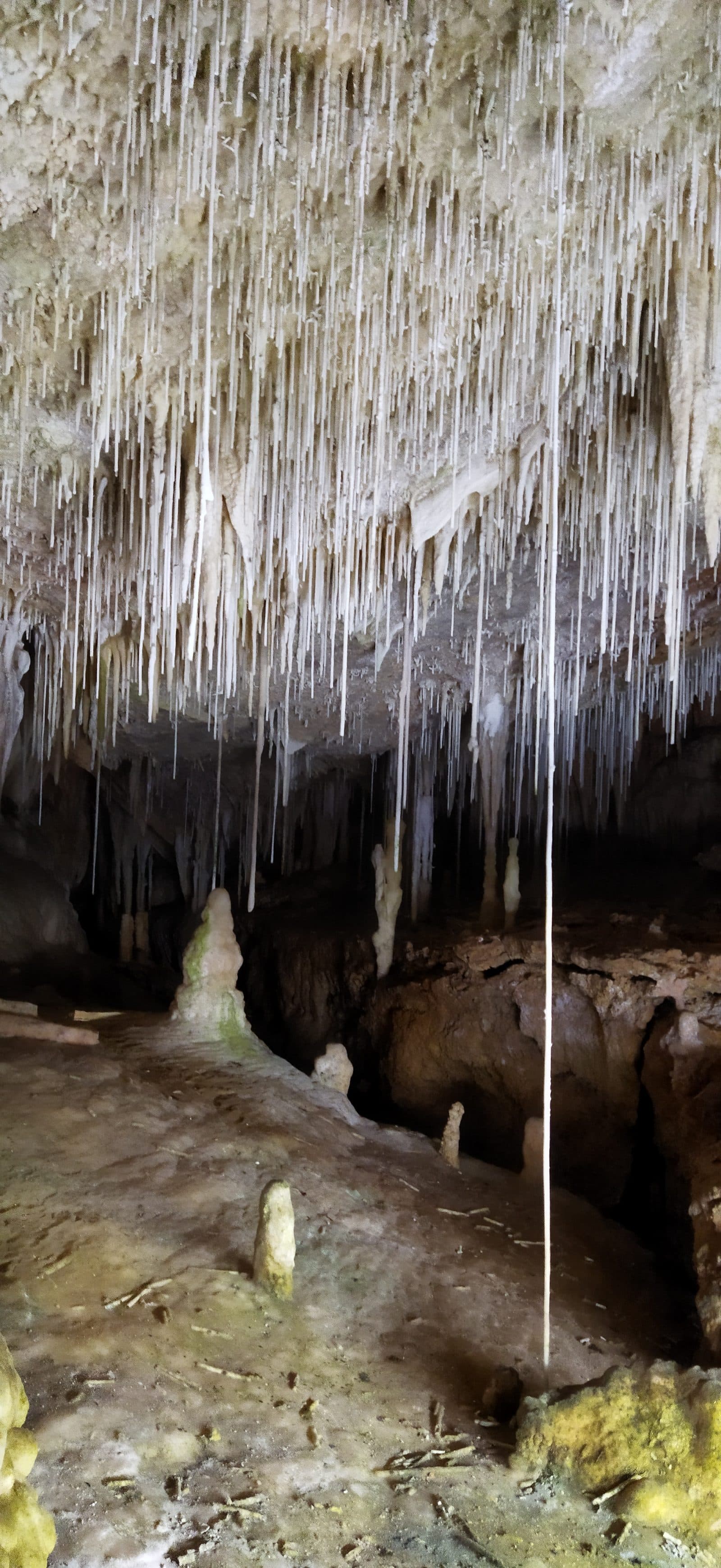
The visit owes its distinctive character not only to the abundance of formations. Unlike some large show caves, there is no staged spectacle at the centre of the experience. The route through the underground chambers gives the shapes, subdued light and natural silence room to speak for themselves. Those who look closely will discover delicate calcite tubes beside heavy formations resembling folded curtains or frozen cascades.
With an optional audio guide, the cave is suitable for nature enthusiasts as well as families and anyone seeking a manageable activity on a hot or unsettled day. Only part of the day is needed for the cave tour itself, although the terrace and rural surroundings make it easy to stay longer.
The story of its discovery is also remarkable. The entrance was not found during a scientific expedition, but while searching for water. What at first seemed to be merely a cool draught emerging from a hole barely the width of a hand proved to be the entrance to an underground cavity of considerable size.
History and significance
The draught at So na Pacs
Local residents had long known of a small opening in the ground from which noticeably fresh air flowed. Its diameter was only about 15 centimetres; today it lies above the present cave entrance. At first, the draught was less an indication of a tourist attraction than a possible sign of water beneath the So na Pacs estate.
The owner, Guillem Torres i Cladera, had the site searched for an underground water source to improve the supply to the farmland. In June 1945, Bartomeu Palou i Bennàsser, known as “Xineta”, interpreted the sound and coolness at the opening as signs of a watercourse. When the hole was enlarged, however, it did not lead to the hoped-for reservoir but into the previously unexplored cave. Xineta also made the first ladder used to enter it.
This unassuming beginning is one of the most appealing chapters in the story of the Coves de Campanet: it was not the search for a natural monument, but a practical question of rural life that brought the underground chambers to light. Within just a few years, the site was transformed from a narrow opening in the ground into a cave accessible to visitors.
Development as a show cave
Antoni Salvà i Torres and Joan Siquier Alemany received permission to operate the caves as a tourist attraction. Architect Josep Ferragut was commissioned to design the site. He planned the buildings, terraces, stairs and gardens above ground, as well as the interior route and entrance corridor. The visible visitor complex is therefore not simply an incidental antechamber to the cave, but part of an overall design connecting the hillside, the views and the descent.
The Coves de Campanet opened to the public on 10 November 1948. Historical photographs from the operator show cave guides from the 60s, the car park in the 70s and scenes from the opening day featuring a folk-dance group from Campanet. Other images tell of early prominent guests: members of the VI. US Fleet left the cave in 1952, and Mexican actress María Félix was photographed having lunch on the large terrace. A caricature by Xavier Cugat from 1957 commemorates the singer and actress Abbe Lane.
A site for research and natural history
The development of the tourist attraction also produced discoveries of scientific significance. Fossil remains of Myotragus balearicus came to light during the work. According to the cave operator, this mammal, found only on Mallorca and Menorca, became extinct around 4.000 years ago. The discovery attracted the attention of palaeontologists and naturalists to the cave.
The fauna living inside today is also remarkable. The operator refers to several endemic species, including members of the genus Chtonius. These animals are adapted to the enclosed, humid and dark habitat. The Coves de Campanet are therefore more than a beautiful collection of cave formations: they preserve geological processes, fossils and specialised cave-dwelling creatures in the same place.
What to see
The cave system beneath Sant Miquel
Beneath the southern slope of Sant Miquel lies a cave system covering approximately 3.200 square metres. On average, it runs about 50 metres below the surface. Altogether, the cave forms a cavity of around 16.000 cubic metres. These figures, however, describe only its scale. While walking through it, the alternation between connecting passages and more spacious chambers feels far more immediate than any measurement.
The route does not follow a single long tunnel. Galleries connect several chambers, reveal new groups of limestone formations and then narrow once again. Some chambers contain small pools of water. These make it especially clear that water was not only involved in creating the cave but continues to shape its character.
Stalactites, stalagmites and columns
The eye moves almost inevitably between ceiling and floor. Stalactites hang from above, while stalagmites grow upwards beneath them. Where the two have met over long periods, columns have formed. The operator emphasises the delicacy and abundance of these limestone deposits, which geologists group under the collective term speleothems.
Their variety of forms is striking. Alongside robust, conical shapes are long and exceptionally delicate calcite tubes, often called “macaroni” because of their appearance. Other deposits are cubic, sheet-like or have grown together into large pillars. In the subdued light, layers and edges stand out without turning the cave into the backdrop for a light show. The eye sometimes needs a moment to distinguish individual shapes within the dense limestone relief.
The story of their formation can be read in these shapes. Mineral-rich water penetrates the limestone, leaves behind tiny deposits with every drop and builds them into new structures over immense periods. The cave thus leads back into a geological history that began more than 10 million years ago. Its most delicate formations make this almost unimaginable timespan particularly tangible: repeated drops became solid tubes, points and columns.
Sala Romàntica
Sala Romàntica, the Romantic Chamber, is one of the specifically named stops along the route.
Such names should be understood as historical and illustrative points of reference. They translate nature’s accidental shapes into familiar images without prescribing a single interpretation. This is precisely where it is worth viewing the tour as more than just a route from one stop to the next. Those who let their gaze linger over the ceiling and floor will continue to discover new slender points and calcite curtains between the dominant formations.
Sala del Llac
Sala del Llac, the Lake Chamber, is one of the specifically named stops along the route. Some areas of the Coves de Campanet contain small pools of water.
The chamber also recalls how closely the cave’s discovery was connected to the search for water. In 1945, the cool draught suggested the presence of an underground watercourse. What was found was an extensive cave system in which water is present, but whose true wealth lies in the deposits it created over millions of years.
Castell Encantat
The “Enchanted Castle” has one of the route’s most evocative names. Here, rising and hanging limestone shapes invite architectural comparisons: towers, battlements and pillars can be imagined, although no human hand played any part in forming them. The attraction lies precisely in this contrast between seemingly constructed shapes and entirely natural origins.
The contours change from different viewpoints. What appears from one side to be a compact wall breaks apart a few steps later into individual points and tiered deposits. Rather than quickly searching for the “castle” that gives the site its name, it is therefore worth changing perspective slowly along the marked route.
Sala de la Palmera
In Sala de la Palmera, a recognisable natural shape once again inspired the name. Through branching forms, ribs and fan-shaped deposits, cave formations can resemble plants even though they develop according to entirely different processes. Such similarities helped early visitors distinguish individual areas within an underground world that was otherwise difficult to describe.
Sala de la Palmera demonstrates how differently limestone can appear to visitors: from a distance, a familiar silhouette emerges; up close, it breaks apart into countless grooves, points and overlapping mineral layers. The named figure is therefore more a starting point than a final explanation.
Cascada Sonora
Cascada Sonora, the “Sounding Cascade”, is also one of the specifically named stops along the route.
This stop encapsulates a central impression of the Coves de Campanet: water shaped the stone. Their atmosphere is defined by restraint.
Visiting the caves
From the hillside into the cave
The arrival begins above ground. From the car park, the access path leads to the elevated entrance area with its garden, terraces and stairs. This complex is based on Josep Ferragut’s design. Before the descent, views open across the rural surroundings of the Sant Miquel Valley; within just a few steps, the world then becomes narrower, darker and cooler.
An audio guide can explain the stops and geological features. Consideration for others nevertheless remains important: in narrower passages, visitors should allow others to pass.
Time required and planning your day
The operator gives an approximate duration of 40 minutes for the cave tour. Those who stop frequently, use the entire audio guide or examine the delicate formations more closely may wish to allow correspondingly more time. The walk between the car park and entrance, along with a possible stay on the terrace, should also be included. The cave can therefore easily fit into half a day’s outing without the visit feeling rushed.
The caves are open daily from 10:00 to 17:30; admission costs 16 euros. Anyone wishing to experience the tour in a quiet atmosphere should allow some flexibility. Slower groups may meet in the narrower galleries.
There is no reliable, year-round “quietest time” that can be inferred from the type of visit. The season, weather and excursion traffic all affect visitor numbers. The underground attraction is an obvious alternative to the beach or hiking, particularly on hot days and during unsettled weather. Flexible visitors can assess the situation at the entrance and use the terrace before descending.
Without elaborate staging
There is no large-scale sound and light production in the Coves de Campanet. The formations and chambers take centre stage. This makes the tour particularly interesting for people who want to experience a cave as a natural environment.
This restraint does not mean there is little to discover. On the contrary, the route thrives on subtle differences. Slender tubes, massive columns, water surfaces and seemingly familiar figures follow one another. Anyone who simply moves briskly along the main path can easily overlook the delicate deposits for which the Coves de Campanet are especially well known.
Getting there and parking
From Palma and the airport
The road distance from central Palma to Campanet is 39 kilometres. The drive takes around 38 minutes and follows the Ma-13 north. From Palma Airport, the road distance to Campanet is 42 kilometres; via Ma-30 and Ma-13, the journey takes around 34 minutes. Both figures explicitly apply only as far as Campanet, not directly to the cave entrance.
The Coves de Campanet lie outside the town centre on the slope of Sant Miquel. For the final section, follow local signs towards the cave or Camí de Ses Coves. After the fast approach along the Ma-13, the character of the route changes: instead of a major through road, the way leads into the rural countryside at the foot of the Serra de Tramuntana.
Car park and access
A free car park is located directly beside the visitor complex. From there, the access route leads uphill to the terraces and entrance area. This matters more for planning than a glance at a road map might suggest: arriving at the car park and beginning the cave tour are not the same moment.
The stairs, terraces and gardens designed by Josep Ferragut are arranged around the entrance. The change in elevation is therefore part of the historic visitor complex. Anyone dropping off fellow travellers or waiting for slower members of their group should use the regular arrival area and keep access roads clear.
By bus
Campanet is listed as the town’s bus stop with the identifier 12002. It is not located at the cave entrance. Anyone arriving by public transport must therefore also organise the final section from the town to the outlying attraction and should plan this connection carefully in advance. Simply arriving in Campanet does not replace the onward journey or walk to the Coves de Campanet.
Allowing sufficient time for the return journey is particularly advisable because the visit does not end directly at the bus stop. The straightforward sequence for drivers—from Ma-13 to the local access road and car park—cannot be transferred unchanged to a bus journey.
Bus lines to Coves de Campanet at a glance
| Line | Route | Departures/day | First | Last |
|---|---|---|---|---|
| 314 | Campanet / Búger | 30 | 06:20 | 22:02 |
From the official GTFS feeds (TIB/SFM), no real-time data. The figures cover all stops in the town; weekend and holiday services differ — check with the operator before travelling.
Getting there by bus
Campanet (12002) · 1.9 km as the crow flies
- 314Campanet / Búger · Daily
Timetable data: official GTFS feeds (TIB/EMT), no real-time — check with the operator before travelling.
Nearby attractions
Campanet
Campanet is more than just the name on the sign pointing towards the cave. The town lies between mountains and valleys and has an old centre with narrow streets and traditional house façades. The Baroque Church of the Immaculate Conception stands on Plaça Major. A short walk through the town provides a deliberate contrast to the underground landscape: after the subdued cave chambers, daylight, façades and views towards the Serra once again define the scene.
Campanet can easily be included before or after the Coves without turning the day into an overloaded sightseeing itinerary. The cave tour lasts approximately 40 minutes, leaving enough time for a walk and a break in the town. Those arriving by bus will pass through Campanet as their arrival point anyway, but must account for the additional journey to the cave.
Sant Miquel Valley
The cave lies in a rural setting on the southern slope of Sant Miquel. The terrace in front of the entrance already offers views across the valley. The landscape is more than a backdrop because it explains the cave’s location at the transition between the northern island interior and the foothills of the Serra de Tramuntana.
The Church of Sant Miquel and the natural phenomenon of Fonts Ufanes are also located in this area. Both can be combined with a cave visit but should be planned as separate destinations. Fonts Ufanes in particular is not an excursion fountain that reliably flows at all times: its famous surging water appears after heavy rainfall. Regardless of this, the surrounding holm oak woodland provides a scenic contrast to the cave.
An excursion combining geology and cultural landscapes
The most natural combination does not follow a long compulsory itinerary, but a thematic connection. Beneath Sant Miquel, the Coves show how water transforms limestone underground. In the surrounding area, springs, vegetation and traditional agriculture shape the visible landscape. The historic centre of Campanet adds the human use of the area.
The cave visit can therefore be extended meaningfully without travelling far beyond northern Mallorca. Those with little time can remain at the cave and terrace. With more flexibility, Campanet and the area around Sant Miquel and Fonts Ufanes are worthwhile options. More distant destinations in the Tramuntana should be given their own dedicated time slot.
The place it belongs to
Campanet in the place guidePractical visitor information
Paths and surroundings
The tour follows a prepared cave path through galleries and chambers. Stairs, changes in elevation and occasionally damp conditions are part of a natural cave. The same applies to the route from the car park up to the entrance area.
Underground, the temperature and humidity differ noticeably from a sunny summer day outside the entrance. At the same time, the visit begins and ends outdoors on the terraces.
Visiting with children
The Coves de Campanet are considered suitable for families. The approximate tour duration of 40 minutes is manageable, and names such as Sala de la Palmera or Castell Encantat give children simple images to search for among the formations.
Small children need close supervision on stairs and in damp areas. Even though the path has been developed for visitors, the setting remains a cave rather than a level indoor play area. Families moving at different speeds should also avoid blocking narrower sections.
Photography and looking closely
The subdued lighting preserves the cave’s atmosphere but presents cameras and mobile phones with different conditions from daylight. Instead of viewing the entire tour through a screen, it is worth standing still at selected points and allowing the eyes to adjust to the lighting. Slender tubes, layered deposits and small points then emerge that initially seem inconspicuous beside the large columns.
The transitions between the named chambers deserve particular attention. Not every interesting formation stands at a major stop. The connecting galleries in particular show how densely limestone covers some surfaces and how abruptly the character of a space can change.
What not to expect
The Coves de Campanet are not an artificially created adventure world or a venue for a loud sound and light production. Their appeal lies in the abundance of natural shapes and the restrained presentation. Anyone expecting a stage show is using the wrong measure; anyone wishing to appreciate structures, geology and quiet spaces will find plenty to observe.
Nor is the visit a sporting cave expedition. The accessible route has been developed for tourists and does not pass through unsecured shafts or narrow crawling passages. Nevertheless, stairs, damp areas and natural ground remain part of the experience. Consideration for others and a calm pace are the best preparation.
Local insider tips
Look for the original opening
Above today’s entrance lies the site of the opening, only about 15 centimetres wide, whose cool draught led to the discovery in 1945. This small detail makes the unusual story of the cave’s discovery tangible on site.
Look closely between the chambers
The named chambers are not the only places worth examining. Particularly delicate calcite tubes and small deposits appear in the connecting galleries and are easy to overlook beside the large columns.
Allow time for the terrace
The terraces designed by Josep Ferragut are part of the historic complex. Before or after the descent, they offer views across the rural landscape of the Sant Miquel Valley.
Plan Fonts Ufanes carefully
Nearby Fonts Ufanes makes a fitting addition, but its famous surging water appears after heavy rain. The cave visit can therefore be planned reliably, while the spring phenomenon depends on the weather.