
Fundació Pilar i Joan Miró: Joan Miró’s Mallorca Studios
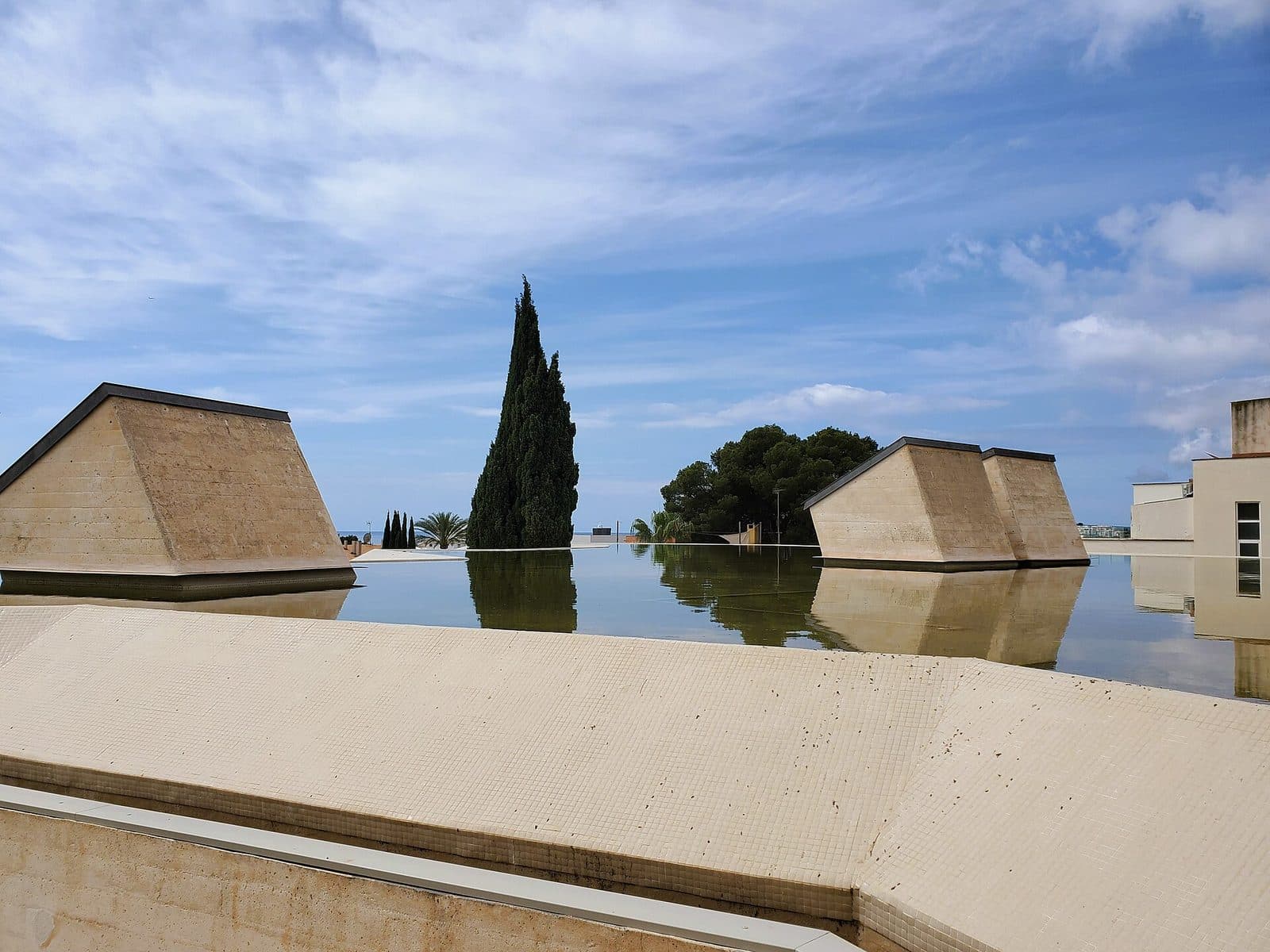

The Fundació Pilar i Joan Miró preserves something that even major art museums can rarely show: not only an artist’s works, but also the place where they were created. Joan Miró worked in the studios near Sant Agustí for almost three decades. Visitors therefore encounter paintings, sculptures, and graphic works in direct proximity to the spaces that Miró sought out and arranged for his art.
Its appeal lies in the shifting perspectives. The studio designed by Josep Lluís Sert tells of focused work, while Son Boter reflects Miró’s experiments with walls, printmaking, and found spaces. Rafael Moneo’s museum building deliberately presents an independent architectural counterpoint to the historic ensemble. A garden with sculptures connects art, buildings, and Mediterranean vegetation.
Anyone expecting only a chronological series of famous paintings would miss the essential point. The foundation presents Miró as a painter, sculptor, ceramicist, and printmaker, but above all as a working artist. His connection to Mallorca is not merely stated through biography here; it can be experienced through the spaces themselves. This makes the visit as rewarding for art lovers as it is for architecture enthusiasts and travelers who want to discover another side of Palma beyond the old town.
The site demands attention. Small traces, transitions between the buildings, and the differences between the studio, old country house, and museum architecture tell at least as much as any individual work on display. That is precisely why it is worth avoiding plans that treat the visit as a quick photo stop.
History and significance
Mallorca as a place to work
Mallorca was not an accidental late destination for Joan Miró. His mother came from Palma, his wife Pilar Juncosa was from the island, and Miró had long maintained a close personal relationship with Mallorca. After living and working in Barcelona and Paris, he settled permanently on the island in 1956. Here he was able to realize a wish he had cherished for years: a large, independent studio with enough space for his increasingly diverse work.
The new surroundings did not mean a retreat into a quiet retirement. Miró continued to work intensively in Mallorca, moving between painting, sculpture, ceramics, wall art, lithography, and other graphic techniques. The studios became a productive center for his late work. Visitors to the foundation therefore enter not merely a memorial site, but the setting of important working years.
Joan Miró and Josep Lluís Sert
The Taller Sert emerged from a long friendship. Miró and the architect Josep Lluís Sert had known each other since the early 1930s and shared an interest in Mediterranean folk culture and supposedly primal art forms. In 1937, both worked together on the Spanish Pavilion at the Paris International Exposition. Alongside Picasso’s “Guernica,” it featured Miró’s monumental mural “El Segador”; the pavilion became an artistic statement against fascism.
Years later, Sert designed the long-awaited workspace for his friend in Mallorca. The studio was therefore more than a functional new building. Its architecture and the artistic practice it housed grew from a long-standing exchange. Three years after moving to Mallorca, Miró expanded his working area by acquiring Son Boter, a neighboring Mallorcan house dating from the 18th century.
The foundation’s establishment
Joan Miró and Pilar Juncosa established the foundation in 1981. Their wish was to leave the studios to the city of Palma while creating a place that would extend beyond the preservation of an artist’s estate. New generations of artists were to be able to work and learn here, and research into Miró’s work was also among its aims.
This vision explains why the Fundació Pilar i Joan Miró does not feel like a closed monument. Educational programs and courses in graphic techniques continue the hands-on work of the studios, while contemporary exhibitions broaden the perspective beyond Miró. The holdings include 2.500 works by the artist as well as hundreds of objects he had collected. The foundation therefore preserves art, working spaces, documents, and personal points of reference at the same time.
The museum and foundation headquarters designed by Rafael Moneo were added in 1992. Only with this building did the ensemble gain the exhibition, administrative, and event spaces it needed. The former workshops did not become a frozen artist’s house, but rather a museum and research center where Miró’s legacy can continue to be examined.
What to see
Taller Sert
The Taller Sert offers the most immediate access to Miró’s working world. Josep Lluís Sert designed it specifically for the artist, who had long dreamed of a spacious studio of his own. The building combines modern architecture with the Mediterranean landscape. It stands on the hill of Miró’s former Son Abrines estate and served as both a retreat and a productive workshop for the artist.
Its significance is revealed less through a single façade than through the relationship between space, light, and work. Some of Miró’s important late works were created here. A visit to the studio therefore redirects attention away from the usual museum setting: paintings appear not only as finished, neatly isolated objects, but as the results of a long process. The space itself becomes an exhibit.
The building also has considerable biographical depth. Sert was not simply a commissioned architect, but a friend and former artistic collaborator. Two positions within modernism meet in the studio: Miró’s open, often abrupt visual language and Sert’s attempt to create a clearly structured workspace for this art. Visitors who take time to study the architecture will recognize that the building is neither a neutral shell nor a decorative backdrop.
Son Boter
Son Boter provides a clear counterpoint to the purpose-built Taller Sert. The Mallorcan house dates from the 18th century and was acquired by Miró three years after his permanent move to the island. He set up areas for engraving and lithography in its old rooms.
Miró’s interventions in the building are especially revealing. Graffiti and wall paintings show that he did not treat the architecture as untouched historic fabric. Walls could become sketching surfaces, testing grounds, or picture supports in their own right. Son Boter thus reveals how little Miró distinguished between artwork, tool, space, and spontaneous idea.
Son Boter is currently temporarily closed to the public for conservation and renovation work. As the progress of the work may change, visitors should check before their visit which areas are actually accessible. Even while closed, the house remains an essential part of the ensemble; its absence nevertheless changes the experience, because Miró’s site-specific wall works and the graphic workshops reveal their full context there in particular.
Edifici Moneo
Rafael Moneo’s new building was constructed between 1987 and 1992. The architect had to respond to surroundings that had become significantly denser since Miró’s arrival. Where there had once been a more open view across the bay, urban development had moved closer. Moneo did not try to conceal this transformation. Instead, he designed a kind of architectural shelter for the art and the foundation.
The building consists of an elongated concrete structure and a star-shaped exhibition hall whose outline recalls the bastion of a fortress. This image was intentional: the museum was meant to assert itself against surroundings perceived as unsettled. A raised entrance and water on the roof of the lower gallery also evoke the lost relationship with the bay without imitating a historic view.
Inside, the light is deliberately softened and filtered. Sun-shading elements articulate the façade, while alabaster panels in the exhibition areas create subdued, transformed daylight. The star-shaped geometry does not produce a uniform sequence of neutral galleries. Changes of direction, surfaces set at angles to one another, and spatial sections perceived in different ways suit a body of work often defined by ruptures, surprising signs, and open pictorial fields.
Another wing of the building contains offices, meeting areas, and the museum shop, among other facilities. This allows the institutional side of the foundation to be distinguished architecturally from the focused exhibition hall without separating it completely. The Moneo building is therefore not merely a newer addition to the studios, but the element that transforms Miró’s private workplace into a public art center.
Collection and sculpture garden
The collection includes works from every period of Miró’s career. Paintings do not stand alone: sculpture, ceramics, graphic art, and other techniques show how frequently the artist changed materials and forms of expression. The scope of the holdings allows the foundation to set changing thematic priorities. Temporary presentations may alter the route through the museum.
Hundreds of objects collected by Miró broaden the perspective. They point to the forms, materials, and everyday things that occupied his visual imagination. Such objects are not merely biographical decoration. In the context of the studios, they help explain how observations, found objects, and experiments could develop into a visual language that initially appears completely free.
Outside, the route continues through the sculpture garden. Miró’s three-dimensional works can be viewed differently among the vegetation and buildings than in an enclosed gallery. At the same time, the site’s three architectural layers become legible: historic Son Boter, Sert’s studio modernism, and Moneo’s self-confident museum building. The garden is thus both a transitional space and an exhibition area.
Visiting the museum
A tour through three working worlds
A well-planned route reveals not only the collection, but also the differences between the buildings. In the Moneo building, art is encountered in curated exhibitions and deliberately staged spaces. The Taller Sert brings visitors closer to the creative process. Son Boter expands this picture through the graphic workshops and Miró’s direct interventions in an old Mallorcan house, provided it is accessible again after the current renovation has been completed.
The order matters less than the shift in perspective. Visitors who see the exhibitions first will later recognize materials, techniques, and spatial conditions more readily in the studio. Those who begin with the Taller Sert will subsequently view the finished works more strongly as the results of concrete labor. The garden provides a pause between them and makes it possible to perceive the buildings as a cohesive ensemble.
How much time to allow and visiting pace
It is difficult to recommend a fixed visit duration. Those primarily interested in seeing a few major works will move through the exhibition spaces more quickly than visitors who devote equal attention to the studio architecture, collection, and garden. When Son Boter is accessible, it adds another distinct area. Temporary exhibitions and events also change the scope of a visit.
The key to planning is not to treat the foundation like a single gallery. Several buildings, outdoor areas, and the different layers connecting art, biography, and architecture require time. In the Taller Sert especially, it is worth looking beyond famous motifs and reading the space as a whole. A visit without an appointment immediately afterward suits the site better than a tightly scheduled stopover.
Current conditions
Opening hours and admission may change and should therefore be checked before visiting. This is particularly important during ongoing exhibitions, events, and conservation work. Son Boter is temporarily closed for renovation; its current status should also be checked before traveling to the museum.
Getting there and parking
From Palma and the airport
From the center of Palma, the route to Sant Agustí follows the Ma-1. The road distance is 6 kilometers, and the journey takes around 16 minutes. These figures apply as far as Sant Agustí, not to a guaranteed parking space directly at the museum. For the final section, the route follows the urban road network toward Carrer de Saridakis; heavy traffic at the western exit from the city may delay arrival.
From Palma Airport, the journey via the Ma-20 to Sant Agustí covers 20 kilometers by road. It takes around 21 minutes. Here too, the distance and travel time refer to the district. The route then climbs through the local road network to the museum. Because the foundation is not located in Palma’s historic center, it can be reached by car without driving through the narrow streets of the old town.
Parking at the museum
Directly opposite the museum entrance is a parking lot reserved exclusively for visitors to the foundation. It has around 60 spaces, including two designated accessible parking spaces. Parking is free. Some spaces are beneath trees and may offer shade, although a free or shaded space is not guaranteed.
Important for planning your day: the parking lot closes outside the museum’s opening hours. It is therefore unsuitable as a starting point for a long stay in the surrounding area afterward. Anyone planning to continue to Cala Major, Portopí, or Palma after visiting the museum should bear the closure in mind and move the vehicle in good time.
By bus
Several urban and regional bus services cover the Cala Major, Marivent, and Sant Agustí area. Depending on the route, the stop is either directly on Carrer de Saridakis or farther down along the main road through Cala Major. From there, the final section climbs uphill to the foundation; services via Marivent or the public parking lot in Cala Major require a walk of about ten minutes.
Construction work may alter bus routes. Since March 2026, some EMT services have been diverted via Portopí because of work on the Carrer de Saridakis viaduct. It is therefore advisable not to rely solely on an older route number on the day of the visit, but to check the current stop and walking route. The stop information displayed on the page provides additional guidance for the surrounding network.
Bus lines to Fundació Pilar i Joan Miró at a glance
| Line | Route | Departures/day | First | Last |
|---|---|---|---|---|
| 108 | Son Caliu - Palma | 42 | 00:05 | 23:00 |
| 1 | Portopí - Sindicat | 6 | 07:01 | 08:37 |
| 30 | Marivent-Palau de Congressos | 6 | 07:55 | 07:55 |
From the official GTFS feeds (TIB/SFM), no real-time data. The figures cover all stops in the town; weekend and holiday services differ — check with the operator before travelling.
Getting there by bus
17-Museu Sant Carles · 1.0 km as the crow flies
- 1Portopí - Sindicat · 08:00–08:00 · Daily
23-Dic de l'Oest - Museu Sant Carles · 1.0 km as the crow flies
- 1Portopí - Sindicat · 08:00–08:00 · Daily
25-rotonda de Portopí - aparcament dissuasiu · 1.3 km as the crow flies
- 1Portopí - Sindicat · 08:00–08:00 · Daily
16-rotonda de Portopí - aparcament dissuasiu · 1.3 km as the crow flies
- 1Portopí - Sindicat · 08:00–08:00 · Daily
Marivent 2 (40012) · 1.3 km as the crow flies
- 108Son Caliu - Palma · Daily
67-Joan Miró - Marivent · 1.3 km as the crow flies
- 4Ses Illetes - Pl. Columnes · 08:00–08:00 · Daily
- 20Portopí - Son Espases · 06:06–22:40 · Daily
- 46la Bonanova - Gènova - Sindicat (dreta) · 08:00–08:00 · Daily
Marivent 1 (40010) · 1.4 km as the crow flies
- 108Son Caliu - Palma · Daily
91-Joan Miró - Marivent · 1.4 km as the crow flies
- 4Ses Illetes - Pl. Columnes · 08:00–08:00 · Daily
- 20Portopí - Son Espases · 06:06–22:40 · Daily
- 47Gènova - la Bonanova - Sindicat (esquerra) · 08:00–08:00 · Daily
66-Joan Miró - Aparcament dissuasiu · 1.4 km as the crow flies
- 4Ses Illetes - Pl. Columnes · 08:00–08:00 · Daily
- 20Portopí - Son Espases · 06:06–22:40 · Daily
- 30Marivent-Palau de Congressos · 08:00–08:00 · Daily
- E46Llançadora Bonanova
1988-Marivent-aparcament dissuasiu · 1.4 km as the crow flies
- 30Marivent-Palau de Congressos · 08:00–08:00 · Daily
92-Joan Miró - Aparcament dissuasiu · 1.4 km as the crow flies
- 4Ses Illetes - Pl. Columnes · 08:00–08:00 · Daily
- 20Portopí - Son Espases · 06:06–22:40 · Daily
- E46Llançadora Bonanova
909-Joan de Saridakis - Marivent · 1.4 km as the crow flies
- 46la Bonanova - Gènova - Sindicat (dreta) · 08:00–08:00 · Daily
- E46Llançadora Bonanova
Timetable data: official GTFS feeds (TIB/EMT), no real-time — check with the operator before travelling.
Nearby
Sant Agustí and Cala Major
The foundation is located in the western part of Palma, above the densely developed coastal area around Cala Major and Sant Agustí. This urban context is part of the museum’s history. When Miró moved into his studio here, the surroundings were less densely built up; Rafael Moneo’s later museum building explicitly responded to the encroaching development and the partially lost view of the bay.
A walk through the neighborhood makes this contrast easier to understand. The foundation does not feel like a secluded artist’s retreat in an untouched landscape, but like a preserved cultural island within an established coastal district. Cafés nearby are suitable for a break before or after the tour. Visitors arriving by bus via Cala Major or Marivent experience the transition from the lively main road to the elevated museum grounds especially clearly.
Portopí and Palma’s art museums
Portopí lies in the direction of Palma. The area is a practical transport hub between the western coast, the harbor, and the city center. Combining a museum visit with time at the harbor or another destination in Palma is therefore easier than taking an excursion to more distant parts of the island. Visitors arriving by public transport can continue in various directions via Portopí.
In terms of subject matter, the foundation also pairs well with Palma’s museums of modern and contemporary art. Es Baluard can place Miró’s work within a broader context of art from the 20th century and the present day. The Fundació Pilar i Joan Miró nevertheless remains the place where the connection between the artist, Mallorca, and his working spaces is most clearly visible. The two experiences do not replace one another.
The wider Miró context
The foundation in Mallorca belongs to a larger network of places that preserve different aspects of Miró’s life and work. Barcelona is closely connected to his origins and public reception, while Mas Miró near Mont-roig is linked to a landscape that was crucial to his artistic development. Mallorca, by contrast, represents the highly productive late decades of his career and the preserved studios.
That is precisely why it is worth seeing the site as more than an outpost of a better-known museum. Its location near Sant Agustí tells a story of its own: Miró’s family ties to the island, his desire for a large studio, and the decision by Pilar and Joan Miró to open the working spaces to the public.
The place it belongs to
Sant Agustí in the place guidePractical information for your visit
Clothing and paths
The route extends across museum galleries, studios, and outdoor areas. Comfortable shoes are therefore more practical than planning for a purely indoor exhibition. The sculpture garden lies between the buildings; depending on the weather, sunshine, heat, or damp paths may be part of the experience. Sun protection and water are particularly useful in the outdoor areas on hot days.
The grounds lie above the coastal road. Anyone arriving from a lower bus stop in Cala Major or Marivent must allow for an uphill walk on the final section. For visitors with limited mobility, traveling directly to the entrance or the visitor parking lot opposite is more practical. Two designated accessible parking spaces are available; however, this does not automatically confirm the accessibility of every historic room.
Visiting with children
Children do not need extensive knowledge of modern art to find points of interest here. Miró’s clear signs, bold forms, sculptures, and changing materials can be appreciated directly. The garden adds variety between the indoor spaces, while the studios demonstrate that art is connected to tools, spaces, and craft processes.
Parents should bear in mind that historic working spaces and artworks require attention and consideration. The foundation runs educational programs and activities involving graphic arts; whether a family-oriented activity is available on the preferred day should be checked in the current program in advance.
What not to expect
The Fundació Pilar i Joan Miró is not a comprehensive retrospective that works through Miró’s entire life chronologically, picture by picture. Although the collection covers every period of his career, its special value lies in the connection between selected works, studios, architecture, and the artist’s estate. Anyone looking only for a series of world-famous masterpieces will overlook much of what the site has to say.
Nor has the complex remained unchanged within the landscape Miró knew when he arrived. Development around Sant Agustí and Cala Major has moved closer. Moneo’s museum building deliberately addresses this loss. This very contrast helps explain why the foundation seeks to protect its historic spaces while continuing to operate as an active art center.
Temporary closures of individual parts of the buildings are part of the appropriate conservation of an ensemble like this. Son Boter is currently affected. Anyone coming primarily for its wall paintings and graphic workshops should check the status of the renovation beforehand; although the Taller Sert, Moneo building, and garden continue to convey Miró’s world, they do not fully replace this part of the tour.
Local insider tips
See the studio before the masterpiece
In the Taller Sert, first consider the space as a whole and only then look for individual works. The building was designed specifically for Miró’s work by his friend Josep Lluís Sert and is itself a key to understanding the late work.
Read Moneo’s star
In the Edifici Moneo, pay attention to the changes of direction in the star-shaped gallery. The fractured geometry is not a decorative effect, but Moneo’s response to Miró’s abrupt visual world, shaped by interruptions.
Light through alabaster
In the exhibition spaces, it is worth looking away from the pictures and toward the illuminated surfaces. Alabaster panels filter the Mallorcan daylight and make the gallery feel different from a neutrally lit museum hall.
Check Son Boter beforehand
Son Boter is temporarily closed for conservation and renovation work. Check its current status before traveling, because the graffiti, wall paintings, and graphic workshops are precisely what make the old house unique.
Three eras in the garden
From the sculpture garden, three layers of the site can be compared: historic Son Boter, Sert’s studio modernism, and Moneo’s museum building. This architectural relationship is easy to overlook indoors.