
Mare de Déu del Puig: Monastery Above Pollença
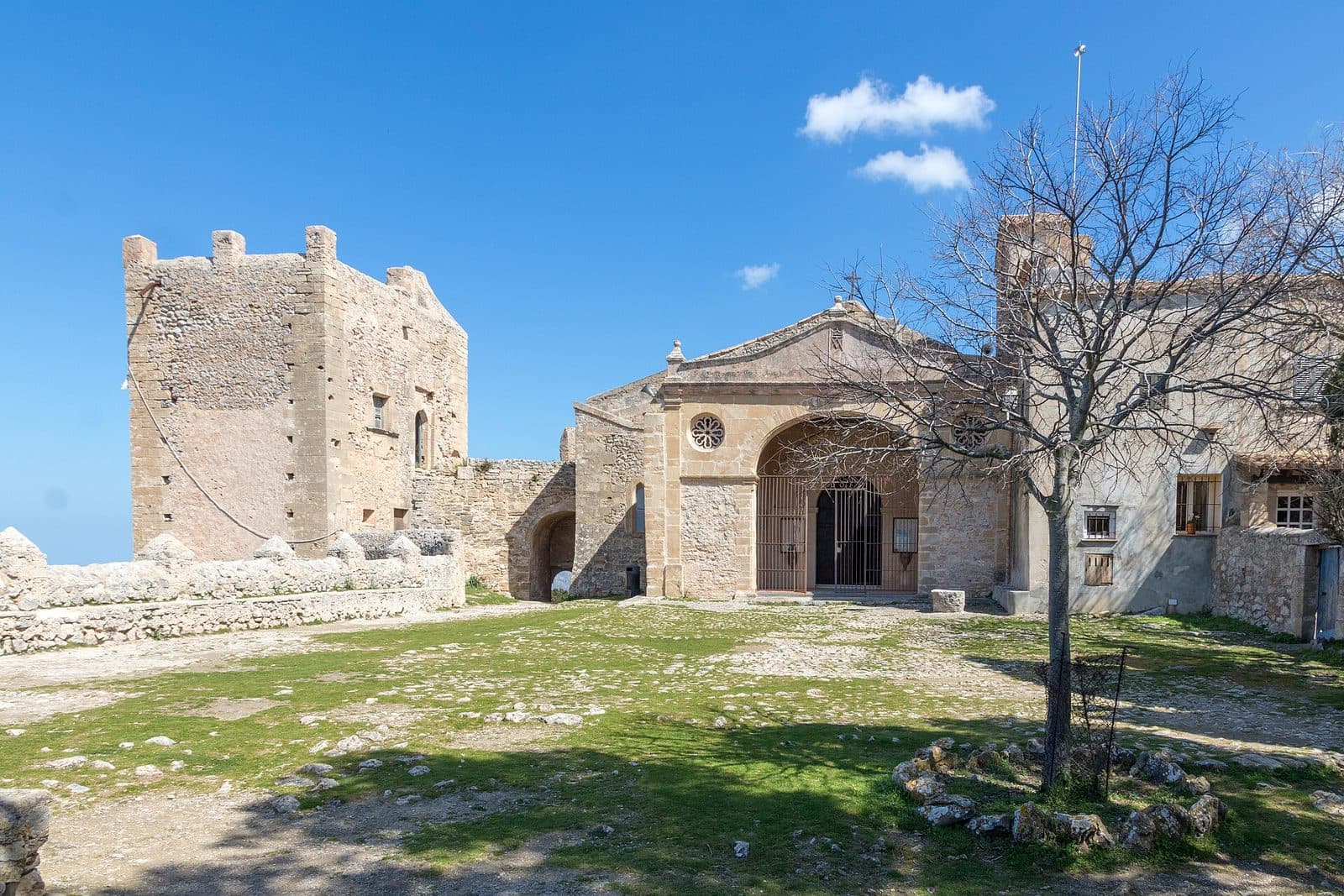

Above the rooftops of Pollença, Mare de Déu del Puig sits like a small fortified world of its own. A church, former monastic rooms, defensive wall, and viewpoint crown Puig de Maria, an isolated mountain on the edge of the plain. The visit therefore does not begin only at the sanctuary gate: the ascent along the old path is an inseparable part of the experience.
Those who reach the top will not find a lavish monumental monastery, but a Mallorcan sandstone retreat that evolved over centuries. Behind the walls, a church, the former chapter house, the refectory, and a massive defensive tower recall prayer, communal life, and the dangers faced even by a monastery on a mountain. The view extends beyond Pollença to the bays of Pollença and Alcúdia, the Serra de Tramuntana, and the island’s interior.
Mare de Déu del Puig is especially worthwhile for travelers who do not merely want to visit a historic site but prefer to approach it on foot. The route is short enough for a half-day excursion, but the continuous incline requires stamina and sensible footwear. The rewards at the top go beyond the distant views: the combination of pilgrimage history, restrained architecture, and secluded location defines the sanctuary’s character.
Even those who already know Pollença will see the town differently after the ascent. From above, the compact old town, the surrounding plain, and the transitions between the Tramuntana, the coast, and Mallorca’s interior can be understood at a glance. The complex is therefore simultaneously a monastery, a viewpoint, and the destination of a historic pilgrimage route.
History and significance
The origins of Mare de Déu del Puig lie in a year of catastrophe. When the plague reached Mallorca in 1348, construction of a Marian sanctuary began on the mountain: the population asked the Virgin for protection from the epidemic, which, according to the municipality of Pollença, killed about 20 percent of the island’s inhabitants. Bishop Berenguer Batle approved the foundation on 31 March 1348; the chapel was consecrated in 1355.
The legend of the light
Alongside the historical circumstances, Pollença preserves a foundation legend. According to the story, women from the town noticed a mysterious light on the mountain at night. Together with the priest, they climbed to the top and found a statue of the Virgin. When men attempted to carry the statue to the parish church, it is said to have become heavier with every step. The miracle was understood as a sign that the image should remain on the Puig and that a chapel should be built there.
The tradition is closely connected to another place on the mountain. According to legend, the Clot de la Verge Maria is the hollow where the image of the Virgin was found. It is not located directly in the monastery courtyard but can be reached via the Camí dels Ermitans. The religious story thus continues into the landscape: the mountain path, the discovery site, and the sanctuary together form a small pilgrimage area.
The first women’s community
From 1362, three lay sisters from Pollença lived on the mountain. Their community developed into a monastery that was consecrated in 1371. Pope Clement VII confirmed the community in 1388 and placed it under the rule of the Augustinian nuns. The site is regarded as the home of Mallorca’s first female eremitic congregation.
The women’s lives were not limited to prayer and enclosure. Records mention a monastic school and a library, as well as work in administration, care for older people, and nursing. As more sisters arrived, the complex also grew. Between 1414 and 1564, rooms required for an organized communal life were added: a chapter house, dormitory, refectory, and kitchen.
Closure and the return of religious life
The monastery was ordered to close in 1564. The complex did not reopen until 1638. Over the following centuries, the religious communities changed, as did the appearance of the building. An extensive renovation in the 18th century gave the originally Gothic church Baroque features; in the late 19th century, another redesign once again aligned its appearance with Gothic architecture. The façade therefore looks Neo-Gothic today, although the sanctuary’s roots extend back to the Middle Ages.
Today, Mare de Déu del Puig no longer serves as an enclosed monastery. It welcomes visitors and is used by the church as a simple hostel, while retaining its character as a pilgrimage sanctuary.
What to see
The first view of the complex explains why this place was more than a mountain chapel. Sandstone walls surround a compact group of buildings consisting of the church, former communal rooms, and defensive structures. The architecture appears restrained and practical. This simplicity makes it especially clear that life here was shaped by seclusion, shared work, and daily religious practice.
The monastery church
The church is the spiritual heart of Mare de Déu del Puig. Its history began with the chapel built in the 14th century and consecrated in 1355. Later alterations repeatedly reshaped the medieval building: it received a Baroque appearance in the 18th century before the Neo-Gothic renovation of the late 19th century deliberately returned to older forms.
Inside is the image of Mare de Déu del Puig, which is central both to the veneration practiced here and to the legend of its discovery. The space should not be viewed as an art museum. Its impact lies in the connection between the revered image of the Virgin, the simple church interior, and the long journey that worshippers and visitors have taken to reach it. Those entering from the bright mountain path experience the contrast between the open landscape and the enclosed place of devotion particularly clearly.
The chapter house and ex-votos
The former chapter house was one of the central spaces of monastic communal life. The community gathered here for discussions and to organize its affairs. Today, it serves as a small museum room where ex-votos are kept. Such votive offerings were donated in gratitude or in the hope of receiving help, revealing the personal side of pilgrimage.
Between the broad history of the plague and the sober dates of the monastery’s foundation, these objects tell of individual petitions. They are a reminder that people climbed the Puig not only for the view but also with worries, hopes, or gratitude. The chapter house is therefore one of the rooms where the site’s religious significance can be understood most directly.
The refectory
The refectory was the community’s dining hall and is one of the most distinctive surviving monastic rooms. Its function can be understood without elaborate staging: long communal meals, a secluded daily routine, and the need to provide for a community living far above the town. Historical accounts highlight the smell of wood smoke, which remained associated with the room’s former use for a long time.
Together with the kitchen, dormitory, and chapter house, the refectory shows that Mare de Déu del Puig was not merely a single place of worship. A complete place for living and working developed behind the chapel. The rooms tell their story less through precious furnishings than through their proportions, materials, and relationship to one another.
Defensive wall and tower
A monastery on an exposed mountain summit was clearly visible but not automatically safe. Toward the end of the Middle Ages, the complex was therefore fortified with walls and a strong defensive tower. These structures were intended to protect it from attacks and still give the sanctuary its almost castle-like appearance.
The tower is more than a picturesque addition. It illustrates how closely religious life and the need for protection could be connected in Mallorca. From the forecourt and exterior areas, it is easy to see how compactly the buildings are grouped within the walled summit area.
The panoramic view
The view opens in several directions. Visible landmarks include the bays of Pollença and Alcúdia, the Serra de Tramuntana, the Pla de Mallorca plain, and the countryside around Pollença. Puig de Massanella forms a striking backdrop. The wetlands of Albufera de Pollença are also part of the sweeping landscape.
This panoramic view is not merely an added attraction; it explains why the site was chosen. The isolated mountain rises above the plain, creating distance from everyday life in the valley. At the same time, its exposed location was the reason defensive walls became necessary. The perspectives change particularly on the return journey: Pollença now lies below the path, with the layered Serra de Tramuntana rising behind it.
Cova del Dimoni and Cadireta del Bon Jesús
Shortly after a gate on the paved section of the path are the Cova del Dimoni and a small chair-shaped hollow in the rock. It is called Cadireta del Bon Jesús. According to local belief, sitting on this “little chair of the good Jesus” promises pregnant women a safe delivery.
This inconspicuous rock feature is easily overlooked when attention is focused solely on the monastery. However, it shows how Christian devotion, folk belief, and natural landforms overlap on the Puig. The small hollow is not a monumental work of art, but it represents one of the most personal stories along the ascent.
Visiting Mare de Déu del Puig
The classic visit begins on the eastern side of Pollença and follows the Camí des Puig. A row of cypress trees marks the entrance. At first, a narrow paved road climbs in curves through the wooded slope. Initial views of Pollença open between the trees; elsewhere, they provide welcome shade. Remnants of the older mule track accompany this lower section.
The historic ascent
Along the way, the route passes carefully constructed terrace walls built by dry-stone wallers from Pollença at the beginning of the 20th century. The Piqueta de l’Ase, a trough where the animals of travelers and pilgrims were once watered, has also survived. Details like these make the path itself part of the attraction.
Farther up, the section accessible to vehicles ends. A paved mule track begins there, restored in 1994 by the dry-stone wallers of the Consell de Mallorca. The surface becomes more irregular and requires greater attention than the paved road. After the gate come the Cova del Dimoni and Cadireta del Bon Jesús; shortly afterward, the Camí dels Ermitans branches off.
The official round trip is 4.192 meters long and covers 270 meters of elevation both uphill and downhill. The estimated walking time alone is 1 hour and 39 minutes. Additional time should be allowed for extended views across the landscape. A visit is therefore more of a short hike with a cultural destination than a quick photo stop.
Planning your time at the site
The experience is most enjoyable when the ascent is not rushed. Despite the manageable length of the route, the continuous gradient is noticeable, and the bends repeatedly provide reasons to pause. Time is also needed at the top: the sweeping view cannot be appreciated from a single point, and each part of the monastery deserves individual attention.
In warmer months, an early start is advisable because it allows a larger part of the ascent to be completed before the strongest heat of the day. Although the path runs beneath trees in places, it is not continuously shaded. Those primarily interested in photography will find more definition in the sandstone walls and layered landscape when the light is lower. Even so, sufficient daylight should be allowed for the descent.
Current access hours and possible restrictions should be checked before beginning the ascent. The same applies to access to interior spaces and services offered by the hostel, since a historic sanctuary is not a permanently accessible museum with a standardized visitor route. Current admission arrangements should also be confirmed in advance.
Getting there and parking
The regional driving directions lead to Pollença, not to the gate of Mare de Déu del Puig. The road distance from Palma Airport to Pollença is 57 kilometers; the journey takes around 45 minutes via Ma-30, Ma-13, and Ma-2200. From central Palma, the road distance is 54 kilometers. The journey via Ma-13 and Ma-2200 takes around 50 minutes.
From Pollença to the trailhead
The starting point of the historic path is on the Ma-2200 at the eastern edge of Pollença. The official route begins at kilometer 51,8, around 300 meters south of the monument to the poet Costa i Llobera. A row of cypress trees and signs for Puig de Maria point toward the ascending path.
The final kilometer details for the journey refer specifically to Pollença. From there, no ordinary road provides access directly to the sanctuary. The narrow route climbs in curves; farther up, vehicle access ends completely and becomes a paved mule track. Even those able to cover part of the lower route by motor vehicle must complete the final section on foot.
Parking and public transport
It is more practical to leave your vehicle in Pollença and begin the ascent there. There is no regular visitor parking directly at the sanctuary. Parking options at the trailhead and near the edge of town may be limited depending on demand; driving onto the narrow mountain road does not remove the need to walk the crucial final section.
Nearby stops include Pollença 2 (42002), Pollença 1 (42001), Poliesportiu (42004), and CEIP Joan Mas (42005). From the stops in town, continue on foot to the trailhead on the Ma-2200 and then uphill. Time planning should therefore account not only for the actual hiking time but also for the walk between the stop and the beginning of the Camí des Puig. Allowing extra time for the return journey is sensible because the descent over irregular paving may be slower than expected.
Bus lines to Mare de Déu del Puig at a glance
| Line | Route | Departures/day | First | Last |
|---|---|---|---|---|
| 322 | Pollença - Port d'Alcúdia | 687 | 00:07 | 23:40 |
| 301 | Port de Pollença - Palma | 114 | 06:18 | 22:38 |
| 321 | Cala de Sant Vicenç | 85 | 07:50 | 22:08 |
| 231 | Port de Sóller - Alcúdia | 16 | 10:39 | 20:21 |
From the official GTFS feeds (TIB/SFM), no real-time data. The figures cover all stops in the town; weekend and holiday services differ — check with the operator before travelling.
Getting there by bus
Pollença 2 (42002) · 0.7 km as the crow flies
- 301Port de Pollença - Palma · Daily
- 321Cala de Sant Vicenç · Daily
- 322Pollença - Port d'Alcúdia · Daily
Pollença 1 (42001) · 0.8 km as the crow flies
- 301Port de Pollença - Palma · Daily
Poliesportiu (42004) · 1.1 km as the crow flies
- 301Port de Pollença - Palma · Daily
- 321Cala de Sant Vicenç · Daily
- 322Pollença - Port d'Alcúdia · Daily
CEIP Joan Mas (42005) · 1.2 km as the crow flies
- 301Port de Pollença - Palma · Daily
- 321Cala de Sant Vicenç · Daily
- 322Pollença - Port d'Alcúdia · Daily
La Font 2 (42033) · 1.7 km as the crow flies
- 231Port de Sóller - Alcúdia · Daily
- 301Port de Pollença - Palma · Daily
- 321Cala de Sant Vicenç · Daily
- 322Pollença - Port d'Alcúdia · Daily
Pont Romà 2 (42046) · 1.8 km as the crow flies
- 231Port de Sóller - Alcúdia · Daily
La Font 1 (42009) · 1.8 km as the crow flies
- 231Port de Sóller - Alcúdia · Daily
- 301Port de Pollença - Palma · Daily
- 321Cala de Sant Vicenç · Daily
- 322Pollença - Port d'Alcúdia · Daily
Pont Romà 1 (42045) · 1.8 km as the crow flies
- 231Port de Sóller - Alcúdia · Daily
Timetable data: official GTFS feeds (TIB/EMT), no real-time — check with the operator before travelling.
Nearby attractions
Pollença draws closer with every bend on the descent. Its historic center is the most natural addition to a monastery visit, as it was where the daily lives of those who climbed to the sanctuary began for centuries. Narrow streets, squares, and churches provide a clear contrast to the mountain’s seclusion.
Pollença
For a combined excursion, it makes sense to explore the town more thoroughly after the hike. By then, the arrangement of its roofs, squares, and streets will already be familiar from above. A walk through the center reveals how closely religious history and urban development are connected in Pollença.
Those who begin the ascent early can spend the latter part of the day in town. Conversely, starting after a long tour of the town is less advisable because sufficient energy and daylight must remain for the outward route, the sanctuary, and the descent. Mare de Déu del Puig works best as the main destination of the excursion, not as a brief addition at the end of a full itinerary.
The northern bays
From the summit, the bays of Pollença and Alcúdia are already part of the panorama. Afterward, Port de Pollença or Alcúdia can be experienced as a natural continuation of the landscape: from above, the coast appears as a broad geographical form, while below it once again becomes a lively area of harbors and beaches. One of these destinations is enough for a single day if the monastery path is not to become a secondary activity.
The Serra de Tramuntana also dominates the view from the Puig. Those planning further hikes receive an excellent geographical introduction to northern Mallorca here. The ascent itself, however, is not an alpine mountain trail but a historic connection between Pollença and its sanctuary. This very distinction makes it a suitable introduction for travelers who want to experience landscape and culture together.
The place it belongs to
Pollença in the place guidePractical visitor information
The path is officially classified as a low-difficulty route, but “low” does not mean level. Elevation is gained continuously from the starting point to the sanctuary. The paved lower half may encourage an overly fast pace; a steady rhythm pays off by the time the stony mule track is reached.
Footwear, water, and sun
Sturdy shoes with good grip are advisable for the restored paving and the rockier upper section. Smooth or irregularly placed stones can require particular care during the descent. Water should be brought from Pollença. The trees along the winding path provide shade in sections, but open stretches and the summit area are exposed to the sun.
In hot weather, starting early is more important than athletic ambition. The bends and openings with views are suitable for short breaks without needing to leave the path. Keep some energy in reserve for the return route: descending places different demands on the knees and sure-footedness than climbing.
Visiting with children
The Consell de Mallorca lists the path as a family route but excludes children under 3 years old. The route is also unsuitable for pushchairs and buggies. The reason becomes clear in the upper section: the paved surface ends there, replaced by a partially irregular stone mule track.
With older children experienced in mountain walking, the clearly defined path and visible monastery complex can provide a motivating destination. Nevertheless, adults should realistically assess the gradient, heat, and return journey. The Cova del Dimoni, Cadireta del Bon Jesús, and old animal trough provide small milestones along the way without requiring anyone to leave the path.
Accessibility and expectations
The route is not suitable for wheelchairs. Attempting to shorten the lower section with a vehicle does not solve this problem because the final passage is accessible only via the historic footpath. People with limited mobility should pay particular attention to the gradient, cobblestones, and absence of vehicle access to the entrance.
Do not expect a modern museum with fully staged rooms. The strength of Mare de Déu del Puig lies in its preserved architecture, religious continuity, old access route, and views. The complex is best appreciated by those who take time to notice the details: the defensive wall, traces of communal life, and the small traditional stories associated with the path.
Local insider tips
Find the rock chair
Shortly after the gate on the paved section of the path, Cadireta del Bon Jesús lies beside Cova del Dimoni. The small chair-shaped hollow in the rock is easily overlooked and is associated with a tradition promising a safe delivery.
Enjoy the views on the descent
Do not stop looking once you leave the summit: on the return route, especially clear views of Pollença and the Serra de Tramuntana open between the bends. The perspective now feels more natural because the town and mountains lie directly ahead of the hiker.
Do not miss the ex-votos
The former chapter house serves as a small museum room for ex-votos. These votive offerings reveal the personal side of the pilgrimage site and provide an important counterpoint to the broader foundation story from the plague year of 1348.
Start at the cypress-lined path
The historic ascent begins on the Ma-2200 at kilometer 51,8. A row of cypress trees marks the entrance; along the way, the Piqueta de l’Ase and remnants of the old mule track point to its former use by pilgrims and pack animals.
Take the turnoff to the discovery site
Above Cova del Dimoni and Cadireta, the Camí dels Ermitans branches off. It leads to the Clot de la Verge Maria, where tradition says the image of the Virgin associated with the sanctuary’s foundation was found.