
Sant Jordi in Pollença: Oratory and Military History
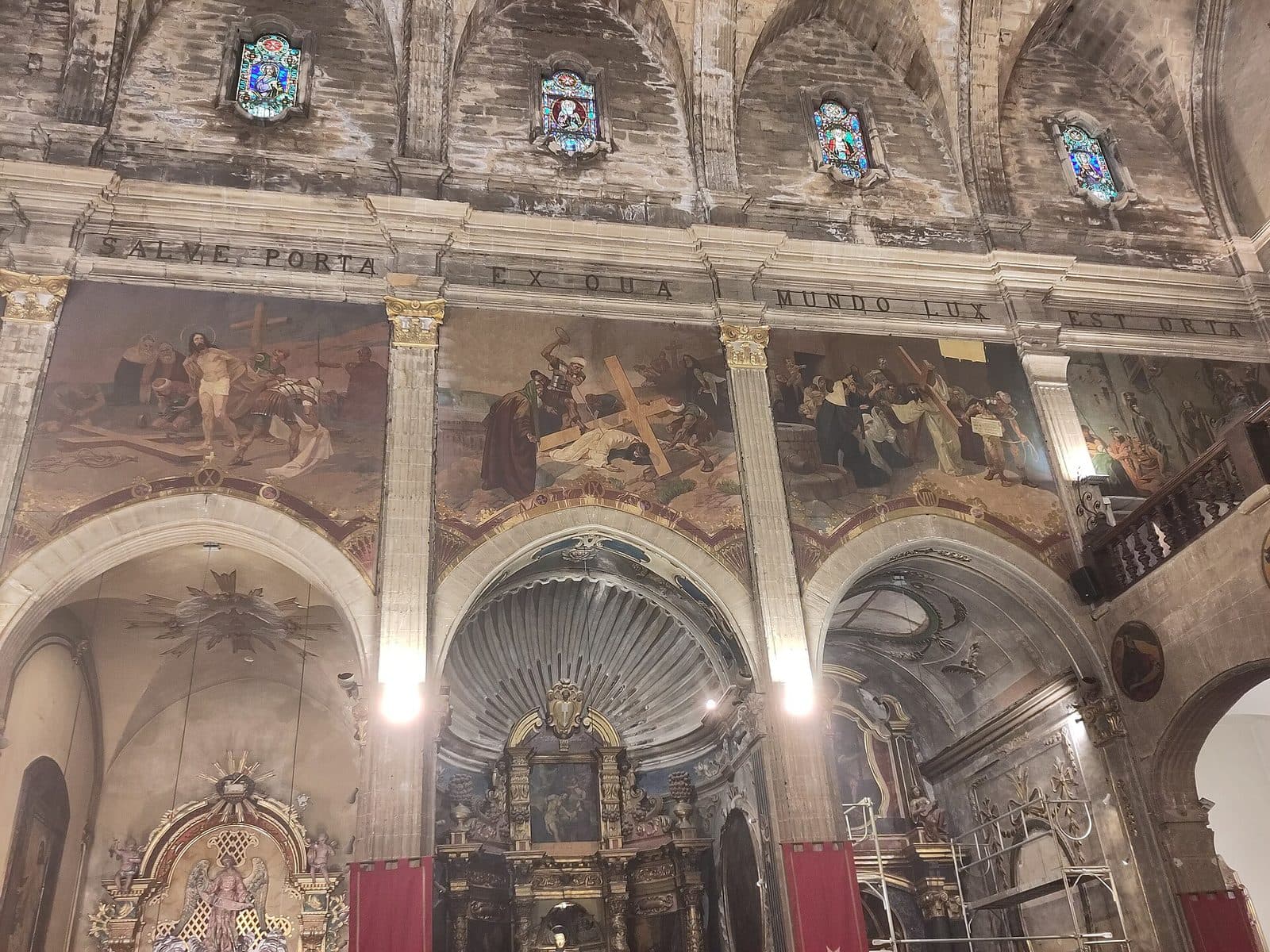

Sant Jordi is one of those buildings in Pollença whose significance cannot be understood solely through its religious function. The old oratory was built at a time when attacks from the sea threatened northern Mallorca. It therefore served more than devotional purposes: able-bodied residents were expected to gather here and prepare for battle.
This connection is precisely what makes the site remarkable. Saint George was deliberately chosen as the patron saint of soldiers, horsemen, archers, and chivalry. His name represented courage and readiness to defend—qualities that were no abstract virtues for a community within reach of the Bay of Pollença.
The oratory makes a worthwhile stop on a walk through the old town: for people who enjoy understanding historic buildings in context and for visitors interested in cultural history who want to explore Pollença’s story of pirate attacks and local self-defense. The strongest impression comes from not viewing the building in isolation. Sant Jordi tells of how closely religion, community spirit, and defense were connected in the early modern period. In an emergency, a place of worship became a shared starting point for armed resistance.
History and significance
The story of Sant Jordi begins not with quiet seclusion but with alarm. In the 16th century, attacks on Mallorca were frequent, and the northern coasts lay within the operating range of Ottoman fleets and North African corsairs. Great seafarers and corsair commanders such as Dragut and Hayreddin Barbarossa made insecurity a lasting part of island life.
An oratory for a threatened community
The residents of Pollença had Sant Jordi built as a gathering place for the local militia. The ecclesiastical authorities determined the location, but its purpose extended beyond worship and devotion. Whenever the coast was threatened, the men called upon to defend the town were expected to assemble here. The oratory was therefore a spiritual space, a muster point, and at times a barracks.
This multiple role explains the character of the building better than a purely art-historical interpretation. Anyone standing before Sant Jordi is looking at a place where prayer and military preparation were not understood as opposites. The community sought religious assistance while also organizing its protection in a highly practical way.
Sant Jordi as patron saint
The dedication to Saint George was a logical choice. Sant Jordi was regarded as the patron of soldiers, cavalry, archers, and chivalry. For an oratory that served as a meeting place for the local militia, he was therefore far more than an arbitrary namesake. His figure embodied ideas of bravery, duty, and assistance in times of danger.
The name also helps today’s visitors decipher the building’s original message. Sant Jordi was not merely a chapel beside which military activities happened to take place. The religious dedication and its function as a gathering point were intrinsically linked: the oratory was intended to give strength to a threatened population while reinforcing its readiness to defend itself.
Corsair attacks and Joan Mas
The attack led by Dragut has left a particularly deep mark on Pollença’s collective memory. His troops managed to land in the Bay of Pollença but were repelled by defenders led by Joan Mas. The episode remains one of the town’s defining historical stories.
Pollença commemorates it during the La Patrona festival with a dramatic reenactment of the battle. This keeps the world from which Sant Jordi emerged alive in local consciousness. The building and the festival tell two sides of the same story: the enduring muster point on one side, and the annually renewed memory of danger, resistance, and communal defense on the other.
Military purpose and historical testimony
Sant Jordi preserves an unusually tangible function from Pollença’s history. Its value lies in its closeness to the everyday lives of the population at the time, as the oratory recalls that coastal attacks were not solely a matter for great fortresses and fleets. A community farther inland also had to designate meeting points, mobilize people, and respond to news from the coast. The place of worship makes this local dimension of the island’s history visible.
What to see
The essential key to Sant Jordi is its dual identity. Anyone who sees only a church overlooks its military background; anyone looking solely for former barracks misses its religious significance. The oratory is particularly interesting because both functions came together in one building.
The oratory
Sant Jordi was built as an oratory, meaning a place of prayer and devotion. The building had to be easily accessible and practical for the local community. When viewing it, therefore, it is worth looking beyond decorative details. The more important question is what requirements such a building had to meet: it was a consecrated place, but also a structure capable of accommodating people during a crisis and serving as an agreed meeting point. Its historical meaning emerges from this combination.
The name above it all is itself a symbolic feature. The dedication to Sant Jordi gave the space a clear program: protection, courage, and defensibility. Visitors who understand this significance will perceive the oratory differently from an ordinary religious building.
The militia’s muster point
Military use is Sant Jordi’s most unusual feature. The local militia assembled here whenever an attack threatened. During times of war, the building was used as barracks and thus formed part of Pollença’s practical defense organization.
This function can be imagined on site: members of the militia gathered at a designated location and prepared for deployment. Sant Jordi marked the threshold between civilian everyday life and armed defense. This idea gives the visit particular tension, as the oratory was not a remote observation post on the coast. It belonged to the second line, where a community had to respond to news of a landing. The threat came from the sea; the response was organized within the town.
The dedication to Saint George
Sant Jordi is one of those buildings where the patron saint comments unusually clearly on the original purpose. Saint George was associated with soldiers, cavalry, archers, and ideals of chivalry. His veneration symbolically placed the defenders under a form of protection that every militiaman could understand.
It is therefore worth pausing during a visit to consider this choice of name. It reveals how the builders interpreted their own situation, while the oratory gave that attitude a permanent home.
The location in Pollença’s old town
Sant Jordi gains additional significance from its location in historic Pollença. The oratory does not stand as an isolated monument in open countryside but forms part of the townscape that developed around it. This makes its former function immediately understandable: a gathering place for residents had to be part of their everyday living environment.
On a walk through the old town, the building may initially appear to be one historic element among many. Knowing its history changes that perspective. The surrounding streets become the imagined routes taken by those who gathered here in times of danger. This creates a vivid impression without the need for a large exhibition: today’s urban fabric provides the scale of the community at the time.
Anyone visiting Sant Jordi should therefore also consider the overall exterior impact of the building and step back a little. Presence and accessibility matter, as the building had to be familiar, easy to find, and available for communal use at the decisive moment.
Visiting Sant Jordi
The best way to begin a visit is with the historical context. A brief look at the name is enough: Sant Jordi, the patron saint of fighters, identifies a place where Pollença’s militia actually assembled. With this knowledge, a religious building becomes a site of local defense history.
Read the building before the history
It is best to begin by quietly viewing the exterior. Sant Jordi draws its meaning from its function and proximity to the town’s population. Its former use as a muster point can then be related to the surrounding streets.
If the interior is accessible, the visit can continue inside. As no permanently reliable visiting hours are recorded, current access should be checked in advance. Admission details may also change and should be confirmed immediately before visiting. Regardless of access, the exterior and its place within the old town can still be readily understood.
The historical context
Sant Jordi gains additional depth from the history of the corsair attacks. Anyone familiar with the connection to Dragut, Joan Mas, and the local militia will recognize it as a place of remembrance. The annual reenactment during La Patrona also helps explain the building’s significance in Pollença’s collective memory.
La Patrona
During the La Patrona festival, the town’s historic defense becomes especially prominent in public awareness. The festival is the key reference point for the living culture of remembrance surrounding the attack and the defenders led by Joan Mas.
Getting there
The stated road distances and driving times lead to Pollença, not directly to Sant Jordi. This is important when planning: after the cross-country drive, you still need to find your way within the town. For this final section, the oratory itself should be selected as the destination in an up-to-date navigation system.
From Palma Airport
The route from Palma Airport to Pollença covers 57 road kilometers. The drive takes around 45 minutes and follows the Ma-30, then the Ma-13, and finally the Ma-2200 to Pollença. The local route to the oratory begins only after reaching the town.
The route is straightforward for a visit to northern Mallorca: after bypassing the greater Palma area, follow the Ma-13 toward the north of the island and switch to the Ma-2200 for the approach to Pollença.
From central Palma
From central Palma, the distance to Pollença is 54 road kilometers. The drive takes around 50 minutes and follows the Ma-13 and the Ma-2200. This travel time also ends in Pollença; locating Sant Jordi within the town must be added separately.
By bus
Several bus stops serve Pollença. These include Poliesportiu (42004), CEIP Joan Mas (42005), Pollença 2 (42002), and Pollença 1 (42001). From the chosen stop, continue on foot through the town to the oratory. The most convenient connection depends on the starting point and the current timetable.
A journey by public transport can be combined with a walk through the old town. The oratory does not require an excursion into remote terrain but belongs to historic Pollença. This allows the visit to be combined with other stops in town without needing another vehicle in between.
Bus lines to Sant Jordi at a glance
| Line | Route | Departures/day | First | Last |
|---|---|---|---|---|
| 322 | Pollença - Port d'Alcúdia | 753 | 00:06 | 23:40 |
| 301 | Port de Pollença - Palma | 133 | 06:15 | 22:38 |
| 321 | Cala de Sant Vicenç | 102 | 07:49 | 22:08 |
| 231 | Port de Sóller - Alcúdia | 12 | 10:38 | 20:21 |
From the official GTFS feeds (TIB/SFM), no real-time data. The figures cover all stops in the town; weekend and holiday services differ — check with the operator before travelling.
Getting there by bus
Poliesportiu (42004) · 0.4 km as the crow flies
- 301Port de Pollença - Palma · Daily
- 321Cala de Sant Vicenç · Daily
- 322Pollença - Port d'Alcúdia · Daily
CEIP Joan Mas (42005) · 0.5 km as the crow flies
- 301Port de Pollença - Palma · Daily
- 321Cala de Sant Vicenç · Daily
- 322Pollença - Port d'Alcúdia · Daily
Pollença 2 (42002) · 0.6 km as the crow flies
- 301Port de Pollença - Palma · Daily
- 321Cala de Sant Vicenç · Daily
- 322Pollença - Port d'Alcúdia · Daily
Pollença 1 (42001) · 0.6 km as the crow flies
- 301Port de Pollença - Palma · Daily
La Font 1 (42009) · 0.7 km as the crow flies
- 231Port de Sóller - Alcúdia · Daily
- 301Port de Pollença - Palma · Daily
- 321Cala de Sant Vicenç · Daily
- 322Pollença - Port d'Alcúdia · Daily
La Font 2 (42033) · 0.7 km as the crow flies
- 231Port de Sóller - Alcúdia · Daily
- 301Port de Pollença - Palma · Daily
- 321Cala de Sant Vicenç · Daily
- 322Pollença - Port d'Alcúdia · Daily
Polígon de Pollença 1 (42043) · 1.5 km as the crow flies
- 231Port de Sóller - Alcúdia · Daily
- 301Port de Pollença - Palma · Daily
- 321Cala de Sant Vicenç · Daily
- 322Pollença - Port d'Alcúdia · Daily
Timetable data: official GTFS feeds (TIB/EMT), no real-time — check with the operator before travelling.
Nearby
Pollença’s historic center is the natural setting for Sant Jordi. Squares with cafés, cobbled streets, and traditional stone houses create a townscape in which the oratory does not feel like a detached museum exhibit. The town remains inhabited today while preserving numerous traces of its long history.
Pollença’s old town
A walk through the old town places Sant Jordi on the right scale. The oratory was built by residents for a purpose that concerned the entire community. The surrounding streets therefore make it easier to understand why a shared meeting point was so important. The need for defense did not begin at the façade of a prestigious palace but in the midst of the population’s living environment.
The squares and lanes are ideal for continuing the visit at a leisurely pace. Instead of simply checking off several sights, Sant Jordi’s story can serve as a connecting thread: How did news move through the town? Where did the militiamen come from? What did a landing in the bay mean for families whose homes did not stand directly beside the sea? The townscape makes such questions more tangible.
La Patrona and the memory of the attack
Anyone interested in Sant Jordi will inevitably encounter Joan Mas and La Patrona elsewhere in Pollença. The annual reenactment of the battle against the corsairs shows how strongly this episode remains part of local identity. The festival is not a side story to the oratory but its living counterpart in the culture of remembrance.
Sant Jordi permanently represents preparation and assembly; La Patrona brings the remembered battle to life. The two are therefore particularly valuable when considered together, even if the visit does not take place during the festival. Anyone who encounters the name Joan Mas again in town can place it within the same historical context.
More walks through Pollença
West of the town, the bridge known as Pont Romà recalls another layer of local history. Pollença’s squares and established street network can be combined with Sant Jordi to create a cultural walk.
Pollença lies at the foot of the Tramuntana and inland from Port de Pollença. A visit to the oratory can therefore form part of a day combining urban history with northern Mallorca.
The place it belongs to
Pollença in the place guidePractical visitor information
Sant Jordi is an oratory with an unusual military past. Its significance comes from the connection between its religious dedication, the local militia, and Pollença’s history of defense.
Check access in advance
As no fixed opening hours are recorded, current access should be checked before setting out. The same applies to any admission arrangements. Anyone planning independently of an interior visit can still meaningfully include the exterior and its setting in the historic town on a walking route.
The visit is considerably more rewarding when the history is already known. Without context, it remains primarily an old religious building; with knowledge of the militia, its role as a muster point becomes clear. Briefly reading about Dragut, Joan Mas, and La Patrona is therefore the best preparation.
Explaining the history
The recorded history describes how the local militia assembled at a shared meeting point when attacks threatened and prepared to defend the town. Saint George also provides an introduction to the connection between patron saint and defenders. The story emerges from the building, the townscape, and the surviving account of resistance against the corsairs.
Read the name carefully
This destination is the oratory in Pollença in the north of the island. When using navigation, Pollença should therefore always be entered together with the name of the oratory.
Sant Jordi in Pollença belongs to the history of the threatened bay, the local militia, Joan Mas, and the La Patrona festival. This is precisely what gives it its distinctive significance.
Local insider tips
See the building as a muster point
Do not look only for religious art: Sant Jordi served as a meeting place for the local militia and at times as barracks. Knowing this makes the oratory’s location and function far easier to understand.
Consider the patron saint
The dedication was no coincidence. Sant Jordi was regarded as the patron of soldiers, horsemen, and archers. The name directly connects the devotional space with its role in the defense of Pollença.
Keep La Patrona in mind
The annual reenactment of the battle against the corsairs keeps the story of Joan Mas alive in the town. Even outside the festival, La Patrona provides the best key to understanding Sant Jordi’s military significance.
Include it on an old-town walk
Sant Jordi is most effective as a stop on a walk through Pollença. The surrounding streets vividly show how residents left their daily routines and came together at a shared muster point when danger threatened.
Do not navigate south
When planning the route, always use “Oratori de Sant Jordi, Pollença.” Colònia de Sant Jordi lies in another part of Mallorca and has nothing to do with this historic oratory or its militia history.