
Mare de Déu del Roser in Pollença
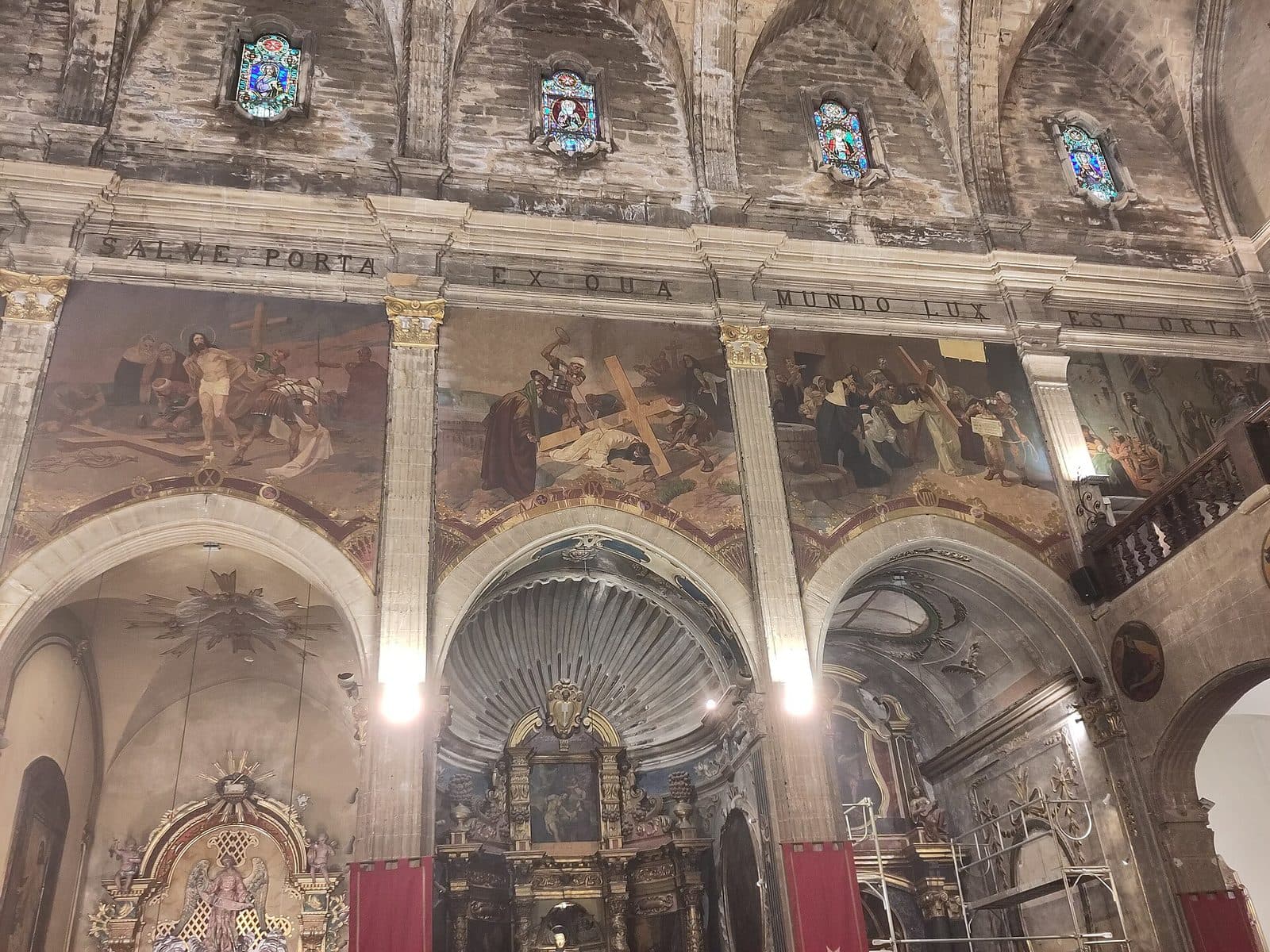

Mare de Déu del Roser is one of those churches in Pollença whose significance only becomes apparent on closer inspection. It forms part of the historic Dominican complex of Sant Domènec and preserves two particularly remarkable examples of sacred art: a Baroque Rosary altarpiece and a historic organ.
The connection between the church and the former convent makes a visit especially appealing. While the neighboring convent now plays a role in Pollença’s cultural life, the church interior recalls the ensemble’s religious roots. Its side chapels, altarpieces, and organ tell not only of devotion but also of the craftsmanship and artistic ambition of past centuries.
The similarity of its name to Oratori del Roser Vell, located outside the town center, can easily cause confusion. The church described here is beside Convent de Sant Domènec in Pollença, not the older Rosary oratory on the outskirts of town. For visitors to the old town, it is above all a peaceful cultural stop that combines well with the convent complex and a walk through the historic streets.
History and significance
Behind the walls of Sant Domènec lies the story of an order that combined religion, teaching, and preaching. The Dominicans had the convent complex built, with the church serving not merely as an attached place of worship but as an essential part of this spiritual house.
The Dominican convent
The present-day combination of different uses makes the site especially vivid. The former convent is associated with the Museu de Pollença and cultural events, while the church has retained its sacred character. As a result, the ensemble does not feel like a sealed-off monument: its spaces continue to be experienced and used, even if they no longer serve the same purpose everywhere as they did in the time of the Dominicans.
Devotion to the Rosary
The name Mare de Déu del Roser means “Our Lady of the Rosary.” This dedication is the key to the church’s most important work of art, the Baroque Rosary altarpiece attributed to Joan Antoni Oms.
Altarpieces of this kind were more than decorative backdrops. They arranged images, figures, and architectural frames into a religious narrative. For worshippers, they made matters of faith visible; for today’s visitors, they also document the visual language and craftsmanship of their era.
From religious house to cultural venue
When the former monastic life came to an end, the complex did not disappear from Pollença’s collective memory. Sant Domènec developed into an important cultural venue for the municipality. The former convent houses the Museu de Pollença, and its cloister is also known as a setting for cultural life. Nevertheless, the church should not be regarded merely as an ancillary space of the convent. Its furnishings convey a historical message of their own and explain why the Rosary dedication remains associated with this ensemble today.
To understand the site correctly, it is important to distinguish it from Roser Vell. Oratori del Roser Vell is a separate sacred building outside the central convent complex. Anyone searching for Mare de Déu del Roser in Pollença should therefore check whether the reference is to the church of Sant Domènec or the old Rosary oratory.
What to see
The eye needs a moment inside the church before moving beyond the overall impression. Only then do the side chapels, altarpieces, and organ emerge as individual points of interest. Mare de Déu del Roser is not a building that should be appreciated solely from the outside. Its most important features are inside and are best discovered by walking slowly through the space.
The nave
Architecturally, the church belongs to the former Dominican convent, but it has a clearly defined sacred interior with side chapels opening along the nave. This relationship between the central axis and the lateral chapels is a defining part of the visitor experience. Anyone who looks only toward the front and immediately leaves will miss much of its structure. It is worth changing your perspective: first look from the entrance toward the altar, then turn toward the chapels at the sides.
The Rosary altarpiece
The most important individual work is the Baroque altarpiece of Mare de Déu del Roser. It is attributed to Joan Antoni Oms. The structure is dedicated to Our Lady of the Rosary and gave the devotion already reflected in the church’s name a visible focal point.
An altarpiece should not be viewed like a single painting. What matters is the interplay of figures, pictorial panels, columns, frames, and ornamental sections. Different layers emerge depending on where you stand. From the center of the nave, the overall arrangement can be appreciated first; from closer range, the sculptural and decorative details become clearer. This shift between distant and close-up views is one of the most rewarding moments of the visit.
The altar is also an important link between the architecture and the history of the religious order. Its elaborate design translates the Rosary dedication into visible art. It is therefore not only the decorative center of the church but also an explanation of its dedication.
The side chapels
The chapels along the sides of the nave give the interior depth and rhythm. With their altarpieces, they contribute to the layered effect of the space. Unlike a church whose furnishings are concentrated almost entirely around the high altar, attention here is distributed among several points of interest.
The historic organ
Alongside the altarpiece and side chapels, a historic organ has been preserved and forms another focal point of the church’s furnishings.
Church and cloister
The church and convent are directly connected, but they should be understood as distinct areas. The cloister is closely associated with Pollença’s present-day cultural life. Visitors who find both areas accessible will therefore experience two very different aspects of the same ensemble: the church focused on altars and organ, and the open architecture of the former convent. This makes Sant Domènec more than a single attraction without diminishing the distinct identity of Mare de Déu del Roser.
Visiting the church
Time required and pace of visit
The actual time required depends on which parts of the ensemble are accessible. Although the church, cloister, and museum share a historical context, they do not necessarily follow the same visiting arrangements. Anyone wishing to see all areas should check the current access conditions for each one separately in advance.
Quiet and consideration
Current opening hours and admission arrangements should be checked before traveling to Pollença, as no reliable fixed hours or permanently valid price have been recorded.
Getting there and parking
The stated road routes lead to Pollença, not directly to the church portal. This is important when planning your journey: after the main drive, you will need to navigate through the town to the former Dominican convent of Sant Domènec, where Mare de Déu del Roser is located.
From Palma Airport
Palma Airport is 57 kilometers by road from Pollença. The journey takes around 45 minutes and follows the Ma-30, then the Ma-13, and finally the Ma-2200. The Ma-13 covers most of the journey north, while the Ma-2200 continues to Pollença.
Within the town, navigation should be directed toward the Sant Domènec convent complex, of which the church forms part. Searching only for “Roser” may lead to the wrong sacred building because Roser Vell is also located in Pollença.
From Palma
The road distance from central Palma to Pollença is 54 kilometers. The journey takes around 50 minutes and follows the Ma-13 and Ma-2200. These directions also end in Pollença; the final section to the church follows the local street network.
Do not use Mare de Déu del Roser alone as the destination when planning the journey. Adding “Convent de Sant Domènec” makes the location unambiguous and avoids confusion with Oratori del Roser Vell outside the central ensemble.
By bus
Several bus stops serve Pollença. Nearby stops include Pollença 1 (42001), Pollença 2 (42002), Poliesportiu (42004), and CEIP Joan Mas (42005). The same guidance applies here: Sant Domènec is a clearer destination name than “Roser.” Current connections are shown in the site’s transport module; seasonal or timetable-related changes should be checked immediately before traveling.
Bus lines to Mare de Déu del Roser at a glance
| Line | Route | Departures/day | First | Last |
|---|---|---|---|---|
| 322 | Pollença - Port d'Alcúdia | 753 | 00:06 | 23:40 |
| 301 | Port de Pollença - Palma | 133 | 06:15 | 22:38 |
| 321 | Cala de Sant Vicenç | 102 | 07:49 | 22:08 |
| 231 | Port de Sóller - Alcúdia | 12 | 10:38 | 20:21 |
From the official GTFS feeds (TIB/SFM), no real-time data. The figures cover all stops in the town; weekend and holiday services differ — check with the operator before travelling.
Getting there by bus
Pollença 1 (42001) · 0.1 km as the crow flies
- 301Port de Pollença - Palma · Daily
Pollença 2 (42002) · 0.1 km as the crow flies
- 301Port de Pollença - Palma · Daily
- 321Cala de Sant Vicenç · Daily
- 322Pollença - Port d'Alcúdia · Daily
Poliesportiu (42004) · 0.7 km as the crow flies
- 301Port de Pollença - Palma · Daily
- 321Cala de Sant Vicenç · Daily
- 322Pollença - Port d'Alcúdia · Daily
CEIP Joan Mas (42005) · 0.7 km as the crow flies
- 301Port de Pollença - Palma · Daily
- 321Cala de Sant Vicenç · Daily
- 322Pollença - Port d'Alcúdia · Daily
La Font 1 (42009) · 1.2 km as the crow flies
- 231Port de Sóller - Alcúdia · Daily
- 301Port de Pollença - Palma · Daily
- 321Cala de Sant Vicenç · Daily
- 322Pollença - Port d'Alcúdia · Daily
La Font 2 (42033) · 1.2 km as the crow flies
- 231Port de Sóller - Alcúdia · Daily
- 301Port de Pollença - Palma · Daily
- 321Cala de Sant Vicenç · Daily
- 322Pollença - Port d'Alcúdia · Daily
Polígon de Pollença 1 (42043) · 2.0 km as the crow flies
- 231Port de Sóller - Alcúdia · Daily
- 301Port de Pollença - Palma · Daily
- 321Cala de Sant Vicenç · Daily
- 322Pollença - Port d'Alcúdia · Daily
Timetable data: official GTFS feeds (TIB/EMT), no real-time — check with the operator before travelling.
Nearby attractions
Outside the church lies not an artificially defined monument district, but the organically developed town of Pollença. The town was founded in the Middle Ages and retains many narrow, irregular streets within its compact layout. Numerous houses that shape its appearance today date from the 17th and 18th centuries. A walk around Sant Domènec therefore reveals more of the historical context than simply arriving and departing directly.
Sant Domènec and the Museu de Pollença
The most obvious next stop is the former Dominican convent itself. Its rooms house the Museu de Pollença, while the cloister is used as a cultural venue. The church, museum, and cloister do not cover the same subject, but they share the architecture and history of the ensemble.
During a combined visit, Mare de Déu del Roser should not be treated merely as a place to pass through. Its Rosary altarpiece and organ form a distinct focus, clearly different from a museum exhibition or an event in the cloister. This contrast is precisely what makes the complex interesting.
Pollença old town
From Sant Domènec, the walk can continue through the historic town center. The parish church of Nostra Senyora dels Àngels, the Calvari, and the stone arch known as Pont Romà are among Pollença’s most notable landmarks. They do not need to be combined into a tightly scheduled itinerary; the routes between them already reveal the dense historic street network.
Anyone including the Calvari should treat it as a separate section of the walk. The climb is very different from the peaceful church visit and requires more time and stamina. Mare de Déu del Roser works well as either the cultural beginning or conclusion of the route because visiting it does not itself require a long outdoor walk.
Roser Vell
Oratori del Roser Vell has a very similar name but is a different attraction. The distinction is important for more than navigation: although both places are associated with devotion to the Rosary, they are not part of the same building complex.
Anyone specifically wishing to see both sacred buildings should plan them as separate stops. Mare de Déu del Roser is beside the Dominican complex; Roser Vell lies outside this central ensemble. A location that appears to differ is therefore not necessarily incorrect and may simply refer to the similarly named site.
Puig de Maria and the north
Pollença is also a good starting point for other destinations in northern Mallorca. Puig de Maria, however, requires a separate climb and should not be treated as a brief extension of the church visit. Port de Pollença, Cala de Sant Vicenç, and the Formentor peninsula also offer experiences quite different from the historic town center.
A balanced day plan should therefore separate the cultural walk through town from longer drives or hikes. Mare de Déu del Roser combines especially well with Pollença’s nearby historic buildings; the coast, mountains, and viewpoints can then provide a striking scenic contrast.
The place it belongs to
Pollença in the place guidePractical visitor information
A church visit may seem straightforward, but at Mare de Déu del Roser a few small preparations determine whether you come away with more than a fleeting impression. The most important points are choosing the correct destination, checking access in advance, and allowing enough quiet time to appreciate the furnishings.
Choose the right Roser
The most common avoidable mistake is confusing the church with Oratori del Roser Vell. For this church, use the Dominican complex of Sant Domènec as your reference point. This is particularly helpful when searching maps and images, as German, Catalan, and Spanish names may appear side by side.
Spellings also vary. Mare de Déu del Roser, Nostra Senyora del Roser, and Nuestra Señora del Rosario express the same Rosary dedication in different languages. Adding Pollença and the reference to Sant Domènec identifies the destination unambiguously.
Take time to look
The Rosary altarpiece should first be viewed from the center of the nave because its structure is clearer from this distance. Only then is it worth moving closer to examine the figures, frames, and ornamental sections.
What not to expect
Do not assume that the church, museum, and cloister are always accessible at the same time, as the areas serve different functions. It is therefore advisable to check the current access conditions before traveling, especially if the church is the main reason for going to Pollença.
Local insider tips
Look up before leaving
When facing the altar, the historic organ lies outside your natural field of attention. Before leaving the church, it is therefore worth deliberately turning back toward the entrance and gallery.
View the altarpiece from two distances
The structure of the Rosary altarpiece is clearest from the center of the nave. Only then move closer: this reveals the sculptural figures and ornaments without losing sight of the overall composition.
Choose Sant Domènec as your destination
For navigation, it is better to search for Convent de Sant Domènec. The name Roser can easily lead to Oratori del Roser Vell, a different sacred building outside the central convent complex.
Combine the church and cloister
If both areas are accessible, first visit the intimate church interior and then the open cloister. The direct transition makes the different functions within the former Dominican convent especially clear.
Check cultural events too
The cloister of Sant Domènec is used for cultural events. Anyone mainly seeking a quiet church visit should therefore check both access information and the convent complex’s events calendar.