
Mirador de sa Foradada: Views of Mallorca’s Pierced Rock
.jpg)
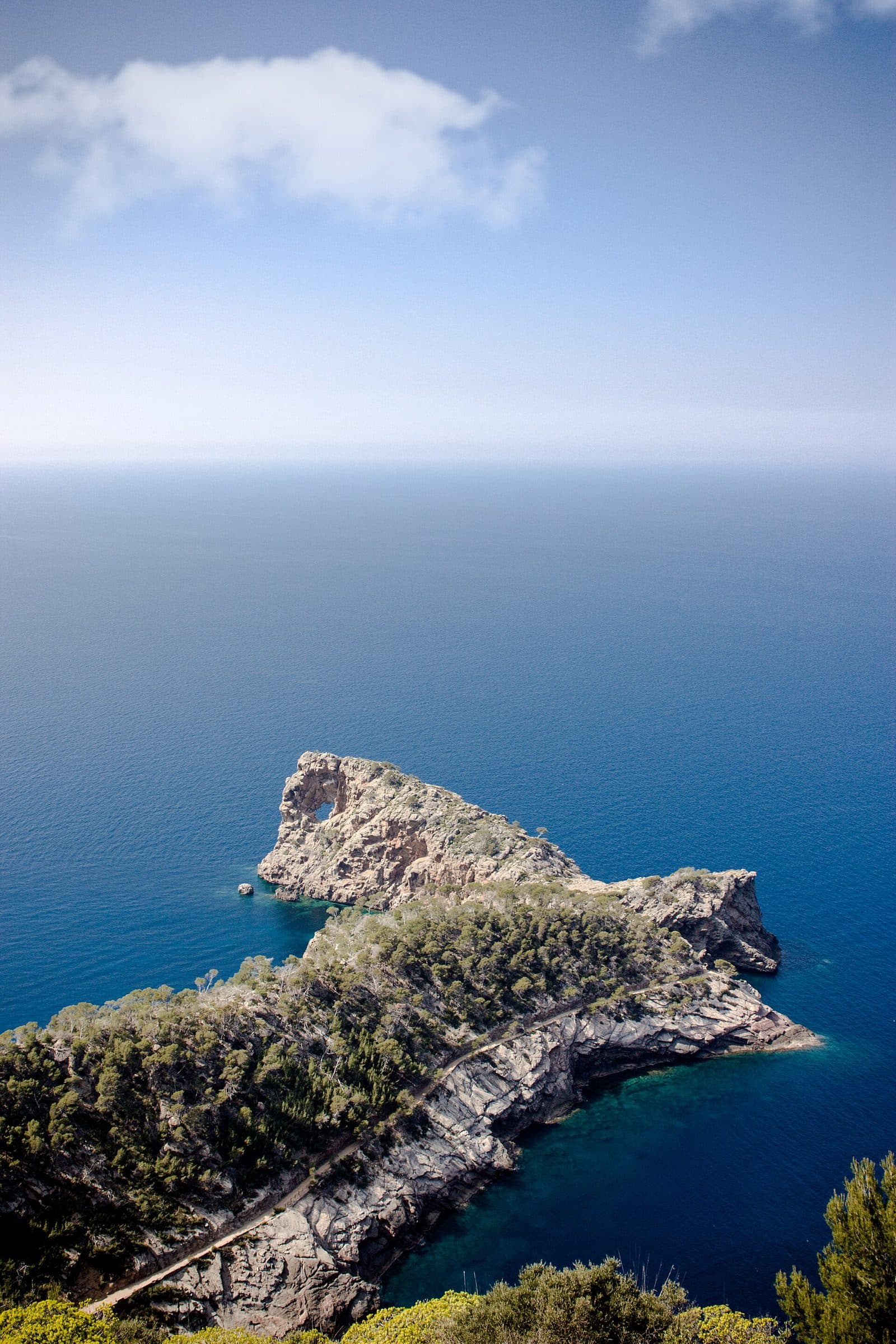
High above the sea, Mirador de sa Foradada overlooks one of the most distinctive formations on Mallorca’s northwest coast. Below the viewpoint, a rocky peninsula extends into the Mediterranean. Near its tip, a natural hole opens in the rock—the feature that gave Sa Foradada, “the pierced one,” its name.
The appeal of the place lies less in any individual structure than in the landscape’s carefully balanced composition. In the foreground, vegetation-covered slopes descend toward the sea; behind them lies the peninsula’s dark rocky ridge, and beyond it there is only the open horizon. Two circular viewing platforms provide different perspectives of the coast, rocks and water.
The viewpoint is particularly well known for sunset. The atmosphere then changes noticeably: a peaceful stop on the Tramuntana coast becomes a gathering place where many visitors watch together as the light fades over the sea. According to consistent reports, music from the terrace and occasional applause are often part of this evening ritual.
The Mirador suits travelers who want to experience a striking coastal panorama without a long hike, as well as photographers and families. One distinction is important, however: the viewpoint is not the peninsula itself. Anyone wishing to hike down to the water or onto Sa Foradada is undertaking a separate and considerably longer excursion.
History and Significance
Sa Foradada as a Landmark
The peninsula’s unusual silhouette can be seen from several elevated locations around Deià. Its name directly describes its defining feature: the Mallorcan word “foradada” refers to something pierced or bored through.
The rock window is not a human-made opening. Erosion shaped the hole in the stone and gave the projecting coastal formation its unmistakable profile. This geological process is easier to appreciate from the Mirador than from close up: the dark hollow stands out clearly against the lighter sea and sky behind it. This contrast explains why this particular peninsula has become such a recognizable photographic subject.
Son Marroig and the Coastal View
The landscape’s cultural significance is closely connected to the nearby Son Marroig estate. It belonged to Archduke Ludwig Salvator von Österreich, who devoted much of his life to researching and describing the Balearic Islands. His interests extended beyond prestigious buildings to include coastal formations, plants, wildlife and routes through the Serra de Tramuntana.
A hike to the peninsula, however, is not part of a short visit to Mirador de sa Foradada. This distinction matters: the easily accessible viewpoint is above, while a hiking area begins below, with a descent and subsequent climb back up that require considerably more time and stamina.
From Scenic View to Sunset Ritual
Today, the Mirador is significant above all as a place where the landscape is experienced collectively. The panorama has not been placed behind walls or interpreted through an exhibition; the coast itself remains the subject. The circular platforms, terrace and dining areas give visitors space to pause and take in the view.
In the evening, this becomes an almost ceremonial moment. People turn toward the sea, conversations grow quieter and cameras follow the changing light. Music from the terrace accompanies the sunset; when the last bright section of the horizon disappears, spontaneous applause sometimes follows. This combination of observing nature and participating in a public ritual has made the Mirador famous far beyond Deià.
What to See
The Sa Foradada Peninsula
The eye finds its subject immediately: Sa Foradada projects into the Mediterranean as a long, uninhabited rocky promontory. From above, the peninsula appears both compact and narrow, like a dark ridge between open water and the steep coast. Vegetation covers parts of the slopes, while the outer rocky sections appear more rugged and exposed to the sea.
The elevated perspective is crucial. From the Mirador, you can see not only the tip but the entire flow of the terrain—from the vegetation-covered coastal slope across the rocky ridge and out toward the sea. Boats lying near the coast reveal the scale without becoming the main subject themselves. The gaze settles on the peninsula’s shape before moving onward to the horizon. Visitors who only explore the platforms remain high above the water and experience Sa Foradada as a landscape composition.
The Hole in the Rock
The opening near the tip is the detail that makes the panorama instantly recognizable. Depending on the light, it appears as a dark oval, a bright window or a sharply defined cutout against the sea and sky. Because it is natural, its edges are irregular; this is precisely what distinguishes it from an archway or an artificially excavated tunnel.
For photographs, it is worth changing position slightly. Just a few steps shift the peninsula’s alignment with the horizon. From one angle, the hole appears almost closed; from another, it is clearly outlined. In low light, the entire rock formation becomes a silhouette, while the opening remains as a bright point within the dark stone.
The name Sa Foradada is often used interchangeably for the peninsula, the hiking destination and the viewpoint. At the site, the shared focal point makes this confusion understandable, since almost everything is oriented toward the same rock. Nevertheless, a visit to the Mirador ends at the upper platforms. The hike down is a different undertaking and should not be treated spontaneously as a short extension of the visit.
The Circular Viewing Platforms
Two circular platforms form the main viewing areas. Their shape opens the view in several directions and prevents the experience from being reduced to a single photographic frame. Sa Foradada dominates from the front edge, while the steep contours of the Tramuntana coast become more prominent from the sides. Toward the sea, the view expands to the uninterrupted horizon.
Anyone who initially focuses only on the hole in the rock can easily overlook the layered coastline. Vegetation-covered slopes, pale rock faces and deeply indented shorelines appear one behind another. These layers change constantly with the light: some contours emerge while others disappear into shadow. The Mirador therefore rewards not only a quick snapshot but also a few quiet minutes without a camera.
The platforms are only a few steps from the parking area. This makes the viewpoint one of the coastal vistas in the Serra de Tramuntana that can be reached without a long walk. However, this easy accessibility also explains why the area fills quickly before sunset.
Sea, Horizon and Evening Light
During the day, the Mediterranean appears as a vast open expanse behind the rocky peninsula. Clouds, haze and wind can dramatically change the panorama’s effect. In clear conditions, the contours are sharp and the colors distinctly separated; in hazy weather, water and sky merge more softly. The viewpoint therefore does not depend on a single ideal view.
Late in the day, the light itself becomes the main subject. The peninsula grows progressively darker while the horizon remains bright. For photography, this transition is more compelling than the mere moment when the sun disappears: the hole in the rock, coastline and sea successively become clear graphic forms.
Terrace and Dining
A bar or terrace area and a restaurant serving Mediterranean cuisine are located directly at the Mirador. From here, the panorama remains part of the experience; food and drinks are enjoyed not in a town center separated from the viewpoint but directly beside the coastal view. The restaurant explicitly describes the landscape, changing daylight and sunset as central to its concept.
The dining facilities should nevertheless not be equated with the viewpoint itself. Operating hours may vary seasonally, and having a place on the terrace is different from visiting the platforms. Anyone wishing to stop there should check availability and current operations in advance, especially for the highly sought-after evening period.
Visiting the Viewpoint
A Short Scenic Stop
The platforms are only a few steps from the parking area. A visit can therefore be very straightforward: arrive, move between the two circular vantage points, locate the hole in the rock and observe the coastline from different angles. Anyone planning the Mirador as a stop during a drive through the Serra de Tramuntana does not need hiking equipment for the viewpoint itself.
A short stay is sufficient for a quick look and a few photographs. More time is worthwhile if the light is changing or a stop on the terrace is planned. A fixed standard duration would be misleading, since sunset visitors naturally stay longer than travelers driving along the Ma-10 during the day.
Quieter Hours of the Day
Anyone primarily wishing to observe the landscape and experience the platforms without large crowds should avoid the concentrated period before sunset. The open sea, hole in the rock and layered coastline do not depend on evening light. These hours are particularly suitable for families, a short stop and anyone wishing to experiment with different photographic positions. On a less crowded platform, it is easier to see how even a small sideways movement changes the overlap between rock and horizon.
Sunset and Crowds
Before sunset, the character of the Mirador changes. Visitors gather along the edges with the best views, the terrace becomes a meeting place and demand for parking increases. Anyone wanting an unobstructed view of the horizon should not arrive at the last moment. The recommendation to arrive well before sunset is not an empty precaution here but follows from the limited parking and the location’s popularity.
Music accompanies the evening on the terrace, and the natural spectacle occasionally ends with collective applause. Those seeking silence may appreciate this sociable ritual less. Anyone wishing to experience the Mirador as a social sunset destination will find this atmosphere part of its special appeal.
Viewpoint or Hike
The most important decision should be made before the visit: is the plan only to see the Mirador, or to hike down to the peninsula? Anyone wishing to hike to the peninsula should plan a separate excursion. The viewpoint, by contrast, requires hardly any walking time. Those wanting to combine both experiences should plan them separately in both practical and time terms. The upper terrace, platforms and view of the hole in the rock already form a complete visit; the descent is an additional undertaking with its own requirements.
Current opening and access information, as well as any conditions applying to the dining facilities, should be checked before visiting. There is also no permanently reliable admission information that can be provided independently of possible changes.
Getting There and Parking
From Palma and the Airport to Deià
From Palma Airport, the route follows Ma-20, Ma-1110 and Ma-10 toward Deià. The road distance to Deià is 32 kilometers, and the drive takes around 48 minutes. These figures explicitly refer to Deià, not to the final approach to the Mirador. The viewpoint lies on the Tramuntana coastal road between Valldemossa and Deià, so the final section on the Ma-10 must be added separately or—depending on the direction of travel—is reached before the village center.
From central Palma, the route follows Ma-1110 and Ma-10. The road distance to Deià is 27 kilometers, for which around 52 minutes should be allowed. Again, this is the driving time to Deià. The longer duration despite the shorter distance is due to the route; on the Ma-10 at the latest, bends and the road’s course through the Serra de Tramuntana determine the pace.
The Final Section on the Ma-10
The Mirador is not in Deià’s compact village center but on the road between Deià and Valldemossa near Son Marroig. The Ma-10 is winding along this section. Travelers coming from Palma via Valldemossa reach the area around the viewpoint before Deià; from Sóller or Deià, it lies in the direction of Valldemossa.
The panorama begins during the coastal drive, but spontaneous stops outside designated areas are not a good alternative. The viewpoint has an assigned parking area from which the platforms can be reached in just a few steps.
Parking at the Mirador
The parking area at the viewpoint requires payment, with the fee paid at a machine. Spaces can become scarce, especially in the late afternoon and before sunset. Arriving early not only improves the chance of finding a parking space but also leaves time to choose a vantage point without rushing.
The short distance between the parking area and the platform clearly distinguishes the Mirador from the hike onto the peninsula. Anyone hiking to the peninsula will not return to the car after only a few steps.
Arriving by Bus
There are bus stops along the Ma-10 nearby, including one named Sa Foradada. Current services and return options should be checked before the excursion, especially if the visit is intended to last until sunset. For an evening visit, it is essential to determine whether a suitable connection in the desired direction is still available afterward.
Bus lines to Mirador de sa Foradada at a glance
| Line | Route | Departures/day | First | Last |
|---|---|---|---|---|
| 203 | Valldemossa / Deià | 319 | 06:29 | 22:47 |
From the official GTFS feeds (TIB/SFM), no real-time data. The figures cover all stops in the town; weekend and holiday services differ — check with the operator before travelling.
Getting there by bus
Sa Foradada (18009) · 0.3 km as the crow flies
- 203Valldemossa / Deià · Daily
Son Gallard 2 (18007) · 1.2 km as the crow flies
- 203Valldemossa / Deià · Daily
Es Clot 2 (18001) · 1.2 km as the crow flies
- 203Valldemossa / Deià · Daily
Es Clot 1 (18011) · 1.3 km as the crow flies
- 203Valldemossa / Deià · Daily
Son Gallard 1 (18008) · 1.3 km as the crow flies
- 203Valldemossa / Deià · Daily
S'Empeltada 1 (18003) · 1.7 km as the crow flies
- 203Valldemossa / Deià · Daily
S'Empeltada 2 (18004) · 1.8 km as the crow flies
- 203Valldemossa / Deià · Daily
Deià 1 (18002) · 1.8 km as the crow flies
- 203Valldemossa / Deià · Daily
Deià 2 (18010) · 1.8 km as the crow flies
- 203Valldemossa / Deià · Daily
Ca Madò Pilla 1 (63005) · 2.1 km as the crow flies
- 203Valldemossa / Deià · Daily
Ca Madò Pilla 2 (63004) · 2.3 km as the crow flies
- 203Valldemossa / Deià · Daily
Timetable data: official GTFS feeds (TIB/EMT), no real-time — check with the operator before travelling.
Nearby Attractions
Deià
Between the sea and mountain slopes, Deià rises across several levels on the edge of the Serra de Tramuntana. Natural-stone facades, narrow roads and the steep setting define the village. Over the course of the past century, it became a magnet for writers, musicians and artists; Robert Graves is among the best-known names associated with Deià.
The Mirador can easily be combined with a walk through the village. While the open sea horizon dominates at the viewpoint, Deià draws attention to houses, terraces, vegetation-covered slopes and mountains. This contrast shows how closely settlement and landscape interlock in northwest Mallorca. A village visit nevertheless requires its own parking and time allowance rather than treating the Mirador parking area as a base for everything.
Son Marroig
Nearby Son Marroig provides a historic counterpoint to the open viewpoint. The former estate of Archduke Ludwig Salvator von Österreich recalls his work on Mallorca and the Balearic Islands. Its position above the coast explains why this section of the Serra de Tramuntana is so closely associated with observing the landscape and viewing Sa Foradada.
A visit to Son Marroig and the Mirador explores the same coastal subject from different perspectives. The estate adds biographical and cultural-historical context, while the Mirador focuses on the platform, terrace and open horizon. The museum’s access conditions should be checked independently of the viewpoint.
Valldemossa and the Coastal Road
Valldemossa lies in the opposite direction and is another suitable village stop along the same route. The drive between them follows the Ma-10 through a particularly striking section of the Tramuntana. Anyone combining both villages and the Mirador in one day should not treat the winding road as a fast transit connection. The route itself requires attention and time.
Cala Deià and the Hike to Sa Foradada
The Sa Foradada peninsula can be reached by boat or as part of a hike. This distinction is useful for planning the day: the Mirador, village, cala and peninsula may all be around Deià, but they are separate excursions. Anyone simply seeking a relaxed scenic stop does not need to descend to the water.
The place it belongs to
Deià in the place guidePractical Information for Your Visit
Clothing and Footwear
No special hiking equipment is required for the few steps from the parking area to the platforms. Sturdy, comfortable footwear is still advisable if Son Marroig, Deià or a hike to the peninsula is also on the itinerary. A hike to the peninsula has different requirements from a visit to the Mirador.
A windproof layer can be useful on the exposed coast. The view extends far across the sea, and the location is more exposed to coastal weather than Deià’s sheltered lanes. Light changes quickly after sunset; anyone driving onward or staying longer should consider this when choosing clothing and making plans.
Sun and Length of Stay
The viewpoint faces the open sea and rocky slopes. A short photo stop can turn into a longer stay lasting until evening. The dining facilities at the Mirador are convenient but should not be considered a guaranteed substitute for personal preparation, as their operation may vary.
Visiting with Children
The Mirador is described as family-friendly, and the short route from the parking area to the platforms makes visiting with children easier. At a viewpoint above a steep coast, however, attentive supervision remains essential. It can become crowded and lively before sunset; less busy daytime hours give families more room to move between vantage points.
The Mirador’s family-friendly nature should not automatically be extended to the hike. Fitness, heat, the return route and suitable footwear must be assessed separately for the path down to the peninsula.
What Not to Expect
The Mirador is neither a museum nor the peninsula itself. There is no sequence of historic interiors to tour. The essential experience consists of landscape, perspective and light. Anyone arriving solely because they expect a stone-built attraction could overlook the location’s true strength.
Nor should visitors expect a quiet hidden gem at sunset. At that time, the Mirador becomes a popular meeting place with music, dining and many cameras. Anyone seeking the shared evening ritual should consider the crowds part of the experience.
Local insider tips
Try Both Platforms
The hole in the rock looks noticeably different depending on your position to the side. Moving between the two circular platforms changes the overlap of peninsula and horizon and often produces a clearer photograph.
Do Not Wait Until the Last Light
Before sunset, parking spaces, terrace seating and unobstructed viewing edges become scarce. Arriving early leaves time to observe the changing light and choose a vantage point without rushing.
Keep the Mirador and Hike Separate
The platforms are only a few steps from the parking area. The route down to Sa Foradada, by contrast, is a separate excursion with a longer uphill return and should not be treated as a short extension.
Combine It with Son Marroig
Son Marroig complements the pure coastal view with the history of Archduke Ludwig Salvator von Österreich. Both places focus on Sa Foradada but present it from different perspectives.
Come Earlier for Peace and Quiet
The area is described as peaceful in the morning, while the Mirador becomes very busy before sunset. Anyone wishing to view the coastline and hole in the rock without the evening crowds should choose an earlier part of the day.