
Mirador Ricardo Roca Viewpoint near Estellencs
.jpg)
Mirador Ricardo Roca is one of those places where Mallorca’s coastal road becomes a destination in its own right. Above the Mediterranean, outside Estellencs and directly on the Ma-10 mountain route, the view opens across the steep west coast and the foothills of the Serra de Tramuntana. The viewpoint is a purpose-built stop above the rocky coast.
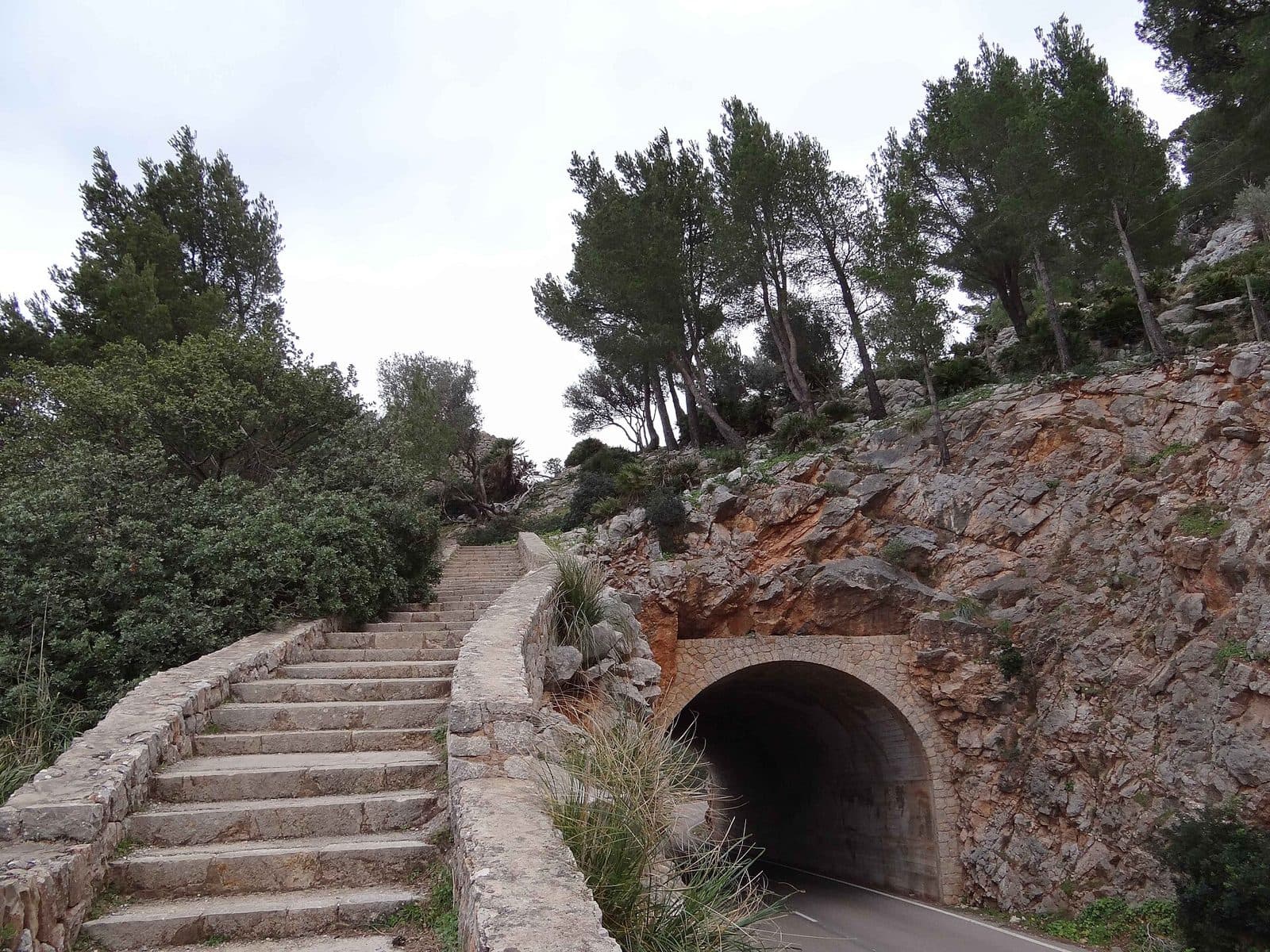
Mirador Ricardo Roca reveals its appeal as soon as the perspective changes. One moment, bends, rock faces, and roadside walls dominate the scene; after climbing the steps, the sea lies far below the platform. The coastline, the slopes of the Tramuntana, and the open horizon come together in a panorama that is especially appreciated late in the day. In clear conditions, the Mirador is therefore a popular place to watch the sunset.
The stop is worthwhile for travelers driving along the Ma-10 between Estellencs and Andratx, as well as for day-trippers visiting Estellencs. Because the viewpoint, tunnel, steps, and parking options are close together, the visit can easily be incorporated into a drive through the southwestern Tramuntana. At the same time, the setting should not be underestimated: the platform sits on a steep coastal slope, and access is via steps.
What distinguishes the site from an ordinary roadside stop is its history. The Mirador was created as part of an early effort to open up the mountain landscape to tourism. A dedication that is now difficult to read commemorates Ricardo Roca and the role that organized excursions and new road connections played in shaping how Mallorca was experienced.
History and significance
The 1919 viewpoint
The viewpoint was built in 1919. Its creation dates from a period when the west coast was becoming increasingly accessible by road. The new route made it possible to experience the landscape deliberately. Stopping places and viewing terraces were built at suitable points, allowing travelers to survey the coast more safely.
From the outset, the Mirador was therefore more than a chance opening beside the road. Its terrace, the supporting structure anchored to the rock, and the enclosure made from local stone show that a permanent viewpoint was intended here. Road and landscape were deliberately connected: the route passes through the mountainside, while the platform directs the view away from the confines of the bends and out toward the Mediterranean.
This idea has a longer history on Mallorca. As early as the late 19th century, Archduke Ludwig Salvator described the Balearic Islands in detail and had viewpoints built on his estates along the Tramuntana coast. The later roadside miradors adapted this principle to travel by modern means of transport. Mirador Ricardo Roca represents this transition from a belvedere-like landscape site to a purposefully accessible stop on a mountain road.
Ricardo Roca and the 1923 dedication
A weathered inscription gives the site its personal significance. The stone roughly reads: “Mirador Ricardo Roca, in memory of the unforgettable president of the Fomento de Turismo, year 1923.” The Fomento de Turismo de Mallorca was among the institutions that promoted excursions, appreciation of the landscape, and Mallorca’s development as a tourist destination from an early stage.
Local accounts honor Ricardo Roca as a promoter of excursions on Mallorca. The Mirador therefore commemorates neither a ruler nor a military event, but the organized discovery of the island by travelers and hikers. The chronology is noteworthy: the viewpoint is dated to 1919, while the commemorative inscription names the year 1923. The site therefore already existed before the explicit dedication to Ricardo Roca was installed.
Today, the viewpoint is also known as Mirador des Grau. This name refers to its local setting and the immediately adjacent tunnel des Grau. Both names refer to the same Mirador above the coastal road near Estellencs.
What to see
The viewing terraces
At the top, the views are spread across two areas from which the coastal landscape can be seen from slightly different angles. The defining impression comes from the height above the sea: below the platform, the terrain drops steeply toward the coast, while behind and beside the viewpoint rise the rocky slopes of the Serra de Tramuntana. In the distance, the view fades into the open horizon.
Different lines stand out depending on where you stand. In one place, the expanse of the Mediterranean dominates; in another, the layers of rock, vegetated slopes, and course of the coastline are more clearly visible. The valley and the landscape around Estellencs are also part of the panorama. The Mirador does not showcase one famous rock formation but an entire stretch of coast—which is precisely why it is worth exploring beyond the first open viewing spot.
In the late afternoon, the sinking light changes the appearance of the rock faces. Gray and rust-colored sections become more pronounced, while the sea appears darker. In clear conditions, the sun sets over the western horizon. This unobstructed west-facing view explains why the Mirador is regularly recommended as a sunset spot.
Parapets and supporting structure
The platform was built directly against the rocky edge. The parapets and edging stones are made from local limestone; below them, concrete elements stabilize the structure against the natural rock. This transition is characteristic of early roadside miradors: from above, the terrace appears simple and closely integrated with the landscape, but its position actually depends on engineering that secures the steep mountainside.
The roadside walls and surrounding terraces also display the Mallorcan dry-stone tradition known as pedra en sec. In this method, stones are carefully layered without mortar. This construction technique shapes large parts of the Serra de Tramuntana and was recognized by UNESCO as intangible cultural heritage in 2018. At the Mirador, these traditional stone structures stand alongside the more modern interventions of road construction.
It is therefore worth looking at the walls, edging stones, and substructure. The viewpoint tells a story not only of beautiful scenery but also of how difficult it was to build a road and a safe stopping place on this coast. Natural stone allows the structure to blend visually into the slope, while its engineered supports make it possible to stand safely at the rocky edge.
The small caseta
There is a small caseta at the site.
The memorial stone for Ricardo Roca is also located at the Mirador. Age and weather have made its lettering difficult to decipher. Yet this unobtrusive detail explains the site’s name and refers to the Fomento de Turismo and the year 1923. It is worth examining the stone up close rather than mistaking it for an ordinary part of the wall.
Steps and tunnel des Grau
Access is via steps leading from the road up to the viewpoint. These do not cover the full height of the cliff; the starting point is already far above the sea. Nevertheless, the steps are an essential part of the experience. With each section, the view moves farther away from the road and parking area until the platform above the coast is reached.
The small tunnel des Grau runs directly below or beside the Mirador, carrying the Ma-10 through the rocky slope. Road, tunnel, and terrace consequently form a striking ensemble. The tunnel is not a separate attraction, but it makes the location of the Mirador easy to recognize and shows how tightly the route had to be fitted between the mountain and the coastal drop.
Visiting the viewpoint
From the roadside stop to the platform
The visit begins not with a long hiking trail but on the Ma-10. After parking the vehicle, the route leads up the steps. Even this short climb provides some separation between the viewing terrace and the road traffic. At the top, visitors can explore both viewing areas, the caseta, the memorial stone, and the different perspectives in turn.
A brief stay is enough for a simple photo stop. Those who want to find the inscription, examine the structure, and experience the panorama from both areas should allow more time. There is no fixed visit duration; it depends primarily on visibility, weather, and daylight. Around sunset, a short stop can easily turn into a longer pause as the atmosphere over the sea and rocks continually changes.
Sunset and clear views
Late in the day is the most atmospheric time to visit. The platform faces west and, under clear skies, offers an unobstructed view of the sunset over the Mediterranean. At the same time, the contours of the coast become more distinct in the lower light. Visitors mainly interested in photography will find different subjects then than in the harsher daytime light.
However, the Mirador is not guaranteed to be quiet at this time of day. Tour groups and excursion vehicles also use the stop; during the summer season, it can become livelier, especially around the neighboring restaurant. Those who want a quieter experience should avoid typical excursion times and arrive before the final minutes preceding sunset. It is not practical to specify an exact time because daylight conditions change with the seasons.
A stop, not a full-day itinerary
Mirador Ricardo Roca is intentionally compact. Its strength lies in the immediate transition from the winding Ma-10 to a high terrace above the sea. The site is therefore particularly suitable as a stop on a drive through the Tramuntana or as an addition to a stay in Estellencs.
Even without a long visit, the impression is striking: the tunnel and road disappear behind the platform, while the west coast opens beyond the parapet. Those who take a little time to appreciate this shift in perspective will experience the Mirador as a landscape destination rather than a quick photo stop.
Getting there and parking
From Palma and the airport to Estellencs
From Palma Airport, the recorded route follows Ma-20, Ma-1110, and Ma-1120 to Estellencs. The road distance is 41 kilometers, and the drive takes around 59 minutes. These figures explicitly apply only as far as Estellencs; the Mirador is outside the village on the Ma-10 toward Andratx.
From central Palma, the route via Ma-1110, Ma-1120, and Ma-10 to Estellencs covers 36 kilometers by road. The drive takes around 64 minutes. This distance and driving time also end in Estellencs. For the final section, continue southwest on the Ma-10 toward Andratx.
The different driving times despite the similar distances are explained by the nature of the mountain roads. On the Ma-10 in particular, bends, gradients, and the narrow route along the Tramuntana determine the pace. The journey is therefore part of the excursion, but it requires more attention than an ordinary drive on broad main roads.
The final section on the Ma-10
The Mirador is located about 4 kilometers outside Estellencs. From there, the Ma-10 runs toward Andratx through the mountainside. The small tunnel des Grau is a useful landmark: the viewpoint is directly above it or in its immediate vicinity. After leaving the tunnel, there is a place to pull over on the left-hand side; slightly farther uphill is the Restaurant Es Grau with another small parking area.
Because parking spaces are limited and located on both sides of the road, traffic should be observed carefully before turning. Especially when excursion traffic is heavier, it is advisable not to stop abruptly. Access to the platform is then via the steps.
Parking and public transport
Two small parking areas are described in the immediate vicinity of the viewpoint, one on each side of the road. One of them is near the Restaurant Es Grau. This makes the Mirador convenient as a roadside stop, but it does not offer the capacity of a large visitor parking lot. During the summer season, the few spaces can therefore fill quickly.
No bus stop is recorded in the immediate vicinity of the viewpoint. When planning a journey by public transport, visitors should therefore not assume that they can get off directly beside the platform. The Mirador is primarily designed for arrival via the Ma-10 followed by a short walk from the road.
Nearby places
Estellencs
Estellencs lies between the sea and the steep slopes of the western Serra de Tramuntana. The village is an obvious starting point for the Mirador, but it is more than a simple landmark on the map. Stone buildings, narrow lanes, and the hillside setting define its appearance.
A walk through Estellencs can easily be combined with the viewpoint before or afterward. This creates a vivid contrast: in the village, the landscape is framed by houses, lanes, and slopes, while at the Mirador it opens toward the sea. Those staying longer in the area can also consider descending to Cala Estellencs or hiking nearby.
Serra de Tramuntana
The Mirador lies within the cultural landscape of the Serra de Tramuntana, which was added to the UNESCO World Heritage List in 2011. Its significance comes not only from the mountain environment but from the centuries-old interaction of terraces, dry-stone walls, paths, and water management. Parts of this human-shaped mountain landscape can be seen from the road and the viewpoint.
The area around Estellencs offers several options for hikers. Routes toward Puig de Galatzó and the Camí des Correu are among those mentioned. The Mirador works well as a brief scenic stop before or after an independently planned hike.
Banyalbufar and Torre des Verger
Travelers continuing northeast from Estellencs on the Ma-10 reach the terraced landscape of Banyalbufar. There, walls, water channels, and reservoirs show particularly clearly how the steep slopes were used for agriculture. The origins of these irrigation structures date back to the Andalusian period before the conquest of Mallorca in 1229.
In the same coastal region stands the Torre des Verger, also known as Torre de ses Ànimes, a historic watchtower. It was completed in 1579 as part of the effort to protect the coast against attacks by North African corsairs. The tower is not part of Mirador Ricardo Roca and should not be confused with its small caseta. As a separate stop along the coastal route, however, it can easily be included in an excursion through the western Tramuntana.
The place it belongs to
Estellencs in the place guidePractical visitor information
Footwear and steps
The climb is short but involves steps. The Mirador is not level with the parking area, even though it is reached directly from the road. Anyone expecting a completely effortless stop after leaving the vehicle should take the stepped access into account when planning the visit.
At the platform, the terrain ends at a steep coastal slope. Parapets mark the designated viewing areas; there is no need to climb over walls or step beyond the structure toward the rocky edge for photographs. Because of the steps, road, and drop, children require continuous supervision.
Weather and visibility
The value of the visit depends heavily on long-range visibility. In clear conditions, the view extends far across the Mediterranean and along the coast; haze or low clouds can significantly restrict the panorama. Because this is an exposed viewpoint above the sea, current weather conditions should be considered before driving through the Tramuntana.
For sunset, it is worth not waiting solely for the moment when the sun reaches the horizon. Even beforehand, lower light changes the appearance of the rocks and makes the coastal contours stand out more strongly. Arriving earlier also leaves enough time to find a parking space, climb the steps without rushing, and explore both viewing areas.
What not to expect at the site
The Mirador is not a tower, although the elevated platform and small caseta can create that impression in some photographs. An earlier fortification on the same site is occasionally suggested, but this has not been confirmed. The visible ensemble should be understood as a 20th-century viewpoint.
The historical information is found primarily in the difficult-to-read memorial inscription, the construction, and the location on the old mountain route. This is precisely why paying attention is worthwhile: visitors who photograph only the panorama and leave immediately may miss the connection between road building, early excursion tourism, and the dedication to Ricardo Roca.
Local insider tips
Look for the memorial stone
The weathered dedication stone is near the small caseta. Its inscription is difficult to read, but it names Ricardo Roca, the Fomento de Turismo, and the year 1923—the key detail in the history of the Mirador.
Arrive before sunset
The unobstructed western view makes the Mirador a popular sunset spot. Arriving earlier leaves time to find parking, climb the steps, and visit both viewing areas before excursion traffic increases late in the day.
Explore both viewing areas
The Mirador has two viewing areas. Rather than turning back at the first parapet, it is worth changing position: from one spot, the open expanse of sea dominates, while from the other, the coastline, rocks, and Tramuntana slopes stand out more clearly.
Use the tunnel as a landmark
The small tunnel des Grau is the most reliable landmark on the Ma-10. The Mirador is directly beside it; parking options are located at the tunnel exit and slightly farther uphill by the Restaurant Es Grau.
Combine it with Estellencs
The viewpoint lies around 4 kilometers outside Estellencs. A walk through the village before or after the stop reveals the same landscape from a different perspective: narrow lanes and stone houses instead of an open horizon above the coast.