
Torre del Verger: Watchtower and Viewpoint near Banyalbufar
.jpg)
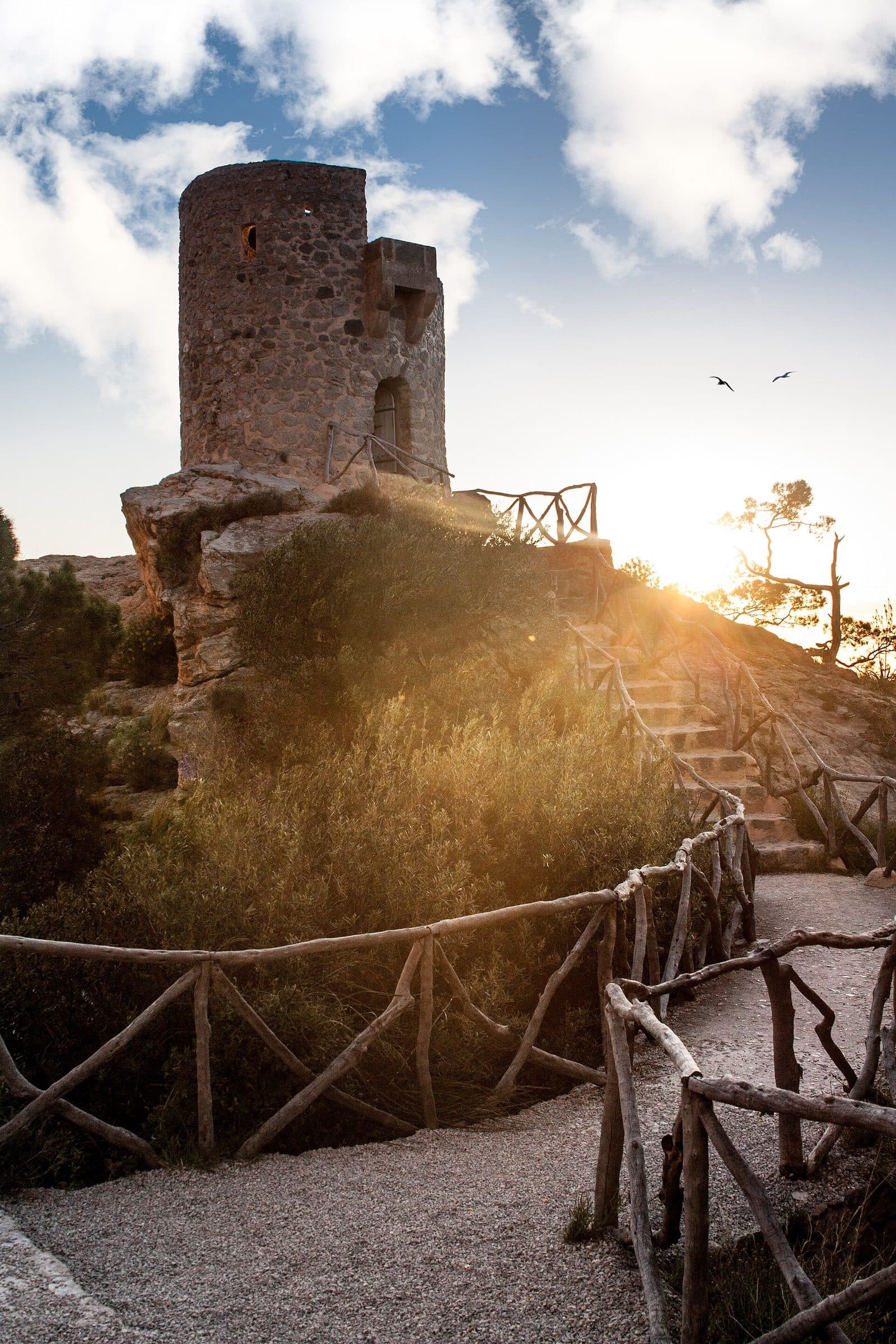
The Torre del Verger stands on a rocky promontory above the west coast, so close to the precipice that its former purpose is immediately clear: from here, guards could survey a vast expanse of sea. Today, no one comes to watch for pirate ships. The old watchtower near Banyalbufar is now a viewpoint where Mallorca’s rugged side reveals itself with particular force.
Below the tower, the Serra de Tramuntana drops steeply toward the Mediterranean. Road, rock and historic architecture lie close together, making the visit an ideal short stop on a drive along the Ma-10. Those who take a little more time, however, will discover more than a picturesque backdrop: arrow slits, a machicolation, the narrow internal staircase and the open platform tell of a coastal watch service that once consisted of long hours of observation.
The tower is also known as Torre de ses Ànimes and Talaya de ses Ànimes – the “Tower of Souls.” Other recorded names include Talaya des Verger, Talaya des Coll d’en Verger, Talaya de Banyalbufar and Sa Torreta. The many names suit a structure that served for centuries as a landmark, warning post and, eventually, observation tower.
The Torre del Verger is especially worthwhile for travelers who enjoy experiencing scenery and history in the same place, for photographers, and for anyone who wants to do more than simply drive through the Tramuntana between Banyalbufar and Estellencs. The actual visit is compact. Its impact comes from the setting: the open sea below, the folded coastline to either side and the steep mountain slopes behind.
History and significance
The watch post from the 16th century
When the Torre del Verger was built in the 16th century, the sea off Mallorca was not merely a trade route and source of livelihood. Pirate attacks threatened the coastal settlements, and approaching ships had to be spotted as early as possible. The rocky promontory near Banyalbufar offered a crucial advantage: from its edge, the view extends far across the water and along the coast. What appears today as an impressive panorama was then a working area that had to be watched constantly.
The tower formed part of Mallorca’s network of watchtowers and signal towers. The individual posts were positioned so that warnings could be relayed from tower to tower. In times of danger, the guards used smoke by day and fire by night; flags are also mentioned as signaling devices. In this way, news of a sighting traveled along the coast until larger settlements could respond and mobilize defenders. The Torre del Verger served primarily as an observation and signal post. It did not have an artillery battery.
Keeping watch without a soldier’s daily life
According to historical accounts, the men stationed at the tower were not permanently deployed professional soldiers. Farm workers from the surrounding area took turns performing watch duty. This background changes how the structure is perceived: behind the arrow slits stood people whose everyday lives normally unfolded in fields and on terraces and who periodically assumed responsibility for the coast’s safety.
The work required constant attention and clear lines of sight. Long before modern communications could transmit a message in seconds, a smoke signal had to be noticed, interpreted correctly and repeated at the next tower. The setting of the Torre del Verger illustrates this system more clearly than any map. From the platform, it becomes apparent why visibility mattered more than comfort and why a small, sturdy tower was sufficient in this location.
From warning system to observation tower
As the threat of piracy declined, the coastal watchtower network lost its original purpose. In the 19th century, the Torre del Verger was still occasionally used for patrols against smugglers and other lawbreakers. Afterward, the military observation post gradually became a historic structure valued primarily for its location, state of preservation and connection to the island’s former coastal defenses.
Around 1875, Archduke Ludwig Salvator von Österreich-Toskana acquired the tower. The Habsburg frequently stayed on Mallorca while conducting his scientific and regional studies and owned several estates along the Tramuntana coast. He is said to have regarded this spot as offering the best view of Mallorca’s coastline. The Torre del Verger was later extensively restored and is therefore one of the island’s well-preserved historic defensive towers. Today, it once again fulfills a version of its former purpose: people climb to the top, look out to sea and read the coastline – though now without fear of attack.
What to see
The round tower
Up close, the Torre del Verger appears more compact than its striking silhouette above the sea suggests. The round structure has a diameter of approximately four meters. It was built from yellowish limestone found in the surrounding area. As a result, the tower does not stand out sharply from the rock but seems to have grown from the same material. Its form reflects not a desire for grandeur but the need to withstand wind, weather and possible attacks.
The masonry bears the marks of age, yet its essential structural features remain clearly recognizable. Small openings pierce the massive walls. They were not intended to create a bright interior but to allow protected observation and defense. Anyone walking around the tower should therefore look at more than the coastline: the contrast between the narrow slits and the seemingly limitless sea makes the tower’s former use particularly tangible.
Entrance and machicolation
A projecting machicolation sits above the entrance. From there, the access point directly below could be defended with projectiles. The feature is small but historically revealing. Although the tower’s main purpose was to report what was approaching across the sea, its entrance also had to be protected if a threat reached the watch post. For today’s visitors, the doorway marks the transition from the expansive landscape to the interior: outside, the horizon and rocky coast dominate the view; inside, stone walls, stairs and small openings crowd closely together.
Internal staircase and platform
An internal staircase leads to the upper platform. At the top, the space suddenly opens up again. The platform is open to the sky, turning the tower into a genuine viewpoint rather than merely a monument viewed from outside.
From here, the coastline can be surveyed in both directions. Below the rocky promontory, the land drops steeply toward the Mediterranean; inland, the slopes of the Serra de Tramuntana rise upward. In clear conditions, regional tourism information states that the panorama extends along the coast from Dragonera toward Sóller. At least as revealing is the view of the immediate terrain: coves, headlands and steep flanks explain why coastal surveillance had to be organized from elevated points.
The viewpoint at the foot of the tower
The view does not begin only on the platform. Even at the foot of the Torre del Verger, a broad panorama opens across the sea and west coast. This matters if the tower is temporarily inaccessible or the narrow climb is not an option: the scenic impact of the place remains intact from the rocky promontory.
For photographs, two very different perspectives are available. From the surrounding area, the round tower appears as a stone silhouette against the sea and sky. From its platform, by contrast, the coastline itself becomes the subject. Late in the day, the Torre del Verger often takes center stage in sunset photographs. However, this is also when particularly large numbers of visitors arrive with the same plan. Anyone who wants to examine the masonry and defensive details in peace should therefore not focus exclusively on the evening.
Its position in the landscape
Only about fifty meters separate the tower from the Ma-10, yet its position feels considerably more remote from the viewpoint. The rocky promontory conceals part of the road, while the sea fills almost the entire field of vision. This proximity between an accessible scenic road and an exposed coastal setting makes the place so unusual: a short path leads into a landscape that appears vast and untamed from the tower.
The architecture cannot be meaningfully separated from this setting. Elsewhere, the Torre del Verger would be a small round tower made of limestone. Here, it becomes an instrument of vision. Every slit, the open platform and even the orientation of the entrance belong to a structure whose significance emerges from the horizon.
Visiting the tower
From the roadside to the tower
The visit begins on the Ma-10 between Banyalbufar and Estellencs. A short path leads from the nearby viewpoint or parking area to the rocky promontory. Even during the approach, the tower appears from changing angles: first as a compact stone shape above the coast, then with its entrance, slits and machicolation visible. Although the path is not long, it is worth seeing it as more than simply access to the platform. The exterior views are among the best ways to appreciate the structure and setting together.
At the tower, visitors usually walk around the structure, take in the view from its base and – if access is currently possible – climb the internal staircase. The attraction is not a museum with a prescribed route. Instead, the experience depends on how long visitors want to observe the coast, take photographs or examine the architectural details.
Time required and crowds
As a single attraction, the Torre del Verger remains a compact stop. Anyone who merely wants to see the viewpoint and take a few pictures will need considerably less time than someone examining the masonry, climbing to the platform and waiting for changing light. An exact visit duration would therefore be of little help. The tower can easily be included as a stop on a Tramuntana road trip; combined with Banyalbufar, it can become a longer excursion.
Sunsets are especially popular here. The warm backlight, the tower’s silhouette and the open sea horizon attract photographers and day-trippers, meaning that the parking area and viewpoint may be busier late in the day. Arriving early makes it easier to find a parking space. Those mainly seeking peace, unobstructed views of the structural features and less competition for photography spots will usually be better served by visiting earlier in the day than during the particularly popular sunset period.
Check current access
It is advisable to check current access before setting out. This applies especially to the interior and platform, as recent reports mention temporary construction work and periods when the tower was closed. Even when the tower is closed, the viewpoint at its base remains the main scenic experience. However, anyone traveling specifically to use the internal staircase and platform should not assume that they will be accessible without restrictions. A quick, up-to-date check prevents the disappointment of seeing the historic tower while being unable to make the planned climb.
Getting there and parking
From Palma Airport
The recorded route from Palma Airport to Banyalbufar follows the Ma-20, Ma-1110 and Ma-1120. The route covers 39 road kilometers, and the journey takes around 77 minutes. These details expressly end in Banyalbufar rather than directly at the Torre del Verger. From the village, continue for approximately one kilometer along the winding Ma-10 toward Estellencs until reaching the viewpoint by the tower.
The relatively long journey time compared with the distance is due to the roads of the Serra de Tramuntana. After leaving the urban road network, the route follows winding sections, passes through settlements and enters narrower stretches. Especially on the final section, drivers should not attempt to make up lost time. Cyclists, oncoming traffic and sudden braking by other day-trippers require close attention.
From central Palma
From central Palma, the recorded distance to Banyalbufar is 34 road kilometers. The journey takes around 82 minutes and follows the Ma-1110, Ma-1120 and Ma-10. Here too, the journey time applies only as far as Banyalbufar. It is then a short, winding drive along the Ma-10 toward Estellencs to reach the Torre del Verger viewpoint.
The Ma-10 is part of the experience, but it is not a road suited to a tightly scheduled itinerary. Dry-stone walls, bends and limited visibility set the pace. Anyone hoping to reach the tower for sunset should therefore allow a generous buffer. Not only the drive but also the search for a legal parking space can take time late in the day.
Parking at the viewpoint
A designated parking area lies near the Torre del Verger, and the short approach to the tower begins there. Parking capacity is limited, and the area can fill quickly at popular visiting times. Drivers should stop along the Ma-10 only where the vehicle can be parked completely off the road and legally. Braking abruptly for a photograph also endangers following traffic on the winding road.
There have been repeated reports of attempted break-ins involving vehicles in the parking area. Valuables should therefore be left neither openly visible nor supposedly well hidden inside the car. Bags, camera cases and navigation devices can attract attention even when seen from outside. The short walk to the viewpoint is no reason to leave the car without taking precautions.
Arriving by bus
The Torre des Verger stop lies directly in the area of the attraction and is the most convenient option for arriving without a car. There are also stops in Banyalbufar and near Planícia. As timetables may vary depending on the season and day of the week, current services and the return journey should be checked before departure.
Taking the bus eliminates the search for parking, but it also makes the day more dependent on the timetable. For an evening visit in particular, it is important to determine whether a suitable service still runs after sunset. Anyone wishing to combine the tower and village can make use of the different stops but should not regard the winding Ma-10 as a pleasant walking route between arbitrary points.
Bus lines to Torre del Verger at a glance
| Line | Route | Departures/day | First | Last |
|---|---|---|---|---|
| 202 | Estellencs - Palma | 157 | 06:42 | 21:31 |
| 131 | Santa Ponça - Banyalbufar | 14 | 11:17 | 16:21 |
From the official GTFS feeds (TIB/SFM), no real-time data. The figures cover all stops in the town; weekend and holiday services differ — check with the operator before travelling.
Getting there by bus
Torre des Verger (7004) · 0.1 km as the crow flies
- 131Santa Ponça - Banyalbufar · Daily
- 202Estellencs - Palma · Daily
Banyalbufar 1 (7002) · 1.2 km as the crow flies
- 131Santa Ponça - Banyalbufar · Daily
- 202Estellencs - Palma · Daily
Banyalbufar 2 (7003) · 1.2 km as the crow flies
- 131Santa Ponça - Banyalbufar · Daily
- 202Estellencs - Palma · Daily
Planícia (7014) · 1.3 km as the crow flies
- 131Santa Ponça - Banyalbufar · Daily
- 202Estellencs - Palma · Daily
Miramar 1 (7015) · 1.7 km as the crow flies
- 131Santa Ponça - Banyalbufar · Daily
- 202Estellencs - Palma · Daily
Miramar 2 (7006) · 1.7 km as the crow flies
- 131Santa Ponça - Banyalbufar · Daily
- 202Estellencs - Palma · Daily
Timetable data: official GTFS feeds (TIB/EMT), no real-time — check with the operator before travelling.
Nearby
Banyalbufar
Banyalbufar lies approximately one kilometer from the Torre del Verger and is the most obvious addition to a visit. The village sits between the slopes of the Serra de Tramuntana and the sea. Its agricultural terraces are particularly distinctive, dividing the steep terrain into narrow, usable plots. From the tower, the coast appears vast and forbidding; in the village, it becomes clear how people made this landscape habitable and farmable over long periods.
A walk through Banyalbufar therefore provides an effective contrast to the watchtower. At the Verger, the focus is on the horizon, signals and defense; in the village, it is on walls, slopes and everyday paths. Combining both places provides a better understanding of the tower’s historical role: it did not protect an abstract stretch of coast but an inhabited and cultivated landscape.
Cala de Banyalbufar
Below the village lies Cala de Banyalbufar, a small pebble cove reached by descending from the village. It makes a scenic addition when the sea is calm and there is enough time for the walk down and the climb back up. From the tower, the coast is viewed from the guards’ perspective; at the cove, the rock walls and water meet at eye level.
The tower, village and cove should not, however, be compressed into an overly tight schedule. The changes in elevation and winding approach make a leisurely pace more sensible. Especially in summer, it is more pleasant not to schedule the viewpoint and descent to the coast during the hottest part of the day.
Ma-10 toward Estellencs
Following the Ma-10 south past the tower leads to Estellencs and further stretches of the Tramuntana coast. In the opposite direction, the road returns to Banyalbufar and continues toward Esporles and Valldemossa. The Torre del Verger therefore works well as a clearly defined stop during a drive through the western mountain range. Its particular strength is the broad overview it offers within such a compact area.
The place it belongs to
Banyalbufar in the place guidePractical information for your visit
Footwear and terrain
Only a short path separates the parking area, viewpoint and tower, but the ground is uneven in places. Sturdy, well-fitting shoes are more suitable than smooth-soled sandals. This is especially true if the tower can be climbed: the historic internal staircase is narrow and requires more care than a modern staircase.
The condition of the path is easily underestimated during a quick photography stop. When looking out to sea, it is easy to lose sight of the ground. Stopping before raising a camera or phone is safer and usually also makes it easier to find a better composition.
Wind, sun and weather
The rocky promontory is exposed above the sea. The wind is clearly noticeable there, and the open upper platform offers none of the shelter of an enclosed space. A light windproof layer can therefore be comfortable even on an otherwise mild day. Loose hats and lightweight objects should be secured so that they cannot blow over the wall or toward the coast. In poor weather, the exposed setting loses its straightforward character: wet stone, gusts and limited visibility are all reasons not to force the climb.
Visiting with children
For children, the idea of an old pirate warning post can make the tower particularly vivid. Smoke signals by day, fire by night and the relay of a warning from tower to tower can be connected directly with the view along the coast. The visit is short enough to fit easily into an excursion that also includes Banyalbufar.
However, the position on a steep coastal slope and the narrow staircase require constant supervision. Children should be kept close on the rocky promontory, near wall edges and on the platform. A viewpoint of this kind is not an enclosed play area; the appeal of its open setting is also the reason children should not be allowed to roam unsupervised.
What to expect
Visitors will see a small historic watchtower, its defensive details, the internal staircase and, above all, the landscape it was built to monitor. This concentration is precisely what makes the visit compelling. Anyone expecting a monumental fortress may dismiss the Torre del Verger too quickly. Those who interpret the arrow slits, machicolation and platform as components of a functioning communication system will find a great deal of history within a very small space. Before setting out, simply check whether the interior and platform are currently accessible.