
Torre de Cala Figuera: Coastal Watchtower near Sol de Mallorca
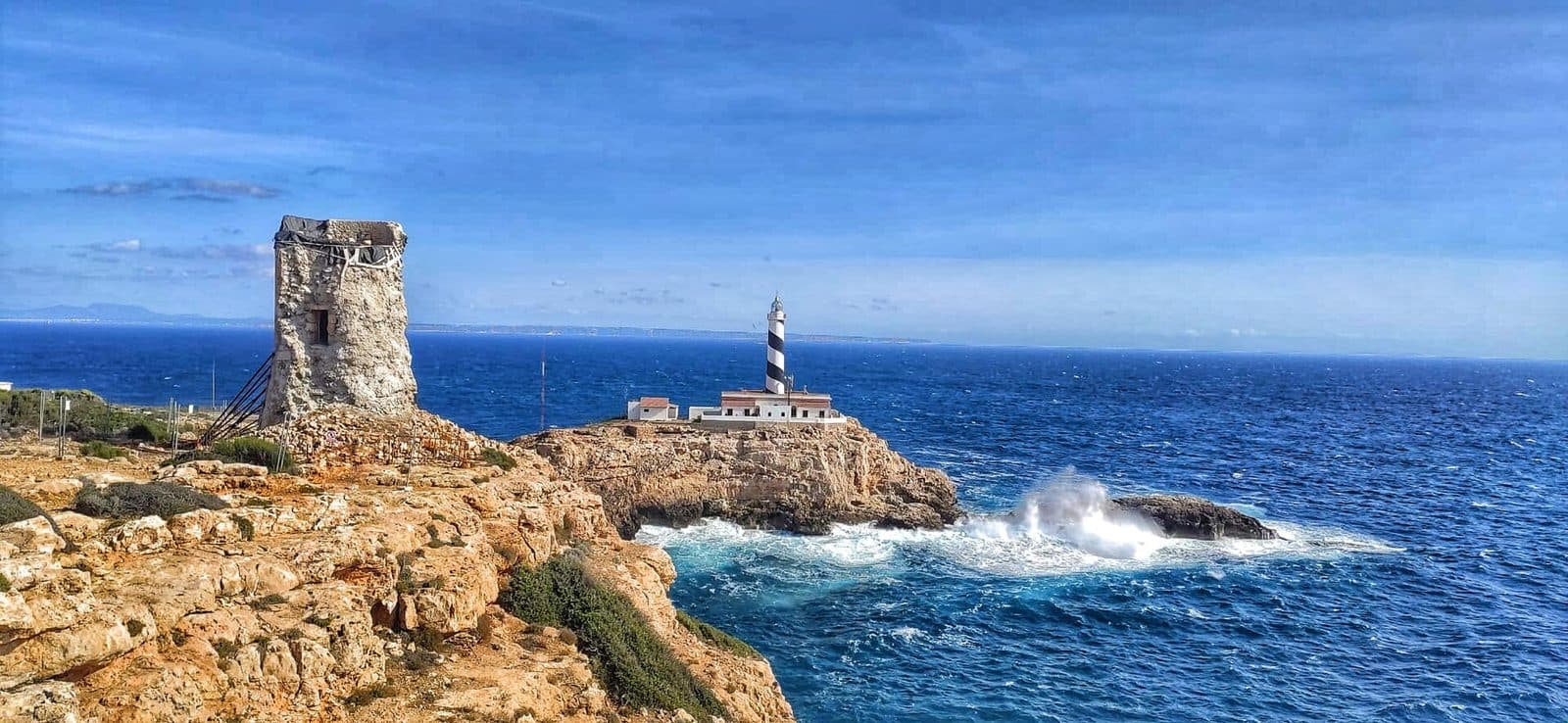

On the rocky headland south of Sol de Mallorca, Torre de Cala Figuera overlooks a particularly quiet stretch of the southwest coast. The historic coastal watchtower, the neighboring military remains, and the views across coves and the open sea make this destination far more than a quick photo stop. Even the approach is part of the experience, as the final stretch must be covered on foot or by bicycle.
Visitors should not expect a developed attraction with an exhibition and visitor services. At Cap de Cala Figuera, landscape and history stand side by side: Mediterranean vegetation, a rocky coast, a centuries-old defensive tower, bunkers, and the nearby lighthouse. The seclusion is part of the appeal, but it requires some preparation. Torre de Cala Figuera is therefore especially suitable for visitors who enjoy combining viewpoints with a short hike. Photographers appreciate the broad sea panorama and the late-afternoon light, while history enthusiasts will recognize the tower as a surviving part of the former coastal defense system. The site is described as considerably quieter on weekdays than on weekends.
The name can easily cause confusion: this article refers exclusively to the watchtower at Cap de Cala Figuera near Sol de Mallorca in the southwest. The fishing village of Cala Figuera near Santanyí lies in the southeast of the island and is a different destination.
History and significance
When Torre de Cala Figuera was built between 1579 and 1582, its location was not a romantic viewpoint. From the rocky cape, guards were expected to watch the sea and nearby coves. The tower belonged to a chain of coastal posts in southwest Mallorca designed to warn of pirate attacks and protect vulnerable sections of the coast. Torre des Morro, Torre de Rafeubetx, and Torre de Malgrat are also mentioned as part of this regional system.
The coastal watch system
The tower’s strength lay in its commanding position. From the headland, guards could monitor the transition between smaller coves and the broad Bay of Palma. Historical records mention tower guards and weapons stationed at the post. Torre de Cala Figuera was therefore not merely a signaling point but a staffed part of the coastal defense system.
Its purpose is easiest to understand today by looking from the structure toward the coastline. The position on the promontory provides a wide view across the sea while keeping the indentations of the nearby coast visible. What now impresses visitors as a panorama was once a working area that guards had to scan constantly for suspicious sails.
Repairs while the tower remained in service
The surviving records show how severely wind, moisture, and the exposed location affected the structure. Work was carried out on the tower in 1643. In 1672, the portal and guard niche were repaired, and the building was replastered. When its poor condition was documented in 1750, another restoration began. The surviving contract mentions cracks and plasterwork, the guard niche, the sheltered entrance area, and parts of the floor.
This did not mark the end of the damage: repairs were still outstanding in 1754, and a significant crack in the seaward-facing wall was recorded in 1794. The cistern was also leaking—an urgent problem at an isolated watch post whose crew depended on stored supplies. In 1876, the tower, by then already in poor condition, was sold at auction.
From defensive structure to cultural monument
Torre de Cala Figuera lost its military purpose long ago. As a historic defensive tower, however, it remains tangible evidence of a period when Mallorca’s coast was protected through lines of sight and a network of watch posts. On 22 June 2015, its declaration as a Spanish cultural heritage asset was published in the official state gazette. Its present-day value lies not only in the masonry but also in how clearly the original purpose of the location can still be understood: tower, cape, coves, and sea together explain why a watch post was needed here.
What to see
The first impression is formed not inside a building but outside on the cape. The small historic tower rises above the rocky shoreline against a broad expanse of sea. Its restrained stone architecture appears almost inconspicuous from a distance; only when standing on the site does it become clear how deliberately the location was chosen. From here, views open across several coastal inlets and toward the Bay of Palma.
Torre de Cala Figuera
The tower is the historic focal point of the site. It belongs to Mallorca’s traditional coastal defense architecture and was built for observation and protection, not as a prestigious building. Its impact therefore comes primarily from its compact form and location on the rocky promontory. The structure was designed to provide an overview of the surrounding landscape while offering its guards a protected post.
Do not expect a conventional museum tour through furnished rooms. Much of what is known about the former interior comes from repair records: they mention the portal, a guard niche, the sheltered entrance area, the floor, and a cistern. These terms indicate the practical requirements the post had to meet, but they should not be understood as a list of structural features that are now fully accessible. A visit focuses primarily on viewing the historic tower from the outside.
The viewpoint on the cape
The most important “room” at Torre de Cala Figuera is the surrounding landscape. The location provides views of the open sea, the Bay of Palma, and several smaller coves along the headland. Rocky surfaces and Mediterranean scrub frame the panorama, while buildings and tourism infrastructure attract little attention along this section of coast.
Photographers should avoid shooting the tower only from the front. Moving just a few steps can significantly change the relationship between the masonry, coastline, and horizon. The site is especially appreciated in the late afternoon and around sunset because of the warm light. Passing boats and seabirds can also be observed from the headland. Near the cliff edge, however, keeping a safe distance is more important than capturing a supposedly perfect image.
The bunkers and military remains
Remains of military use can be found around the historic watchtower. These include bunkers and an abandoned military complex. Together with the defensive tower, they reflect the military use of this stretch of coast for surveillance and protection.
Some bunkers are described as freely accessible and possible to enter. This should not, however, be treated as an invitation to explore underground areas without preparation. Tunnels also run through the former military base, and their condition and layout cannot be reliably assessed during a normal viewpoint visit. Anyone coming primarily to see the tower can view the military remains from outside and stay on the visible paths.
Faro de Cala Figuera
Faro de Cala Figuera stands near Torre de Cala Figuera and remains an operational, automated lighthouse. Because they are neighbors, the watchtower and lighthouse are sometimes perceived as a single ensemble, but they served different purposes: Torre de Cala Figuera protected the coast, while Faro de Cala Figuera supports navigation at sea.
Access to the lighthouse itself is restricted. It can therefore be viewed as part of the coastal scenery, not as an attraction that visitors can enter. This clear distinction helps explain the site: the historic tower tells of human guards and the threat of pirates, while the modern lighthouse operation represents technical guidance for shipping.
Visiting Torre de Cala Figuera
A visit begins where the drive ends. Cars cannot continue beyond the access gate; the route to Torre de Cala Figuera must be completed on foot or by bicycle. The paved route runs through wooded terrain and is about 3 kilometers long. Allow around 25 to 30 minutes for this section. Anyone walking should account for both directions and leave enough time to spend at the cape.
The direct route
The paved access road is the simplest option. It is suitable for visitors who care more about the tower and views than about taking a longer coastal hike. The route is easier to follow than the narrower paths through the terrain and heads toward the cape without the more pronounced uneven sections of the coastal alternative.
There is no prescribed circuit at the destination. Most visitors first look at the tower, followed by the bunkers, lighthouse, and coastline. A manageable break at the cape is sufficient for a short visit. Those wishing to take photographs, change perspectives, or examine the military remains more closely from outside will need correspondingly more time.
The coastal alternative
A route closer to the coast is more varied but also more demanding. The ground becomes more uneven, and some paths can be difficult to identify. Basic navigation is advisable for longer circular hikes through the area because clear signposts are not available everywhere. One described circular route connects Cap de Cala Figuera with places including Cova de la Mare de Déu and the abandoned military base; it covers 10 kilometers and is a separate hiking excursion, not merely an approach to the viewpoint.
Visitors who only want to see Torre de Cala Figuera do not need to take this extension. The direct paved route makes navigation straightforward and reduces the physical demands. On a longer circuit, daylight, water supplies, and the return journey should be considered from the outset; mobile phone reception may also fail in parts of the area.
Time of day and visitor numbers
In the late afternoon, the light falls favorably on the tower, rocks, and sea. Visiting at this time also avoids the strong midday sun. Sunset is attractive for photography but requires especially careful timing because the return journey from the cape still lies ahead. Anyone staying until the final light should not assume that the entire route back can be completed in daylight.
Reports draw a clear distinction between quieter weekdays and busier weekends. Those seeking seclusion are better advised to visit during the week. Current access conditions should be checked before traveling because neither reliable opening hours nor an admission price have been recorded. In particular, the absence of a listed price does not mean that every area may be entered freely; the lighthouse remains closed off.
Getting there and parking
From Palma, the journey initially heads southwest to Sol de Mallorca. From central Palma, the road distance is 18 kilometers; the drive takes around 25 minutes via Ma-1. From Palma Airport, the route follows Ma-20 and Ma-1. Sol de Mallorca is 28 kilometers away by road, with a driving time of around 26 minutes.
These distances and driving times apply specifically to Sol de Mallorca, not directly to the tower. Torre de Cala Figuera lies farther out on the headland. For the final section, follow the access route toward Camí Cala Figuera until a gate prevents motor vehicles from continuing. From there, the journey proceeds exclusively on foot or by bicycle.
The final stretch to the cape
From the gate, the direct route runs for about 3 kilometers on a paved road through woodland toward the coast. The walk takes around 25 to 30 minutes. Despite the paved surface, this is not a stop to squeeze casually between other driving destinations: the outward and return walks are an integral part of the visit, and water and sun protection should be taken from the vehicle.
An alternative approach closer to the coast offers more varied scenery but crosses more demanding terrain. Paths can be indistinct there, so visitors unfamiliar with the area should not rely solely on visible tracks. For a first visit, the paved access road is the clearer choice.
Parking at the access point
It is not possible to drive directly to Torre de Cala Figuera. Vehicles must be left before the restricted access point, so there is no parking immediately beside the structure. Park only where signs, property entrances, and the remaining road width allow it. The gate itself must remain clear.
No bus stop has been recorded in the immediate vicinity of the attraction. Visitors arriving by public transport should therefore not expect a bus to take them to the beginning of the walking route. The return journey is also essential to planning: after the visit, the route between the cape and access gate must be covered again.
Nearby places
Sol de Mallorca is the practical starting point for the visit, but the inhabited area quickly recedes into the background at the tower itself. Once visitors have passed the restricted access point, woodland, scrub, and rocky coastline dominate the scenery. This transition from a coastal residential area into a landscape that feels more remote is precisely what makes the route interesting.
Sol de Mallorca and Portals Vells
Sol de Mallorca lies close to several small coves in the southwest. A visit to the tower is best combined with Portals Vells without turning the day into a tightly scheduled sightseeing program. The coves and beaches there provide a clear contrast to the historic watch post: sheltered water and swimming areas below, and views across the open sea from the cape.
Cala Portals Vells, Cala des Reis, and the smaller coastal sections nearby can also be included in a day trip. However, the walk to Torre de Cala Figuera should not be underestimated. Anyone who spends a long time swimming first and sets off for the cape late in the day must allow enough daylight for the return journey.
Cova de la Mare de Déu
Cova de la Mare de Déu de Portals Vells lies along one of the longer hiking routes through the area. Together with the abandoned military base and lighthouse, it can form part of an extended circuit. This combination is more suitable for hikers than for visitors who simply want to see the viewpoint. Because the paths can be unclear in places, a prepared route is more important than taking spontaneous turns.
The coastal landscape at Cap de Cala Figuera
Cap de Cala Figuera is worth visiting even without any additional attraction. Rocky promontories, low Mediterranean vegetation, small coves, and the open sea form the tower’s true setting. Visitors with enough time should therefore not turn back immediately after taking the first photograph. Slowly changing perspective around the safe area of the viewpoint often explains the historic location better than any information panel: the guards could monitor both the nearby inlets and the broad expanse of sea.
Confusing the site with the harbor village of Cala Figuera near Santanyí would instead lead to an entirely different part of the island. For navigation and route planning, the additions Sol de Mallorca, Calvià, or Cap de Cala Figuera are therefore essential.
The place it belongs to
Sol de Mallorca in the place guidePractical visitor information
The cape is not a conventionally developed excursion destination. There are no visitor facilities or exhibitions at the tower and no reliable opportunity to buy supplies along the way. Anyone setting out from the gate should already have everything they need. Water and sun protection are especially important because shade is scarce along the exposed coastal section.
Footwear and route choice
Comfortable shoes with good grip are sufficient for the paved access road. Once coastal paths, bunkers, or the area around the military complex are included, sturdy footwear is the better choice. Rocky ground, loose stones, and indistinct tracks require more attention than the direct route.
Marked or clearly recognizable paths should not be left without good reason. This applies particularly near cliffs and former military installations. The easier paved route is not an inferior option: it also leads to the historic tower and viewpoint without requiring visitors to seek out difficult sections.
Sun, water, and the return journey
The coast is highly exposed to the sun, while shaded places at the destination are rare. A later visit reduces the midday heat and provides better light for photography. Anyone waiting for sunset, however, needs a reliable plan for the return journey. A flashlight should then be part of the preparation, along with a sufficiently charged battery.
Water should be calculated not only for the stay at the tower but also for the outward and return walks. The amount needed increases considerably on a longer circular hike. Mobile phone reception may fail along parts of the route; a saved map is therefore more useful than navigation that constantly depends on a data connection.
Visiting with children
When visiting with children, the main consideration is the length of the route. Although the direct access road is paved, the same distance must be covered again after the stay. Continuous supervision is necessary along the rocky coast, near the bunkers, and beside cliffs. Torre de Cala Figuera is not a playground or adventure park, and dark military cavities should not be treated as terrain for spontaneous exploration.
Families who can assess the route confidently will find the cape an instructive destination: the relationship between the view and coastal surveillance can be explained directly on site. The direct route is recommended for a simpler excursion, while the longer circular hike requires separate planning.
What not to expect
Torre de Cala Figuera has neither furnished historic rooms nor an exhibition about defense against pirates. The neighboring lighthouse is also not open to visitors. The value of the visit lies in the building’s exterior, its location, the visible military remains, and the panorama.
For that reason, the site should not be treated as a monument to be consumed quickly. Anyone allowing only a few minutes at the tower will miss the essential elements: the coastline, lines of sight, and long approach that still convey the isolation of the former watch post today.
Local insider tips
Late-afternoon light
In the late afternoon, the light falls particularly favorably on the tower, rocks, and sea. Anyone staying until sunset should plan for the return journey of around 25 to 30 minutes from the cape from the outset.
Choose the paved route for your first visit
The direct route from the access gate is about 3 kilometers long and paved. The coastal alternative offers more variety but is more uneven and harder to identify in places.
Do not photograph only from the front
The tower is easiest to understand when the coastline and horizon are included in the image. Even a small change of position shows why the watch post could monitor the coves and open sea at the same time.
Choose a weekday over the weekend
The headland is described as considerably quieter on weekdays than on weekends. This is especially suitable for visitors who want to appreciate the views and historic setting without larger crowds.
Choose the correct Cala Figuera
Search for Sol de Mallorca, Calvià, or Cap de Cala Figuera when using navigation. The well-known fishing village of Cala Figuera near Santanyí lies in the southeast and leads to an entirely different destination.