
Nostra Senyora de la Consolació in Porreres
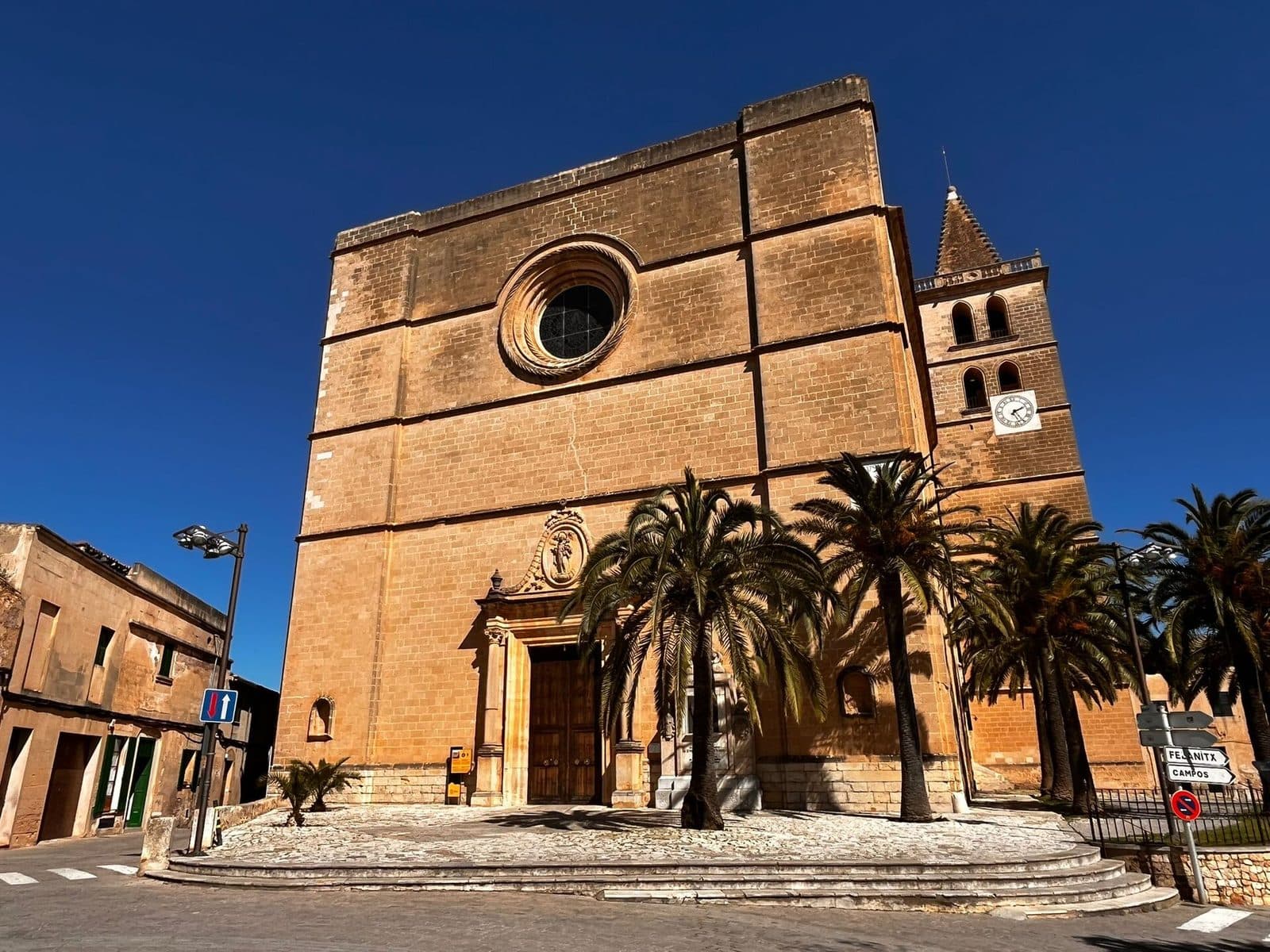

Nostra Senyora de la Consolació dominates the historic center of Porreres not through extravagant splendor, but through sheer presence. The large parish church, built of pale Marès sandstone, rises far above the low houses of the rural town. Anyone approaching it through the streets of the town center soon understands why it is often called the “cathedral of rural Mallorca.”
The comparison with a cathedral does not indicate an official status, but rather the church’s unusual dimensions and rich furnishings. Behind the comparatively austere façade lies a spacious interior with side chapels, a monumental high altar, and a dedicated Rosary Chapel that feels almost like a church within the church. A visit is particularly rewarding for travelers who want to discover Mallorca’s sacred architecture away from Palma’s famous monuments. Art enthusiasts will also find much to explore: sculptures, altars, and images of saints tell the story of several centuries of local devotion. At the same time, Nostra Senyora de la Consolació is not a museum exhibit, but the Roman Catholic parish church of Porreres.
It should not be confused with the sanctuary of the same name near Santanyí. The church described here stands in the heart of Porreres and is part of both the town’s history and its present-day life. Do not expect a hilltop viewpoint, a hermitage, or a monastic complex—the focus here is the monumental church interior and its furnishings.
History and significance
Long before the present building was constructed, Porreres already had an ecclesiastical center. A church at this location is documented in 1242 and was mentioned again a few years later in a papal document. Porreres has been an independent parish since 1277. According to the municipality, the present building is already the third church erected in Porreres within four centuries. Each church was larger than its predecessor—an illuminating sign of the community’s growth and confidence.
The new church
In the second half of the 17th century, master builder Oliver began constructing the present parish church. It was not a single project completed quickly: several decades passed before the nave was finished in 1714. This long construction period explains why the church appears to be a coherent whole while still revealing different phases in its architectural and artistic details.
The building was not constructed for a religious order, but as the parish church of the people of Porreres. Its name means “Our Lady of Consolation.” Marian devotion is clearly visible in prominent parts of the building: a relief above the main portal announces the dedication on the exterior, while inside, a polychrome statue of the Virgin dominates the high altar.
The “cathedral of the countryside”
Its dimensions and artistic furnishings earned Nostra Senyora de la Consolació the nickname “cathedral of the part forana.” This Mallorcan expression refers to the countryside beyond Palma. The title should not be taken literally, as under canon law the building is a parish church. Instead, it describes the impression created by such a structure in a town shaped by wine, grain, almond, and apricot cultivation.
The church is therefore more than a historic monument. It represents the importance traditionally held by a Mallorcan parish as the religious, social, and spatial center of its community. The large building had to accommodate services and devotion to various saints. Its numerous side chapels and elaborately designed altars bear witness to this role.
An art collection developed over centuries
The furnishings continued to evolve after the nave was completed. The large high altar was created in 1762, and a sundial stone on the façade bears the date 1798. Some works of art are even older than the present building: the statue of Saint Sebastian by Gaspar Homs is dated 1564, making it older than the current church.
This layering of different periods is essential to understanding the church. Nostra Senyora de la Consolació was not a building that was “finished” on a single date, because its architecture, altars, and artworks come from different phases. The space still serves its original purpose as a parish church today. A visit should therefore be understood not merely as an opportunity to view art, but also as an entry into a sacred space that remains in active use.
What to see
The strongest impression comes from the contrast between exterior and interior. The front is clearly structured and almost restrained, while behind it lies a surprisingly large space filled with a dense succession of sacred artworks. It is therefore worth resisting the urge to walk straight toward the high altar. Details on the façade and in the front part of the nave can easily be missed during a quick tour.
The main façade
Four horizontally divided zones structure the front. Molded stones and cornices break up the large sandstone surface without turning it into restless decoration. The main portal has a straight lintel. Above it is a high-relief depiction of the Mare de Déu de la Consolació, the Mother of God of Consolation. Before visitors even enter, this image makes clear to whom the church is dedicated.
Higher up, a large opening for light interrupts the otherwise solid façade. On the right is the sundial dated 1798. It is a small detail beside the imposing portal, but that is precisely what makes it worth seeing: while the church embodies religious permanence, the clock marks the passing of the day on its exterior wall.
On the right-hand side, a monument commemorates Bishop Pere Joan Campins. His name is associated above all with the extensive restoration of the Santuari de Monti-Sion outside Porreres. The monument therefore creates a visible link between the parish church in town and another important religious site belonging to the municipality.
The bell tower
A square tower rises to the right of the church. Cornices divide it into seven stories, clearly emphasizing its height. A balustrade and pyramidal spire crown the structure. Unlike a freestanding campanile, the tower is closely integrated with the façade and main body of the building, yet it still forms a distinct vertical landmark above the rooftops of Porreres.
From close by, it is worth looking back up. The tower’s tiered structure, the façade’s clear geometry, and the Marès stone create a different impression than they do from the narrow streets, where only sections are usually visible. This change between close-up views and the overall effect is one of the building’s particular attractions.
The nave
Inside, a long central nave opens beneath a semicircular vault. Seven chapels line each side. This regular sequence gives the interior rhythm while providing space for different altars, statues of saints, and forms of devotion. Even so, the eye is guided unmistakably forward toward the elevated chancel.
The size of the nave explains the popular comparison with a cathedral better than any description could. Yet its impact does not come from spaciousness alone: during a tour, the side chapels repeatedly make the interior feel smaller and more intimate. From the central axis, the church appears monumental; in front of an individual altar, artworks and local devotion take center stage.
The high altar by Josep Sastre
Josep Sastre created the altarpiece in the presbytery in 1762. Six Corinthian columns divide its main lower section. At the center, they frame a large tabernacle with an exposition area. The two patron saints of Porreres stand on either side: Saint John the Baptist and Saint John the Evangelist.
The polychrome statue of Nostra Senyora de la Consolació occupies the next level. She is at once the patron, the church’s namesake, and the visual center of the altar. Saint Stephen and Saint Francis appear at her sides. Above them is a painting of Saint Peter, while the entire ensemble is crowned by the town’s coat of arms.
Anyone who sees the figures merely as an abundance of decoration will miss their careful arrangement. The Mother of God stands at the center, the local patrons flank the sacramental core, and the municipal coat of arms visibly links the religious composition to Porreres. Architecture, devotion to the saints, and civic identity meet here directly.
The presbytery
A shell-shaped vault closes the chancel. This structure, known as a conch, focuses the eye and forms an architectural frame for the large altarpiece. From the rear of the nave, the altar, columns, and figures appear as a single unified composition in the distance. As visitors draw closer, the individual levels and depictions of saints become easier to distinguish.
It is therefore worth changing position while viewing it. First, take in the overall effect from the central axis; then view it from the sides to see the depth of the altar and how it interacts with the vault of the presbytery. Respect for services and any restricted liturgical areas should, of course, be maintained.
The Rosary Chapel
The Capella del Roser is far more than an ordinary niche beside the nave. With two side chapels on each side and its own presbytery, it forms almost a small church within the larger parish church. Above it is a rectangular crossing tower or lantern whose paintings depict the mysteries of the Rosary.
The altarpiece in this chapel is also by Josep Sastre. At its center stands the Mare de Déu del Roser, Our Lady of the Rosary. After the monumental main nave, the scale changes here: the enclosed space and its dedicated pictorial program invite closer, slower observation. Anyone who walks only as far as the high altar and then turns back will miss one of the church’s most distinctive sections.
The chapels of Saint Joseph and Saint Sebastian
The chapel dedicated to Saint Joseph contains a statue of the saint from the 19th century. It also includes a depiction of the Dormition of the Mother of God, the Mare de Déu Morta. Of particular historical significance is the statue of Saint Sebastian in the chapel bearing his name. Created by Gaspar Homs in 1564, it is older than the present church building. Its age shows that the church’s art collection includes works dating from before the current structure.
Visiting the church
The best place to begin a tour is outside the portal. From there, the four-part structure of the façade, the Marian relief, the large opening for light, the sundial, and the bell tower at the side can each be appreciated separately. Only after that does the dramatic shift in scale become apparent inside. Anyone who walks directly toward the high altar will notice the monumentality but may overlook the structure of the space.
A recommended route
Inside, start along the central axis. From here, the barrel vault, the regular sequence of side chapels, and the altarpiece in the presbytery can all be seen together. The route can then continue along the chapels. The Rosary Chapel deserves a stop of its own because its architecture and art make it feel almost like an independent place of worship.
At the end, it is worth taking a second look at the high altar. After seeing the individual chapels, the relationships between the Marian statue, the town’s two patron saints, and the coat of arms of Porreres become clearer. Outside, look up once more at the sundial and the articulated tower.
How much time to allow
A short stop is enough for a fleeting impression, but it hardly does the church justice. Anyone wishing to examine the façade, nave, Rosary Chapel, high altar, and selected side chapels attentively should treat the visit as a separate part of the day rather than squeezing it between two other destinations. The actual time required depends greatly on how closely the artworks and altars are examined.
Nostra Senyora de la Consolació is an active parish church. During a service or church celebration, the liturgy takes priority, and an art-historical tour is not appropriate. Even at other times, quiet conversation, discreet photography, and respectful distance from the chancel suit the character of the place better than hurried sightseeing.
Access and current visiting hours
No reliable general opening hours or permanently valid admission price have been recorded. Because access to an active parish church may depend on services, public holidays, and local events, current information should be checked immediately before visiting. An open exterior door should not be mistaken for a guaranteed tourist visiting period.
If the church is closed, visitors can still view the façade, portal relief, sundial, and tower and combine the visit with a walk through the town center. For the important interior furnishings—especially the altarpiece and the Rosary Chapel—it is worth trying again at a confirmed access time.
Getting there
Nostra Senyora de la Consolació stands in the center of Porreres, near the main square and town hall. The stated road distances and driving times therefore refer to the journey as far as Porreres. The final section leads through the established town center, where the tall church serves as a useful landmark.
From Palma Airport
The road distance from Palma Airport to Porreres is 36 kilometers. The drive takes around 32 minutes and follows the Ma-5020. After reaching the town, the local approach to the church begins. Since it stands near the center, it is advisable to follow the local traffic layout for the final section rather than relying solely on the church tower as a guide.
From Palma
The road distance from central Palma to Porreres is 40 kilometers. The journey takes around 41 minutes and follows the Ma-15 and then the Ma-5030. These details also end in Porreres. The final section to the parish church continues along the streets of the town center.
Public buses and the final walk
Porreres is also served by public buses, with several stops located within the town. Because timetable information and the most convenient connection depend on the point of departure, the route and departure time should be checked before traveling. From the appropriate stop, the remaining route leads through Porreres to the centrally located church.
Bus lines to Nostra Senyora de la Consolació at a glance
| Line | Route | Departures/day | First | Last |
|---|---|---|---|---|
| 403 | Campos - Algaida - Palma | 96 | 06:23 | 22:12 |
| 417 | Porreres - Manacor - Son Carrió | 48 | 07:10 | 21:55 |
| 514 | Cala d'Or - Felanitx - Porreres | 48 | 07:15 | 20:07 |
From the official GTFS feeds (TIB/SFM), no real-time data. The figures cover all stops in the town; weekend and holiday services differ — check with the operator before travelling.
Getting there by bus
N'Hereveta 1 (43008) · 0.4 km as the crow flies
- 403Campos - Algaida - Palma · Daily
N'Hereveta 2 (43009) · 0.4 km as the crow flies
- 403Campos - Algaida - Palma · Daily
Ronda d'Alcassor 1 (43013) · 0.6 km as the crow flies
- 417Porreres - Manacor - Son Carrió · Daily
- 514Cala d'Or - Felanitx - Porreres · Daily
Ronda d'Alcassor 2 (43004) · 0.6 km as the crow flies
- 417Porreres - Manacor - Son Carrió · Daily
- 514Cala d'Or - Felanitx - Porreres · Daily
Ronda de l'Estació 2 (43007) · 0.8 km as the crow flies
- 403Campos - Algaida - Palma · Daily
- 417Porreres - Manacor - Son Carrió · Daily
- 514Cala d'Or - Felanitx - Porreres · Daily
Ronda de l'Estació 1 (43006) · 0.8 km as the crow flies
- 403Campos - Algaida - Palma · Daily
- 417Porreres - Manacor - Son Carrió · Daily
- 514Cala d'Or - Felanitx - Porreres · Daily
Timetable data: official GTFS feeds (TIB/EMT), no real-time — check with the operator before travelling.
Nearby
After leaving the church, its bell tower remains visible between the houses for some time. Porreres lies in the Es Pla plain and reveals a different side of Mallorca from the coastal resorts: sandstone-colored façades, traditional townhouses, and a compact historic center characterize a walk through the town. Nostra Senyora de la Consolació is the natural starting point because it stands close to the main square and town hall.
Porreres and its agriculture
The town’s history is closely connected with grain, almonds, and wine. Porreres later became particularly well known for its apricots and the drying of the fruit. Old windmills recall the processing of grain, while the parish church served as the spiritual center of Porreres.
Spending time afterward in the streets and squares helps place the building in its surroundings. The church then appears not as an isolated monument, but as the heart of a town where everyday life is still shaped more by island residents than by conventional coastal tourism.
More places to visit in town
Those wishing to continue their walk can include Sant Felip Neri, the small church de l’Hospitalet, the municipal museum, or the Parc de n’Hereveta. They should not be viewed as competitors to the parish church: each destination reveals a different aspect of local history, while Nostra Senyora de la Consolació remains the clear highlight because of its size and art collection.
The atmosphere in the center can change considerably depending on the day of the week and the occasion. Local festivals and the apricot fair are part of the cultural life of Porreres. They make especially clear that the squares, churches, and streets remain part of the community’s everyday life.
Santuari de Monti-Sion
South of the town lies the Santuari de Monti-Sion, a separate excursion destination outside the center. It combines well thematically with the parish church because both belong to the religious history of Porreres. The monument to Bishop Pere Joan Campins at Nostra Senyora de la Consolació refers to his role in restoring the sanctuary.
It is important to distinguish clearly between them: Monti-Sion is the elevated sanctuary outside the town, while Nostra Senyora de la Consolació is the large parish church in the center. Visiting both reveals two very different forms of Mallorcan sacred architecture—the monumental communal church here and the pilgrimage site outside town there.
The place it belongs to
Porreres in the place guidePractical information for visitors
The description “cathedral of rural Mallorca” creates high expectations, but it should be understood correctly. This is neither a bishop’s church nor a monastery with a cloister and monks’ cells. Nostra Senyora de la Consolació is the parish church of Porreres. Its distinctive character comes from its exceptional dimensions for a rural town, its richly furnished altars, and its parish history stretching back to the Middle Ages.
Respect inside the church
As an active Catholic church, the building may be used for services, prayers, and local celebrations. Visitors should therefore remain attentive to liturgical activities, speak quietly, and not enter the chancel without clear permission. During a service, it is more appropriate to remain quietly at the rear or postpone the sightseeing portion of the visit until another time.
What cannot be planned
Because no reliable general visiting hours have been recorded, checking current information remains important. Church celebrations may affect access to the interior at short notice. Anyone making a longer journey specifically to see the interior should not assume that spontaneous entry will be possible.
No special circular route is required to view the exterior. The church stands in the built-up town center; viewing terraces and panoramic vistas across the island are not part of this destination. Yet this integration into Porreres is especially revealing: only among the town hall, square, and residential streets does it become clear why the parish church formed the center of the town for centuries.
Local insider tips
Look for the sundial
A sundial dated 1798 is set into the right side of the façade. It is easy to overlook beside the portal and bell tower, but it offers a particularly vivid reminder of the building’s long history of use.
A church within the church
Do not turn back at the high altar: the Rosary Chapel has its own side chapels, a presbytery, and a painted rectangular lantern. It feels almost like a second, smaller place of worship.
Find the older artwork
The statue of Saint Sebastian by Gaspar Homs dates from 1564 and is older than the present church. It now forms part of the art collection of Nostra Senyora de la Consolació.
View the altar from two distances
First view the high altarpiece from the central axis of the nave and then from closer up. From a distance, it appears as a unified composition; at the front, the six columns, local patron saints, and different levels of figures become clear.
Combine it with Porreres
The church stands near the main square and town hall. A walk through the historic center afterward places its unusual size in context alongside the low houses of this agricultural town.