
la Bona Pau near Montuïri: Oratory on Puig de Sant Miquel
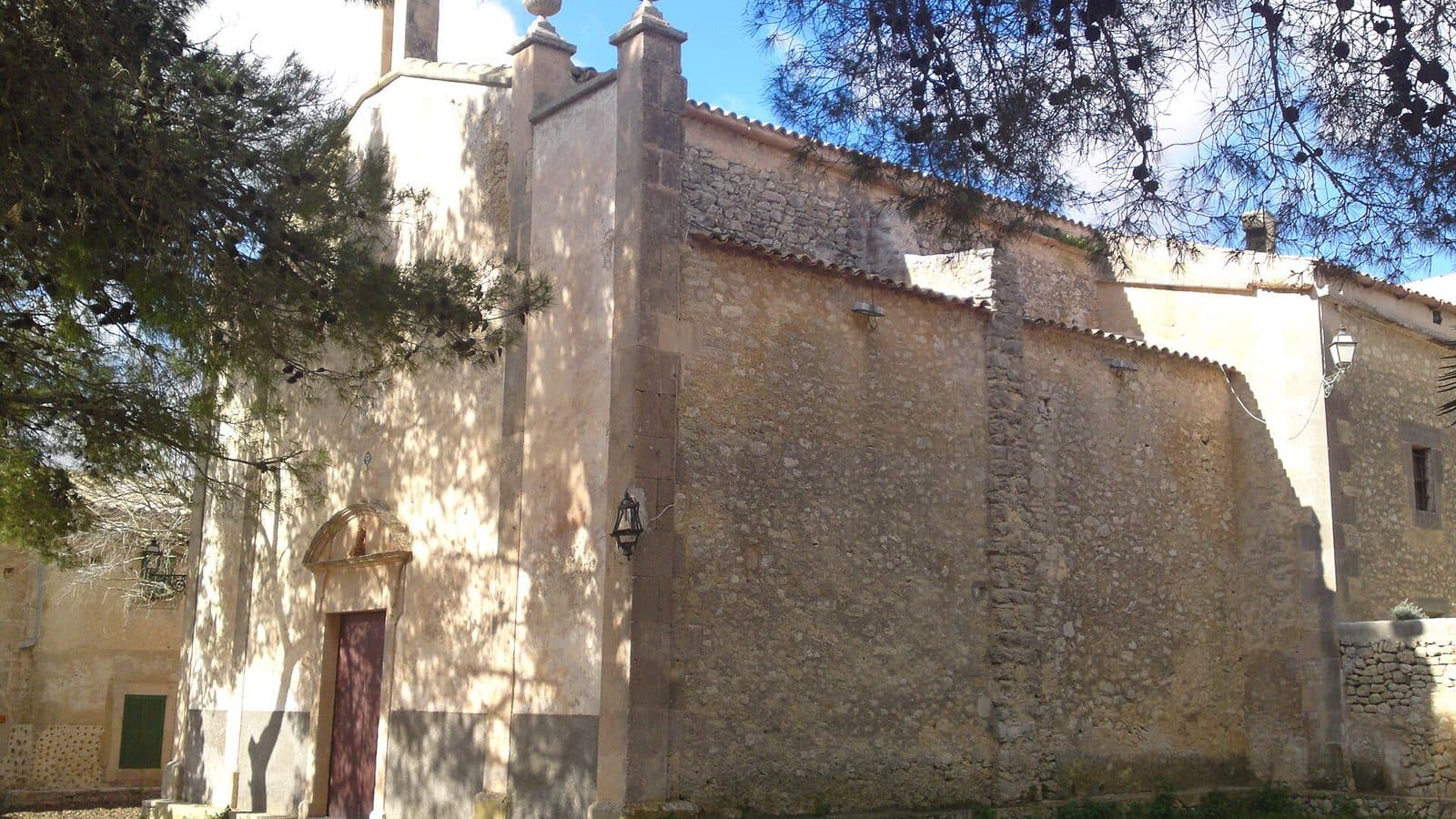

On the plateau of Puig de Sant Miquel, la Bona Pau rises above the broad landscape of the Pla de Mallorca. The small place of worship near Montuïri is known in full as Oratori de la Mare de Déu de la Bona Pau, the Oratory of Our Lady of Good Peace. Visitors therefore come not to a large monastic complex but to a place of devotion that evolved over centuries at a prominent viewpoint in the center of the island.
Its appeal lies precisely in this combination. The route first leads out of rural Montuïri to the hill east of the town, before the plateau opens onto views across central Mallorca. Against this sweeping horizon, the oratory feels less like an isolated architectural monument and more like the spiritual center of Puig de Sant Miquel.
La Bona Pau is worth visiting for travelers who want to discover Mallorca’s religious architecture away from the major urban churches. It also makes a good short detour during a drive through the Pla de Mallorca: the building can be combined with the views, a walk through Montuïri, and the archaeological remains of Son Fornés.
The site is best appreciated when a visit is not reduced solely to whether the church door is open. The plateau, the historic dedication, the pilgrimage tradition, and the position above the plain are inseparable parts of the experience of la Bona Pau.
History and significance
When the oratory was established in the Middle Ages, Puig de Sant Miquel was already a widely visible landmark in the area around Montuïri due to its elevated position. The origins of the present place of worship are dated to the 14th century. What can be seen on the plateau, however, does not result from a single building phase: la Bona Pau was repeatedly altered, enlarged, and adapted to new needs over the following centuries.
Medieval origins
The oldest documented core dates from the 14th century. The choice of the hill gave the devotional site a distinctive presence. From the plain, the Puig forms a natural landmark; at the summit, the religious purpose of the oratory is combined with a sense of separation from everyday life in the town.
The available sources do not allow any firm conclusions about the exact appearance of this early building. What matters more for understanding the site is that la Bona Pau is not an unchanged 14th-century structure. Its present appearance combines several historical layers, even if these cannot readily be distinguished individually during a visit.
Alterations through the 19th century
Repeated alterations and extensions shaped its subsequent history. The 19th century is cited as the final phase of completion. A long period of development therefore separates its medieval origins from this late completion, during which the oratory acquired its current form.
This long time span makes la Bona Pau a typical example of a rural sacred site that was not conceived as a finished project. Generations used, maintained, and modified it. Instead of a single, clearly defined stylistic building phase, visitors encounter a place of worship whose significance grew through continuing religious practice.
Our Lady of Good Peace
The name refers to its dedication to the Mare de Déu de la Bona Pau, Our Lady of Good Peace. This invocation gives the site its calm, almost programmatic name. La Bona Pau belongs to the Diocese of Mallorca and is explicitly described in the sources as an oratory. Its occasional classification as a church or monastery should therefore not create the expectation of finding an extensive convent with a cloister and numerous ancillary rooms.
Its living significance is especially apparent on 24 January. On the feast day of Our Lady of Good Peace, many Mallorcans make their way to the small place of worship on Puig de Sant Miquel. The hill then becomes not only a viewpoint and historic destination but also a pilgrimage site. Anyone who experiences la Bona Pau in peaceful surroundings on an ordinary day therefore sees only one side of the place; the other is revealed through its communal religious tradition.
The protected Puig de Sant Miquel
The surrounding area has also received special recognition. The area of Puig de Sant Miquel was designated a Natural Area of Special Interest in 1991. This classification applies to the hill whose plateau holds the oratory and emphasizes that the landscape and building should be considered together.
La Bona Pau is thus more than a single historic building. The oratory marks a place where sacred history, local identity, and the open landscape of the Pla de Mallorca converge. For Montuïri, the Puig is both a religious destination and a viewpoint—a dual role that has endured to the present day.
What to see
The first impression comes not from an ornately decorated portal but from the setting. The oratory stands at the top of Puig de Sant Miquel, whose plateau rises noticeably above the surrounding area. This alone gives the small building a presence beyond its actual size: la Bona Pau asserts itself not through monumentality but through the open space all around it.
The Oratori de la Mare de Déu de la Bona Pau
The historic oratory itself is the main focus. Its documented building history extends from the 14th to the 19th century and includes several alterations and additions. This long development explains why the structure is better understood as an organically evolved devotional site than as the unchanged work of a single era.
From outside, it is worth first viewing the building in relation to the plateau. The location was not merely a practical building site: the elevated position makes the place of worship visible and clearly separates the devotional site from the built-up area of Montuïri. Those who walk straight up to the building can easily overlook how strongly its impact depends on distance and the open surroundings.
The interior serves a religious purpose. Accordingly, a visit should not depend solely on whether every interior area is accessible. Even an exterior viewing conveys the building’s historic function and the distinctive choice of its site.
The plateau of Puig de Sant Miquel
Puig de Sant Miquel reaches a height of 247 meters and lies about five kilometers east of Montuïri. On its plateau, la Bona Pau has the space needed to be perceived as the focal point of the hill. Here, the view continually shifts between the nearby sacred building and the landscape of the Pla de Mallorca.
This alternation is an essential part of the visit. Up close, the oratory appears as a small place of worship altered over a long period; a few steps farther away, it recedes behind the vastness of its surroundings. This makes it easy to understand why this particular place was chosen for devotion and pilgrimage. The elevated position creates distance without severing the oratory’s connection to Montuïri.
The plateau is also the best area from which to appreciate the building on the scale of the surrounding landscape. Rather than taking only a quick photo directly in front of the church, it is worth finding a more distant viewpoint. Only when some of the surroundings are included does it become clear what distinguishes la Bona Pau from a church in the town center.
Views across the Pla de Mallorca
Puig de Sant Miquel offers views across the landscape of central Mallorca. Its appeal lies less in a single famous sight than in the broad perspective over rural Mallorca: fields, scattered properties, roads, and towns combine from above into a larger whole.
This view is not merely an incidental bonus. It explains the character of the oratory. La Bona Pau does not stand between enclosed rows of houses but at a point from which the central plain remains constantly present. Looking outward therefore accompanies any exploration of the history of the place of worship.
Visitors who come primarily for the architecture should still allow time for the panorama. Conversely, those visiting the viewpoint should take a closer look at the oratory and its long building history. Both perspectives belong together; only in combination do they make Puig de Sant Miquel a special destination near Montuïri.
The pilgrimage site
On 24 January, the perception of the plateau changes. The devotion to Our Lady of Good Peace then brings many Mallorcans up to the oratory. What can appear on other days to be a quiet viewpoint becomes a religious site visited by the community.
Even outside the feast day, this knowledge adds meaning to a walk around the site. The open area around the place of worship is more than a backdrop for views across the center of the island. It is part of a place that people have deliberately visited over a long period. La Bona Pau is therefore best understood as a living devotional site, not as a decorative ruin or merely a setting for photographs.
Visiting la Bona Pau
A visit is best begun away from the door of the oratory. On arriving at the plateau, visitors should first keep some distance from the building and take in the setting: Montuïri lies to the west, the Pla de Mallorca spreads out all around, and la Bona Pau occupies the prominent highest part of the destination.
Walking around the oratory
For an exterior visit, a quiet walk around the accessible part of the place of worship is sufficient. This primarily reveals the relationship between the building and the landscape. The oratory is small enough to be viewed as a whole, yet historically complex enough that it should not be treated merely as a picturesque endpoint to a scenic drive.
The length of a visit depends greatly on whether the interior is accessible and how much time is set aside to look across the plain. Those who only want to see the building from outside can plan la Bona Pau as a short stop. Anyone who wants to consciously absorb the views, history, and plateau should avoid squeezing the visit between two tightly scheduled activities.
Access to the interior
No reliable general opening hours have been recorded. Before making a journey solely to see the church interior, it is therefore advisable to check current access locally or with the relevant authority in Montuïri. The same applies to any admission arrangements; no specific price can be stated reliably.
This uncertainty does not have to diminish the excursion. The exterior appearance, historic setting, and views are central elements of the visit, regardless of whether the interior can be seen. Those who plan flexibly and combine la Bona Pau with Montuïri or Son Fornés will also avoid having a locked door determine the entire outing.
Quiet days and pilgrimage
On ordinary days, la Bona Pau is a destination away from the major tourist attractions of the coast. A markedly different situation can be expected around 24 January, when the feast day of Our Lady of Good Peace is celebrated and many Mallorcans make the pilgrimage to the oratory.
Visitors seeking quiet and space to enjoy the view should take this significant religious date into account when planning. Those who wish to experience local tradition, on the other hand, will find the pilgrimage the strongest expression of the oratory’s continuing importance. It should be remembered that a feast day is not an ordinary sightseeing day: religious observances and the needs of participants take priority over tourist interests.
la Bona Pau as a short excursion
The visit works particularly well as part of a day in the island’s interior. The oratory itself does not require an extensive sightseeing itinerary, but it gains meaning through the journey uphill, the viewpoint, and its place in the history of Montuïri. This concentrated experience also makes la Bona Pau appealing to travelers who prefer to avoid vast church interiors or lengthy museum visits.
The focus is on a historic oratory, a pilgrimage site rich in tradition, and an elevated location. Visitors seeking exactly that will experience Puig de Sant Miquel not as a minor stop but as a vivid insight into rural Mallorca.
Getting there and parking
Long-distance driving directions initially lead to Montuïri. From Palma Airport, the road distance to the town is 35 kilometers; the journey takes around 34 minutes via the Ma-15. From central Palma, the road distance is 37 kilometers, also via the Ma-15, with a driving time of around 42 minutes.
From Montuïri to Puig de Sant Miquel
These distances and driving times expressly end in Montuïri, not directly in front of la Bona Pau. The oratory lies about five kilometers east of the town on Puig de Sant Miquel. Additional time should therefore be allowed for the final section. Locally, follow the access road toward Puig de Sant Miquel and Bona Pau.
The transition from the Ma-15 to the local road network is part of the character of the journey. While the main road connects Montuïri quickly with Palma and the airport, the final section leads out of the town and up to the plateau. Current navigation is more useful here than simply entering “Montuïri,” since the town center and the oratory are not in the same location.
Parking at the destination
The parking situation immediately beside the oratory should be assessed according to local signs. Arrival may differ considerably from an ordinary visit, especially on a religious feast day. Access routes or usable parking spaces should not be assumed merely because the plateau appears accessible by car.
Those combining the visit with a walk through Montuïri should also distinguish between parking in the town and continuing to the Puig. La Bona Pau is not in the historic town center. A parking space in Montuïri therefore does not automatically resolve the planning needed for the final section to the hill around five kilometers to the east.
Arriving by public transport
No bus stop has been recorded in the immediate vicinity of la Bona Pau. Taking a bus only as far as Montuïri therefore still leaves the final section to Puig de Sant Miquel. Travelers without a car should arrange onward transport or the journey to and from the hill in advance rather than relying on a stop directly beside the oratory.
For most visitors, independent transport is therefore the simplest option. It also makes it possible to combine la Bona Pau with other destinations in the Pla de Mallorca and to spend time on the plateau without depending on timetables.
Nearby attractions
After the expansiveness of Puig de Sant Miquel, Montuïri seems almost like its opposite: instead of a single place of worship on a plateau, visitors find narrow streets, squares, stone houses, and the still-recognizable layout of a historic town. This combination makes the excursion particularly coherent, as la Bona Pau and Montuïri reveal two different sides of the same rural cultural landscape.
Montuïri’s historic center
Montuïri was founded in 1300 through a settlement charter issued by King Jaume II. The early town center developed along Carrer Major and several squares. This medieval structure can still be traced on a walk without requiring a lengthy tour of the town.
La Bona Pau, however, is not located within this street pattern. Puig de Sant Miquel lies east of the town, so the viewpoint and historic center should be planned as two separate stops. This distance is precisely part of the appeal: below, Montuïri conveys the everyday life of a community in the Pla; above, the same region appears as a broad landscape.
Sant Bartomeu and the windmills
In the townscape, the parish church of Sant Bartomeu provides a distinctly different sacred accent from la Bona Pau. While the oratory stands alone on the hill and is associated with pilgrimage, Sant Bartomeu forms part of the built-up center. Combining both places is particularly worthwhile for a comparative look at the religious architecture of Montuïri.
The historic windmills are another characteristic feature, recalling the former importance of grain processing. They shape the profile of Montuïri and draw attention back to the agricultural history of the Pla de Mallorca. An extensive windmill tour is not necessary when visiting la Bona Pau, but even seeing them within the townscape adds to an understanding of the surrounding area.
Son Fornés
The archaeological site of Son Fornés and its associated museum considerably broaden the historical scope of the excursion. While la Bona Pau developed from the Middle Ages into the modern era, Son Fornés reaches back into Mallorca’s Talayotic past.
The two destinations should not be conflated, but they fit well into the same day trip. The oratory tells of Christian devotion and local pilgrimage, while Son Fornés reveals much older forms of settlement. Between them lies Montuïri, a historic town that geographically holds together the transition between these periods.
A day in the Pla de Mallorca
La Bona Pau is not a destination that needs to fill a packed day by itself. Its strength lies in a focused experience: the drive up the Puig, the small oratory, the views, and the knowledge of the pilgrimage on 24 January. There is then ample time left for the lanes of Montuïri or a detour to Son Fornés.
The result is an excursion that is not about ticking off as many attractions as possible. Puig de Sant Miquel provides an overview of the landscape, Montuïri the scale of an organically evolved town, and Son Fornés a glimpse into a more distant past. Throughout it all, la Bona Pau remains the quiet, widely visible landmark on the hill.
Local insider tips
Take photos from a distance
The most revealing view is not found directly in front of the church. Stepping back on the plateau shows la Bona Pau together with its open setting on Puig de Sant Miquel—precisely the combination that defines the place.
Look beyond the door
Since no reliable general access times have been recorded, the excursion should not depend solely on the interior being open. The oratory, plateau, and views make for a rewarding visit even when only the exterior can be seen.
Keep 24 January in mind
On the feast day of Our Lady of Good Peace, many Mallorcans make the pilgrimage uphill. Those seeking quiet should take the date into account; those wishing to experience local religious tradition will understand the significance of la Bona Pau especially well on this day.
Combine it with Montuïri
First look across the Pla de Mallorca from the Puig, then walk through Montuïri’s historic center: the transition from the open hilltop to the old streets and squares makes the oratory’s location particularly easy to appreciate.
Step back in time at Son Fornés
La Bona Pau can be usefully combined with Son Fornés. The oratory spans the period from the Middle Ages into the modern era, while the archaeological site and museum reveal the area’s much older Talayotic past.