
Palau de l'Almudaina: Royal Palace in Palma
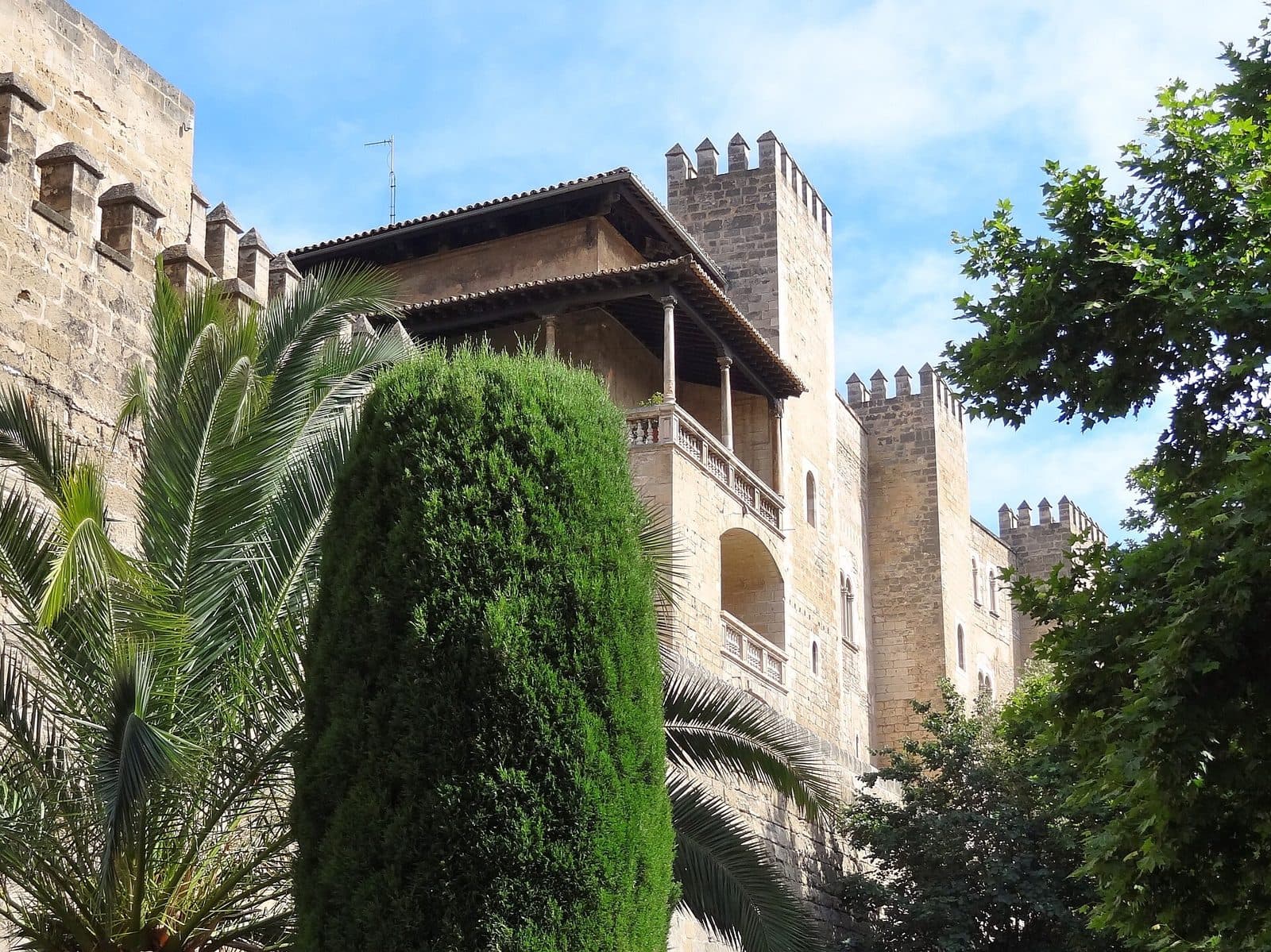

The Palau de l'Almudaina stands where Palma offers an especially impressive view of its own history: directly beside La Seu Cathedral and above the bay. From the outside, with its high walls and towers, the building looks more like a fortress than a courtly palace. Inside, however, a sequence of spaces unfolds, including the parade ground, halls, royal chambers, chapel, and terraces.
A visit is particularly worthwhile because several periods of Mallorca’s history can be read here in a single place. The complex preserves the memory of Roman Palma, Islamic rule, and the Christian kings of Mallorca. At the same time, it is not a disused monument: the palace is one of the official residences of the Spanish royal family and continues to be used for ceremonial occasions.
The Almudaina is especially interesting for travelers who want to see La Seu not merely as a beautiful building in its own right, but to understand Palma’s former center of power. The two monuments stand side by side but served different purposes: secular rule here, ecclesiastical representation there. Even without in-depth historical knowledge, the tour remains vivid, as defensive walls, Gothic rooms, tapestries, and views over the sea tell the story of this place in very different ways.
Anyone expecting sumptuous palace rooms in the Central European tradition may be surprised. The effect comes less from lavish decoration than from grand sequences of rooms, stone, historic textiles, and the contrast between fortified architecture and courtly living. It is precisely this comparatively austere atmosphere that makes the palace such a striking counterpart to the neighboring cathedral.
History and significance
The name reaches far back into the past: “Almudaina” derives from a term for a fortified citadel and recalls that this site was a political and military center long before it became a Christian royal palace. Its position above the sea provides views of the bay and harbor area.
From ancient settlement to Islamic citadel
The site was already in use during Roman times. Under Islamic rule, the complex developed into a fortified residence where government, defense, and courtly life came together. The present-day palace should therefore not be understood as the work of a single construction period: its walls bear traces of successive cultures, even though later alterations significantly changed its visible appearance.
The Islamic past survives in more than the name alone. The surviving areas of the palace include Arab baths, which differ markedly from the large Christian Gothic halls. They make it clear that the Christian rulers did not take over an empty building site, but adapted an already important residence to their own needs.
The residence of the kings of Mallorca
Following the Christian conquest of Palma in 1229, a new phase began: the former citadel was gradually transformed into a royal palace. The development of the Gothic-style residence is particularly associated with Jakob II. of Mallorca. From 1281 onward, the complex was altered for monarchical use; during the following century, it acquired essential parts of the fortified palace form that still defines its appearance today.
The Almudaina now became a central site of the Kingdom of Mallorca. It contained the areas of the king and queen, ceremonial halls, and the royal chapel. The palace therefore served not only as a home but also as the seat of the Mallorcan monarchy. Its proximity to the cathedral emphasized the relationship between Crown and Church without architecturally merging the two spheres.
A royal palace to the present day
The end of the independent kingdom did not end the Almudaina’s story. It remained connected to the Spanish Crown and is still one of its official residences today. During royal stays and ceremonial occasions, the building can continue to serve representative functions, which is why not every area is always part of the public tour.
The palace is managed by Patrimonio Nacional, the state institution responsible for properties serving the Spanish Crown. This continued use distinguishes the Almudaina from an ordinary castle ruin or a palace used exclusively as a museum. Visitors enter a historic seat of power whose original purpose, in a modified form, still endures.
What to see
Even the first impression contradicts the familiar image of a palace. Massive stone surfaces and the rectangular tower emphasize its defensive character; only behind the walls does the courtly side of the complex emerge. The tour passes through publicly accessible sections of a much larger complex and is shaped by the contrast between the parade ground, restrainedly furnished rooms, and views of Palma and the sea.
The parade ground
The parade ground is one of the Almudaina’s defining open spaces. Its size reveals the scale of the complex, while the surrounding façades provide a good overview of the building’s fundamentally fortified character.
It is worth not moving on immediately. From the courtyard, different parts of the structure can be viewed together: the enclosed walls, entrances to the palace areas, and angular silhouette of the towers. What appears from outside as an almost forbidding block becomes an articulated residence within.
The king’s palace and the queen’s palace
The historic areas of the king and queen recall the period when the Almudaina was the residence of the Mallorcan monarchs. The rooms are not presented as a complete reconstruction of medieval daily life. Instead, furniture, furnishings, and textiles from different periods create an overall courtly impression without concealing the fortress character of the architecture. The comparatively bare stone surfaces direct attention toward proportions, passageways, and ceilings. The chambers therefore explain the palace more through sequences of rooms than through an abundance of small exhibits.
The Tinell Hall
One of the most important interiors is the Tinell, the palace’s great Gothic hall. Its impact comes from its spaciousness and architectural austerity, which clearly distinguish it from the smaller chambers.
Rather than treating the room simply as a passageway, it is worth examining its structure. Walls and ceiling shape the impression more strongly than lavish ornamentation. This suits the Almudaina as a whole, whose beauty often lies in clear forms and the contrast between its military shell and royal use.
The Santa Anna chapel
The Gothic Santa Anna palace chapel is one of the most refined architectural sections of the tour. Its ribbed vault and more carefully executed sacred design provide a deliberate counterpoint to the mighty walls and large reception rooms. The chapel was part of courtly life and shows that religious practice had its own clearly designated place within the residence.
The direct comparison with neighboring La Seu is particularly revealing. The palace chapel was not a substitute for the cathedral, but a more intimate space for the court. This helps explain the proximity of the two buildings: the cathedral shaped the city’s religious center, while Santa Anna brought worship into the daily life of the royal residence.
The Arab baths
The Arab baths are among the clearest reminders of the palace’s Islamic past. They tell a different story from the Gothic halls: not one of public receptions, but of an older domestic and bathing culture. Their preservation makes the Almudaina more than a Christian royal palace with an exotic name.
During the tour, this area should consciously be understood as a remnant of an earlier complex. The baths show how the Christian palace adopted, altered, and partly preserved older structures. Within just a few steps, Islamic Palma and the Gothic kingdom meet without their architectural differences being erased.
Tapestries, furniture, and historic furnishings
The interiors contain furniture and furnishings from different periods. Flemish tapestries provide a particularly striking accent. Against the large stone surfaces, these textiles do not appear as incidental decoration but as colorful, narrative counterparts to the restrained architecture.
The furnishings should not be understood as the completely preserved inventory of a single ruler. Instead, they convey how a royal residence was used and repeatedly refurnished over long periods. Anyone mainly expecting glittering treasure chambers might overlook the quieter qualities: textile details, historic furniture, the sequence of rooms, and the relationship between the furnishings and the masonry.
The terraces and views of the bay
On the terraces, the palace opens outward. The view extends across the sea and the Bay of Palma, while the harbor area, shoreline, and cityscape are also visible. This panorama is more than a beautiful addition to the tour, as it reveals the Almudaina’s elevated position and surroundings. After the more enclosed interiors, the transition onto the terrace is especially striking: suddenly, sky, sea, and the modern city replace stone walls and subdued halls.
Visiting the palace
The tour includes the parade ground, interiors, and viewpoints. Because visitors see only the publicly accessible parts of a royal residence that remains in use, the experience is not like freely exploring a castle ruin. Individual areas may lie outside the visitor route in accordance with their function.
Time needed for the tour
For a focused overview, the palace can be toured in around forty minutes. Anyone who wants to examine the chapel, baths, historic rooms, tapestries, and terraces carefully should allow one to two hours. The difference is considerable: a quick walk-through mainly leaves an impression of the spaces, while a longer visit reveals the different historical layers.
Additional time is advisable if La Seu and the surrounding Old Town are to be visited afterward. Although the two monuments stand directly beside each other, each demands attention. An overly tight schedule diminishes the Almudaina’s particular strength, since its impact comes less from a single centerpiece than from the sequence of very different spaces.
Time of day and crowds
The palace is one of Palma’s best-known cultural attractions and can therefore be busy. For a quieter experience, it is best to arrive at the beginning of the visiting day, especially between ten and eleven o’clock. At that time, it is easier to pause in the parade ground or examine the architecture of the halls without constantly moving through the same rooms alongside others.
Those arriving later should expect more activity around the cathedral, Plaça de la Reina, and the palace entrance. The entire area is among the most visited parts of the Old Town. Timed admission can regulate the flow into the interiors, but it does not replace allowing your own time buffer before reaching the entrance.
Opening hours and admission
The Palau de l'Almudaina is open from Tuesday to Sunday from ten to nineteen o’clock and remains closed on Mondays. Since the palace continues to perform official functions, it is nevertheless advisable to check current information about possible special arrangements or restrictions before visiting. The interiors open to the public operate under a regulated visitor system. Anyone wishing to avoid waiting should check the current admission conditions in advance.
Getting there and parking
The Almudaina stands in Palma’s historic center directly beside La Seu. The final stretch therefore does not lead to a detached attraction with its own parking lot, but into a heavily visited Old Town district. Around the cathedral, pedestrian paths, squares, steps, and narrow streets define access; walking is usually unavoidable for the actual arrival at the palace.
From the airport to Palma
From Palma Airport, the route follows the Ma-19 to Palma. The road distance is 11 kilometers, and the drive takes around 20 minutes. These figures expressly apply to the journey as far as Palma, not to a guaranteed stop immediately at the palace entrance. City traffic, searching for parking, and the subsequent walk through the cathedral area must be added. Because the palace stands in the middle of the historic urban area, it is more practical to head for a parking garage than to search the streets directly beside the monument for a free space.
Parking at Parc de la Mar
The underground parking garage at Parc de la Mar is an obvious choice. It is located below the cathedral and palace and is already signposted on the approach roads to the center. From the parking garage, the route continues uphill on foot into the monumental district. This makes the fortified position of the Almudaina especially clear: together with La Seu, the palace rises prominently above the waterfront.
Other parking garages are located in the center and by the harbor. Regardless of the choice, the final section remains a walk. Anyone with a timed admission should therefore allow not only for the driving time but also for parking the car and walking uphill to the entrance.
By bus
Several city buses stop near the cathedral. The stops Plaça de la Reina – Catedral and Parc de la Mar – Catedral are particularly convenient. From there, the route continues on foot; from Plaça de la Reina, steps also lead toward the palace and cathedral.
Taking the bus avoids searching for parking in the center, but it likewise does not end directly inside the complex. The entrance is located within the historic ensemble opposite or immediately beside La Seu. The cathedral is therefore the clearest point of reference for finding your way on site.
Bus lines to Palau de l'Almudaina at a glance
| Line | Route | Departures/day | First | Last |
|---|---|---|---|---|
| 35 | Aquàrium - Pl. Reina | Catedral | 8 | 07:10 | 13:50 |
| 3 | Pont d'Inca / Joan Carles I | 6 | 07:37 | 09:46 |
| 25 | s'Arenal - Pl. Reina | Catedral | 6 | 09:35 | 12:41 |
| 20 | Portopí - Son Espases | 4 | 07:17 | 07:31 |
From the official GTFS feeds (TIB/SFM), no real-time data. The figures cover all stops in the town; weekend and holiday services differ — check with the operator before travelling.
Getting there by bus
453-pl. de la Reina - Catedral · 0.1 km as the crow flies
- 25s'Arenal - Pl. Reina | Catedral · 06:36–21:01 · Daily
7-pl. de la Reina - Catedral · 0.1 km as the crow flies
- 35Aquàrium - Pl. Reina | Catedral · 06:21–22:41 · Daily
986-pl. de la Reina - Catedral · 0.2 km as the crow flies
- 35Aquàrium - Pl. Reina | Catedral · 06:21–22:41 · Daily
- CCCircular Centre Ciutat · 08:00–08:00 · Daily
1982-Parc de la Mar - Catedral · 0.2 km as the crow flies
- 25s'Arenal - Pl. Reina | Catedral · 06:36–21:01 · Daily
- 30Marivent-Palau de Congressos · 08:00–08:00 · Daily
662-pl. de Cort · 0.3 km as the crow flies
- CCCircular Centre Ciutat · 08:00–08:00 · Daily
985-pl. de Joan Carles I · 0.4 km as the crow flies
- CCCircular Centre Ciutat · 08:00–08:00 · Daily
1048-pl. de Joan Carles I · 0.4 km as the crow flies
- 25s'Arenal - Pl. Reina | Catedral · 06:36–21:01 · Daily
- 35Aquàrium - Pl. Reina | Catedral · 06:21–22:41 · Daily
929-Parc de la Mar-Catedral · 0.4 km as the crow flies
- 30Marivent-Palau de Congressos · 08:00–08:00 · Daily
105-pl. de Joan Carles I - Catedral · 0.4 km as the crow flies
- 3Pont d'Inca / Joan Carles I · 08:00–08:00 · Daily
- 4Ses Illetes - Pl. Columnes · 08:00–08:00 · Daily
- 7Son Gotleu - Son Serra - Sa Vileta / Son Vida · 08:00–08:00 · Daily
- 20Portopí - Son Espases · 06:06–22:40 · Daily
53-pl. de Joan Carles I - Catedral · 0.4 km as the crow flies
- 4Ses Illetes - Pl. Columnes · 08:00–08:00 · Daily
- 7Son Gotleu - Son Serra - Sa Vileta / Son Vida · 08:00–08:00 · Daily
- 20Portopí - Son Espases · 06:06–22:40 · Daily
52-pl. del Mercat · 0.4 km as the crow flies
- 4Ses Illetes - Pl. Columnes · 08:00–08:00 · Daily
- 7Son Gotleu - Son Serra - Sa Vileta / Son Vida · 08:00–08:00 · Daily
- 20Portopí - Son Espases · 06:06–22:40 · Daily
- 35Aquàrium - Pl. Reina | Catedral · 06:21–22:41 · Daily
106-pl. del Mercat · 0.5 km as the crow flies
- 3Pont d'Inca / Joan Carles I · 08:00–08:00 · Daily
- 4Ses Illetes - Pl. Columnes · 08:00–08:00 · Daily
- 7Son Gotleu - Son Serra - Sa Vileta / Son Vida · 08:00–08:00 · Daily
- 20Portopí - Son Espases · 06:06–22:40 · Daily
Timetable data: official GTFS feeds (TIB/EMT), no real-time — check with the operator before travelling.
Nearby sights
In front of the palace, a simple turn is enough for Palma to begin telling its next chapter. La Seu Cathedral stands immediately beside the Almudaina; below them stretch Parc de la Mar and the area toward the bay. Few other parts of the city bring royal, ecclesiastical, and maritime history together so closely.
La Seu and Parc de la Mar
The most obvious combination is La Seu. Visiting them together explains more than two separate tours: the Gothic cathedral and fortified royal palace represent the spiritual and secular power of medieval Palma. Nevertheless, enough time should be allowed for both, as their spatial impact and furnishings differ greatly.
Afterward, a descent to Parc de la Mar is worthwhile. From below, the silhouette of the entire ensemble is easier to appreciate. Only from this perspective does it become clear how dominantly the cathedral and Almudaina stand above the present-day park and waterfront. The location is also ideal for comparing the palace’s austere façade with the soaring forms of La Seu.
Old Town and Plaça de la Reina
On the other side begins the network of Old Town lanes. Via Plaça de la Reina, visitors reach areas with historic streets, courtyards, shops, and restaurants. After the large and comparatively quiet palace rooms, the transition into the lively center is particularly noticeable.
For a coherent cultural day, the Almudaina and cathedral can be combined with a walk through the Old Town. Other monuments are better treated as stops along a route rather than as a tightly scheduled list. The palace itself benefits when time remains after the tour to view its outer walls once more from different angles.
Harbor and seaward side
From the palace terraces, the relationship with the sea is already part of the visit. A subsequent walk toward the harbor or along the waterfront continues this view. From below, the perspective changes: the residence overlooking the sea becomes a fortified urban edge standing above the modern traffic and harbor landscape.
This connection makes the Almudaina’s location particularly easy to understand. The palace stands at the edge of the historic center while remaining close to the cathedral and Old Town. A short walk around the ensemble explains this topography better than the interior tour alone.
The place it belongs to
Palma in the place guidePractical information for your visit
The Almudaina requires no special equipment, but it does call for realistic expectations. Visitors explore a historic palace with fortified outdoor areas, steps, and publicly accessible sections. Comfortable shoes are therefore advisable, especially when combining the visit with the cathedral, Old Town, and Parc de la Mar.
Clothing, sun, and walking routes
Part of the tour passes through interiors, while other sections cross the parade ground or terraces. The sun can be strong in the open areas, whereas the stone halls feel considerably more sheltered. Sun protection is therefore particularly important when longer walks around the cathedral and waterfront are planned before or after the palace.
Access from the direction of Parc de la Mar or Plaça de la Reina may include steps and uphill paths. Anyone trying to reach a fixed admission time should allow enough time for this. Hurrying is also ill-suited to a building whose most interesting details are often found in transitions, vaults, and sightlines.
What the palace is not
The Almudaina is neither a ruin that can be climbed freely nor a fully furnished fairy-tale palace. Nor does its Islamic past survive as a completely preserved Moorish palace. What visitors see instead is a seat of power altered over centuries, where older traces remain alongside the dominant Gothic residence.
Not every part of the building is open to the public either. Its royal function continues, and the visitor route focuses on selected rooms. The value therefore lies not in the number of open doors, but in the quality of the preserved areas: the Tinell Hall, Santa Anna chapel, Arab baths, royal chambers, tapestries, and terraces together provide an unusually complete picture of Palma’s political history.
Local insider tips
Do not skip the terrace
The sea view is more than a quick photo stop: the terrace makes it clear why the residence was built in this exact location. The bay, harbor area, and elevated palace position can all be understood together from this viewpoint.
Come at the start of the day
Between ten and eleven o’clock is the best chance for a quieter tour. Especially in the parade ground, chapel, and in front of the tapestries, it is then easier to examine details without the pressure of larger groups.
Look out for the baths
Among the Gothic halls, the Arab baths are easily overlooked. Yet they make it especially clear that the Christian royal palace developed from an older Islamic citadel.
View from Parc de la Mar
After the interior tour, it is worth descending to Parc de la Mar. From below, you can see how the Almudaina and cathedral stand together above the waterfront while remaining two very different buildings.
Read the palace alongside the cathedral
Anyone visiting the Almudaina and La Seu on the same day should view them as centers of secular and ecclesiastical power. The small Santa Anna palace chapel makes the contrast with the neighboring cathedral particularly clear.