
Porta des Moll: Alcúdia’s Medieval City Gate
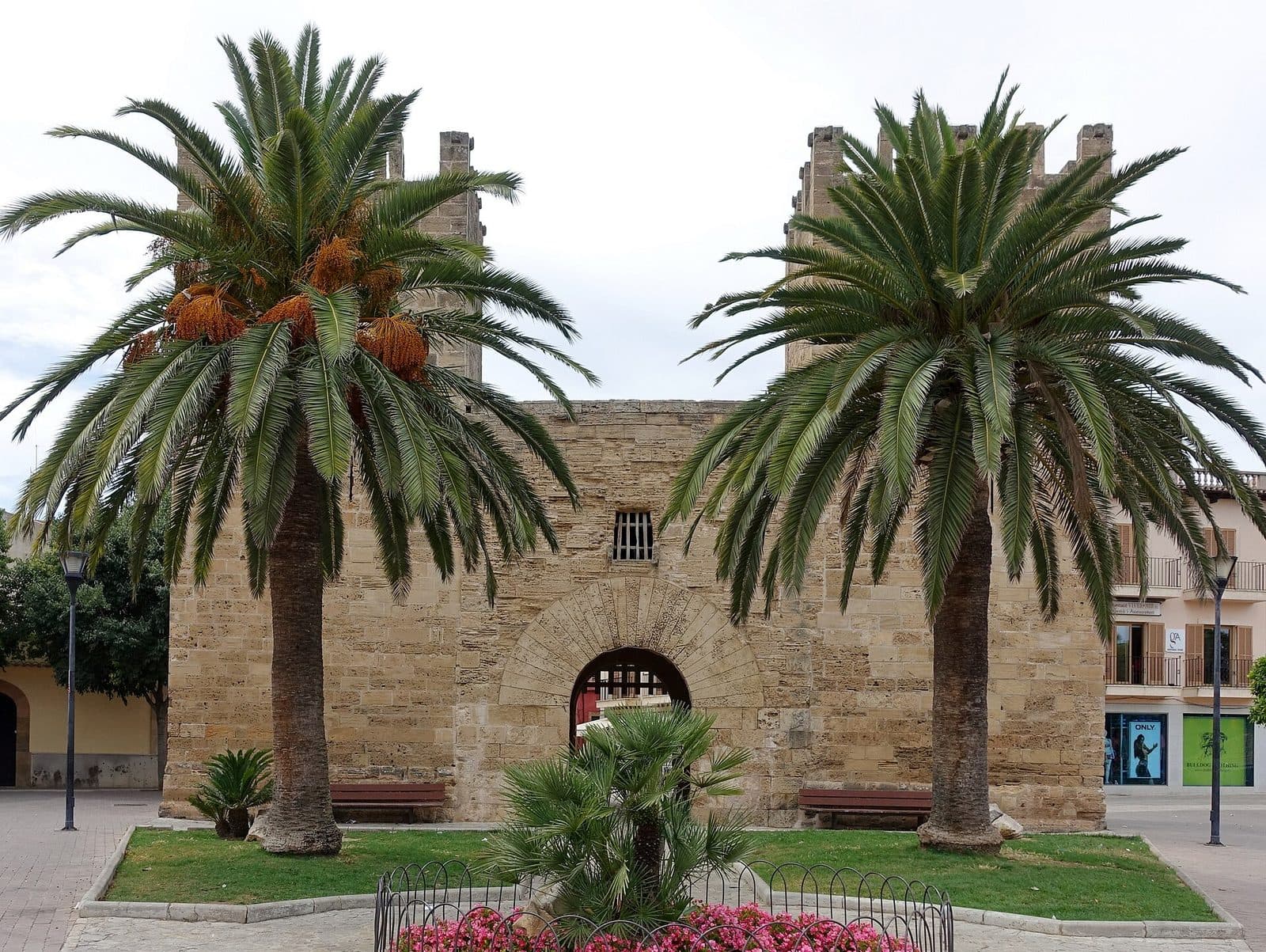

Even from the outside, Porta des Moll shows why Alcúdia’s old town is more than a picturesque backdrop. Two crenellated towers frame the stone passageway; beyond them begins the narrow street network of the walled town. The gate, often also called Porta del Moll or Xara Gate, was the eastern connection toward the harbor and remains one of the most striking entrances to the historic center.
Its appeal lies less in an extensive sightseeing program than in a clear, immediately understandable scene: you can still see how a medieval town was organized around its wall, gate, and approach road. Standing before the towers, walking through the arch, and then turning around again lets you experience the transition from the open area outside to the protected urban space in just a few steps. Porta des Moll is therefore well suited to history enthusiasts, photographers, and visitors who want to explore Alcúdia on foot. The gate itself can be viewed quickly, but it gains considerably more depth in connection with the adjoining town wall, the old town lanes, and the second surviving city gate.
Porta is most impressive not as a single photo subject but as the starting point for a walking tour. Early in the day, the light falls favorably on the stone and the area is usually quieter; on market days, by contrast, the lively side of the old city entrance emerges, with considerably more people moving through the surrounding area.
History and significance
When construction of Alcúdia’s fortifications began toward the end of the 13th century, the aim was not prestigious architecture. Northern Mallorca had to be protected against attacks from the sea, especially pirate raids. King Jakob II had the fortifications planned; during the 14th century, they developed into the circuit of walls that still defines the appearance of the old town today.
The medieval town wall
The fortifications followed an approximately square layout. Their total length is given as 1.5 kilometers, and they were protected by 26 towers. Large sections of the wall survive. One striking feature is the mortarless construction: the stones were positioned so that their weight, shape, and careful layering gave the masonry stability. With an average height of six meters, the structure visibly separated the urban area from the open countryside.
This wall was not an insurmountable boundary. Despite its strength, the fortifications were breached several times over the course of their history. That is precisely what makes them so revealing: they tell the story not of a completely secure fortress, but of a town that had to respond to recurring threats. Gates such as Porta des Moll were both weak points and vital connections to the outside world.
Porta des Moll as the harbor gate
Porta des Moll stood on the eastern side and opened the town toward the harbor, which had been important to the area long before the medieval walls were built. In Roman times, Pollentia used the coastal access; however, no structures from an ancient harbor survive there. Porta des Moll itself belongs to a much later period and should not be confused with Roman building fabric. It represents medieval Alcúdia, which reorganized itself within a closed circuit of walls.
Two gates, two directions
In addition to the eastern Porta des Moll, Alcúdia has another surviving historic entrance, Porta de Santa Sebastià. While the harbor gate marked the route east, Porta de Santa Sebastià stood on the road toward Palma. Together, the two gates illustrate the town’s former traffic organization: those arriving in Alcúdia did not enter just anywhere, but passed through a clearly defined and controllable point.
Today, this boundary is no longer military. Nevertheless, Porta des Moll still functions as a threshold. Outside, the towers and the body of the wall stand fully exposed to view; a few steps later, narrow streets continue between the houses of the old town. The structure is therefore not merely a monument on the edge of Alcúdia, but still visibly fulfills its original historical function as an entrance to the town.
What to see
The best first view is from in front of the gate. From here, both towers, the central passageway, and the adjoining sections of wall can be seen together. The structure does not look like a freestanding triumphal arch, but like an opening firmly integrated into the defensive line. This connection between gate and wall is its most important architectural feature.
The two crenellated towers
Two sturdy, crenellated towers flank Porta des Moll. Their position immediately makes clear why a city gate needed particular protection: anyone wishing to reach the passageway had to approach a narrow area that could be controlled from both sides. The battlements create a distinctive silhouette against the sky and give Porta its unmistakable appearance.
It is worth viewing the towers from the side as well as from the front. From there, it becomes clearer how they connect to the adjoining sections of wall and how compactly the entire structure was designed. From this perspective, the gate appears less like a decorative façade and more like part of a continuous defensive system.
The gateway arch
The stone arch opens between the towers. It channels the route and forms the actual transition into the old town. As you walk through it, your perception changes quickly: in front of the gate lies the more open street space, while beyond it the axis continues into the historic lanes. The strength of the structure is easier to appreciate here than in a photograph, because the passageway makes the depth of the wall and gate complex tangible.
A second look from the old town side is essential. Many visitors photograph only the well-known exterior view and then continue on their way. From inside, however, it is particularly easy to see that Porta was not designed with only one showpiece façade. It was a functional passageway connecting two very different urban spaces.
The adjoining Murada d’Alcúdia
The medieval town wall continues to the right and left. Its seemingly irregular courses of stone, towers, and continuous wall top demonstrate that Porta is only one component of a much larger complex. Only in this context does the historical scale become clear: the town was surrounded by a 1.5-kilometer circuit of walls, whose 26 towers provided additional protection at short intervals.
Not every visible section can be accessed directly at Porta des Moll. The publicly accessible section of the wall walk is located by Porta de Santa Sebastià. Anyone wishing to experience the fortifications from above should therefore continue through the old town to this western gate rather than looking for stairs at Porta des Moll.
Carrer del Moll and the old town side
Behind the gate, Carrer del Moll leads into the historic center. The street name preserves the old orientation toward the harbor and still makes the connection between gate and transport route legible today. Restored townhouses, small shops, cafés, and restaurants appear farther inside; directly at the gate, however, the masonry remains the defining impression.
The view from the lane back toward the brighter gateway arch is especially appealing. It shows Porta not as an isolated landmark, but as a framed exit from the dense old town. In the morning, this axis is often quieter, and the light brings out the texture of the stone more clearly. This gives photographers two distinct subjects: the symmetrical exterior view with both towers and the view from inside the town through the passageway to the outside.
The gate as a landmark
Porta des Moll is an excellent place to understand Alcúdia’s layout. From here, you can begin a walk along the wall, continue through the lanes to Plaça de la Constitució, and later leave the old town again at another section of the fortifications. Throughout the route, the gate remains an easily recognizable landmark.
The attraction is the structure itself: its towers, arch, connections to the wall, and still-comprehensible role as an entrance to the town. Anyone who takes time to explore the different viewing directions will discover significantly more than with a quick souvenir photograph from the front.
Visiting Porta des Moll
A sensible visit begins outside the wall, where the overall form of Porta des Moll is easiest to take in. The route then leads through the arch into the old town. On the inside, it is worth stopping and looking back, because this simple change of perspective reveals more about the gate’s function than a front view alone.
A short stop or the start of a walking tour
A short but attentive stop is enough for the gate itself. Those wishing to photograph architectural details, examine the wall connections, and compare both sides will naturally stay longer. The real value, however, comes from combining it with a walk through the walled old town.
A coherent route initially follows Carrer del Moll into the center. From there, the walk can continue to Porta de Santa Sebastià and the accessible wall walk nearby. In this way, the individual gate becomes an introduction to the entire fortification system: first the eastern harbor entrance, then the lanes within the circuit of walls, and finally an elevated view from another section of the complex.
Early morning
In the early morning, the surroundings are usually quieter, and the light falls favorably on the masonry. Anyone wishing to photograph the symmetrical exterior view without many passersby will find the best conditions then. The passageway and Carrer del Moll can also be examined more carefully before the old town becomes livelier.
Later in the day, movement becomes part of the scene. Porta remains a frequently used entrance rather than a cordoned-off architectural model. People leave the old town, stop to take photographs, or begin their walking tour here. This use is historically appropriate: a city gate was always a place of arrivals and departures.
Market days
On market days, the area around Porta becomes considerably busier. Clothing, jewelry, leather goods, fruit, vegetables, and household items are among the products sold around the old town. Those seeking a market atmosphere will then experience the gate as a lively entrance to the town. For unobstructed architectural photographs or a quiet view of the arch, another time is more pleasant.
The larger number of visitors also changes the character of the walk. Instead of a quiet approach to the fortifications, the route leads directly into bustling Alcúdia. Both experiences have their appeal, but expectations should match: visiting the market and closely examining the architecture are two different experiences.
Access and current conditions
As no reliable opening hours or admission details are recorded, current access conditions should be checked before visiting. This is particularly important if the plan includes not only the gateway but also accessible sections of the town wall. The wall walk is not entered directly at Porta des Moll, but in the area around Porta de Santa Sebastià.
Anyone wishing to explore the building history in greater depth can easily include Porta in a historical walking tour. Without context, you see a photogenic stone gate; with knowledge of the harbor route, pirate threat, and circuit of walls, it becomes a key to understanding medieval Alcúdia.
Getting there and parking
From Palma, the main route north follows the Ma-13. The stated distances and driving times apply as far as Alcúdia, not directly to the gateway arch. The final section leads to the edge of the historic old town; from there, you approach Porta des Moll on foot.
From Palma Airport
From Palma Airport, the road distance to Alcúdia is 58 kilometers. The drive takes around 45 minutes and follows the Ma-30 and then the Ma-13. After arriving in Alcúdia, head toward the historic center and the eastern side of the town wall. For the final meters, it is more practical to leave the vehicle outside the narrow old town center.
From central Palma
From central Palma, the road distance to Alcúdia is 55 kilometers. The drive takes around 49 minutes and largely follows the Ma-13. The highway leads north through the island’s interior; only after entering Alcúdia does the local route toward the walled old town and Porta des Moll begin.
Parking by the old town
Parking is mainly available along the outer road ring around the old town, including on Avinguda des Príncep d’Espanya. Street parking is also available near the historic center. On busy days and during the market, expect more traffic searching for spaces. Parking outside the wall also avoids driving through narrow streets and makes the approach to the gate more evocative.
Porta stands on the eastern side of the circuit of walls. When choosing a parking space, it is therefore worth considering whether you plan to visit only the gate or take a complete old town walk. Almost any space along the outer ring can be practical for a circuit through Alcúdia; those heading specifically to Porta des Moll should stay on the eastern side of the historic center.
By bus
Several bus stops serve the area around the old town. The Centre històric and Pol·lèntia areas are particularly useful reference points for approaching on foot; the historic center can also be reached from stops near Ses Forques. Porta itself lies within the compact old town area, so the final section is covered on foot. Current routes and departure times should be checked before traveling.
Bus lines to Porta des Moll at a glance
| Line | Route | Departures/day | First | Last |
|---|---|---|---|---|
| 324 | Can Picafort - Alcúdia | 304 | 00:01 | 23:49 |
| 322 | Pollença - Port d'Alcúdia | 229 | 07:00 | 23:55 |
| 302 | Can Picafort - Palma | 186 | 00:01 | 23:42 |
| 315 | Sa Pobla - Badia d'Alcúdia | 84 | 06:51 | 23:29 |
| A32 | Can Picafort - Aeroport | 73 | 00:06 | 23:17 |
| 327 | Alcúdia - Estany Petit | 72 | 07:47 | 23:42 |
| 325 | Alcúdia - Cala Rajada | 52 | 08:27 | 22:38 |
From the official GTFS feeds (TIB/SFM), no real-time data. The figures cover all stops in the town; weekend and holiday services differ — check with the operator before travelling.
Getting there by bus
Entre-mar-i-estany 2 (3065) · 1.4 km as the crow flies
- 302Can Picafort - Palma · Daily
- 315Sa Pobla - Badia d'Alcúdia · Daily
- 322Pollença - Port d'Alcúdia · Daily
- 324Can Picafort - Alcúdia · Daily
- 325Alcúdia - Cala Rajada · Daily
- 327Alcúdia - Estany Petit · Daily
- A32Can Picafort - Aeroport · Daily
Entre-mar-i-estany 1 (3064) · 1.4 km as the crow flies
- 302Can Picafort - Palma · Daily
- 315Sa Pobla - Badia d'Alcúdia · Daily
- 322Pollença - Port d'Alcúdia · Daily
- 324Can Picafort - Alcúdia · Daily
- 325Alcúdia - Cala Rajada · Daily
- 327Alcúdia - Estany Petit · Daily
- A32Can Picafort - Aeroport · Daily
Pla del Pinar 2 (3063) · 1.8 km as the crow flies
- 302Can Picafort - Palma · Daily
- 315Sa Pobla - Badia d'Alcúdia · Daily
- 324Can Picafort - Alcúdia · Daily
- 325Alcúdia - Cala Rajada · Daily
- 327Alcúdia - Estany Petit · Daily
- A32Can Picafort - Aeroport · Daily
Pla del Pinar 1 (3062) · 1.8 km as the crow flies
- 302Can Picafort - Palma · Daily
- 315Sa Pobla - Badia d'Alcúdia · Daily
- 324Can Picafort - Alcúdia · Daily
- 325Alcúdia - Cala Rajada · Daily
- A32Can Picafort - Aeroport · Daily
Timetable data: official GTFS feeds (TIB/EMT), no real-time — check with the operator before travelling.
Nearby attractions
Alcúdia’s old town begins immediately behind Porta des Moll. Narrow streets lead between restored historic houses to small squares, shops, cafés, and restaurants. The gate is therefore not an isolated attraction, but a natural starting point for a walk through the walled town center.
Alcúdia old town
Carrer del Moll leads farther into the center and to Plaça de la Constitució. There, Alcúdia reveals its urban side, while Porta previously marked the fortified edge. This contrast makes the walk interesting: within just a few streets, the scene changes from massive walls to squares and inhabited townhouses.
For a complete impression, the walk should not follow only the main routes. Returning occasionally to the wall makes it easier to understand how tightly enclosed the historic center once was. Porta des Moll remains a useful starting point and landmark throughout.
Porta de Santa Sebastià and the wall walk
On the opposite side of the old town stands Porta de Santa Sebastià, the second surviving major city gate. This is where the publicly accessible section of the town wall is located. Combining the two gates reveals the fortifications from two perspectives: at Porta des Moll, the historic orientation toward the harbor; at Porta de Santa Sebastià, the entrance from the road to Palma and the opportunity to walk along part of the wall.
The two gates can easily be connected on a walk through the old town. This is more rewarding than driving to Porta des Moll in isolation and leaving immediately after taking a photograph, because only the route through the walled town conveys the scale and organization of the entire complex.
Pollentia and the Roman heritage
South of the historic center are the archaeological areas of Roman Pollentia, with the forum, La Portella, and theater. They are not part of Porta des Moll and date from a much earlier period, but they provide an illuminating contrast. A visit combines two different chapters of Alcúdia’s history: the Roman town of Pollentia and the medieval fortifications with their harbor gate.
This chronological distance helps prevent a common misunderstanding. Porta des Moll is not a Roman city gate, but part of the medieval town wall. Pollentia explains the site’s earlier importance; Porta tells how Alcúdia was protected and accessed many centuries later.
Port d’Alcúdia and the bay
The gate’s historic orientation toward the harbor can be understood more clearly with a subsequent visit to Port d’Alcúdia. Today’s harbor has a commercial area as well as an area for smaller boats, with a fishing quay and marina. The gate’s historic orientation toward the harbor therefore remains understandable.
The beaches on the Bay of Alcúdia can also be combined with a visit to the old town. This creates a day of history and coastline without reducing Porta itself to a mere stopover. To understand the structure properly, the walk through the walled town should first be given enough time.
The place it belongs to
Alcúdia in the place guidePractical information for your visit
Porta des Moll is a structure within public urban space. Its impact comes from its architecture and its position in the town wall.
Photographing from two perspectives
The familiar view is from outside the old town, where both towers and the arch fit into the same frame. The opposite direction is equally worthwhile: behind the gate, the view from Carrer del Moll passes through the stone passageway to the outside. Anyone who photographs only the front misses Porta’s spatial function.
Fewer people are around in the early morning, and the light clearly brings out the stone surfaces. On busy days, patience is required because Porta continues to be used as an entrance. Passersby, however, belong to the setting and show the scale of the tall towers better than a completely empty photograph.
Urban space and wall walk
Porta stands in an active urban area, and other pedestrians and traffic should be considered in the passageway and on the adjoining streets. The accessible wall walk is also not directly at the gate, but by Porta de Santa Sebastià.
Sun, market, and crowds
The exterior view is outdoors, so sun protection is advisable on bright and warm days. Anyone wishing to examine and photograph the gate in detail should ideally combine the visit with breaks inside the old town.
On market days, the surrounding area is livelier and more crowded. This suits visitors who want to experience Alcúdia with market stalls and street activity. Those seeking unobstructed views of the towers and arch should instead choose the early morning outside the busiest period.
What is not part of Porta
The name and its location toward the harbor can create false expectations. Porta does not stand in the modern harbor of Port d’Alcúdia, but on the eastern edge of the historic old town. Nor is it part of Roman Pollentia, even though those excavations lie close to the later Alcúdia.
The well-known accessible section of wall is also not entered at Porta des Moll. The gate is worth seeing primarily for its surviving towers, arch, and role as a historic entrance to the town. Understanding these distinctions makes it easier to plan a realistic visit and clearly separate Alcúdia’s different historical periods.