
Punta de sa Bateria Lighthouse in Portocolom
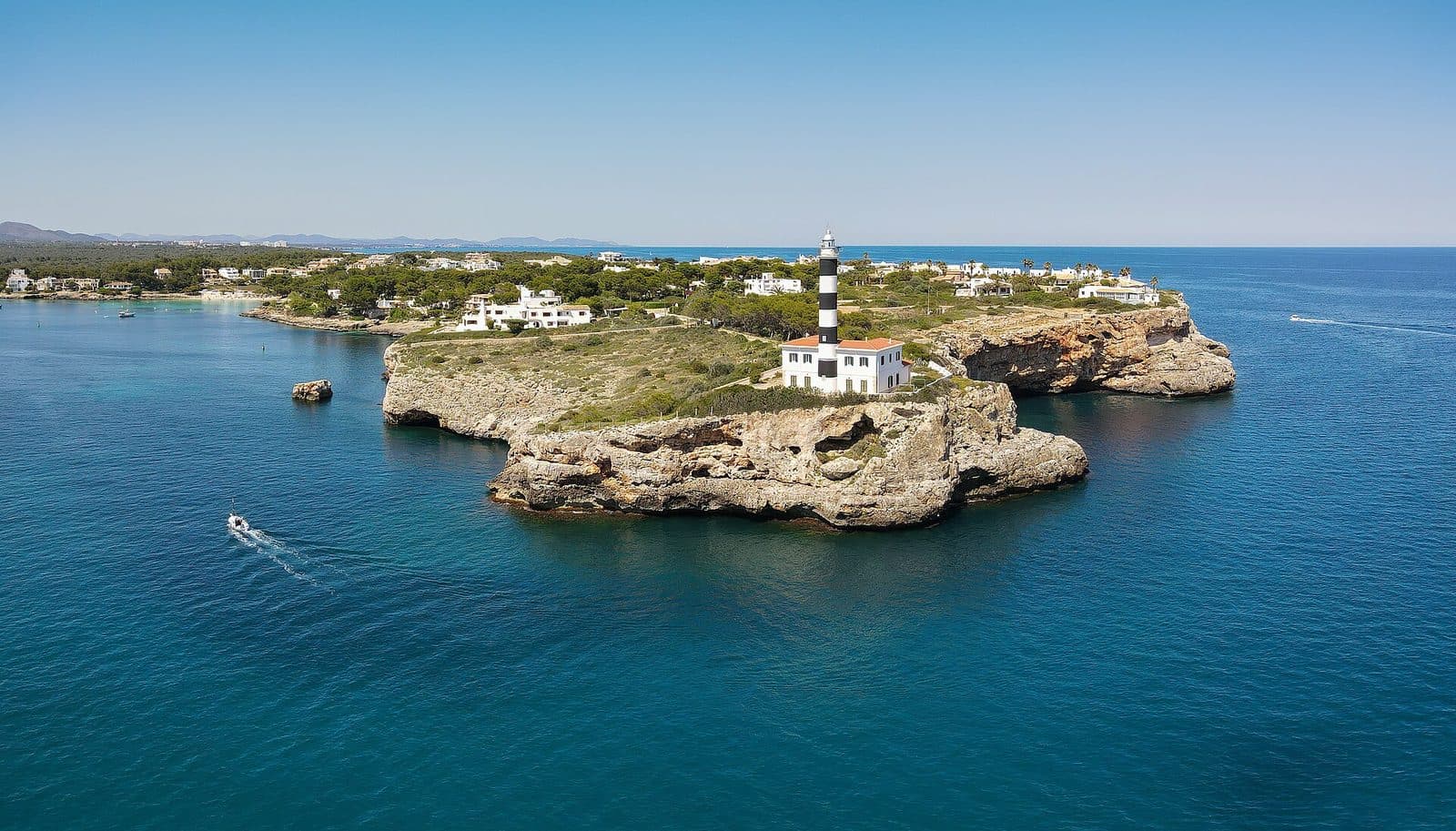

Punta de sa Bateria adds a maritime landmark to the coast of Portocolom. The lighthouse is one of those attractions whose appeal lies less in an extensive sightseeing program than in its location and relationship with the sea. It is particularly well suited to travelers who want to discover Portocolom not only as a beach destination but also as a historic harbor town.
The best way to experience the lighthouse is as part of a walk through the town. Portocolom’s large natural harbor, old fishermen’s houses, and still-visible connection to the fishing industry provide the appropriate backdrop. Punta de sa Bateria offers the seaward perspective: rather than focusing on a single museum exhibit, the view takes in the coast, shipping, and the topography of a sheltered harbor.
It is precisely this simplicity that makes the visit enjoyable. Instead of halls, exhibition panels, and a fixed route, visitors can expect a short coastal stop that is easy to plan freely. Anyone who photographs lighthouses, collects maritime destinations, or seeks a peaceful alternative to the well-known attractions in the island’s interior will find this a fitting destination.
On its own, Punta de sa Bateria should not be regarded as an attraction that fills an entire evening. Combined with the harbor, the old town center, and a break by the water, however, it becomes an excursion that reveals Portocolom’s character very directly.
Visiting the Lighthouse
First impressions matter more here than a prescribed sightseeing itinerary. Punta de sa Bateria is a lighthouse destination where the exterior of the structure and its maritime surroundings take center stage. Time should only be set aside for an interior visit, exhibition, or guided tour if current access has been confirmed in advance.
The Lighthouse as a Destination
It makes sense to begin a visit with the lighthouse itself. Rather than simply checking it off as a photo opportunity, it is worth considering its role in the coastal landscape: lighthouses guide shipping, and in Portocolom this function meets one of Mallorca’s large natural harbors. The structure therefore derives its significance primarily from the interplay between headland, sea, and harbor town.
How much time is needed depends greatly on personal interest. Anyone who simply wants to see and photograph the lighthouse can keep the visit brief. Those who then explore Portocolom on foot, take in the harborfront, or linger by the water can turn this short stop into a more extensive visit to the town. A fixed duration would not be particularly helpful here.
Portocolom as Part of the Experience
The lighthouse should not be viewed separately from the town. Portocolom is clearly divided between the traditional harbor and old-town area and the section around Cala Marçal that is more strongly shaped by tourism. These two sides can be contrasted easily during a day’s visit: first the maritime landmark, then the historic harbor landscape, and finally, if desired, the beach cove.
Portocolom is described as a comparatively quiet fishing town, although visitor numbers have increased. There is no reliably documented time of day when Punta de sa Bateria is guaranteed to be uncrowded. Anyone seeking a quieter impression should therefore not reduce the visit to a few minutes between other activities, but allow some flexibility and explore the harbor first if it is busier.
Current access conditions should be checked before setting out. Confirmed opening hours and an admission price are not available, so specific details would not be reliable. This applies especially to any plans that go beyond viewing the lighthouse from the outside.
Getting There and Parking
The main routes first lead to Portocolom. From there, Punta de sa Bateria must be approached as a separate destination. This distinction is especially important for planning your time: the stated road distances and driving times end in the town, not directly at the lighthouse.
From Palma Airport
From Palma Airport, the route follows the Ma-19, then the Ma-5120 and the Ma-4010 to Portocolom. The road distance to the town is 59 kilometers, and the drive takes around 54 minutes. Depending on traffic and the selected destination in Portocolom, the final stretch to Punta de sa Bateria must then be added.
The route initially follows the fast connection toward the east of the island before continuing along regional roads. Up-to-date navigation is recommended for finding the exact location within Portocolom, as entering only the town’s name will not automatically lead to the Punta.
From Central Palma
From central Palma, the route via the Ma-19, Ma-5120, and Ma-4010 covers a total road distance of 65 kilometers to Portocolom. The drive takes around 63 minutes. Here too, the figure refers specifically to the town; additional time should be allowed for continuing to the lighthouse.
Travelers arriving from Palma can make good use of the longer journey by combining the lighthouse with a walk around the harbor and a stop for food or refreshments. For only a very short photo stop, the balance between travel time and time spent there would be less worthwhile.
The Final Stretch and Parking
The travel figures should not be understood as a guarantee of direct vehicle access or parking immediately beside the structure. Within Portocolom, follow the signs and park only where this is clearly permitted. For the final stretch, it is sensible to assess local conditions on arrival and allow for a short walk if necessary.
Portocolom is also served by public buses. Which connection is suitable on the day of the visit depends on the departure point and the current timetable. As there are several stops within the town, travelers should consider not only their arrival in Portocolom but also the onward route to Punta de sa Bateria.
Bus lines to Punta de sa Bateria at a glance
| Line | Route | Departures/day | First | Last |
|---|---|---|---|---|
| 428 | Cala d'Or - Portocristo | 113 | 09:38 | 21:45 |
| 512 | Portocolom - Felanitx | 85 | 06:42 | 23:15 |
From the official GTFS feeds (TIB/SFM), no real-time data. The figures cover all stops in the town; weekend and holiday services differ — check with the operator before travelling.
Getting there by bus
Es Corso (22010) · 0.7 km as the crow flies
- 428Cala d'Or - Portocristo · Daily
- 512Portocolom - Felanitx · Daily
Moll (22037) · 0.8 km as the crow flies
- 428Cala d'Or - Portocristo · Daily
- 512Portocolom - Felanitx · Daily
Gravina (22036) · 1.0 km as the crow flies
- 428Cala d'Or - Portocristo · Daily
- 512Portocolom - Felanitx · Daily
Cristòfol Colom (22041) · 1.1 km as the crow flies
- 428Cala d'Or - Portocristo · Daily
- 512Portocolom - Felanitx · Daily
Ronda Nadal Batle (22035) · 1.1 km as the crow flies
- 428Cala d'Or - Portocristo · Daily
- 512Portocolom - Felanitx · Daily
Vapor Santueri 1 (22046) · 1.9 km as the crow flies
- 428Cala d'Or - Portocristo · Daily
Vapor Santueri 2 (22047) · 1.9 km as the crow flies
- 428Cala d'Or - Portocristo · Daily
Timetable data: official GTFS feeds (TIB/EMT), no real-time — check with the operator before travelling.
Nearby
Colorful boats, low houses beside the water, and a harbor basin extending deep into the coast: Portocolom is far more than the backdrop to the lighthouse. The town belongs to the municipality of Felanitx and has preserved parts of its traditional character despite growing visitor numbers. Fishing still plays a visible role, even though many private boats now use the natural harbor.
The Natural Harbor of Portocolom
The natural harbor shapes the entire town. Fishermen’s houses line the waterfront, some with boathouses and moorings in front of them. Anyone continuing into town from Punta de sa Bateria should therefore not head for just one promenade, but explore different sections of the harborfront. Only then does it become clear how strongly Portocolom has been shaped by the sheltered bay.
The connection to the sea also remains alive in the local cuisine. Fish restaurants are an obvious choice for a break after visiting the lighthouse. Instead of ending the excursion after the photo stop, this allows the maritime theme to continue through the meal.
The Old Town Center
The older part of Portocolom lies on a peninsula. Its focal points are the square and the church of Sant Jaume. The town’s history was not always as closely connected to fishing as today’s harbor scene might suggest. Trade in wine from Felanitx and the surrounding area once played an important role; the infestation of the vines by phylloxera at the beginning of the 20th century severely damaged this branch of the economy.
This background makes a walk through the old harbor area particularly interesting. The lighthouse tells the story of routes across the sea, while the town itself reflects trade, fishing, and changes in the coastal economy. A small local tradition even connects Portocolom with Christoph Kolumbus and interprets the town’s name as a reference to the seafarer. This origin story is not historically verified, but it nevertheless forms part of the local identity.
Cala Marçal and the Coastal Coves
South of the traditional harbor area, Portocolom presents a different face. The more tourist-oriented part of the town lies around Cala Marçal. Combining it with the lighthouse is particularly appealing when the day’s plans include time at the beach as well as the harbor.
Several other coves in the surrounding area are also mentioned, including s’Arenal, s’Algar, Cala Brafi, Cala Estreta, and Cala Sa Nau. They do not all need to be fitted into one day. It makes more sense to combine the lighthouse and harbor with one suitable swimming cove and to experience Portocolom beyond the view from the car window.
The place it belongs to
Portocolom in the place guidePractical Information for Your Visit
Punta de sa Bateria is not a conventional sightseeing building with a reliably scheduled interior program. The dependable focus is on the lighthouse as an exterior landmark and on its place within the coastal town. Anyone traveling specifically to climb the tower, see a technical collection, or access the interior should have that possibility expressly confirmed in advance.
Setting the Right Expectations
The visit is rewarding because of careful observation, not because of a packed program. An interesting question is why a lighthouse stands in this particular location and how it relates to the harbor town. Portocolom then offers plenty of material for continuing the visit: fishermen’s houses, moorings, the old town center, and the more tourist-oriented coast around Cala Marçal reveal different sides of the same place.
Photographers should not focus exclusively on waiting for a frontal view of the entire lighthouse. The relationship between the structure, coastline, and harbor is also a rewarding subject. Restricted or private areas should always be respected; an attractive view does not justify entering land that is not open to the public.
Preparing Before the Trip
As neither confirmed opening hours nor admission conditions are available, current information should be checked whenever an interior visit is essential to the excursion. If only the exterior is of interest, the lighthouse can be incorporated flexibly into a stay in Portocolom.
The return journey also deserves attention: the driving times from Palma and the airport apply only as far as Portocolom. Anyone also visiting the harbor, old town, or Cala Marçal should plan these stops as separate parts of the day. In this way, Punta de sa Bateria does not remain an isolated waypoint but becomes the starting point for exploring one of the characteristic harbor towns in eastern Mallorca.
Local insider tips
Include the Harbor
Do not drive on immediately after seeing the lighthouse: only the subsequent walk along the natural harbor, with its fishermen’s houses, boathouses, and moorings, reveals why Punta de sa Bateria belongs to Portocolom.
Two Sides of Portocolom
The lighthouse and old harbor can be combined with Cala Marçal. This allows one excursion to reveal both the traditional town center and the southern part of Portocolom, which is more strongly shaped by beach tourism.
A Maritime Finale
After Punta de sa Bateria, consider stopping at the harbor for a meal. Portocolom remains an important fishing harbor, and its fish restaurants provide a culinary continuation of the visit’s maritime theme.