
Raixa Manor House and Gardens in the Tramuntana Foothills
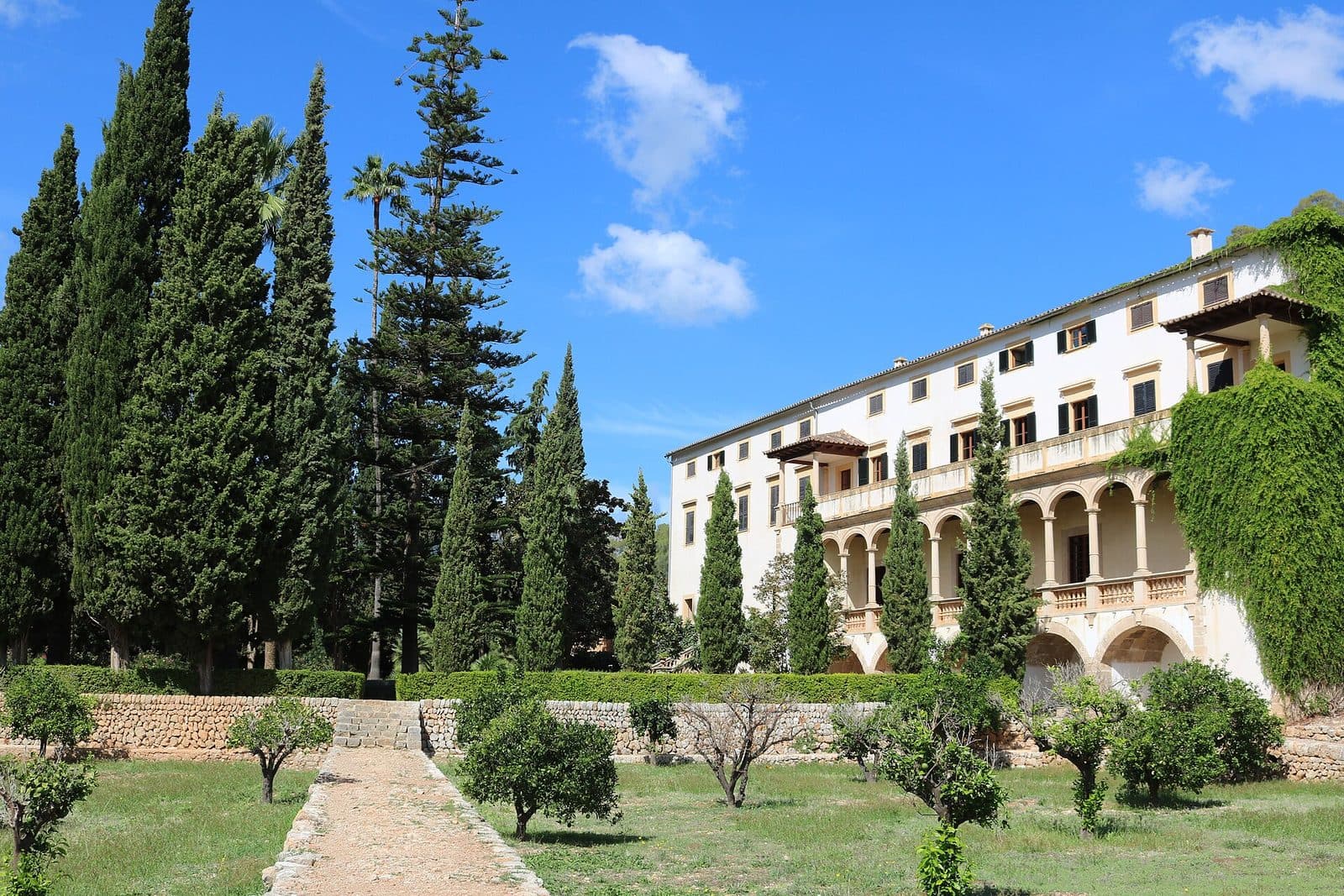

Raixa reveals Mallorca from a perspective that brings together a manor house, agriculture, and garden design. The historic estate near Palmanyola rests at the foot of the Serra de Tramuntana: behind the house, the hillside rises in landscaped terraces, while in front, the countryside opens toward Palma and the sea. This transition from mountains to plains shapes the entire visit.
There is more to see than a single building. The central courtyard, former agricultural rooms, chapel, Italianate gallery, and gardens collectively tell the story of how a Mallorcan possessió changed over the centuries. Particularly striking features include the monumental open staircase, the large water reservoir, and the views from the upper gardens.
Raixa appeals to visitors who enjoy architecture and garden design, as well as anyone wishing to understand how people shaped the Tramuntana landscape through agriculture and water management. Since 2021, the estate has also served as the visitor centre for the UNESCO World Heritage Site Serra de Tramuntana. This makes it more than an attractive country estate: the house, exhibition, and cultural landscape explain one another.
Its appeal lies in the changing sequence of spaces. The stone agricultural courtyard gives way to prestigious living areas, while geometrically ordered gardens lead into shady groves and long sightlines. Raixa requires no specialist knowledge. Those who look slowly will discover the estate’s history in its masonry, water systems, and the way paths and staircases open up the hillside.
History and significance
A scorch mark in a Gothic window leads directly into a turbulent episode in the island’s history. In 1522, supporters of the Germanías attacked the estate and set parts of the building on fire because its owner at the time, Pere-Joan Safortesa i Descatlar, supported the Crown. Traces of this fire reappeared in the main hall during the most recent restoration. Raixa’s history is therefore not only preserved in documents but can also be read directly in parts of the building.
From an Islamic estate to a possessió
Its origins reach back to Mallorca’s Islamic period. At that time, an Alquería, an agricultural estate, stood here; according to the present-day operator, the name is the main surviving element of the Islamic property itself. After the conquest of Mallorca by King Jakob I. in 1229, the lands passed to the Count of Ampurias. During the Middle Ages, Raixa changed hands between the Sureda de Sant Martí and Safortesa-Tagamanent families.
At the beginning of the sixteenth century, the estate was remodelled. The Gothic rib vaults and entrance arches of the stone courtyard survive from this phase. During this period, Raixa developed into a feudal country estate while remaining a working agricultural property. Records from the seventeenth century mention an oil mill, a grain mill, two distilleries, and a windmill. The land produced olives, carob, grain, pulses, wine, and saffron, among other crops; sheep were also raised, while horses and mules were used for work.
The Despuig family
On 18 June 1660, Ramon Despuig i Rocabertí, the first Count of Montenegro, purchased the estate. The Despuig family shaped Raixa for longer and more decisively than any previous owners. During the eighteenth century, the buildings were expanded and altered in the Baroque taste. Pleasure gardens named “les Llimoneres,” “la Gruta,” and “Hort Nou” are documented as early as 1740.
The key figure was Antoni Despuig i Dameto. Born in Palma in 1745, the cleric rose to the rank of cardinal and encountered neoclassical architecture, ancient art, and Italian gardens during his travels in Italy. Together with his brother Joan, he commissioned a fundamental transformation of Raixa. The established Mallorcan agricultural estate became a prestigious country residence without its older structures disappearing completely.
Despuig collected ancient sculptures in Italy and brought works of art to Mallorca. Much of this collection was sold after his death; individual pieces are now housed in Castell de Bellver. What chiefly survives at Raixa is the spatial concept: architecture, staircases, terraces, water, and views were intended to combine into a carefully staged garden composition.
From private estate to public heritage site
The entrance gate from 1898 bears the coat of arms of Ramon Despuig i Fortuny. He sold Raixa to the businessman Antoni Jaume in 1910. Over the course of the twentieth century, agricultural activity declined in importance, while garden structures deteriorated and storm damage was not repaired everywhere.
After the estate received protected status, the Island Council of Mallorca acquired the 52-hectare property in 2002. A restoration lasting more than ten years followed before Raixa reopened to the public. Since 2021, the estate has housed the Centre Serra de Tramuntana. This present-day role suits the historic setting: Raixa demonstrates that the Tramuntana is not merely a natural backdrop but a cultural landscape shaped over a long period by agriculture, paths, settlements, and water use.
What to see at Raixa
The first impression is deliberately prestigious. The entrance gate leads into an estate whose various parts were not created in a single period. Behind the orderly façade lies a complex that developed over time: medieval and early modern structures, Baroque alterations, and the Italianate neoclassical design commissioned by the Despuig family stand directly alongside one another.
The courtyard and agricultural rooms
The spatial heart of the house is the clastra, the traditional stone courtyard of a Mallorcan possessió. A well stands in one corner. The surrounding rooms show that Raixa was never intended solely as an elegant retreat. They housed the oil mill, oil store, stables, workers’ accommodation, estate administration rooms, and the owners’ living quarters.
This courtyard is especially helpful for understanding the building. Pack animals, harvests, and oil production belonged to the same complex as the chapel, reception rooms, and gallery. The arches at the entrance to the courtyard date from the remodelling phase at the beginning of the sixteenth century. Anyone who pays attention to the masonry and different openings will recognise that Raixa’s present appearance did not emerge from one uniform design.
The chapel and main hall
The Gothic rib vault of the chapel is among the older surviving structures. It contrasts clearly with the later sections of the manor house, which were designed more strongly around views and prestige. In the main hall, a scorch mark was discovered on a Gothic window and linked to the attack of 1522.
These details are easy to overlook because the gardens initially attract more attention. Yet they are crucial to understanding the estate’s history. They show that a much older architectural core survives beneath the neoclassical image of the country residence.
The south gallery
The south-facing colonnaded gallery is the house’s elegant showpiece. Its openings frame the landscape almost like individual pictures. Decorative hydraulic tiles lie underfoot, while the terrace and garden extend beyond the columns and the terrain opens across the valley toward Palma and the bay.
The Italian influence is especially clear here. The gallery does not sharply divide indoors from outdoors but mediates between the residence, garden, and distant view. Depending on where you stand, columns, balustrades, and vegetation form changing sightlines. It is therefore an ideal place to survey the estate as a whole before heading into the higher gardens.
The lower gardens
Several garden areas with historically recorded names surround the house. These include the kitchen garden, the orange garden “dels Tarongers,” the “de la Galeria” garden with its central fountain, and the entrance garden with a small pond. They recall how ornamental and useful plants existed side by side on a country estate.
The lower sections feel more orderly and more closely connected to the house than the higher areas. Paths, fountains, and beds create clear lines. Seen from the colonnade, they become part of the architectural composition; while walking among the beds, however, the water channels, planting, and terracing of the land come to the fore.
The Escala d’Apol·lo
The monumental open staircase, commonly known as the Escala d’Apol·lo, is Raixa’s best-known feature. Its 69 steps rise through the terraces in a straight, ceremonial sweep. Stone balustrades, sculptures, and layered vegetation heighten the effect. The staircase is not merely a link between two levels but the backbone of the upper garden.
The view changes with every terrace during the ascent. At first, the house dominates; later, the plains and distant views come into focus. From above, it is especially easy to see how consistently the estate uses the slope: the gardens do not simply lie beside the building but rise behind it, making the natural topography part of the composition.
The large water reservoir
Behind the house lies the long water reservoir, one of the estate’s most impressive technical features. It was not created solely as a decorative reflecting pool. Water was essential for agriculture, orchards, and the elaborate planting of the terraces. The available inflow was insufficient for the garden plans, making storage and distribution central concerns.
The calm surface of the water forms a strong counterpoint to the steep staircases and dry stone. At the same time, the reservoir clearly illustrates how closely garden design and water management are connected in Mallorca. Without storage, channels, and targeted irrigation, a prestigious complex of this kind would not have been possible.
Pavilions, grotto, and viewpoints
A small hermitage, a historicist pavilion, a grotto, columns, and other decorative features are distributed throughout the upper gardens. They were designed to create changing scenes and places to pause during a walk. Some structures appear only as you approach them between trees and terrace walls; others serve as the destination of a long sightline.
From the higher points, views extend across the landscape toward Palma, the bay, and the Mediterranean. Behind the estate, the foothills of the Serra de Tramuntana rise at the same time. This view in both directions—to the mountains and the plains—explains Raixa’s special location better than any map.
The Centre Serra de Tramuntana
The exhibition in the manor house focuses on the natural and cultural landscape of the Serra de Tramuntana. It covers flora and fauna, the history of the mountain villages, traditional ways of life, and the human labour that shaped this landscape. Raixa itself serves as a tangible example: the oil mill, kitchen gardens, water reservoir, and terraces can then be viewed directly on the grounds.
A dedicated area, the Espai Collidores, commemorates the women whose physically demanding work during the cold months helped preserve the cultural landscape. The exhibition therefore focuses not only on counts, cardinals, and architecture but also on the people whose often-invisible labour sustained the estates and the cultivation of the Tramuntana.
Visiting Raixa
The best place to begin the tour is the manor house. The courtyard and former agricultural rooms establish the estate’s historical layout, while the Centre Serra de Tramuntana explains the broader context. Afterward, the oil mill, gardens, and water systems are much easier to understand. For the outdoor areas, a route from bottom to top is recommended: entrance garden, gallery, orange garden, open staircase, and upper terraces.
How much time to allow and suggested route
Raixa is too complex for a fleeting photo stop. The house, exhibition, and lower gardens can be viewed one after another, but the upper terraces and viewpoints require additional time and involve several steps. Anyone who reads the exhibition carefully, walks around the water reservoir, and follows the garden’s sightlines can easily spend half a day visiting.
A free audio guide leads through the exhibition rooms and gardens. It is particularly helpful because the significance of some inconspicuous rooms becomes clear only through their former use. Without an explanation, an oil mill can quickly seem like merely another historic interior; with an understanding of processing, storage, and irrigation, the estate becomes comprehensible as a working enterprise.
Best time of day and visitor numbers
Raixa is open on Saturdays and Sundays from 10 to 14, and admission is free. As visitor capacity may occasionally be limited, the beginning of the opening window is the most reliable choice for anyone wishing to see the house and gardens without time pressure. The exhibition in particular should not be left until only a short amount of time remains.
The light noticeably changes the effect of the gardens. During the earlier hours, columns, balustrades, and trees cast clear shadows, while the climb through the terraces is generally more comfortable than in strong midday sun. Visitors primarily interested in photography should head first to the south gallery and then to the upper garden axis before more people arrive on the narrower paths.
A visit for different interests
Visitors interested in architecture should allow more time for the courtyard, chapel, and gallery. Garden enthusiasts will find the strongest impressions at the Escala d’Apol·lo, the water reservoir, and the transitions between the individual terraces. For those interested in cultural history, the combination of the exhibition and the historic agricultural rooms is particularly rewarding.
Raixa is not a conventional palace museum filled with lavishly furnished state rooms. Its real substance emerges from the interplay of house, labour, water, and landscape. Anyone looking only for richly decorated halls will miss the essence of the place; those who consider the indoor and outdoor spaces together will gain a vivid impression of a Mallorcan country estate.
Getting there and parking
Raixa lies near Palmanyola on the Ma-11, the main route between Palma and Sóller. The access road branches off from this road toward the estate; the final section leads from the main road along a rural access track to the entrance area. Signs for the estate are therefore more useful than navigation that uses only Palmanyola as the destination.
From Palma Airport
The road distance from Palma Airport to Palmanyola is 20 kilometres. The drive takes around 25 minutes and follows the Ma-20 to the Ma-11. These figures expressly apply only as far as Palmanyola, not directly to the manor house. From there, follow the Ma-11 and the signposted turnoff to Raixa; additional time should be allowed for the access road to the estate.
From central Palma
The road distance from central Palma to Palmanyola is 15 kilometres. The drive takes around 30 minutes via the Ma-11. This journey time also ends in Palmanyola for calculation purposes. The estate lies outside the built-up area, so the final section then follows the route toward Bunyola and the access road to the property.
Parking and access
There is a public car park at the entrance to Raixa. The final section of the access road may feel more rural and uneven than the well-developed Ma-11. Dust can be expected, especially after dry weather; driving slowly is advisable along the narrower section. From the car park, the path leads to the historic entrance gate and onward to the house.
Its location on the Ma-11 makes Raixa an obvious stop on a journey between Palma, Bunyola, and Sóller. Even so, the visit should not be planned as a brief roadside stop: the route through the house and lower gardens already requires time, while the upper terraces add staircases and slopes.
By bus and on foot
The nearest bus stops are called Raixa 1 and Raixa 2. The estate can be reached from them via its access road. Additional stops are located near Sa Font Seca. Before travelling, check which side of the road serves the required direction and whether the timetable matches the estate’s limited opening window.
A scenic alternative begins in Bunyola. From the railway station there, an easy, 3,5-kilometre walk leads to the estate; allow a little over an hour for the outward journey. The route passes through agricultural countryside with almond trees, among other features, and must be walked again on the return trip. It is therefore better suited to a dedicated excursion than a spontaneous addition.
Bus lines to Raixa at a glance
| Line | Route | Departures/day | First | Last |
|---|---|---|---|---|
| 205 | Bunyola - Palma | 201 | 06:35 | 22:36 |
| 204 | Port de Sóller - Palma | 152 | 00:17 | 23:47 |
| 303 | Bunyola - H. Joan March - Palma | 121 | 06:58 | 21:50 |
From the official GTFS feeds (TIB/SFM), no real-time data. The figures cover all stops in the town; weekend and holiday services differ — check with the operator before travelling.
Getting there by bus
Raixa 1 (10046) · 0.8 km as the crow flies
- 204Port de Sóller - Palma · Daily
- 303Bunyola - H. Joan March - Palma · Daily
Raixa 2 (10026) · 0.8 km as the crow flies
- 204Port de Sóller - Palma · Daily
- 205Bunyola - Palma · Daily
- 303Bunyola - H. Joan March - Palma · Daily
Sa Font Seca 2 (10008) · 1.3 km as the crow flies
- 205Bunyola - Palma · Daily
Sa Font Seca 1 (10007) · 1.4 km as the crow flies
- 205Bunyola - Palma · Daily
Urb. sa Coma 2 (10050) · 1.4 km as the crow flies
- 205Bunyola - Palma · Daily
- 303Bunyola - H. Joan March - Palma · Daily
Urb. sa Coma 1 (10049) · 1.4 km as the crow flies
- 205Bunyola - Palma · Daily
- 303Bunyola - H. Joan March - Palma · Daily
Hospital Joan March (10012) · 1.4 km as the crow flies
- 205Bunyola - Palma · Daily
- 303Bunyola - H. Joan March - Palma · Daily
Pla de sa Coma (10044) · 1.7 km as the crow flies
- 205Bunyola - Palma · Daily
- 303Bunyola - H. Joan March - Palma · Daily
Clavells 1 (10020) · 1.9 km as the crow flies
- 205Bunyola - Palma · Daily
Clavells 2 (10019) · 1.9 km as the crow flies
- 205Bunyola - Palma · Daily
Can Penasso 1 (10029) · 2.0 km as the crow flies
- 204Port de Sóller - Palma · Daily
- 303Bunyola - H. Joan March - Palma · Daily
Can Penasso 2 (10015) · 2.1 km as the crow flies
- 204Port de Sóller - Palma · Daily
Timetable data: official GTFS feeds (TIB/EMT), no real-time — check with the operator before travelling.
Places to visit nearby
Palmanyola lies between the plains of Palma and the first heights of the Serra de Tramuntana. The settlement itself is primarily a practical starting point; Raixa stands outside the residential areas on the way toward Bunyola. Even the short onward journey reveals the landscape transition that defines the estate: flatter cultivated land on one side and wooded mountain slopes on the other.
Palmanyola and Bunyola
Bunyola is the better choice for a break or a meal. The historic village lies closer to the mountains and has an established centre with a central square. Raixa’s former agricultural activity, water use, and exhibition about the Tramuntana gain a geographical context there: Bunyola was and remains a gateway to the cultivated slopes and valleys of the mountains.
Travelling via Bunyola can also be combined with the historic railway line between Palma and Sóller. Anyone who gets off at the station and walks to Raixa turns the visit into a longer countryside excursion. The return walk from the finca to Bunyola must be considered alongside the estate’s opening window.
More gardens and the Tramuntana
The Jardins d’Alfàbia are also located near the Ma-11. Both sites can be combined during one excursion but should not be confused: Raixa is a public country estate with a UNESCO visitor centre, a historic agricultural courtyard, and extensive terraced gardens; Alfàbia is a separate house and garden complex with its own history.
Anyone continuing toward Sóller follows one of the classic routes into the Serra de Tramuntana. After visiting the Centre Serra de Tramuntana, dry-stone walls, terraces, olive groves, and settlements along the route no longer appear merely as picturesque scenery. They become legible as parts of the cultural landscape to which the exhibition is dedicated.
Palma can also be added to the itinerary. Castell de Bellver houses individual sculptures from Cardinal Despuig’s former collection of antiquities. The connection is culturally and historically interesting because it shows that Raixa’s former furnishings are now distributed among different locations. The estate itself chiefly preserves the collector’s architectural framework and garden concept.
The place it belongs to
Palmanyola in the place guidePractical tips for visiting Raixa
The elegant open staircase appears in almost every image of Raixa, but it also provides a practical warning: a complete tour follows stone paths, terraces, and numerous steps. Comfortable shoes with a secure grip are therefore more suitable than smooth-soled sandals. Visitors who do not wish to climb to the upper garden can still see essential parts of the estate from the house, the south gallery, and the lower gardens.
Sun, shade, and water
The gardens alternate between open terraces and planted areas. The sun can be strong on the south side and around the large water reservoir, while the colonnade, house, and individual groves provide shade. Sun protection and your own drinking water are therefore sensible essentials, especially on warm days.
The large pool is a historic water reservoir, not a place for swimming. Its importance lies in supplying the gardens and in its visual effect as a calm expanse of water within the estate. The fountains and small ponds are also elements of the historic design, not facilities for visitors to cool off.
Visiting with children
Raixa is most interesting for children when the visit is presented as a journey of discovery through a former country estate. The well courtyard, stables, oil mill, water reservoir, staircases, and garden pavilions are more tangible than a simple sequence of exhibition rooms. However, attentive supervision is important near open water and on the long stone staircases.
The exhibition about the Tramuntana also provides an introduction through animals, plants, and former ways of life. Families are advised to alternate between interiors and gardens instead of completing the entire exhibition first and then all the outdoor areas. This keeps the tour varied without missing the upper garden.
Food and expectations
Visitors should not rely on finding refreshments at the estate. For a longer visit, it is sensible to bring water and a small snack; Bunyola is a good option for a meal afterward. The historic gardens and water systems should be kept clean, and animals in the reservoir should not be fed.
Raixa is neither a theme park nor a fully furnished aristocratic palace. It is a restored heritage site whose strengths lie in its surviving building phases, agricultural service rooms, exhibition, and landscape design. The quieter details—a Gothic arch, the well in the courtyard, the gallery tiles, or the water channels on the slope—are precisely what make the visit rewarding.
Local insider tips
Start in the courtyard
Begin in the Clastra and look for the well, oil mill, stables, and older arches. Anyone who understands the layout of the Possessió here will find it easier later to see how agriculture and prestigious garden design belonged together.
Columns as picture frames
From the south gallery, the columns frame the garden and landscape like individual pictures. First enjoy the view outside, then look at the floor: the decorative hydraulic tiles are easily overlooked beside the panorama.
Changing views from the staircase
Do not photograph the Escala d’Apol·lo only from below. Turn around on the upper landings: as the elevation increases, the house, terraces, and plains toward Palma come together in a single composition.
Follow the water
The well, small ponds, and large reservoir are more than decoration. By following them through the estate, you can understand Raixa as the result of sophisticated water storage and irrigation—the foundation of the gardens.
Walk from Bunyola
Anyone wishing not only to visit Raixa but also to experience its landscape can walk from Bunyola railway station. The easy route is 3,5 kilometres long and takes a little over an hour; the equally long return journey must also be planned.