
Balma de Son Matge – Mallorca’s History Beneath a Rock Shelter
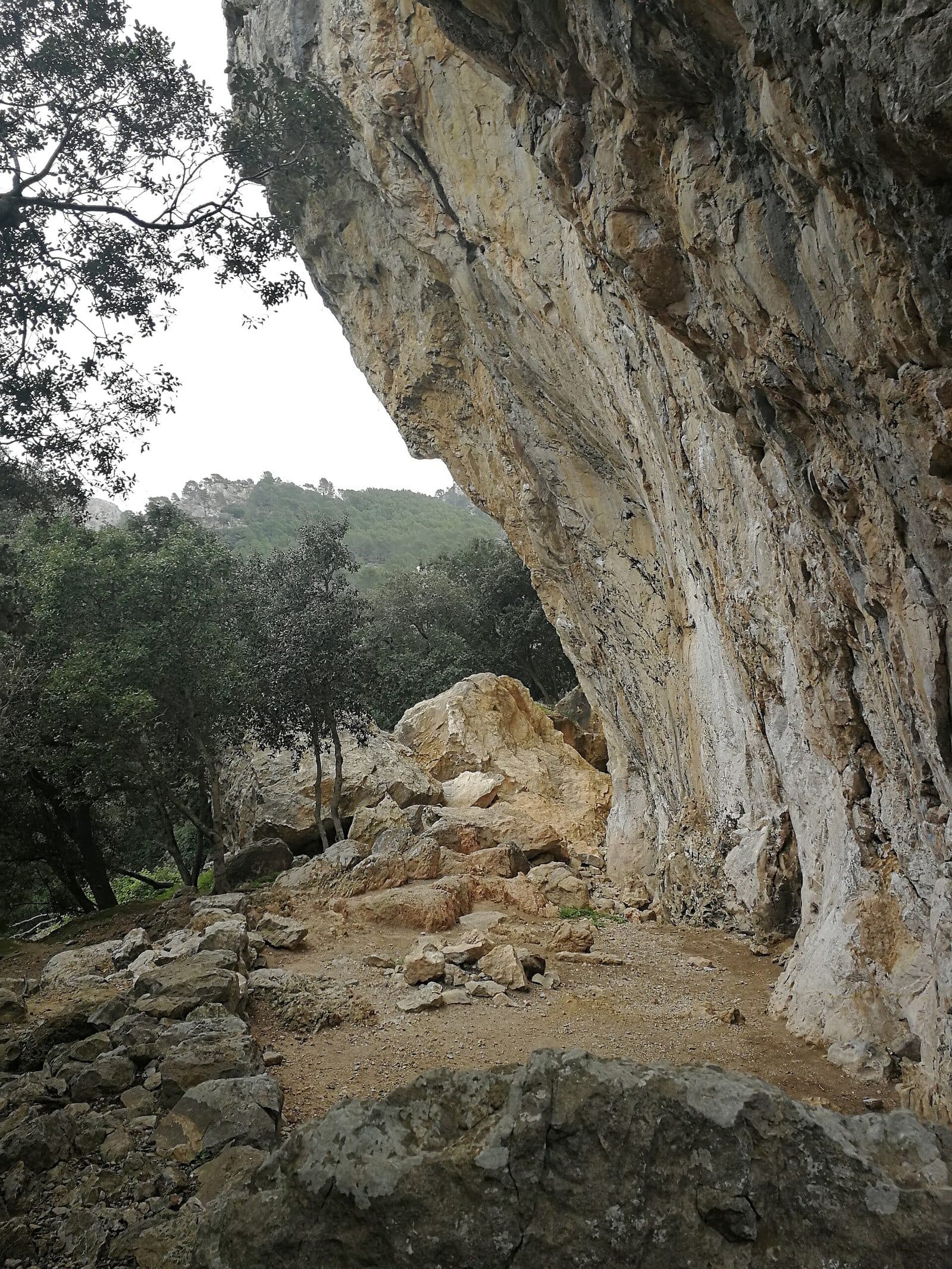

Beneath a natural rock overhang near Valldemossa, traces of several eras accumulated one above another. The Balma de Son Matge is therefore not a monument with façades, halls, or reconstructed living spaces, but an archaeological site whose significance quite literally lies in the ground. Five distinct cultural horizons have been identified here in the sequence of layers.
The site is aimed primarily at travelers who want to discover Mallorca’s prehistory beyond the large Talayot settlements. At first glance, rock, terrain, and individual preserved stone blocks dominate the scene. Only with some knowledge of the excavations and finds does it become clear why this unassuming rock shelter ranks among the important archaeological sites in the island’s northwest.
Son Matge is particularly closely associated with research into the extinct Balearic cave goat Myotragus balearicus. There are also Bronze Age ceramics, tools, jewelry, and everyday objects. The rock overhang is simultaneously a landform, a shelter, and an archive of human activity. Anyone who enjoys interpreting a genuine excavation site within its landscape setting will find an unusual route into Mallorca’s early history here.
History and significance
A small stone sculpture with a distinct head and recessed eyes is among the most remarkable finds associated with Son Matge. Known as the “Dama de Son Matge,” it has entered the archaeological literature. Its highly abstract form dates from the second half of the Bronze Age and shows that the site preserved far more than remains of everyday activity.
The five cultural horizons
The particular value of the Balma de Son Matge lies in its stratigraphy. Archaeologists distinguish five cultural horizons within the sequence of deposits. Such layers are crucial to research because finds are not considered only as isolated objects: Their positions in relation to one another help reveal chronological sequences and changes in how the site was used.
The rock shelter provided natural protection, while sediments, animal bones, and human remains accumulated beneath it over long periods. Son Matge should therefore not be understood as a structure from a single era. Through repeated use and deposition, the site became an archive in which different phases lie one above another.
The excavations
Guillermo Rosselló Bordoy and William Waldren carried out numerous excavations at the rock shelter between 1968 and 1975. Waldren was originally a painter and became an archaeologist in Mallorca. His research at Son Matge and other cave sites made him known far beyond the island; even earlier, he had searched the region for traces of the Balearic cave goat.
The excavations focused on more than human prehistory. Animal bones also provided insight into an island environment whose fauna had developed largely in isolation over a very long period. Some of the finds associated with Waldren and his research are presented at the Archaeological Museum of Deià.
Myotragus balearicus
Among the best-known finds from Son Matge are skeletal remains of Myotragus balearicus. This extinct species of goat had been native to the Balearic Islands since the Pliocene. It reached a shoulder height of 60 centimeters and weighed up to 70 kilograms. Its striking features included short, sharp horns and greatly enlarged lower incisors, which are sometimes compared to those of a beaver.
The bones known from Son Matge were dated to 1870±120 BC. Together with finds from the Cova de Muleta, they are among the most recent evidence of the species and therefore play an important role in determining when the Balearic cave goat disappeared. The fragments from Son Matge were taken to the museum in Deià.
Bronze Age remains
Simple ceramics, bronze awls, and characteristic bone objects with V-shaped perforations date from the second half of the second millennium BC. An ivory comb bears incised geometric patterns. Such objects make the world of the period more tangible: Alongside tools and utilitarian pottery are items whose materials and decoration indicate meticulous craftsmanship.
Today, Son Matge is listed as a Bien de Interés Cultural, meaning a protected cultural asset. This protection applies to a site whose value lies not in monumental walls but in the relationship between the rock shelter, the sequence of layers, and the scientifically documented finds.
What to see
The first thing to notice is not an entrance gate but the rock itself. The Balma is a rock shelter on Puig de sa Bombarda in the S’Estret de Valldemossa area. A rock shelter is an overhang formed by natural erosion: not a deep, enclosed cave, but a protective space that remains open to the outside. This simple form explains precisely why people could use the site and why deposits could be preserved there.
The rock overhang
The projecting rock is the defining feature of the site. It creates a sheltered area without completely separating the space from its surroundings. Unlike a limestone cave, there is no sequence of underground chambers here. The archaeological site remains connected to the slope, daylight, and landscape.
When viewing it, it is worth treating the natural formation as more than just a backdrop. The rock shelter made it possible for people to return to this spot repeatedly. At the same time, it aided the preservation of material that would have been more easily eroded or scattered in a completely exposed location.
The stratigraphy
The five cultural horizons form part of the scientific interpretation of the ground. Different deposits, find locations, and groups of materials together revealed the chronological sequence that gives Son Matge its significance.
For visitors, this knowledge changes the way seemingly ordinary earth and stones are perceived. An archaeological layer is not a decorative surface but the result of many individual processes: use, abandonment, sedimentation, and renewed occupation. Son Matge demonstrates particularly clearly why excavations must be carried out in a controlled manner. If the position of an object is not documented, a substantial part of its historical meaning is lost.
The preserved stone blocks
Various stone blocks have survived at the site. They appear understated and do not form an enclosed building that can be explained through rooms or rings of walls. Nevertheless, they are part of the site’s archaeological appearance.
This is precisely where the visitor experience differs from that of a restored settlement. Son Matge presents no fully reconstructed architecture. Its appeal lies in viewing the few visible structures together with the rock shelter and recognizing that the most important insights came from the documented sequence of layers.
Finds made of bone, bronze, and ivory
The objects recovered during the excavations show the breadth of the material discovered. Simple ceramics appear alongside bronze awls, perforated bone objects, the geometrically decorated ivory comb, and the abstract Dama de Son Matge.
The same applies to the bones of Myotragus balearicus. Their significance is best understood at the site, although the fragments themselves were taken to Deià. Son Matge and the Archaeological Museum there therefore tell two parts of the same story: The rock shelter reveals the topographical and stratigraphic setting, while the museum focuses on Waldren and his discoveries.
The site as a whole
The strongest impression comes from the relationship between the natural shelter and the archaeological ground. The terrain explains why the location was chosen; the finds demonstrate that its history extends far back into prehistory. Prior knowledge helps place the site in context: Visitors familiar with the concepts of a rock shelter, stratigraphy, and Myotragus balearicus will recognize correspondingly more. The rock overhang then becomes an archive with five cultural horizons, and the individual stone blocks become a sensitive part of a protected archaeological site.
Visiting the site
Son Matge is experienced by observing the rock overhang and the preserved stone blocks. The true discovery takes place in the mind: The visible site becomes connected with the history of its excavated layers and finds.
Preparation and context
A little preparation is particularly worthwhile here. The terms “five cultural horizons,” “Bronze Age,” and “Myotragus balearicus” provide a framework for what is visible. Without this context, the site can quickly appear to be merely a rock formation; with it, visitors can understand why archaeologists worked here repeatedly between 1968 and 1975.
It is also helpful to distinguish between the archaeological site and the collection of finds. Son Matge preserves the spatial context in which the material was discovered. The well-known animal bones were taken to Deià, and the scientific significance of other objects is also understood primarily through their documented origins.
Time needed
There is no set duration for a visit to the Balma de Son Matge. The appropriate amount of time depends on whether visitors simply want to see the rock overhang or consciously explore the stratigraphy and history of the finds. Son Matge is therefore less suitable for a fleeting photo stop than for a quiet archaeological detour.
Anyone subsequently visiting the museum in Deià or the historic center of Valldemossa should plan these as separate activities rather than viewing them as parts of a single exhibition site.
Check access in advance
Opening hours and admission details have not been reliably recorded. Before traveling, visitors should therefore check whether the site is currently accessible and under what conditions. This is more important for archaeological grounds than for an openly visible viewpoint, as protective measures, work, or access regulations may affect the possibility of visiting.
The final section of the route also deserves attention in advance. The known road route ends in Valldemossa; the site itself lies in the S’Estret de Valldemossa area on Puig de sa Bombarda. Up-to-date navigation and confirmation of permitted access will prevent visitors from accidentally entering private paths or sensitive excavation areas.
Getting there and parking
The two reliably documented driving routes initially lead to Valldemossa, not directly beneath the rock overhang. This distinction is crucial when planning. The Balma de Son Matge lies outside the usual walking route through the village streets, in the S’Estret de Valldemossa area on Puig de sa Bombarda.
From Palma Airport
From Palma Airport, the route first follows the Ma-20 and then the Ma-1110 to Valldemossa. The distance to Valldemossa is 25 road kilometers, and the drive takes around 30 minutes. Traffic and the increasingly winding approach toward the Tramuntana may affect the actual arrival time.
From Valldemossa, separate navigation to the archaeological site is required. The rock shelter should therefore be entered as a destination in its own right; the location “Valldemossa” alone leads only to the municipality. Before continuing, it is advisable to check current access conditions and use only publicly permitted routes.
From central Palma
From central Palma, the route follows the Ma-1110. The distance to Valldemossa is 19 road kilometers, and around 35 minutes should be allowed for the drive. The shorter distance takes longer than the route from the airport because of the departure through the city and the journey out of Palma.
This information also expressly ends in Valldemossa and should not be understood as the driving time directly to the Balma. For the final section, the location on Puig de sa Bombarda and the name S’Estret de Valldemossa are the key points of reference.
Parking and the final section
Access roads, property boundaries, and the protection of the site must be respected. The exact route should be checked using current information; a shortcut across unmarked or private land is not a suitable alternative.
Getting there without a car
No bus stop has been recorded in the immediate vicinity of the Balma de Son Matge. Anyone traveling without a rental car should determine in advance how to continue from the village legally and safely.
The visit is therefore easier to prepare if the journey to Valldemossa and access to the archaeological site are planned separately. For this destination in particular, an exact location is more helpful than simply entering the municipality’s name.
Bus lines to Balma de Son Matge at a glance
| Line | Route | Departures/day | First | Last |
|---|---|---|---|---|
| 203 | Valldemossa / Deià | 94 | 06:50 | 22:30 |
From the official GTFS feeds (TIB/SFM), no real-time data. The figures cover all stops in the town; weekend and holiday services differ — check with the operator before travelling.
Getting there by bus
Valldemossa 1 (63002) · 2.2 km as the crow flies
- 203Valldemossa / Deià · Daily
Valldemossa 2 (63001) · 2.2 km as the crow flies
- 203Valldemossa / Deià · Daily
Timetable data: official GTFS feeds (TIB/EMT), no real-time — check with the operator before travelling.
Nearby attractions
After the quiet archaeology beneath the rock shelter, Valldemossa almost feels like a contrasting image: Narrow streets, natural-stone houses, green shutters, and entrances decorated with plants define the historic village. The Balma belongs to the municipality but is not located in the well-known village center. Both destinations can be linked thematically on an excursion without treating them as a single walking route.
Valldemossa
The village lies in Mallorca’s northwest in the Serra de Tramuntana and is best known for its charterhouse. Frédéric Chopin and George Sand stayed in Valldemossa during the winter of 1838/39. Their story represents a comparatively recent layer of local history, while Son Matge takes visitors back to the Bronze Age and beyond.
Catalina Thomás is also closely associated with Valldemossa. Anyone continuing from Son Matge to the village center can therefore experience several historical levels in one day: prehistory at the rock shelter, religious tradition, and the memory of Chopin and Sand in the village.
The charterhouse and historic center
The charterhouse is the cultural focus of many visits to Valldemossa. Son Matge, by contrast, requires visitors to understand an open archaeological site through its landscape and excavation history. A walk through the village streets is a good way to connect the two stops. The flower-decked houses and cobblestones form part of the townscape for which Valldemossa is known. A Coca de Patata, the village’s characteristically soft potato pastry, provides a culinary conclusion without reducing the archaeology to a mere stopover.
The Archaeological Museum of Deià
For understanding Son Matge, Deià is the most thematically appropriate addition. William Waldren founded the archaeological museum there in 1962. His discoveries, research, and works from his career as a painter are all associated with the museum.
The connection to Myotragus balearicus is particularly important. Fragments from Son Matge were taken to Deià, and Waldren became known for his discoveries of the extinct Balearic cave goat. A visit to the museum does not replace the archaeological site: In Deià, the focus is on objects and research history, while near Valldemossa, the original location beneath the rock shelter becomes understandable.
The place it belongs to
Valldemossa in the place guidePractical information for your visit
An archaeological site is less forgiving of carelessness than a paved viewpoint. Loose stones, excavation areas, and natural terrain are not decorative features here. They are part of the protected context from which researchers derived their findings.
Footwear and terrain
The current condition of the access route should be checked before setting out. Anyone who feels unsure on natural terrain should not attempt unmarked sections or force the visit by taking an improvised shortcut.
Protecting the site
Stone blocks must remain where they are, even if they look unremarkable. Likewise, no pottery fragments, bones, or other supposed finds should be picked up. In archaeology, it is not only the object itself that matters but also its exact position within a layer. Even a small displacement can destroy this context. Its status as a protected cultural asset applies particularly to elements that may easily appear ordinary to untrained eyes.
Visiting with children
For children, the story of the sturdy Balearic cave goat, which stood just 60 centimeters tall, can provide a good introduction to the site. The idea that five cultural horizons were discovered beneath a single rock shelter also makes archaeological work easier to understand. Children must, however, be able to walk safely across the terrain and should be closely supervised.
Families can prepare for the visit with a short discovery activity: Where does the natural rock end, why did it provide protection, and why must stones or objects found in the ground not be moved? This makes the understated site easier to understand.
What not to expect
The Balma de Son Matge is neither a large walk-in cave nor a reconstructed Bronze Age settlement. Its value lies in the original setting of the rock overhang and its layers. This very restraint is what makes the difference: Anyone judging the site by the standards of a museum can easily overlook what matters most. Those who consider the rock shelter, terrain, and research history together will recognize a site that has preserved important evidence of Mallorca’s prehistory and the late survival of Myotragus balearicus.
Local insider tips
Read the rock as architecture
The rock shelter is not an enclosed cave. Start by observing the line of the natural overhang: It explains why this open site provided protection and was able to preserve archaeological deposits.
Pay attention to the layers
The main attraction lies not in monumental walls but in the stratigraphy. With knowledge of the five cultural horizons, the ground, rock, and preserved stone blocks become far more meaningful.
Explore Myotragus further in Deià
The fragments of the extinct Balearic cave goat found at Son Matge were taken to Deià. The Archaeological Museum there is therefore the ideal scholarly complement to the site.
Connect two historical periods
After the rock shelter, continue to the center of Valldemossa: Son Matge tells the story of prehistory and the Bronze Age, while the charterhouse and village streets reveal more recent chapters of the island’s history.