
Palmanyola – peaceful living between Palma and the Tramuntana

Places to stay in Palmanyola
AdTo load the accommodation map by our partner Stay22, we need your consent for marketing cookies. Your consent applies to all marketing content on mallorca.com.
Palmanyola is not a historic mountain village with narrow lanes and a large parish church, but a peaceful residential area northwest of Palma. Its appeal therefore lies less in traditional sights than in its location: the village is situated between the island’s capital and Bunyola, at the foot of the Serra de Tramuntana. From here, the city, cultural landscapes, and mountains can easily be combined.
For visitors, Palmanyola is particularly suitable as a brief stop, a starting point for walks, or a peaceful base for excursions. Plaça Major, the cultural center, and the newly designed Paseo make for a manageable tour of the village. Anyone expecting monumental architecture, a historic old town, or an extensive museum program should not confuse Palmanyola with Bunyola, Valldemossa, or Sóller.
For people who live in Mallorca or are looking for a permanent home, Palmanyola is interesting for a different reason. Daily life is geared toward residents, local amenities go beyond the essentials, and Palma remains accessible via the Ma-11. The settlement is accordingly regarded as a residential location for families and commuters, not as a seasonal vacation center.
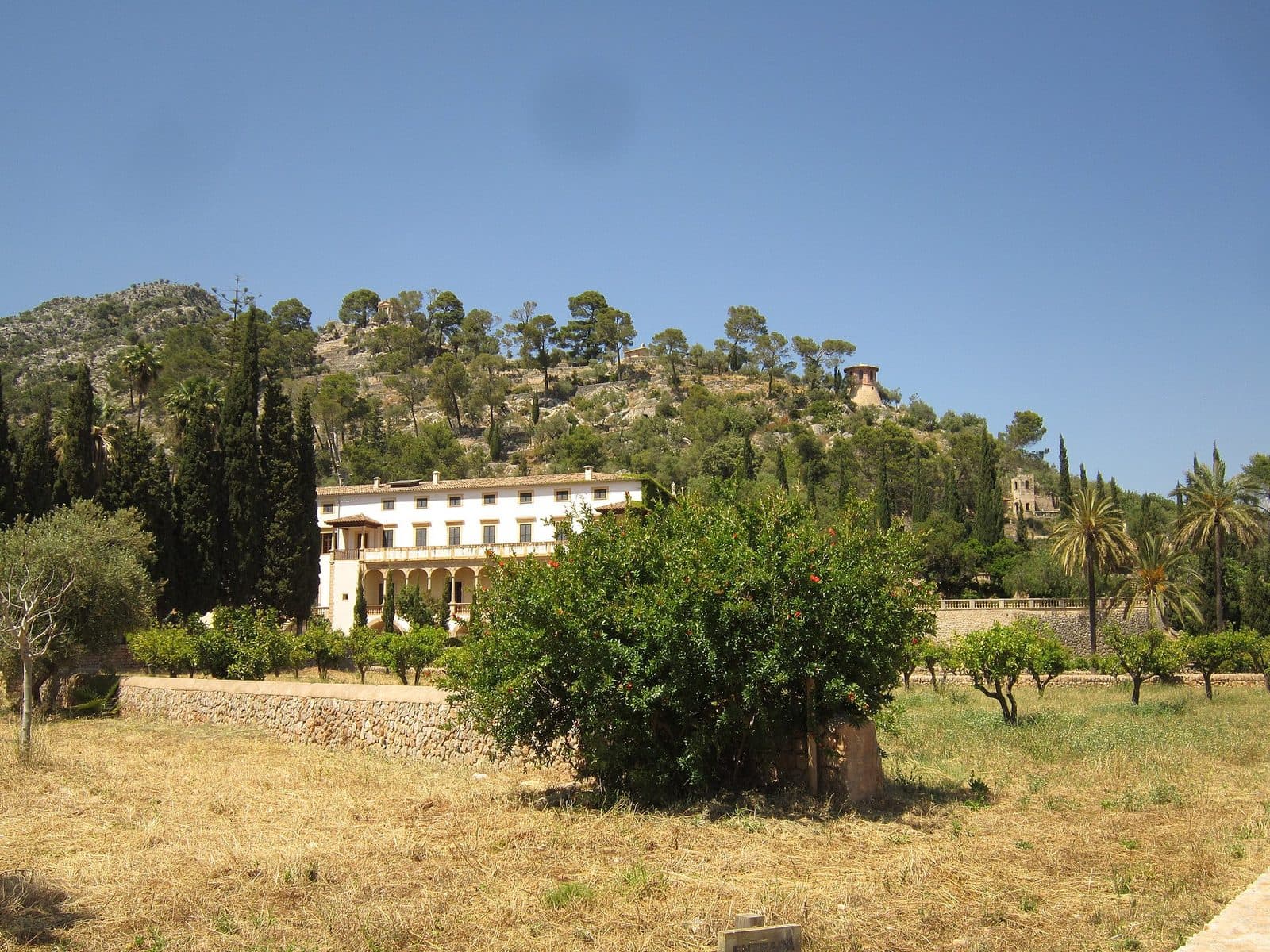
The surrounding area is characterized by almond and carob fields, as well as the nearby foothills of the Tramuntana. Palmanyola thus marks a transition between the urbanized area around Palma and the rural landscape of the northwest. This in-between character defines the village more strongly than any single landmark.
History of Palmanyola
Palmanyola’s early history is connected with the old estates of Sa Font Seca and Son Amar. The later settlement developed on land that belonged to them. Local accounts trace the history of the area back to the Middle Ages; present-day Palmanyola, however, is shaped far more by its recent development as a residential community than by any preserved medieval village center.
This clearly distinguishes Palmanyola from Bunyola and the old villages of the Serra de Tramuntana. There is no cohesive ensemble of a historic parish church, stone stepped lanes, and centuries-old townhouses here. Its older history lives on instead in the names of the former estates and in the cultural landscape. Almond trees, carob trees, and the open land along the edge of the settlement recall that the area was shaped by agriculture for a long time.
Its origins as an urbanization also explain the layout and present function of the village. Palmanyola primarily became a place to live. As it developed, community facilities, shops, and services were established, turning a purely residential development into a village with its own social center. Plaça Major and the cultural center exemplify this transformation: they give the residential area spaces where public life can come together.
Since 1985, Palmanyola has held the status of an Entidad Local Menor. This development is important to local identity because, although Palmanyola belongs to the municipality of Bunyola, it sees itself as a separate village in everyday life. This is particularly apparent during local events and in the use of the central squares. The history of Palmanyola is therefore less a sequence of famous rulers and buildings than a story of a community created by its residents.
Its residential character has remained a defining feature. The convenient position in the corridor between Palma, Bunyola, and the Tramuntana made Palmanyola attractive to people whose daily lives take them to the capital but who do not want to live in the middle of the urban area. The land of the former estates thus became an independent settlement whose importance lies primarily in its location and established community.
Sights in Palmanyola
Palmanyola is not a destination for a long sightseeing tour. Instead, its places of interest tell the story of how a residential settlement became a functioning center of daily life. A walk can focus on Plaça Major, Casal de Cultura Jaume Mir, and the Paseo. There is also the landscape of fields and foothills visible around the edges of the built-up area.
Plaça Major
Plaça Major is the social heart of Palmanyola. It was already a venue for festivals and gatherings in the past, and residents still use it as a meeting place today. Its significance lies less in outstanding architecture than in its role within the village: it turns the surrounding residential streets into a recognizable center.
For visitors, the square is the most useful starting point for understanding Palmanyola. It shows that the village does not merely consist of scattered houses but also has communal spaces. During local events, part of the program moves onto the square and into the adjacent areas. Outside such dates, it feels considerably more ordinary and peaceful.
Casal de Cultura Jaume Mir
Casal de Cultura Jaume Mir is the village’s most important cultural institution. It includes a multipurpose hall, a library, an area dedicated to Gaspar Sabater, and an exhibition room. The building therefore supports not just individual events but several forms of local cultural life.
For visitors, the Casal is particularly worthwhile when an exhibition or part of the Fira Bona program is taking place. Without an event, it is not a museum that would justify planning a longer journey solely to see it. Its real significance lies in its local use: Palmanyola has created a permanent venue for reading, exhibitions, performances, and community activities.
The name Jaume Mir further anchors the institution in local identity. The library area dedicated to Gaspar Sabater also shows that the building aims to be more than a neutral events hall. Anyone wishing to discover everyday Palmanyola will gain better insight here than by searching for traditional monuments.
Paseo de Palmanyola
Paseo de Palmanyola is a newer open space with a shaded area and benches. It combines exercise, relaxation, and recreational facilities and is explicitly intended for different age groups. The grounds include a pump track, a calisthenics area, and a dog exercise zone.
This makes the Paseo one of the most practical destinations for families, young people, active visitors, and people with dogs. It is not a historic promenade but modern infrastructure for everyday life. That is precisely what makes it typical of Palmanyola: the village does not present itself as an open-air museum but invests in spaces that residents can use regularly.
Visitors should include the Paseo as part of a short walk rather than treat it as a separate full-day attraction. Together with Plaça Major and the cultural center, however, it provides a coherent impression of how Palmanyola functions. The shaded relaxation area offers seating, while the pump track gives active children and young people a specific reason to stop.
Landscape on the edge of the village
Almond and carob fields surround Palmanyola. They form the scenic transition from the residential area to the foothills of the Serra de Tramuntana. Those exploring on foot will experience a stronger contrast here than in the village center: residential streets give way to agricultural land and views toward the mountains.
This setting is not a single attraction with an entrance or a fixed sightseeing route. Nevertheless, it is an essential part of the village’s atmosphere. It is particularly appealing to people who use Palmanyola as the starting point for a peaceful walk or who want to take a short break on their way to Bunyola and farther into the Tramuntana.
Sights in Palmanyola
Activities and excursions
Palmanyola’s strength when it comes to activities lies not in a large selection within the village, but in the combination of nearby open spaces, rural surroundings, and good excursion options. Palma lies in one direction, while Bunyola and the Serra de Tramuntana lie in the other. This makes it possible to plan anything from short walks to a full day among gardens, mountain villages, and the capital.
Walks among almond and carob fields
The fields on the edge of Palmanyola are ideal for peaceful walks. They reveal a cultural landscape characteristic of the area at the foot of the Tramuntana without requiring a challenging mountain hike. Their appeal lies in the transition between the settlement, open farmland, and the mountains drawing closer.
For visitors, this is a good way to discover Palmanyola through its surroundings rather than its buildings. Respect for agricultural land and private access roads should be a matter of course. The landscape is a working environment, not a freely accessible park. Those who stay on public paths can experience its rural character without entering private property.
Paseo de Palmanyola
For a short, active break, the Paseo is the first place to visit in the village. The pump track is intended for users of suitable bicycles and sports equipment, while the calisthenics area allows for bodyweight training. Shaded areas and benches also make the facility useful for accompanying adults and visitors less interested in sports.
Families can easily combine the Paseo with a short walk around Plaça Major. The facility is also an important alternative for residents who would otherwise need to travel to larger neighboring towns: exercise, relaxation, and a dedicated area for dogs are all located in one shared public open space.
Serra de Tramuntana
Palmanyola lies at the foot of the Serra de Tramuntana and is therefore a suitable base for trips into the northwest of Mallorca. Bunyola is the nearest first stop, with routes continuing from there into the mountains. Valldemossa and Sóller can also be included as destinations on a day trip.
Palmanyola itself should not, however, be regarded as a mountain village. It lies in the foothills of the Serra and serves more as a peaceful starting point. This is practical for travelers who want to visit historic villages, gardens, or mountain landscapes during the day but do not want to stay in the middle of a heavily visited excursion destination in the evening.
Jardins d’Alfàbia
Jardins d’Alfàbia is one of the most important excursion destinations in the Bunyola area. The gardens offer a completely different visitor experience from Palmanyola itself, making them a sensible addition to a stay in the village. The gardens make Alfàbia a destination in its own right and deserve more time than a walk through Palmanyola.
This combination is particularly suitable for a day not planned solely as a mountain tour. Palmanyola can serve as a peaceful starting point or stopover, while Alfàbia provides the cultural and historical focus. Throughout the year, the estate is also associated with local traditions in the municipality, such as Diumenge de l’Àngel after Easter.
Palma
In the opposite direction lies Palma, with shopping, architecture, and further attractions. The journey from Palmanyola to the center covers 15 kilometers by road via the Ma-11 and takes around 30 minutes. This makes half a day in the capital just as realistic as regular travel for professional or personal reasons.
For vacationers, this creates a practical division: cultural and urban activities in Palma, with quieter parts of the day on the edge of the Tramuntana. Palmanyola itself does not need to compete with the capital’s attractions. Its role is that of a manageable residential village between two very different areas of experience.
Bunyola and Sóller
Unlike Palmanyola, Bunyola has a historic village center and is therefore a suitable complement. Anyone looking for old lanes, traditional stone architecture, and a classic village square should include the municipality’s main town in their excursion. From there, the journey can continue toward Sóller and deeper into the Serra de Tramuntana.
Sóller, in turn, adds a stronger tourist and historical focus. Palmanyola provides a quieter starting point closer to Palma. Travelers with their own vehicle can develop a route from this combination that links a residential village, a mountain village, and the Tramuntana landscape without mistakenly treating Palmanyola as an extensive sightseeing destination.
Festivals and events
Local events are when Palmanyola most clearly departs from its understated everyday character. The main event is Fira Bona, which was closely associated with horses and rural tradition for many years. During the festivities, streets, the square, green spaces, and the cultural center become event venues; visitors then experience a considerably livelier Palmanyola than on ordinary days.
Fira Bona de Palmanyola
Fira Bona, also known as Fira del Cavall, takes place in March. Traditionally, horse culture and rural heritage were at its heart. Programs in previous editions included horse parades and shows, riding demonstrations, craft stalls, food markets, Mallorcan cuisine, music, and street entertainment.
Venues include Avinguda de les Dàlies, Plaça Major, and green spaces around the village. The Fira is therefore not an isolated event inside a hall but extends into public spaces. For residents, it is a social gathering; for visitors, it is the best time to experience Palmanyola with a clear program of events.
The 2026 edition was the XIII Fira Bona and took place from 6 to 8 March. Under the motto “Un pas en el temps,” it changed its previous focus and featured historical reenactments. The program included medieval, Roman, and Viking-era camps, staged battles, a craft market, fire rituals, and evening events. Casal de Cultura Jaume Mir was also incorporated into the program with an exhibition.
This new direction shows that the Fira is not an unchanging traditional format. Horses shaped the festival for many years, but individual editions may choose other themes and program priorities. Anyone traveling specifically for the event should therefore check the program for that year rather than automatically expecting the same horse shows.
For families, the Fira is appealing because of its children’s activities, demonstrations, and open event spaces. At the same time, the music, fire performances, and evening program can be considerably livelier than normal village life. Anyone wishing to discover Palmanyola at its peaceful best should choose another day; those seeking local community life will find the Fira the most revealing time to visit.
Upcoming dates
Getting there and around
Palmanyola lies northwest of Palma on the transport corridor that runs from the capital via the Ma-11 toward Bunyola and Sóller. This road is the key connection for visitors and commuters alike. The village is close enough to Palma for regular journeys but already outside the continuous urban area.
By car from the airport
From Palma Airport, the route initially follows the Ma-20 and then the Ma-11 to Palmanyola. The distance is 20 kilometers by road, and the journey takes around 25 minutes. The village can therefore be reached after arriving at the airport without a long drive across the island, making it a suitable base for travelers who primarily want to explore Palma and the northwest.
The route avoids driving through the center of Palma. After the section on the Ma-20, the Ma-11 leads directly toward the Tramuntana foothills. In practical terms, this means Palmanyola can also be reached easily on the day of arrival or departure without having to tackle a long mountain road.
By car from Palma
From the center of Palma, the distance is 15 kilometers by road via the Ma-11. The journey takes around 30 minutes. The connection is straightforward for day visitors and also makes Palmanyola an understandable choice for commuters. Additional time should be allowed during rush hour, but the specific point of reference remains the measured journey of around 30 minutes.
The Ma-11 continues toward Bunyola and Sóller. Palmanyola is therefore suitable as a stopover on a trip into the Serra de Tramuntana. Anyone who only wants to see Plaça Major, the cultural center, and the Paseo does not need to devote a whole travel day to it, however; the village is better incorporated into a broader route.
By bus
Palmanyola and its immediate surroundings are served by regional buses. This generally provides an alternative to driving for journeys toward Palma and Bunyola. As stops are not always located directly beside the desired destination, planning should also account for the walk from the bus stop to Plaça Major, the cultural center, or a residential address.
The bus is suitable for occasional excursions, particularly when the day’s destination lies along the same transport corridor. A car offers greater flexibility for several scattered destinations in the Tramuntana. Hikes and visits to rural estates in particular cannot always be combined as directly by public transport as a simple trip to Palma.
Walking and cycling in the village
Palmanyola’s central destinations can be linked on a short walking route. The Paseo also provides a dedicated space for exercise and relaxation. Outside the settlement, visitors should bear in mind that Palmanyola lies beside an important road connection and that not every scenic route is automatically suitable as a comfortable walking or cycling path.
The location on the edge of the Tramuntana is generally appealing for sport cycling, but the mountain roads require experience and appropriate equipment. The pump track at the Paseo serves a different purpose: it is a local recreational facility, not a training route through the mountains.
Bus lines to Palmanyola at a glance
| Line | Route | Departures/day | First | Last |
|---|---|---|---|---|
| 204 | Port de Sóller - Palma | 76 | 00:17 | 23:47 |
| 303 | Bunyola - H. Joan March - Palma | 68 | 07:03 | 21:48 |
| 205 | Bunyola - Palma | 42 | 06:50 | 22:15 |
From the official GTFS feeds (TIB/SFM), no real-time data. The figures cover all stops in the town; weekend and holiday services differ — check with the operator before travelling.
Getting there by bus
Raixa 2 (10026) · 0.3 km as the crow flies
- 204Port de Sóller - Palma · Daily
- 205Bunyola - Palma · Daily
- 303Bunyola - H. Joan March - Palma · Daily
Raixa 1 (10046) · 0.4 km as the crow flies
- 204Port de Sóller - Palma · Daily
- 303Bunyola - H. Joan March - Palma · Daily
Urb. sa Coma 2 (10050) · 0.5 km as the crow flies
- 205Bunyola - Palma · Daily
- 303Bunyola - H. Joan March - Palma · Daily
Urb. sa Coma 1 (10049) · 0.5 km as the crow flies
- 205Bunyola - Palma · Daily
- 303Bunyola - H. Joan March - Palma · Daily
Timetable data: official GTFS feeds (TIB/EMT), no real-time — check with the operator before travelling.
Living in Palmanyola
Palmanyola is primarily a residential village. This shapes its daily rhythm, infrastructure, and public more strongly than tourism. Many routes and facilities serve ordinary daily life rather than a seasonal visitor program. For people who live permanently in Mallorca, this may be more important than a long list of attractions.
Local amenities in the village
Local amenities include a supermarket, bakeries, butcher shops, and providers of prepared food. There are also restaurants and various personal services such as hairdressers and beauty businesses. Many everyday errands can therefore be completed in Palmanyola itself without having to travel to Palma or Bunyola for every purchase.
This structure is particularly relevant for families and working people. A residential village where bread, groceries, and prepared meals are accessible functions differently from an isolated urbanization without its own center. Plaça Major and the surrounding facilities also give errands a social context: residents do not have to drive exclusively to a shopping center outside the village but can combine several tasks within Palmanyola.
Palma remains important for a wider selection, specialist shopping, and the full range of urban amenities. Local businesses are geared more toward regular everyday needs than extended shopping trips. This suits Palmanyola’s character as a residential settlement and should be assessed realistically when choosing the village as a place to live.
Health and everyday services
A pharmacy is part of the local infrastructure. There is also a post office and a bank. Such facilities make Palmanyola considerably more practical for permanent living than a purely residential vacation development. Many routine errands can be handled locally, while more advanced medical examinations or specialist services may require travel to larger towns.
The pharmacy is particularly relevant for everyday needs and advice on minor health concerns. It does not replace a comprehensive medical center, but it shortens journeys for medication and standard pharmacy products. Anyone planning a move who requires regular medical care should specifically check their personal care options in Palma or at a suitable health center in advance.
The post office and bank reinforce the village’s year-round residential character. Palmanyola is not geared solely toward guests staying for a few days but has services that are particularly important to residents. This makes daily life easier for older people, families, and those who work from home.
Commuting to Palma
The connection to Palma is one of Palmanyola’s main advantages. Via the Ma-11, the journey to the center covers 15 kilometers by road and takes around 30 minutes. This is manageable for a daily commute, although extra time should be allowed for rush-hour traffic when attending fixed appointments.
Palmanyola is therefore particularly appealing to people whose workplace, education, or regular appointments are in Palma but who wish to spend their daily lives closer to the Tramuntana. The route is direct enough to use the capital continuously without having to live in the densely built-up center.
A car offers the greatest flexibility in terms of time, especially when working hours vary or other errands need to be completed along the way. Regional buses provide an alternative for people whose destination and daily schedule are compatible with the timetable. Before deciding to live here, it is advisable to make a realistic trial journey at the usual commuting time and from the specific address to the appropriate bus stop.
Daily life without a car
Part of daily life can be managed within the village thanks to the supermarket, bakeries, butcher shops, pharmacy, post office, bank, and restaurants. This provides a good basis for short journeys. Living completely without a car in Palmanyola is nevertheless practical mainly when work, school, medical appointments, and leisure destinations are easily accessible by regional bus or on foot.
The bus is a serious option for journeys to Palma. It becomes more difficult when several destinations need to be reached in one day, for late return journeys, or for excursions into more remote parts of the Tramuntana. Anyone who deliberately wants to live without a car should therefore consider not only the general bus service but their entire weekly routine: commuting, shopping, accompanying others, and regular appointments.
Within Palmanyola, the concentration of local amenities improves walkability. The village does not depend on every everyday journey leading to the capital. At the same time, it remains a settlement outside Palma’s urban network, so mobility requirements differ significantly from those of a central residential neighborhood.
Families and public open spaces
Palmanyola is described as a residential location for families. The Paseo supports this character with its pump track, shaded areas, calisthenics facility, and dog exercise zone. Such facilities are often more meaningful in daily life than tourist attractions because they enable regular exercise and social interaction.
Plaça Major and Casal de Cultura Jaume Mir also play a role for families. The cultural center provides space for a library, exhibitions, and events; during Fira Bona, children’s activities and street entertainment are added. This creates both peaceful places and spaces shaped by community life.
A specific decision about where to live must nevertheless include an assessment of personal education and childcare needs. Palmanyola’s family-friendly profile and recreational areas say a great deal about the village’s character, but they do not replace checking the schools or childcare services required by each household.
Residential areas and village character
The more central areas around Plaça Major, the cultural center, and local amenities offer shorter routes to shops and community facilities. Along the edges, the surrounding landscape of almond and carob fields becomes more prominent. Which location is more suitable therefore depends on whether short everyday journeys or an immediate connection to the rural surroundings is more important.
Palmanyola is shaped by its residents, not by groups of visitors changing every day. Long-established residents and newcomers meet in a village that is comparatively young because of its development as an urbanization, yet has built a distinct local identity. Events such as Fira Bona and institutions such as the cultural center create shared points of reference.
Anyone looking for historic lanes and a centuries-old village ensemble outside their front door will find more suitable places in the Tramuntana. Those who prefer a functional residential village between Palma and the mountains, however, should not regard Palmanyola as a second-rate alternative. Its proximity to the capital, local services, and quieter surroundings provide a distinctive residential appeal.
Palmanyola in winter
Palmanyola is primarily a residential village. A supermarket, pharmacy, post office, bank, bakeries, and other everyday businesses are part of the local infrastructure.
Plaça Major, the cultural center, and local shops are focal points for residents. Fira Bona in March is a notable public event in the annual calendar.
For permanent residence, the village’s residential character and local services are relevant. Life revolves around the neighborhood, amenities, work, and proximity to Palma and Bunyola.
Practical information for your visit
Palmanyola is best visited with appropriate expectations. The village is not a substitute for Bunyola’s historic center and is not a standalone day-trip destination with numerous museums. It becomes interesting as a place for a short walk, as the venue for Fira Bona, or as a base between Palma and the Tramuntana.
Time needed and planning your day
A manageable part of the day is enough for Plaça Major, Casal de Cultura Jaume Mir, and the Paseo. More time is worthwhile if an exhibition is taking place at the cultural center, children are using the recreational facilities, or a walk around the edge of the settlement is planned. Without an event, Palmanyola can sensibly be combined with Bunyola or Jardins d’Alfàbia.
The village is suitable for errands and a peaceful walk in the morning. During the warmer part of the year, the shaded areas at the Paseo are pleasant; longer walks through the rural surroundings are better suited to the cooler parts of the day. For photographs and scenic impressions, the edge of the village is more rewarding than the functional center.
Visiting during Fira Bona
During Fira Bona, the village’s character changes considerably. Avinguda de les Dàlies, Plaça Major, green spaces, and the cultural center may all be part of the program. Central areas are therefore busier, and everyday routes are less direct than on ordinary days.
A visit during the Fira is worthwhile for crafts, demonstrations, music, food, and the family program. The specific concept can change from year to year, as shown by the historical redirection of the 2026 edition. Anyone primarily interested in seeing horse shows should therefore check before traveling whether they are actually included in the current program.
Useful combinations
The most obvious combination is with Bunyola, where a historic village center offers a distinctly different atmosphere. Jardins d’Alfàbia provides a cultural, historical, and botanical focus. For a longer excursion, the route can then continue toward Sóller and farther into the Serra de Tramuntana.
To the south, Palma is an obvious option. The 15 kilometers by road via the Ma-11 take around 30 minutes. A peaceful morning in Palmanyola can therefore be combined with an afternoon in the capital. Conversely, the village is suitable for a short break on the way from Palma to the northwest.
The right expectations
Palmanyola has no beach, no harbor, and no monumental old town center. There is also no reason to artificially present the village as a major sightseeing destination. Its appeal lies in ordinary village life, its public open spaces, and its location between the capital and the mountains.
Anyone looking for exactly that will find an understated glimpse of Mallorca beyond the vacation resorts. For a traditional sightseeing day, Bunyola, Alfàbia, Valldemossa, Sóller, or Palma offer more. For residents and travelers seeking a peaceful base, however, Palmanyola demonstrates how practical life on the edge of the Tramuntana can be.
Eating, drinking and staying in Palmanyola
The best-rated businesses from our directory, ordered by Google rating — not by advertising.
Latest news from Bunyola
- 27 Mallorca towns lack Alcover and La Balanguera
- Mallorca electric cars and fire demo fill Palma
- Mallorca storm kills woman amid 173 incidents
- Mallorca cemetery yields two Civil War victims