
Rei en Jaume I in Palma – Monument to the Conqueror King
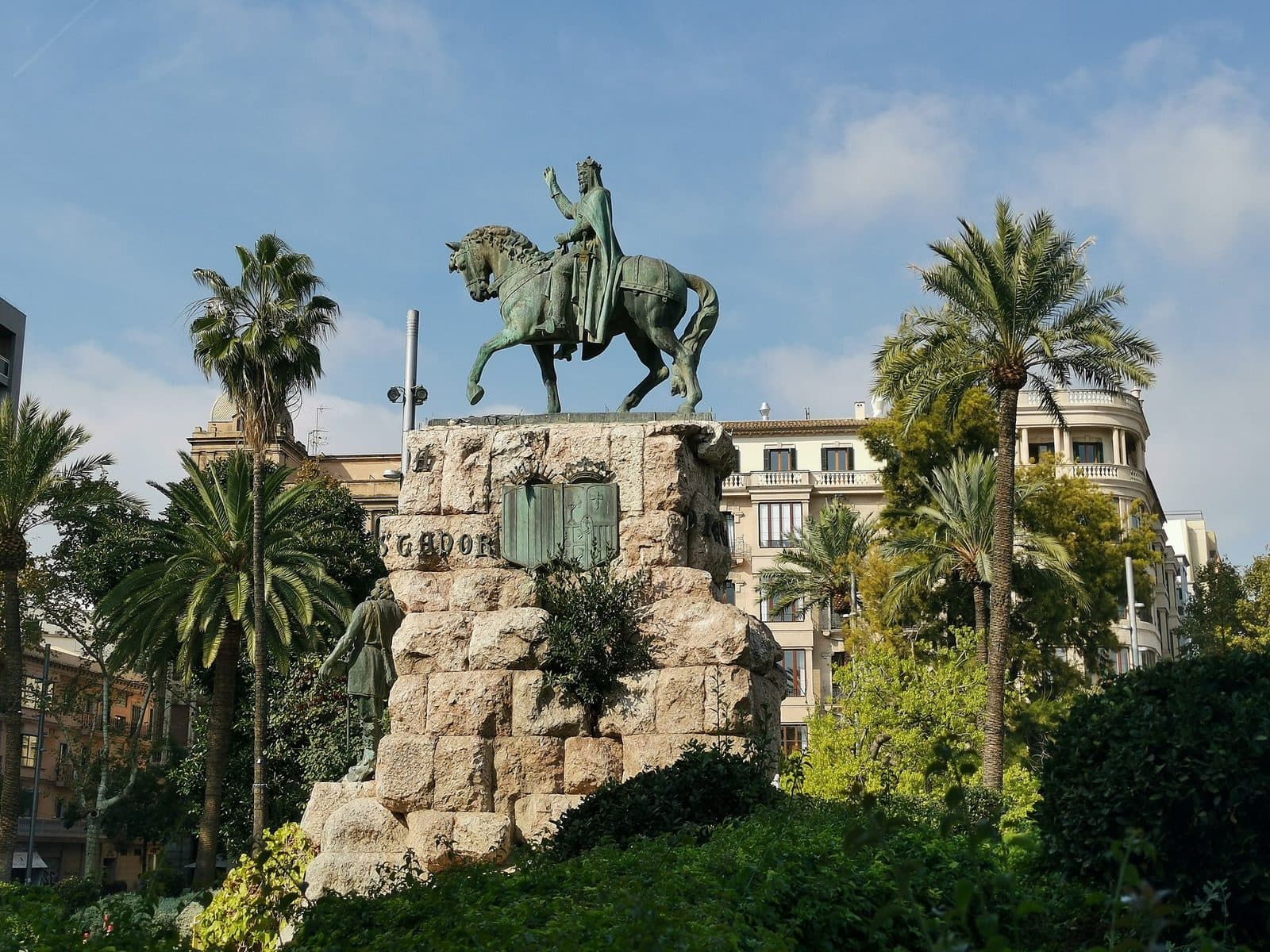

Amid the daily flow of the island’s capital, Rei en Jaume I recalls the king whose campaign fundamentally changed Mallorca’s medieval history. The equestrian monument stands on Plaça d’Espanya in Palma, one of the city’s most important arrival and orientation points. Anyone walking from the centre towards the old town encounters not only a historical image of a ruler, but also a key figure in Mallorca’s understanding of its own history.
The visit is worthwhile less as a standalone sightseeing activity than as an illuminating introduction to Palma. The statue shows how closely today’s urban landscape is associated with the conquest of 1229 and the subsequent reorganisation of Mallorca. From here, the story can be followed onwards to the cathedral, the royal palace and the medieval streets of the old town. At the same time, the monument is a good place to examine the grandeur of a classical equestrian statue at close range: king and horse form a widely recognisable silhouette that holds its own against the open space of the square. There is no museum, interior or exhibition to discover here; its appeal comes from the interplay of sculpture, historical knowledge and vibrant city life.
Rei en Jaume I is therefore particularly interesting for history enthusiasts, urban walkers and anyone who wants to experience Palma as more than a shopping and port city. A quick glance is enough for a souvenir photo. Those who can place the depicted figure and his impact on Mallorca in context, however, will see far more than a king on horseback.
History and significance
The decisive episode begins not on Plaça d’Espanya, but on Mallorca’s south-western coast. In September 1229, Jaume I of Aragón reached the area around Santa Ponça with a Christian army. Mallorca was under Muslim rule at the time; for the king, the island was also a strategically and economically important objective in the western Mediterranean.
Jaume I of Aragón
Jaume I lived from 1208 to 1276 and went down in history as the Conqueror King. His epithet “the Conqueror” refers to the territorial expansion of his rule, with which Mallorca remained permanently associated. The monument depicts him not as a lawgiver or courtly ruler, but in the traditional image of a mounted monarch. This alone places energy, military leadership and the assertion of power at the forefront.
The campaign of 1229 was not a single symbolic landing, but a military undertaking. After arriving near Santa Ponça, the army had to advance towards Palma and overcome resistance. On 31 December 1229, Palma fell to the conquerors after a siege. This day became a historic turning point because it brought more than a mere change of power in the city.
The reorganisation of Mallorca
The conquest was followed by new laws, administrative structures and Christian resettlement from regions of the Iberian Peninsula. This marked the beginning of a new era in Mallorca’s history. The statue therefore represents more than a medieval victory; it commemorates a change of power and the subsequent reorganisation of Mallorca.
The memory of these events, however, is not neutral. A monumental equestrian statue tells history from the victor’s perspective. It places the king at the centre, while the Muslim population and the violent consequences of the conquest remain invisible in the statue itself. This very tension makes closer examination worthwhile: the monument reveals both a historical event and the way later generations wanted to represent that event in public.
A memory that remains alive today
Palma’s medieval monuments also continue the story. The Christian reorganisation after 1229 formed the backdrop to the development of the royal and ecclesiastical buildings that now define the appearance of the old town. Rei en Jaume I is therefore a meaningful starting point: first the conqueror appears as a mounted figure, while later the political and religious consequences of his campaign emerge in the cityscape.
What to see
Even from some distance, it is clear why European rulers were so often depicted on horseback. A mounted king towers over ordinary passers-by, appears mobile and simultaneously dominates the public space. At Rei en Jaume I, this visual form conveys a particularly clear message: the monarch portrayed is the one whom Mallorca’s historical memory associates with landing, campaign and conquest.
The equestrian statue
At the centre is the union of ruler and horse. Unlike a seated or standing royal figure, Jaume I is presented as a man of action. The horse expands the silhouette and makes the monument legible even from a greater distance. Up close, animal and rider can be examined more clearly; from afar, they merge into a single image of power.
It is worth changing position while viewing the statue. From the front, the figure has a different effect than from the side, where its character as an equestrian monument is most apparent. From an oblique angle, the spatial depth and the relationship between horse and king become easier to understand. As the work does not stand in a museum gallery, there is no prescribed route. The square itself allows visitors to alternate between an overall view and closer observation.
The monument does not explain its historical context like an exhibition. Its language is visual and condensed: a ruler, a horse, an elevated position and a central location are enough to assert authority. Those passing by without prior knowledge recognise a king. Those familiar with the events of 1229 also read the landing, siege and change of power into the figure.
Plaça d’Espanya as a stage
The location is essential to the monument’s effect. Plaça d’Espanya is not a secluded memorial site, but a busy transport hub on the edge of the historic centre. Several bus stops concentrate public bus services here. The monument is therefore encountered not only by visitors who have come specifically to see it, but also every day by commuters, travellers and passers-by.
This contrast is particularly vivid: the modern city moves around the historical figure of the ruler; people change between forms of transport, arrange to meet or continue towards the centre. Meanwhile, the monument remains a fixed point of orientation within the square. History is not preserved behind museum doors here, but placed within Palma’s everyday rhythms.
The central location also creates a figurative sightline. Behind the figure lies not a historical theme park, but a real city whose older districts can be explored on foot. The statue marks the transition between a place of arrival and the exploration of the city. Those who continue from here move from the symbolic representation of the king to the actual sites and buildings of the era that followed.
Perspective and detail
For photographs, proximity is not the only important factor. Directly beside the monument, its sculptural modelling can be examined, but the relationship with the square is lost. A few steps back reveal more clearly how the figure rises above the urban space. A side view emphasises the horse; a diagonal angle connects rider and surrounding square.
Even without specialist knowledge of art history, a simple question can guide observation: How does the effect change once the monument is understood not merely as the likeness of a person, but as a deliberately composed image of a ruler? Posture, elevation and the equestrian motif are not random ingredients. They translate political history into a form that remains recognisable without a lengthy text.
Visiting Rei en Jaume I
The first impression usually comes while passing by. Rei en Jaume I is not situated along a quiet side street, but where many routes through Palma begin or end. This makes a spontaneous stop easy: the monument can be viewed before a walk through the old town, used as a point of orientation during a city stroll or made the final stop on a historical route.
A short walk around the monument
A brief stay is enough for the statue alone. Rather than taking a quick look from only one side, it is more rewarding to walk around it while varying your distance. First, take in the complete silhouette from within the square, then examine the relationship between king and horse from the side. Finally, a greater distance helps reveal the deliberate placement at Palma’s transport hub.
Those with more time should not artificially prolong the visit at the pedestal, but instead follow the historical thread through the city. The monument is best understood together with the old town, the cathedral and the royal palace. This turns a short photo stop into a coherent story about conquest, rule and Palma’s transformation.
Time of day and activity in the square
Plaça d’Espanya is a lively arrival point due to its several bus stops. No reliably quiet visiting time can be inferred from this; urban activity is instead part of the experience of the monument. Anyone seeking an unobstructed photographic angle should wait a moment and change position rather than expect a completely empty setting.
Current access conditions should be checked before visiting, as no fixed opening hours are recorded. The same applies to any admission information. The monument is, however, located in open urban space and is generally viewed from outside as part of a walk through the square or city; there are neither interiors nor an exhibition route for which time slots would need to be planned.
Getting there and parking
From the airport, the journey initially follows one of the bay’s most important road links. Palma is around 11 road kilometres away via the Ma-19, and the journey takes around 20 minutes. These figures expressly apply to Palma, not to a specific parking space by the monument. The final section leads through city traffic to Plaça d’Espanya.
From the airport via the Ma-19
The Ma-19 connects the airport with Palma. After entering the city, it is advisable to use Plaça d’Espanya or Estació Intermodal as the destination. The monument stands on the square and is therefore easy to include in a wider city itinerary after arriving in the centre. Depending on traffic, the urban section may require more attention than the straightforward drive along the Ma-19.
By bus
Several bus stops on Plaça d’Espanya bear the name of the square and Estació Intermodal. This makes Rei en Jaume I particularly suitable as a meeting point or as the first historical stop after arriving in Palma. Instead of searching for a remote monument address, visitors can orient themselves directly at the central transport hub.
Parking in Palma
When arriving by car, bear in mind that Palma’s centre is characterised by one-way streets, pedestrian areas and access restrictions. Those unfamiliar with the narrow streets are better off approaching a central car park via the main roads and walking the final section. Searching for street parking immediately beside the monument is not a reliable strategy for a visit.
Areas marked ACIRE deserve particular attention. These access zones are reserved for authorised vehicles and are monitored. An up-to-date navigation system can help with orientation, but it does not replace paying attention to road signs. For a short visit to the monument, it is generally not worth driving deep into unfamiliar old-town streets.
Bus lines to Rei en Jaume I at a glance
| Line | Route | Departures/day | First | Last |
|---|---|---|---|---|
| N1 | Portopí - Porta des Camp | 4 | 00:02 | 02:05 |
| N4 | Pl. Progrés - Pont d'Inca | 4 | 00:55 | 02:45 |
| N2 | Can Blau - Can Valero | 3 | 00:30 | 01:45 |
| N3 | Germans Escales - sa Indioteria | 3 | 00:30 | 01:45 |
| 25 | s'Arenal - Pl. Reina | Catedral | 2 | 10:33 | 10:39 |
| 35 | Aquàrium - Pl. Reina | Catedral | 2 | 10:06 | 12:51 |
| 7 | Son Gotleu - Son Serra - Sa Vileta / Son Vida | 1 | 07:37 | 07:37 |
From the official GTFS feeds (TIB/SFM), no real-time data. The figures cover all stops in the town; weekend and holiday services differ — check with the operator before travelling.
Getting there by bus
598-pl. d'Espanya - Estació Intermodal · 0.0 km as the crow flies
- A1Aeroport - Palma Centre · 08:00–08:00 · Daily
455-pl. d'Espanya - Estació Intermodal · 0.0 km as the crow flies
- 23s'Arenal / Parc Aquàtic - Pl. Espanya · 06:27–21:50 · Daily
- 25s'Arenal - Pl. Reina | Catedral · 06:36–21:01 · Daily
- 35Aquàrium - Pl. Reina | Catedral · 06:21–22:41 · Daily
- N1Portopí - Porta des Camp · 08:00–08:00 · Daily
- N2Can Blau - Can Valero · 08:00–08:00 · Daily
- N3Germans Escales - sa Indioteria · 08:00–08:00 · Daily
- N4Pl. Progrés - Pont d'Inca · 08:00–08:00 · Daily
295-pl. d'Espanya - Estació Intermodal · 0.1 km as the crow flies
- 5Es Rafal Nou - Pl. Progrés · 08:00–08:00 · Daily
- 46la Bonanova - Gènova - Sindicat (dreta) · 08:00–08:00 · Daily
- 47Gènova - la Bonanova - Sindicat (esquerra) · 08:00–08:00 · Daily
1078-pl. d'Espanya - Estació Intermodal · 0.1 km as the crow flies
- 16Es Muntant - Mercat de Pere Garau · 06:36–21:55 · Mon-Sat
- 19UIB i Parc Bit - Porta des Camp · 05:46–22:12 · Daily
- 33Son Espases - Son Fuster · 07:12–19:32 · Daily
- A1Aeroport - Palma Centre · 08:00–08:00 · Daily
- CCCircular Centre Ciutat · 08:00–08:00 · Daily
219-pl. d'Espanya - Estació Intermodal · 0.1 km as the crow flies
- 1Portopí - Sindicat · 08:00–08:00 · Daily
- 3Pont d'Inca / Joan Carles I · 08:00–08:00 · Daily
- 4Ses Illetes - Pl. Columnes · 08:00–08:00 · Daily
- N1Portopí - Porta des Camp · 08:00–08:00 · Daily
- N2Can Blau - Can Valero · 08:00–08:00 · Daily
- N3Germans Escales - sa Indioteria · 08:00–08:00 · Daily
- N4Pl. Progrés - Pont d'Inca · 08:00–08:00 · Daily
2-pl. d'Espanya - Estació Intermodal · 0.1 km as the crow flies
- 6Son Espases - Sindicat · 08:00–08:00 · Daily
- 7Son Gotleu - Son Serra - Sa Vileta / Son Vida · 08:00–08:00 · Daily
- 8Son Roca - Sindicat · 08:00–08:00 · Daily
1139-Plaça d'Espanya · 0.1 km as the crow flies
- 1Portopí - Sindicat · 08:00–08:00 · Daily
- 6Son Espases - Sindicat · 08:00–08:00 · Daily
- 8Son Roca - Sindicat · 08:00–08:00 · Daily
Timetable data: official GTFS feeds (TIB/EMT), no real-time — check with the operator before travelling.
Nearby attractions
Palma begins immediately beyond Plaça d’Espanya. The square lies at the threshold between the transport-oriented city, shopping streets and historic centre. This makes Rei en Jaume I less a standalone excursion destination than a well-placed introduction to a longer walk.
Palma’s historic centre
On the way into the old town, the scale of the city changes. Open traffic areas give way to squares, shopping streets and eventually the tighter network of historic lanes. There it becomes clear that Palma did not begin with Jaume I: the city has Roman origins and was shaped by Muslim rule for centuries before the change of power in 1229 ushered in a new era.
The Arab Baths, as well as the medieval streets and courtyards, provide valuable context. They tell different chapters from the equestrian statue and prevent Palma’s history from being read solely from the conqueror’s perspective. The monument provides the starting point; the city adds contradictions, prehistory and consequences.
Cathedral and royal palace
The cathedral and Almudaina are the most obvious reference points for anyone interested in the political and religious consequences of the Christian conquest. Neither should be understood merely as a photographic backdrop. Their location and function show how closely secular and ecclesiastical power stood alongside each other in medieval Palma.
A route from the Rei en Jaume I monument to these buildings therefore has a clear narrative structure: it begins with the public image of the Conqueror King and later reaches the monumental sites of royal and ecclesiastical power. Between them lies the organically developed city with its different historical layers.
Squares, promenades and the sea
Those who prefer not to delve so deeply into history can combine the monument with Palma’s central squares, Passeig del Born or a walk towards the waterfront. Parc de la Mar, Llotja and Es Baluard can also be included in an extended city walk. They do not require their own detailed itinerary here: what matters is that Rei en Jaume I is not out of the way, but stands at a practical starting point for many classic routes through Palma.
The place it belongs to
Palma in the place guidePractical information for your visit
For most travellers, an excursion solely for the monument would be too limited. Rei en Jaume I has no accessible rooms, exhibition or defined visitor route. Its value lies in its historical context and central position on Plaça d’Espanya. The stop becomes most rewarding when followed by further sights in Palma.
Look instead of simply passing by
On the busy square, the statue can easily become no more than a meeting point. For more deliberate observation, simply change sides and alternate between close-up and distant views. The profile is particularly revealing because it makes the equestrian motif clearly legible. Afterwards, view the whole square again: only from a distance does it become apparent how the historical image of a ruler functions within a modern transport hub.
Visiting with children
For families, the stop is straightforward because there is no lengthy indoor route to complete. The horse provides an immediately understandable way into the subject. Older children can be introduced to the story through a question: Why is a king depicted on a horse, and why does this particular king stand in the middle of Palma? Because of the busy urban surroundings, younger children should be kept close while on the square.
Clothing and expectations
No special equipment is required for the monument; comfortable footwear for the subsequent walk through Palma is what matters. Anyone expecting a large museum or an extensive historical presentation will not find it here. Rei en Jaume I is a public memorial. It presupposes prior knowledge or curiosity and gains its meaning primarily through its relationship with the city’s history.
Before visiting, it is advisable to check current information about access and conditions on the square. Specific opening hours and admission conditions are not recorded and may change. As the page’s data modules display the available visitor information separately, plans should be based on those current details.