
Safari Zoo Mallorca: Animals and Safari near Sa Coma
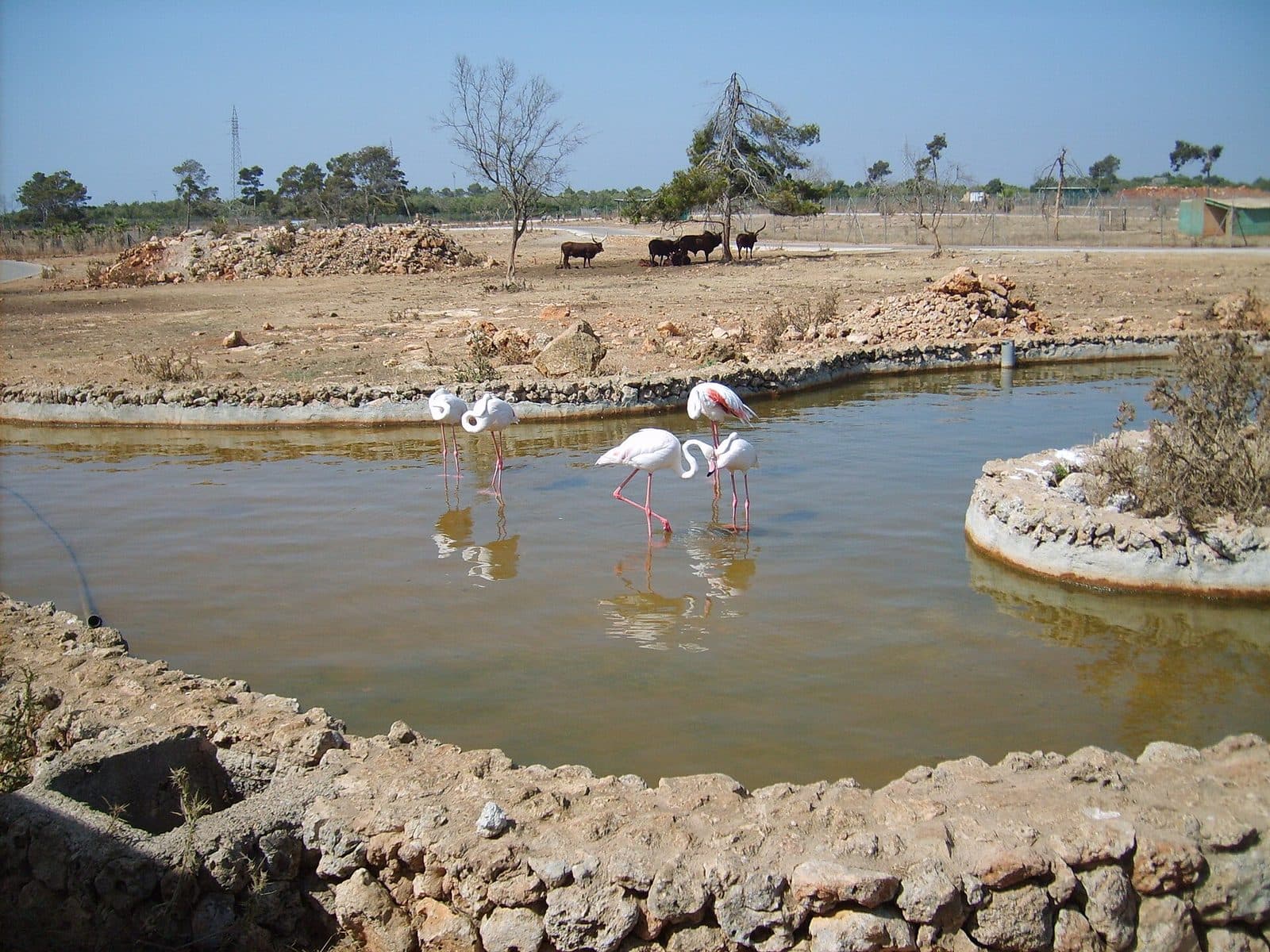

Giraffes and zebras do not appear behind the next Mallorcan dry-stone wall, but along a safari route: Safari Zoo Mallorca near Sa Coma combines a drive through spacious animal areas with a park section that visitors can then explore on foot. This change of pace in particular sets the visit apart from a traditional zoo, where the entire route follows paths between individual enclosures.
The drive can be made in your own vehicle or on the safari train. While larger animals and primates take center stage outdoors, the walking area brings visitors closer to additional enclosures and the reptile house. The park is said to have more than 600 animals; species regularly listed include giraffes, zebras, monkeys, elephants and reptiles.
Families especially appreciate that getting around is already part of the experience. Children first observe the animals from the vehicle and can then continue exploring in the pedestrian area. Adults will also find more than a vacation attraction here: the park’s history shows how profoundly society’s view of keeping wild animals has changed since its foundation.
Safari Zoo Mallorca is currently undergoing a period of transition. Following a change of operator, the grounds are being renovated step by step, with a greater focus on animal welfare, species conservation and environmental education. Anyone familiar with older reports about the park should therefore expect changes and check the current visitor procedure in advance.
History and significance
When the park opened in 1969, its concept was new to the Balearic Islands. A German initiative brought exotic animals to Mallorca and combined two forms of encounter: a safari zone crossed by vehicle and an area for visitors to explore on foot. The first site occupied a plot directly beside the present grounds near Sa Coma.
The park was founded during an era when international trade in wild animals was regulated far less strictly. The Washington Convention on International Trade in Endangered Species, CITES, did not come into force until 1975. Practices viewed critically today were then widely considered a normal part of zoos, circuses and private animal collections. In Mallorca too, entertainment and the direct presentation of exotic animals initially took clearer precedence over modern conservation programs.
From animal shows to a wildlife park
For decades, the park offered performances with wild animals as well as pony and donkey rides. Such attractions were by no means unusual in their time, but from today’s perspective they illustrate particularly clearly how fundamentally expectations of zoological institutions have changed. The former shows were gradually discontinued. They were replaced by respect for the animals, the sharing of knowledge and questions about the conditions in which the species are kept.
This change involves more than new signage. Modern zoological work is increasingly guided by internationally coordinated breeding and conservation programs. In Europe, the EAZA coordinates programs for threatened species, among other initiatives, with the aim of keeping populations healthy and genetically viable. The park’s more recent direction near Sa Coma reflects this understanding of animal care.
Move to the current site
Management changed in the early 1990s. Under the name Safari-Zoo Mallorca, the operation moved to its present 23-hectare site. The original basic principle was retained: the drive through the safari area is followed by a section explored on foot. This preserved the park’s unusual sequence even though its location, facilities and operators changed.
A severe storm struck the site in 2001. A substantial part of the vegetation was lost, and fallen trees and damaged paths shaped the grounds. The loss of plant cover intensified soil erosion, while grazing pressure from herbivores made natural regeneration more difficult. The consequences of this event explain why the development of soil, shade and vegetation played a special role in the park’s later renovation.
A new beginning under Rain Forest
Rain Forest took over the park in January 2025. The company also operates Bioparc facilities in Valencia, Fuengirola and Gijón and announced a far-reaching transformation for Mallorca. The main priorities are intended to be more modern habitats, animal welfare, nature conservation and environmental education.
Safari Zoo Mallorca is therefore not a completed, unchanging attraction. It is undergoing a development process in which older structures are being altered and new educational experiences introduced. This turning point matters to visitors: past experiences of the former park cannot simply be applied to its current or future condition.
Animals and attractions
The defining scene does not unfold in front of a single aviary, but on a driving route. The vehicle moves through open animal areas while zebras, giraffes and other residents appear from changing perspectives. Instead of walking from enclosure to enclosure, visitors initially remain in the protected interior of their car or take a seat on the safari train.
The safari route
The signposted safari circuit is 3 kilometers long. Larger mammals and primates can be observed along the route, including giraffes, zebras and monkeys. More recent park offerings and descriptions also mention rhinoceroses and hippopotamuses. However, which animals are clearly visible during a particular circuit depends on their behavior. A wildlife park is not a performance with a fixed schedule: some animals stand close to the route, while others remain farther away or rest outside the best viewing angle.
The slow drive changes the way the animals are perceived. A giraffe’s height becomes apparent, but so does its calm movement among the other animals. Zebras do not appear as a single image behind glass, but as part of a larger open space. Monkeys, meanwhile, may come very close to vehicles. This is precisely why strict rules apply in the safari area: leaving the vehicle, opening windows, feeding animals or stopping in the baboon area is prohibited.
The safari train
Visitors who do not want to drive through the park in their own car can use the safari train. The journey provides the same basic experience without the responsibility of driving. This is especially practical for travelers without a rental car and for families who want to observe the animals together during the circuit.
Organized excursions describe a train journey of about 30 minutes. However, it is only one part of the visit. The train does not replace the walking area afterward, and its departure time should not be confused with the general arrival time. If a train time has been assigned, it is advisable to arrive at the park sufficiently early.
Primates along the route
Monkeys are among the most conspicuous residents of the driving zone. The park now also dedicates a separate themed trail to primates. Restrained behavior inside the vehicle is particularly important here. Windows remain closed, and vehicles must not stop in the baboon area. What may initially sound strict protects both sides: the animals should neither become accustomed to being fed from cars nor gain access to objects inside vehicles.
This proximity often feels more impressive than a distant view of a larger animal. At the same time, it should not be mistaken for direct contact. The appeal lies in observing movement, group behavior and reactions within the animal area—not in attracting or touching the animals.
The walking area
After the safari drive, the pace changes. Additional animal enclosures can be viewed up close in the walkable section. Historically, this division was already part of the first park in 1969 and was retained when the operation moved to its current grounds.
The walking area also gives families an opportunity to take breaks after the drive. Play areas for children are mentioned, and food service is also available in the park. Nevertheless, observing the animals remains the main focus. Anyone who completes only the safari route and then immediately leaves will therefore see just part of the grounds.
Elephants and animal care
Asian elephants are present not only as large animals popular with visitors. The current educational program also addresses enrichment measures and veterinary training. This gives visitors insight into the work taking place behind the visible enclosures.
Animal enrichment is likewise part of the modern care concept. Anyone who experiences related program activities should therefore understand them less as a show and more as a glimpse into daily animal care.
Reptile house and smaller species
The reptile house offers a different focus from the open safari zone. After the broad outdoor spaces, attention shifts here to body shapes, skins and movements that can easily be overlooked in passing. Reptiles have long been part of the park’s animal collection and were also highlighted in older descriptions together with young animals born at the zoo.
The contrast in particular makes this section interesting. Outdoors, distance and movement define the experience; with reptiles, patience and close observation matter. An animal that initially appears motionless may closely match its surroundings in color and texture.
Educational experiences
Alongside traditional animal information, the park lists themed trails about primates and adaptations in the animal kingdom. A virtual-reality experience is also available. These stations are intended to explain connections that are barely visible during a drive alone: habitats, physical adaptations, threats and the work involving individual species.
As the grounds have been changing since the operator transition, routes and program activities may be adjusted. The current park map is therefore more useful than older overviews. It not only shows the way but also helps visitors coordinate the safari drive, walking area and possible animal-care activities effectively.
Visiting Safari Zoo Mallorca
The visit begins with a practical decision: drive your own vehicle or take the safari train. Both options lead through the animal area, but the procedures differ. In your own vehicle, you remain inside the car throughout the safari circuit and follow the designated route. When taking the train, your plans depend on the assigned departure.
Arriving and finding your way
Before starting, it is worth checking the current park map. Although the safari drive is the most striking part, it is not the entire visit. Anyone wishing to see the walking area, reptile house and educational experiences should not end the visit immediately after the drive.
There is no single visit duration suitable for everyone. The train journey alone is described as taking about 30 minutes; arrival, orientation and the walking tour must be added. Families with young children, animal photographers and visitors who want to follow animal-care activities will naturally need different amounts of time.
The best time to visit
An older visitor recommendation advises arriving early because feedings may then be observed. This does not guarantee particular animals or program activities. The current daily schedule is what matters, as feeding, enrichment and veterinary training also depend on the animals’ needs.
To minimize time pressure, it is particularly important not to arrive just before a scheduled train departure. The departure of a shuttle bus, arrival at the park and start of the safari circuit are different times. Keeping them separate makes for a more relaxed start and avoids having to shorten the walking section later.
Visiting during the renovation phase
The park has been undergoing renovation since Rain Forest took over. This may mean that paths, animal areas or activities have changed compared with older travel reports. Up-to-date information is especially important at a zoo: animals may be relocated, enclosures redesigned and daily programs adjusted.
Opening hours and admission prices should therefore be checked immediately before the visit. Specific times and prices are deliberately not repeated here because they may change and appear in separate data fields on the page.
Directions and parking
The park is located outside the densely developed coastal strip, along the road connecting Porto Cristo and Son Servera near Sa Coma. Visitors arriving in their own car can also use the vehicle for the safari circuit if they wish.
From Palma Airport
The road distance from Palma Airport to Sa Coma is 68 kilometers via the Ma-15. The drive takes around 60 minutes. This information applies to Sa Coma, not the exact entrance to Safari Zoo Mallorca. From there, the final section leads toward the road between Porto Cristo and Son Servera and on to the park.
The Ma-15 is the main east-west connection for this journey. Especially when planning around a scheduled train departure, additional time should be allowed for leaving the airport grounds, traffic and finding the destination.
From central Palma
The road distance from central Palma to Sa Coma is 70 kilometers. The drive via the Ma-15 takes around 67 minutes. This journey time also ends in Sa Coma for calculation purposes; the short onward drive to Safari Zoo Mallorca must still be added.
For a day trip from Palma, the journey is therefore a separate part of the itinerary. It is advisable not to squeeze the safari drive and walking area between two closely scheduled appointments. The return journey again follows the Ma-15 toward the center of the island and Palma.
Without your own vehicle
Sa Coma is connected to the public bus network; the nearest stops are shown separately on the page. The park also offers its own bus connections from several coastal resorts, including S’Illot, Sa Coma, Cala Millor and Cala Bona. Some additional routes operate only on certain days or under special booking conditions.
It is important to distinguish between the transfer and the safari drive. The departure time of a shuttle bus is not the beginning of the circuit through the animal area. For the safari train, the departure specified in the relevant visitor plan applies.
Bus lines to Safari Zoo Mallorca at a glance
| Line | Route | Departures/day | First | Last |
|---|---|---|---|---|
| A42 | Cala Bona - Aeroport | 336 | 00:13 | 23:22 |
| 401 | Cala Millor - Palma | 328 | 00:09 | 23:48 |
| 424 | Cala Rajada - Portocristo | 172 | 07:55 | 23:43 |
| 425 | Cala Bona - Portocristo | 164 | 07:49 | 22:24 |
From the official GTFS feeds (TIB/SFM), no real-time data. The figures cover all stops in the town; weekend and holiday services differ — check with the operator before travelling.
Getting there by bus
Palmeres 2 (51005) · 1.0 km as the crow flies
- 401Cala Millor - Palma · Daily
- 424Cala Rajada - Portocristo · Daily
- 425Cala Bona - Portocristo · Daily
- A42Cala Bona - Aeroport · Daily
Palmeres 1 (51006) · 1.0 km as the crow flies
- 401Cala Millor - Palma · Daily
- 424Cala Rajada - Portocristo · Daily
- 425Cala Bona - Portocristo · Daily
- A42Cala Bona - Aeroport · Daily
Savines 1 (51002) · 1.4 km as the crow flies
- 401Cala Millor - Palma · Daily
- 424Cala Rajada - Portocristo · Daily
- 425Cala Bona - Portocristo · Daily
- A42Cala Bona - Aeroport · Daily
Savines 2 (51001) · 1.4 km as the crow flies
- 401Cala Millor - Palma · Daily
- 424Cala Rajada - Portocristo · Daily
- 425Cala Bona - Portocristo · Daily
- A42Cala Bona - Aeroport · Daily
Estanyol (51014) · 1.5 km as the crow flies
- 401Cala Millor - Palma · Daily
- 424Cala Rajada - Portocristo · Daily
- 425Cala Bona - Portocristo · Daily
- A42Cala Bona - Aeroport · Daily
Cala Nau (51013) · 1.6 km as the crow flies
- 401Cala Millor - Palma · Daily
- 424Cala Rajada - Portocristo · Daily
- 425Cala Bona - Portocristo · Daily
- A42Cala Bona - Aeroport · Daily
Av. Llevant 1 (51016) · 1.8 km as the crow flies
- 401Cala Millor - Palma · Daily
- 424Cala Rajada - Portocristo · Daily
- 425Cala Bona - Portocristo · Daily
- A42Cala Bona - Aeroport · Daily
Av. Llevant 2 (51017) · 1.8 km as the crow flies
- 401Cala Millor - Palma · Daily
- 424Cala Rajada - Portocristo · Daily
- 425Cala Bona - Portocristo · Daily
- A42Cala Bona - Aeroport · Daily
Bon Temps 1 (51019) · 2.0 km as the crow flies
- 401Cala Millor - Palma · Daily
Timetable data: official GTFS feeds (TIB/EMT), no real-time — check with the operator before travelling.
Nearby places to visit
After observing the animals, the coast is close enough for a distinct change of scene. Sa Coma is a vacation resort on Mallorca’s east coast, with a long sandy beach, tourist infrastructure and links to neighboring coastal towns. This makes it easy to combine the zoo visit with time by the sea afterward, without planning another major transfer across the island.
Sa Coma and the beach
Sa Coma beach is well suited to a relaxing finish after the safari circuit and walking tour. The combination is particularly natural for families: the wildlife park provides the active part of the day, followed by time for swimming, eating or taking a walk. On very warm days, the reverse order may also make sense, provided it fits the park’s current visiting and departure times.
Punta de n’Amer
The Punta de n’Amer natural area lies between Sa Coma and Cala Millor. It offers a scenic contrast to the designed wildlife park: coastal vegetation, trails and views across the sea take center stage there. Anyone combining both on the same day should allow enough time, as a short detour can easily turn into a longer walk.
Cala Millor, Cala Bona and S’Illot
Cala Millor and Cala Bona lie north of Sa Coma, while S’Illot adjoins it to the south. All three places are useful starting points because the park lists its own coastal transfers on selected routes. Visitors staying there therefore do not necessarily need to rent a car solely for the zoo visit.
Porto Cristo can also be included as another coastal stop. The road to the park runs in its direction, allowing Safari Zoo Mallorca to fit into an excursion along the east coast. However, a separate block of time should still be reserved for additional sights; the safari circuit and walking area are more than a brief photo stop.
The place it belongs to
Sa Coma in the place guidePractical visitor information
The most important rule is simple: everyone remains inside the vehicle in the safari area. Doors and windows must not be opened, and stopping is prohibited in the baboon section. Animals may not be fed either from the car or in the walking area. These rules protect visitors, vehicles and animals alike.
In your own car
Drive slowly along the route without crowding the animals or leaving the designated track. Anyone uncomfortable driving among freely moving animals is better off choosing the safari train.
A clear view through the windows is more important. Photographs must be taken from inside the closed vehicle; neither opening a window nor stopping in the baboon area is permitted for a picture.
Walking through the park
Comfortable shoes are advisable for the walkable section. The grounds extend beyond the driving route, and anyone who carefully explores the reptile house, animal enclosures and educational stations will spend longer on the paths. Sun protection and drinking water are sensible preparations for the open areas. Water is permitted in containers not made of glass; according to park rules, food and other drinks are not allowed outside designated areas.
Visiting with children
The combination of a vehicle circuit, animals and play areas is designed with families in mind. Before entering, children should be told that monkeys must not be fed despite their proximity and that the windows must never be opened. Shouting to attract animals or tapping on the windows is also inconsistent with calm animal observation.
The walking area prevents the entire visit from being spent sitting down. Expectations should nevertheless remain realistic: animals do not follow a fixed script. Not every species stands close to the route during every circuit, and periods of rest are a normal part of their day.
What not to expect
Safari Zoo Mallorca is not a safari in the wild. The animals live in a zoologically managed park, and the route passes through defined areas. Nor is the driving zone a petting enclosure. Proximity results from the route layout, not from permitted contact.
The park is also not an unchanged relic of its founding era. Since the change of operator, its facilities, content and animal-care concepts have continued to evolve. Old photographs and visitor reports may have historical value, but they do not necessarily reflect current conditions.
Local insider tips
Arrive early for the daily program
An early arrival is recommended because feedings may then be observed. The current daily schedule remains decisive: animal care and enrichment are organized around the animals’ needs.
Do not confuse the train times
The departure of a shuttle bus is not the start of the safari circuit. Anyone using the safari train should check the assigned train time and arrive at the park sufficiently early.
Rules in the monkey zone
Stopping is prohibited in the baboon area, and the windows must remain closed throughout the safari.
Keep exploring after the drive
The safari circuit is only the first part. More animal enclosures, the reptile house and educational experiences await in the walking area. Anyone who leaves immediately after the drive misses a substantial part of the park.
Combine the wildlife park with the beach
Sa Coma beach is a convenient place to visit after the zoo. Anyone wanting more exercise can instead combine the day with Punta de n’Amer, but should reserve a separate block of time for it.