
Santa Teresa in Palma: Convent, Church and History
,_cantonada_c._Tereses.jpg)
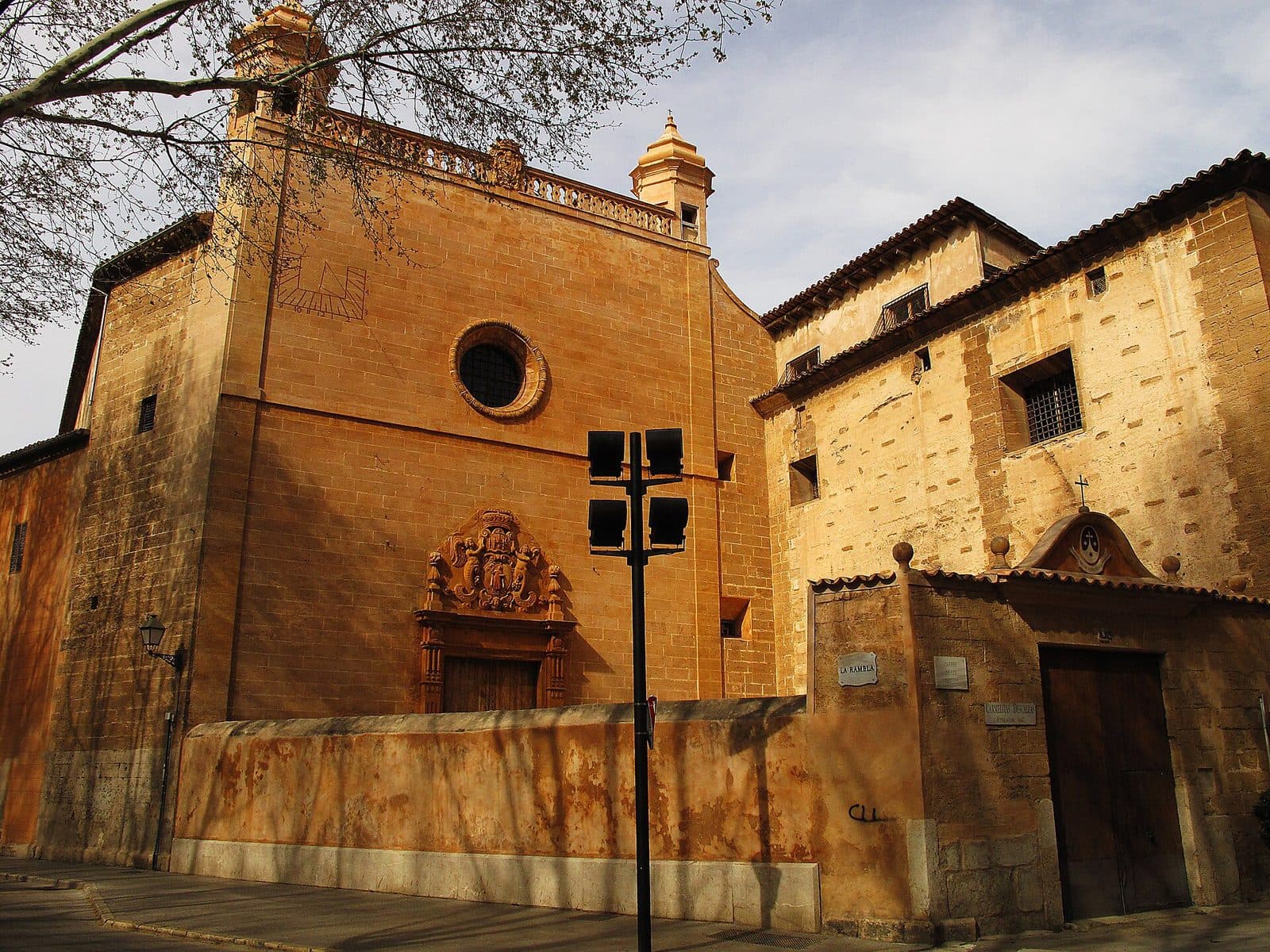
Anyone looking from La Rambla into Carrer de les Tereses stands before a quiet chapter of the city's history. Santa Teresa, usually known in Palma as “Les Tereses,” is the convent of the Discalced Carmelite nuns with its historic church. Behind the Baroque portal lies not a museum complex staged for visitors, but a religious site whose history reaches back to a small community of women gathered around Elionor Ortiz.
It is precisely this restraint that makes the place so appealing. Santa Teresa tells a story not of royal display or military power, but of the persistent building of a community, resistance from within its own order and a convent life that remains defined by seclusion to this day. As a historic cultural property, the complex is protected as a Bien de Interés Cultural.
The main sights are the Baroque portal, the church with its altars and floor tiles, and the cloister. Not every part of the complex is freely accessible. Santa Teresa therefore calls for different expectations than Palma's major museums: a visit depends on looking closely and understanding what continues behind the walls.
The site is best included in a walking tour through the center of Palma. Anyone exploring La Rambla or the area around Plaça del Mercat can discover a lesser-known side of the city here. Santa Teresa is also a worthwhile stop for travelers interested in convent history, Baroque religious architecture and women's religious history.
History and Significance
It began not with a large convent, but with a beaterium: a small community of women living religious lives who had gathered around Elionor Ortiz. Ortiz belonged to the Third Order of Carmelites and had a reputation for exceptional piety. When this reputation reached both ecclesiastical and secular authorities, she expressed her wish to establish a permanent house for the community in Palma.
Elionor Ortiz and the Beaterium
Elionor's brother supported the project in two crucial ways: he provided land for the planned convent and petitioned the king on behalf of its foundation. Royal approval, however, did not remove every obstacle. The Order of Discalced Carmelites itself was initially hesitant about the project because it did not yet have a house of its own on Mallorca at that time.
While negotiations over the actual foundation of the convent continued, the small community moved into houses where the bishop consecrated a church in 1616. It was dedicated to Teresa de Jesús, who had then only been beatified. This early place of worship preceded the later convent building and shows that religious life had already begun before the institutional questions had been fully resolved.
Founding the Carmelite Convent
The foundation was approved in 1617. At the same time, three nuns from Guadalajara were permitted to move to Mallorca, one of whom took charge of the new convent as prioress. This gave the locally formed community of women a permanent connection to the reformed Carmelite order on the Iberian Peninsula.
For Elionor Ortiz herself, the story took an unexpected turn. The strict demands of convent life overwhelmed her fragile health, forcing her to leave the community. Her family then withdrew its support. The loss struck the young convent at a vulnerable stage, as the very woman who had initiated the project could not become part of the regular convent.
Building the Church and Consolidating the Convent
Despite these difficulties, the community succeeded in acquiring additional properties. Construction of the present church began in 1624, and it was consecrated in 1637. The development from the first beaterium to the completed place of worship was therefore marked by improvisation, negotiations and financial setbacks.
The convent subsequently continued as a house of the Discalced Carmelite nuns. The community lives in seclusion, which means that the enclosed design of Santa Teresa is not merely an architectural feature. It is part of the community's religious identity and explains why the site cannot be experienced like a conventional visitor attraction.
Elionor's Return
Elionor Ortiz died in 1650 and was initially buried in Convent del Carme. After it was demolished during the confiscation of church property, her mortal remains were transferred to Palma Cathedral. In 1909, they were finally moved to Santa Teresa. The convent's founder thus returned long after her death to the place whose creation she had initiated, although she herself had been unable to live there permanently as a nun.
This episode gives Santa Teresa a special historical depth. The complex recalls not only the institutional spread of the reformed Carmelite order, but also the opportunities and limitations faced by religious women in Palma. Elionor's initiative set in motion a process that outlasted her personal withdrawal and culminated in a convent tradition that remains visible today.
What to See at Santa Teresa
The first impression comes from the street. Santa Teresa stands within the urban fabric near La Rambla, but anyone who merely glances at the entrance while passing can easily overlook how much history lies behind the portal.
The Baroque Portal
The most striking exterior feature is the Baroque portal. It marks the sacred entrance, making it worth pausing outside to view its framing as an architectural detail in its own right.
The portal belongs to the church and is also the visible threshold between the public street and a religious world that is only partly accessible. At Santa Teresa, the architecture can therefore be read particularly well as a sequence of levels: street, church entrance, place of worship and, finally, the cloistered area each have different degrees of public access.
The Church
Inside the church, attention is drawn to the altars and the altarpiece honoring Santa Teresa. The sacred ornamentation gives the room its religious focus. Among the details easily overlooked during a brief visit are the floor tiles. They are closer and less conspicuous than the altars, but they too are part of the church's visible features. Anyone who looks not only straight ahead but lets their gaze move between the floor and the altars will gain a more complete impression.
Santa Teresa is not a cathedral, even though some online directories describe the church that way. Its historic core is a Carmelite convent with a convent church. This distinction helps set expectations: what visitors see is not a monumental episcopal center, but a place of worship built for a contemplative religious community.
The Cloister
The convent includes a cloister that forms part of the monastic complex. Its status as a distinctive architectural feature of the ensemble does not mean that the convent can be entered at any time like a museum courtyard. The separation between the accessible church and the cloistered area should be respected. A visit is enriched more by understanding this boundary than by attempting to see as many rooms as possible.
Convent and Enclosure
The enclosure itself is also important to observe. Its clear separation from the public area reflects the character of an enclosed convent. The building was not designed for a public tour, but serves a way of life that deliberately maintains distance from the city's daily routine, even though La Rambla and the center's busy streets are immediately nearby.
This contrast is one of the strongest impressions Santa Teresa creates. Outside, Palma moves among shops, the market district and traffic; beyond the convent threshold, silence, prayer and retreat prevail. The complex does not have to be fully open for this historic function to be understood. The relationship between the portal, church and enclosure already tells that story.
The Lost Alabaster Sculpture
The history of the convent is also associated with an alabaster sculpture of the Virgen del Carmen. It survived the seizures of church property, but is no longer in Santa Teresa and is now kept in the church of La Sang. For visitors, this is primarily a useful clarification: anyone looking for this particularly notable work in Santa Teresa will not find it there.
The object refers to the veneration of Our Lady of Mount Carmel, a figure particularly associated with sailors and fishermen on Mallorca. Its relocation also shows that historic convent furnishings have not always been preserved together in their original setting.
Visiting Santa Teresa
Santa Teresa cannot be visited like a museum with a fixed route. The church is the main focus, while the convent enclosure remains reserved for the life of the Carmelite nuns. Whether and when the church is accessible outside religious occasions should be checked before making the journey. Reliable general opening hours and admission information have not been recorded.
Arriving at the Convent Church
A visit is best begun outside the Baroque portal. From here, the complex can be placed within the cityscape before entering the church, if access is possible. Inside, the altars and especially the floor tiles deserve attention. A little prior knowledge about Elionor Ortiz and the convent's foundation is extremely helpful.
No fixed amount of time should be expected for a visit. If only the exterior can be seen, Santa Teresa remains a brief stop on a city walk. If the church is open, the visit can be enjoyed at a slower pace. Anyone who carefully observes the altars, tiles and spatial layout and knows the history of the complex will stay longer than someone who only wants to see the portal.
A Living Religious Site
Santa Teresa is not an abandoned convent monument. The Carmelite nuns live in strict seclusion, and their privacy defines the boundaries of every visit. Quiet conversation and respect for closed areas should be taken for granted. During a service or prayer, religious use takes priority over tourist interests.
This restriction is not a shortcoming of the site, but part of its meaning. The complex does not merely show how a Carmelite convent once functioned; it continues to preserve the separation between the public church and the contemplative enclosure. Those who accept this will experience Santa Teresa not as an incomplete attraction, but as a historic building with an enduring purpose.
Planning Without Guaranteed Entry
Because access to the church can change, Santa Teresa is best included as part of a wider walk through the center. This ensures that the journey remains worthwhile even if only the portal and complex can be viewed from outside. La Rambla and Plaça del Mercat provide natural points of connection.
No one should expect a freely accessible convent. The reward lies in its concentration: a Baroque portal, a historic church interior, the memory of Elionor Ortiz and the immediate proximity of city life and convent seclusion.
Getting There and Parking
From Palma Airport, the route initially follows the Ma-19 into Palma. The distance to the city is 11 road kilometers, and the journey takes around 20 minutes. These details apply specifically to Palma, not directly to the entrance of Santa Teresa.
The Final Stretch Through the Center
Santa Teresa is near La Rambla and is easy to reach on foot from the central city area. In addition to Carrer de les Tereses, La Rambla and Plaça del Mercat are particularly useful landmarks. Several bus stops are located around these routes, including La Rambla–Via Roma and Plaça del Mercat. From the relevant stop, the route continues through city-center streets to the convent church.
Its central location makes it more practical to leave the car in a public underground garage and walk the rest of the way. One option is the garage at Passeig Mallorca. Car parks farther away may also be useful if Santa Teresa is part of a longer walking tour through the old town.
On Foot and by Bus
For visitors already in Palma's center, walking is usually the simplest option. The convent church is not isolated but lies within the street network around Rambla and Mercat. This makes it easy to include in a city walk without a separate journey.
The nearby stops also make Santa Teresa accessible without a rental car. The most suitable bus route depends on the starting point in Palma; the key landmarks are the stops La Rambla–Via Roma and Plaça del Mercat. From there, the final section leads through central streets, where the Baroque portal is easier to overlook than a free-standing monument.
Bus lines to Santa Teresa at a glance
| Line | Route | Departures/day | First | Last |
|---|---|---|---|---|
| 3 | Pont d'Inca / Joan Carles I | 6 | 07:37 | 09:46 |
| 20 | Portopí - Son Espases | 4 | 07:17 | 07:31 |
| 25 | s'Arenal - Pl. Reina | Catedral | 2 | 10:33 | 10:39 |
| 35 | Aquàrium - Pl. Reina | Catedral | 2 | 10:06 | 12:51 |
| N1 | Portopí - Porta des Camp | 2 | 00:50 | 02:05 |
| N3 | Germans Escales - sa Indioteria | 2 | 00:30 | 01:45 |
| N4 | Pl. Progrés - Pont d'Inca | 2 | 00:55 | 02:10 |
| N2 | Can Blau - Can Valero | 1 | 01:15 | 01:15 |
From the official GTFS feeds (TIB/SFM), no real-time data. The figures cover all stops in the town; weekend and holiday services differ — check with the operator before travelling.
Getting there by bus
107-la Rambla - Via Roma · 0.2 km as the crow flies
- 25s'Arenal - Pl. Reina | Catedral · 06:36–21:01 · Daily
- 35Aquàrium - Pl. Reina | Catedral · 06:21–22:41 · Daily
52-pl. del Mercat · 0.2 km as the crow flies
- 4Ses Illetes - Pl. Columnes · 08:00–08:00 · Daily
- 7Son Gotleu - Son Serra - Sa Vileta / Son Vida · 08:00–08:00 · Daily
- 20Portopí - Son Espases · 06:06–22:40 · Daily
- 35Aquàrium - Pl. Reina | Catedral · 06:21–22:41 · Daily
106-pl. del Mercat · 0.2 km as the crow flies
- 3Pont d'Inca / Joan Carles I · 08:00–08:00 · Daily
- 4Ses Illetes - Pl. Columnes · 08:00–08:00 · Daily
- 7Son Gotleu - Son Serra - Sa Vileta / Son Vida · 08:00–08:00 · Daily
- 20Portopí - Son Espases · 06:06–22:40 · Daily
108-La Rambla-Via Roma · 0.3 km as the crow flies
- 3Pont d'Inca / Joan Carles I · 08:00–08:00 · Daily
- 4Ses Illetes - Pl. Columnes · 08:00–08:00 · Daily
- 7Son Gotleu - Son Serra - Sa Vileta / Son Vida · 08:00–08:00 · Daily
- 20Portopí - Son Espases · 06:06–22:40 · Daily
50-la Rambla - Via Roma · 0.3 km as the crow flies
- 4Ses Illetes - Pl. Columnes · 08:00–08:00 · Daily
- 7Son Gotleu - Son Serra - Sa Vileta / Son Vida · 08:00–08:00 · Daily
- 20Portopí - Son Espases · 06:06–22:40 · Daily
- 35Aquàrium - Pl. Reina | Catedral · 06:21–22:41 · Daily
105-pl. de Joan Carles I - Catedral · 0.3 km as the crow flies
- 3Pont d'Inca / Joan Carles I · 08:00–08:00 · Daily
- 4Ses Illetes - Pl. Columnes · 08:00–08:00 · Daily
- 7Son Gotleu - Son Serra - Sa Vileta / Son Vida · 08:00–08:00 · Daily
- 20Portopí - Son Espases · 06:06–22:40 · Daily
53-pl. de Joan Carles I - Catedral · 0.3 km as the crow flies
- 4Ses Illetes - Pl. Columnes · 08:00–08:00 · Daily
- 7Son Gotleu - Son Serra - Sa Vileta / Son Vida · 08:00–08:00 · Daily
- 20Portopí - Son Espases · 06:06–22:40 · Daily
663-pl. d'en Coll · 0.4 km as the crow flies
- CCCircular Centre Ciutat · 08:00–08:00 · Daily
1048-pl. de Joan Carles I · 0.4 km as the crow flies
- 25s'Arenal - Pl. Reina | Catedral · 06:36–21:01 · Daily
- 35Aquàrium - Pl. Reina | Catedral · 06:21–22:41 · Daily
598-pl. d'Espanya - Estació Intermodal · 0.4 km as the crow flies
- A1Aeroport - Palma Centre · 08:00–08:00 · Daily
985-pl. de Joan Carles I · 0.4 km as the crow flies
- CCCircular Centre Ciutat · 08:00–08:00 · Daily
455-pl. d'Espanya - Estació Intermodal · 0.4 km as the crow flies
- 23s'Arenal / Parc Aquàtic - Pl. Espanya · 06:27–21:50 · Daily
- 25s'Arenal - Pl. Reina | Catedral · 06:36–21:01 · Daily
- 35Aquàrium - Pl. Reina | Catedral · 06:21–22:41 · Daily
- N1Portopí - Porta des Camp · 08:00–08:00 · Daily
- N2Can Blau - Can Valero · 08:00–08:00 · Daily
- N3Germans Escales - sa Indioteria · 08:00–08:00 · Daily
- N4Pl. Progrés - Pont d'Inca · 08:00–08:00 · Daily
Timetable data: official GTFS feeds (TIB/EMT), no real-time — check with the operator before travelling.
Things to See Nearby
In front of Santa Teresa, the Rambla does not simply end at an attraction. The convent stands in a part of Palma where shopping streets, squares, churches and historic residential buildings alternate in close succession. This is precisely why the visit works better not as a standalone destination requiring a long journey, but as a quiet interlude during a walk through the center.
La Rambla
La Rambla is the most obvious starting point. The broad urban avenue creates a clear contrast with the Carmelite enclosure: movement and public daily life here, the secluded world of the convent only a few steps away. Anyone approaching from the Rambla should deliberately slow down at Carrer de les Tereses, as the Baroque portal is easier to overlook than Palma's grand church façades.
Plaça del Mercat
Plaça del Mercat is also in the immediate central area and serves as a useful next landmark. From there, the route can continue through the historic city center. Santa Teresa is not an endpoint, but one element for anyone wishing to understand Palma beyond its best-known monuments.
Religious Palma
The visit can be combined thematically with other churches and convent sites in Palma. The church of La Sang is particularly interesting because it houses the alabaster sculpture of the Virgen del Carmen associated with Santa Teresa. Combining the two sites reveals how works of art changed location as a result of historical upheavals.
The cathedral also belongs on a tour of the city's religious history. Elionor Ortiz's mortal remains were kept there for a time before being transferred to Santa Teresa in 1909. An extensive sightseeing itinerary is not necessary; simply knowing about these stages connects several places in Palma into one coherent story.
A Detour Rather Than a Full-Day Visit
Santa Teresa does not fill an entire day of sightseeing. The site gains its appeal from its context and its contrast with public life in Palma. A walk along La Rambla, a look inside the convent church and then a route through the streets around Mercat create a satisfying sequence without turning the convent into a major tourist destination it was never intended to be.
The place it belongs to
Palma in the place guidePractical Tips for Visiting
A sign, a locked portal or an ongoing religious service may change the planned visit. Santa Teresa should therefore not be treated as an appointment with guaranteed full access. Current access arrangements should be checked before visiting. Specific opening hours and admission prices cannot be stated reliably from the available information.
Conduct
Quiet behavior is important because Santa Teresa serves not only as a protected monument but also continues to have a religious purpose. The Carmelite enclosure is not an additional sightseeing area. Closed doors and restricted zones mark the community's privacy and should be respected without question.
What Santa Teresa Is Not
The name can cause confusion in Palma. This is the historic Carmelite convent Santa Teresa de Jesús, also known as Les Tereses, near La Rambla. It is neither the house of the same name in Sóller nor a school or the parish church Santa Teresa de l’Infant Jesús.
Nor should visitors expect a cathedral with extensive public access. Santa Teresa is a convent church attached to an enclosed community. Its most important visible features are concentrated and comparatively understated: the portal, church interior, altars and floor tiles. The cloister belongs to the historic ensemble and the convent complex.