
Museu Fundación Juan March in Palma
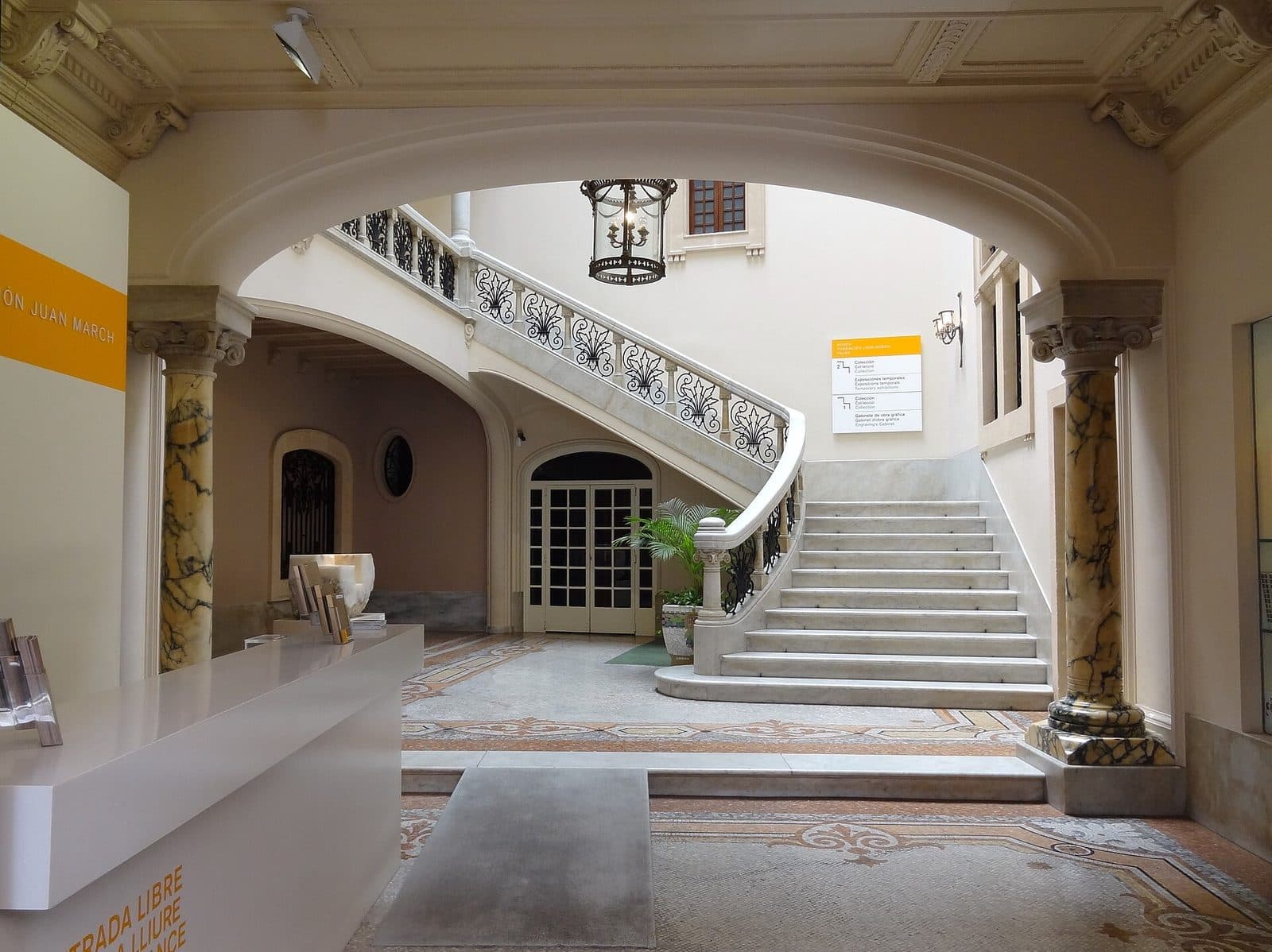

Behind a stately façade in Palma's old town lies a world far removed from the bustling street outside. The Museu Fundación Juan March displays 20th-century Spanish art in a former city mansion. The route through the entrance, courtyard and staircase already makes clear that paintings have not simply been hung in neutral galleries here: historic architecture and modern art meet within a compact space.
The collection introduces defining figures of Spanish modern and contemporary art, including Pablo Picasso, Joan Miró, Salvador Dalí, Juan Gris, Antoni Tàpies and the Mallorcan Miquel Barceló. It is manageable enough for a focused visit yet broad enough to reveal different movements and generations side by side. This concentration is one of the museum's strengths. Rather than an exhaustive art-historical tour, it offers a pointed view of Spain's artistic upheavals.
There are also changing exhibitions and a cultural program featuring discussions, lectures, concerts, guided tours and workshops. Because the rooms are regularly rearranged for these activities, the museum remains dynamic. Visitors returning after some time may encounter familiar works in a new context or a completely different selection.
A visit is therefore worthwhile not only for dedicated art connoisseurs. Anyone exploring Palma primarily for its old town will also find a peaceful, rewarding break here between shopping streets and squares. The building reflects the urban residential culture of past centuries, while the collection draws attention to Spanish modern art.
History and significance
The building's history began long before it became a museum. Today's Museu Fundación Juan March occupies a former stately residence known in Palma as Can Gallard del Canyar. Such city mansions served both as homes and as expressions of social status. Their original purpose is still evident today in the imposing sequence of entrance, courtyard and staircase.
Can Gallard del Canyar
In 1916, the March family acquired the property to establish their Palma residence there. The Mallorcan architect Guillem Reynés was commissioned to renovate the building. The alterations transformed the mansion without erasing its identity as a historic urban residence. Elements of the older architecture remained linked to the representative design of the early 20th century.
This dual character continues to shape the visitor experience. The building feels neither like an untouched historic house museum nor like a completely gutted exhibition cube. Instead, art enters rooms whose staircases, floors and proportions tell a story of their own. The building is therefore more than a shell for the collection; it is an essential part of the tour.
The Fundación Juan March
Juan March Ordinas founded the Fundación Juan March in 1955 with the aim of promoting culture and science in Spain. During its first two decades, the foundation awarded scholarships, prizes, pensions and grants in cultural, social, artistic and scientific fields, among other activities. From 1975 onward, it shifted its focus more strongly toward cultural programs it developed and organized itself.
This development explains why the institution in Palma is now more than a traditional collection museum. Exhibitions form its core, while events and educational activities are also central to its identity. The foundation also operates institutions in Madrid and Cuenca; for visitors to Palma, however, the distinctive combination of Spanish art and a Mallorcan city mansion is what matters most.
From residence to cultural center
The museum in Palma opened in 1990. Can Gallard del Canyar thus acquired a public cultural role markedly different from its former use as a family residence. The historic reception rooms became places for viewing, education and discussion. Since 1998, the museum has also made its collection and exhibitions available for educational activities aimed at teachers and school groups from the Balearic Islands.
Today, the museum focuses on 20th-century Spanish art, paying particular attention to developments in more recent decades. Its significance lies less in monumental scale than in its carefully targeted selection. Famous leading figures appear alongside artists and movements that do not always receive the same public attention outside Spain. This allows Spanish modernism to be viewed as a development with many voices rather than merely a succession of internationally celebrated names.
What to see
The first striking impression comes not from an individual painting but from the building itself. From the lively Carrer de Sant Miquel, the route leads into architecture once designed for arrival and display. Floor mosaics, the courtyard, the grand staircase and the glass dome above create a spatial composition before the actual galleries begin.
The entrance and courtyard
The entrance preserves the character of a stately urban residence. At first, the street façade reveals little of how spacious the interior feels. Perception changes in the courtyard: attention shifts away from the narrow old-town street toward the mosaic floor, the staircase and the building's vertical structure.
The floor is especially worth seeing. It should not be treated merely as a decorative surface, since its patterns are among the details that reveal the building's former representative function. While modern museums often deliberately make their architecture unobtrusive, this courtyard demands attention in its own right. It is worth pausing here before the collection fully captures your gaze.
The grand staircase and glass dome
The staircase is one of the most memorable architectural features of Can Gallard del Canyar. It does more than connect one floor to another; it stages the transition from the reception area to the upper rooms. Different steps and landings offer changing perspectives of the courtyard, balustrade and surrounding façades.
A glass dome closes the courtyard from above. The incoming daylight distinguishes the mosaic, staircase and wall surfaces from one another, making the interior appear more open than the dense old-town surroundings would suggest. Anyone proceeding directly to the paintings can easily overlook how carefully this sequence of spaces was composed. Looking back from the staircase is therefore as much a part of the visit as looking ahead into the galleries.
The collection of Spanish art
The galleries present a cross-section of 20th-century Spanish art. Pablo Picasso, Joan Miró, Salvador Dalí and Juan Gris represent different departures from traditional visual language. Their works demonstrate that Spanish modernism cannot be reduced to a single school or aesthetic.
Picasso and Juan Gris lead into the Cubist reordering of form and perspective. Dalí evokes the imagery of Surrealism, while Miró employs a language of signs, color and seemingly free-floating forms. The close proximity of these positions within a compact tour enables comparisons that often require long walks in larger museums.
With Antoni Tàpies, the emphasis shifts more strongly toward material, surface and gesture. Miquel Barceló extends the perspective to a younger generation of artists closely connected with Mallorca. The collection thus views the century not only through its early avant-garde movements but also follows how Spanish artists worked with matter, abstraction and new visual forms in later decades.
The changing displays
The collection does not have a completely fixed arrangement. Rooms are regularly reorganized to accommodate temporary exhibitions. This changes not only the number of works on view but also their relationships to one another. A familiar painting may appear in a different thematic or formal context on a later visit.
Some temporary exhibitions are produced by the foundation itself, while others are connected with its activities in Madrid. The program therefore extends beyond an unchanging overview of the collection. Individual artists, media or art-historical questions can receive greater emphasis for a limited period.
This flexibility matters when planning a visit: the museum does not promise an identical canon at all times. Instead, it presents a curated selection that responds to current exhibitions. Anyone hoping to see a particular work should therefore check the current program in advance. Visitors open to the arrangement on display will experience a museum that repeatedly reexamines its own collection.
The interplay of building and art
The strongest moments often occur at the transitions. A modern gallery ends and a historic staircase appears; after a concentrated group of works, the view opens onto the courtyard again. The architecture is not merely a picturesque backdrop. Its decorated surfaces and ceremonial routes create a deliberate contrast with the ruptures and experiments of the art on display.
The building is therefore also suited to visitors initially more interested in architecture than in art history. Conversely, its manageable sequence of rooms makes it easier to engage with individual works. No one has to navigate an endless succession of neutral galleries. The route remains spatially clear while the artistic positions open up a broad spectrum.
Visiting the museum
A good tour begins slowly. The courtyard and staircase are not merely circulation areas but among the building's highlights. Paying them some attention at the start makes it easier to understand how a private residence became a public museum. The collection can then be explored either chronologically or according to personal interests.
A focused tour
For a first visit, it is advisable not to approach every work with the same intensity. A selective route is more revealing: begin with the familiar names for orientation, then turn to works that stand out from their surroundings through material, color or subject. Because different generations are represented, the distinctions between the early avant-garde movements and later forms of expression become immediately visible.
No fixed visit duration can be derived from this. Anyone viewing only the principal galleries and courtyard can include the museum as a compact stop on an old-town walk. Visitors who read the artwork texts, compare artists or explore a temporary exhibition in detail should allow considerably more time. If a lecture, workshop or concert is scheduled, the museum visit naturally becomes a separate event in its own right.
Temporary exhibitions and events
It is worth checking the current exhibition and events program before visiting. Alongside presentations of the collection, the foundation organizes discussions, interviews, guided tours, workshops, lectures and music events. Not every format is offered continuously, and gallery rearrangements may affect which parts of the collection are currently on view.
Current opening hours and applicable admission policies should likewise be checked immediately before visiting. Reliable times and prices are deliberately not listed here because they may change. This is particularly important on public holidays or special program days.
Crowds and planning your day
There is no reliable information about regularly quiet or especially busy hours. However, the location on a central shopping street means that the area around the museum is usually lively. Inside, visitors spread out across the courtyard, staircase and several rooms; events and temporary exhibitions can further alter visitor flows.
Anyone seeking an undisturbed visit should rely less on a supposedly secret time of day than on the events calendar. Openings, guided tours and other scheduled activities naturally attract their own audiences, but they can also enrich the experience. Without an event, there is more space for the collection; with a program, the building reveals itself more fully as a cultural center.
Returning with a different perspective
The Museu Fundación Juan March is unusually well suited to repeat visits. This is not only because of the changing temporary exhibitions. The collection is also rehung, placing familiar artists in new relationships. A second tour therefore need not repeat the first.
Free Wi-Fi is available in the building. This can be useful for looking up information about the program and individual foundation topics during or after the tour. For direct observation, however, it is still worth putting the phone away from time to time: differences between small details, surfaces and image formats are easier to appreciate without constantly switching media.
Getting there and parking
From Palma Airport, the journey initially follows the Ma-19 toward Palma. The road distance to Palma is 11 kilometers, and the drive takes around 20 minutes. These figures expressly apply to the route as far as Palma, not directly to the museum entrance. Traffic and access to the center can affect the final part of the journey.
The final stretch through the old town
The Museu Fundación Juan March is located in the historic center on Carrer de Sant Miquel, a lively shopping thoroughfare. The surrounding area is denser and more pedestrian-oriented than the major access roads on the outskirts. When arriving by car, it therefore makes sense to plan the drive into the center and the subsequent walk as two separate stages rather than assume direct vehicle access to the entrance.
Specific parking conditions in the center may change and should be checked before departure. The available sources do not document a dedicated visitor parking area at the museum. Realistic city-center planning is therefore essential: after parking the vehicle, the final section continues on foot through the old-town and shopping district.
By bus
Several bus stops are located nearby. These include pl. d'en Coll, pl. del Mercat and pl. de sa Quartera. Which is most convenient depends on the route and direction of travel. From each stop, the final section is on foot; approaching through the center suits the museum's character, as its entrance blends into the street frontage of Carrer de Sant Miquel.
The name pl. del Mercat is used for several stops, so route planning should take account not only of the name but also of the line and direction of travel. Anyone already in central Palma can reach the museum most easily as part of an old-town walk. This avoids another search for parking and makes the transition from the lively street into the quieter courtyard particularly striking.
Bus lines to Museu Fundación Juan March at a glance
| Line | Route | Departures/day | First | Last |
|---|---|---|---|---|
| 1 | Portopí - Sindicat | 6 | 07:15 | 09:15 |
| 8 | Son Roca - Sindicat | 6 | 07:24 | 09:50 |
| 10 | Son Castelló - Sindicat | 6 | 07:30 | 14:48 |
| 46 | la Bonanova - Gènova - Sindicat (dreta) | 6 | 07:20 | 09:15 |
| 47 | Gènova - la Bonanova - Sindicat (esquerra) | 6 | 07:30 | 08:53 |
| 6 | Son Espases - Sindicat | 2 | 08:11 | 08:50 |
| 35 | Aquàrium - Pl. Reina | Catedral | 2 | 09:18 | 13:34 |
From the official GTFS feeds (TIB/SFM), no real-time data. The figures cover all stops in the town; weekend and holiday services differ — check with the operator before travelling.
Getting there by bus
663-pl. d'en Coll · 0.2 km as the crow flies
- CCCircular Centre Ciutat · 08:00–08:00 · Daily
106-pl. del Mercat · 0.2 km as the crow flies
- 3Pont d'Inca / Joan Carles I · 08:00–08:00 · Daily
- 4Ses Illetes - Pl. Columnes · 08:00–08:00 · Daily
- 7Son Gotleu - Son Serra - Sa Vileta / Son Vida · 08:00–08:00 · Daily
- 20Portopí - Son Espases · 06:06–22:40 · Daily
52-pl. del Mercat · 0.2 km as the crow flies
- 4Ses Illetes - Pl. Columnes · 08:00–08:00 · Daily
- 7Son Gotleu - Son Serra - Sa Vileta / Son Vida · 08:00–08:00 · Daily
- 20Portopí - Son Espases · 06:06–22:40 · Daily
- 35Aquàrium - Pl. Reina | Catedral · 06:21–22:41 · Daily
664-pl. de sa Quartera · 0.2 km as the crow flies
- CCCircular Centre Ciutat · 08:00–08:00 · Daily
1-Sindicat - Àrea d'intercanvi Sindicat · 0.3 km as the crow flies
- 46la Bonanova - Gènova - Sindicat (dreta) · 08:00–08:00 · Daily
- 47Gènova - la Bonanova - Sindicat (esquerra) · 08:00–08:00 · Daily
360-Sindicat - Àrea d'intercanvi Sindicat · 0.3 km as the crow flies
- 6Son Espases - Sindicat · 08:00–08:00 · Daily
- 8Son Roca - Sindicat · 08:00–08:00 · Daily
662-pl. de Cort · 0.3 km as the crow flies
- CCCircular Centre Ciutat · 08:00–08:00 · Daily
6-Sindicat - Àrea d'intercanvi Sindicat · 0.4 km as the crow flies
- 1Portopí - Sindicat · 08:00–08:00 · Daily
1139-Plaça d'Espanya · 0.4 km as the crow flies
- 1Portopí - Sindicat · 08:00–08:00 · Daily
- 6Son Espases - Sindicat · 08:00–08:00 · Daily
- 8Son Roca - Sindicat · 08:00–08:00 · Daily
983-Jutjats Nous · 0.4 km as the crow flies
- CCCircular Centre Ciutat · 08:00–08:00 · Daily
422-Grans Magatzems - Àrea d'intercanvi Sindicat · 0.4 km as the crow flies
- 4Ses Illetes - Pl. Columnes · 08:00–08:00 · Daily
- 23s'Arenal / Parc Aquàtic - Pl. Espanya · 06:27–21:50 · Daily
- 35Aquàrium - Pl. Reina | Catedral · 06:21–22:41 · Daily
- A1Aeroport - Palma Centre · 08:00–08:00 · Daily
810-Sindicat - Àrea d'intercanvi Sindicat · 0.4 km as the crow flies
- 10Son Castelló - Sindicat · 08:00–08:00 · Daily
Timetable data: official GTFS feeds (TIB/EMT), no real-time — check with the operator before travelling.
Nearby
Outside the entrance, everyday life in Palma continues without a distinct museum threshold. Carrer de Sant Miquel belongs to the city's central shopping district; pedestrians, shops and routes between old-town squares shape the streetscape. The museum therefore feels less like an isolated cultural building than an unexpected interior in the middle of daily city traffic.
Palma's historic center
The location makes the Museu Fundación Juan March a convenient stop on a walk through the old town. A visit does not have to be planned as a separate, out-of-the-way appointment. It can be combined with the center's lanes, squares, shops and other cultural venues without requiring another journey between them.
A particularly effective itinerary is one in which the museum does not fill the entire day but provides a deliberate moment of calm. After the busy walk along Carrer de Sant Miquel, the spatial scale changes immediately in the courtyard. The route then leads back into Palma's dense street network. This contrast is part of the experience of the place.
Squares and market district
The stop names pl. del Mercat, pl. d'en Coll and pl. de sa Quartera already point to the central urban spaces around the museum. They provide useful reference points for continuing a walk through the center. Instead of rapidly checking off individual nearby sights, visitors can integrate the museum into the city's normal rhythm.
Anyone wishing to combine art and urban history can first examine the historic architecture of Can Gallard del Canyar and then explore Palma's older streets. Those more interested in contemporary culture should check whether a foundation event is taking place that day. The museum can then become the starting point for a cultural evening rather than just an intermediate stop.
Beware of name confusion
Palma is home to both the Museu Fundación Juan March and the Palau March. Both places are connected with the March family, but they are not the same museum. The venue described here is located in Can Gallard del Canyar on Carrer de Sant Miquel and is operated by the Fundación Juan March. The Palau March is a different attraction belonging to the Fundación Bartolomé March Servera.
The distinction matters for route planning and expectations. Anyone looking for the art museum featuring Picasso, Miró, Dalí, Tàpies and Barceló must go to the Museu Fundación Juan March. Architectural details, collections or parking information for the Palau March must not be applied to this museum.
The place it belongs to
Palma in the place guidePractical information for your visit
The Museu Fundación Juan March requires no special equipment. Normal, comfortable city shoes are sufficient for the walk through Palma and the tour of the building. More useful than additional gear is paying close attention to the transitions: the mosaic floor, courtyard, staircase and glass dome are easy to overlook when attention remains focused exclusively on famous artists' names.
With children and school groups
Since 1998, the museum has offered educational programs for teachers and students from the Balearic Islands. Guided tours and workshops are also part of its cultural program. This supports a visit with children, provided that the selection of works and the duration are adapted to their age. The striking staircase, mosaic and clearly distinguishable visual worlds can offer particularly good starting points for conversation.
A family visit should not be designed as a complete art-history lesson. A few deliberately selected works are generally more rewarding than an attempt to explain every movement of the 20th century. Anyone interested in an organized activity should check the current program in advance, as workshops and guided tours are not automatically available at every visiting time.
What to expect
Expect a focused art museum in a historic city mansion, not a vast national gallery. Its strength lies in the combination of selected Spanish artists, changing displays and architecture with a presence of its own. Anyone primarily hoping to study a single world-famous artist in depth will not find a comprehensive monographic exhibition here. Picasso, Miró and Dalí appear within the broader development of Spanish art.
Nor is Can Gallard del Canyar presented as a completely preserved historic residence. The former home is now an active venue for exhibitions and cultural events. Historic spatial character and modern museum use overlap. Furniture and everyday domestic history are not the main focus; the courtyard, staircase, architectural details and art are what matter.
Check current information in advance
Opening hours and admission policies are not fixed in the text and should be checked for current information before visiting. The same applies to public holidays, guided tours, workshops, concerts and lectures. It is particularly important to check the current temporary exhibition, since rooms containing the collection may be rearranged for it.
Anyone hoping to see a particular work or artist should not assume that every piece in the collection is displayed at all times. For an open-ended visit, this variability is part of the appeal. Targeted art-historical research, however, requires some preparation. Wi-Fi is available in the building, but planning before arrival prevents a large part of the visit from being spent searching for current information.
Local insider tips
Look up in the courtyard first
Do not head straight into the galleries: the mosaic floor, grand staircase and glass dome form a spatial composition of their own. From the staircase landings, the view of the former reception area changes especially clearly.
Check the current display
The collection is regularly rearranged to accommodate temporary exhibitions. Anyone coming for a particular artist should check in advance what is currently on view; for repeat visitors, this creates new relationships between works.
Combine the museum with a cultural event
Alongside exhibitions, the museum organizes discussions, lectures, concerts, guided tours and workshops. A suitable event can turn the compact museum tour into a longer cultural outing in central Palma.
Approach on foot along Sant Miquel
Approaching through the lively Carrer de Sant Miquel heightens the contrast: the stately courtyard opens up behind the shopping street. The museum can easily be included in an old-town walk without an additional journey.
Do not confuse it with Palau March
The Museu Fundación Juan March is located in Can Gallard del Canyar on Carrer de Sant Miquel. The Palau March is a different museum run by a different foundation; its architecture, collection and visitor information do not apply here.