
Santuari de Cura – Mallorca’s Hilltop Sanctuary
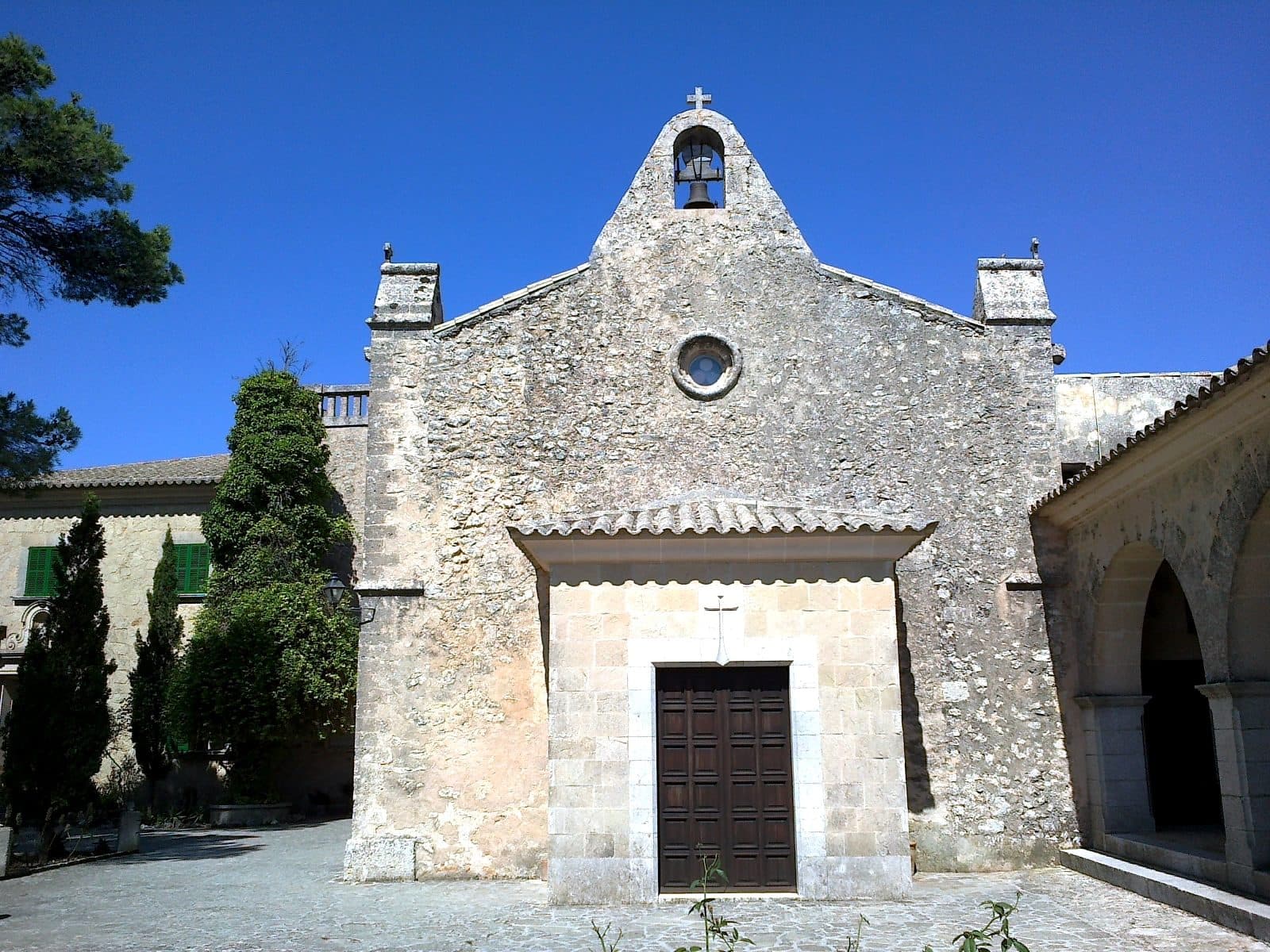

At the summit of the Puig de Randa, the road ends before a place that is a viewpoint, pilgrimage site and living monastery all at once. The Santuari de Cura rises 543 meters above the broad plain of the island’s center. The location alone changes the way you see Mallorca: instead of seafront promenades and bathing coves, the view is defined by the Pla de Mallorca, the distant Serra de Tramuntana and the horizon above the southern coast.
Its full name is Santuari de Nostra Senyora de Cura. Among Mallorcans, it is considered the island’s most important pilgrimage site after Lluc. Yet its significance extends far beyond Marian devotion. Cura is inseparably linked to Ramon Llull, the Mallorcan philosopher, theologian and writer who withdrew to the mountain and, according to his own account, had a decisive spiritual experience here.
A visit is therefore worthwhile for more than the panorama alone. Beyond the stone entrance are a large square, the chapel with the Virgen de Cura, a museum, the historic Aula de Gramática and the Franciscans’ living quarters. The complex remains in religious use while also accommodating guests and welcoming day visitors. It is precisely this coexistence that prevents Cura from feeling like a sealed-off monument.
Anyone interested in Mallorcan history, religious sites or Ramon Llull will find plenty to explore here. Families and travelers without specialist knowledge can also understand the place easily: the route is manageable, many details are clearly identified, and the view opens across the island’s broad central region.
History and significance
Cura’s history begins not with the construction of a large monastery, but with retreat and solitude. After King Jaume I conquered Mallorca in 1229, the caves and hermitages of the Puig de Randa offered space for ascetic and contemplative life. Near the summit, remains of a defensive structure also recall the island’s Islamic era. Today’s sanctuary is therefore part of a much older cultural landscape.
Ramon Llull
Around 1274, Ramon Llull withdrew to the mountain. In his autobiographical account written in 1311, he described a vision that he said he had received here. It became the starting point for his intensive work on a philosophical and missionary system. Llull concerned himself with reforming the Church, communicating knowledge and establishing a new order of thought; his writings had an influence far beyond Mallorca and his own era.
For him, the summit was more than an impressive backdrop. Its seclusion provided the intellectual space from which an extraordinary body of work emerged. Ramon Llull therefore appears in several places at the Santuari de Cura: as a small figure at the monastery entrance, as a member of a Mallorcan noble family represented by the coat of arms above the portal, and as the central figure in the museum exhibition. His connection with the mountain explains why Cura is both a pilgrimage site and a memorial to intellectual history.
From a place of retreat to a center of learning
The hermits’ retreat later developed into a center of religious learning. The museum traces the establishment of a grammar school and the construction of a classroom that admitted more than 100 pupils each year. The Aula de Gramática, whose name survives to this day, recalls that Cura was a place not only of prayer but also of teaching.
This educational tradition fits Ramon Llull, whose thinking closely linked missionary work with the communication of knowledge. It gives the sanctuary an additional dimension: Cura was neither exclusively a monastery nor merely a destination for pilgrims, but at times also a school. Anyone who visits the Aula de Gramática and the exhibition can recognize a chapter of Mallorcan educational and cultural history behind the quiet stone buildings.
Pilgrimage and Franciscan life
In the second half of the 19th century, Cura once again gained importance as a place of religious devotion and contemplation. Followers of Ramon Llull’s teachings were drawn to the mountain and continued his spiritual tradition. At the same time, devotion to the Virgen de Cura, from whom the sanctuary takes its name and Marian orientation, became firmly established.
Today, Franciscans of the Third Order Regular run the Santuari de Cura. The order understands the site as a religious house combining simplicity, hospitality and protection of its natural and cultural heritage. This matters during a visit: Cura welcomes travelers, but it remains an active sanctuary. The chapel, convent area, museum, guesthouse and restaurant share the same historic setting without the religious heart of the place having disappeared.
What to see
The first impression is not of a monumental façade, but of a sequence comprising a portal, an open square and simple stone buildings. The Santuari de Cura has grown over centuries. Accordingly, the site does not read as a single uniform building, but as an ensemble serving different purposes: arrival, prayer, learning, living and hospitality.
The sanctuary portal
At the entrance, it is worth resisting the urge to continue straight into the square. The stone portal bears an inscription dated 1682 featuring a sentence by Ramon Llull from “Blanquerna.” In essence, it calls upon the beloved son to greet the Mother of God, who signifies salvation and blessing. In just a few words, the entrance brings together the two defining forces of the site: Marian devotion and Llull’s intellectual legacy.
Alongside the inscription are religious symbols, references to the missions of Saint Bernardino of Siena and the coat of arms of the Llull family. A symbol of the Franciscan penitential community also forms part of the imagery. The portal is therefore more than an old doorway. It acts like a stone summary of what follows inside.
Plaça del Santuari
Beyond the entrance, the Plaça del Santuari opens up. Today, it serves as the central point linking the sanctuary, guesthouse and other areas of the complex. Some guest rooms are located directly on the square, making the intersection of religious life, overnight accommodation and day visits clearly visible here.
Part of the site’s supply history lies hidden beneath the open space. Around 1564, cisterns were built to collect rainwater for the sanctuary. They are no longer used for this purpose, but they explain how a community could survive on the dry summit. Their significance is easily overlooked precisely because the reservoirs remain invisible beneath the square.
The chapel and the Virgen de Cura
The chapel is the spiritual center of the Santuari de Cura. It houses the venerated image of the Virgen de Cura, and services continue to be held here. The room should therefore not be entered as if it were simply another exhibition hall. If prayers are being said or Mass is being prepared, sightseeing must take second place.
The chapel makes it clear why Cura remains a pilgrimage destination today. The view and memories of Llull may attract many day visitors, but the sanctuary’s name refers to the Mother of God. A quiet moment before her image therefore belongs to the visit, even if your main interest is historical or architectural.
The monastery
The actual convent area was built in the middle of the 20th century. Its dressed-stone entrance is accompanied by a small figure of Ramon Llull, with a coat of arms of the Franciscan order at its feet. Behind it are the friars’ private living quarters.
This area also establishes a clear boundary. Cura is not a fully accessible museum complex, but the home and workplace of a religious community. Visitors may view the visible façades and symbols, but the enclosure remains reserved for monastic life. Anyone arriving with the expectation of freely accessible cloisters and cells will instead find a convent that is still in use today.
The museum
The museum brings together subjects that appear outside only as individual traces. It tells the story of the grammar school and its classroom, Ramon Llull, the Franciscan missions and the development of the sanctuary. It also includes an ethnological collection that makes the site’s everyday life and cultural setting more tangible.
This section is particularly valuable for understanding Cura. Without the exhibition, a visit can easily stop at the portal, chapel and view. In the museum, these individual images combine into a coherent story: the retreat of a medieval thinker became a place of education, pilgrimage and Franciscan life.
The Aula de Gramática
The Aula de Gramática recalls the period when education was one of the principal activities at the summit. The classroom represents the school that admitted more than 100 pupils each year. Visitors thus encounter a surprisingly outward-looking chapter at a place that initially appears to embody complete seclusion.
The historic classroom should not be regarded merely as a side room of the museum. It shows how knowledge was passed on in Mallorca and how closely the name Ramon Llull remained linked to education. Its location high above the villages also makes clear the journey that pupils and teachers undertook to reach this place of learning.
The viewpoint
From the summit viewpoints, the panorama extends across large parts of Mallorca. You can see the plain of the Pla de Mallorca, the Serra de Tramuntana and the southern coast around Palma. On clear days, Cabrera and Ibiza may also be visible on the horizon. Whether these distant destinations actually appear depends less on the season than on the visibility that particular day.
The panorama is an important part of visiting the monastery. The isolated mountain rises prominently from the island’s center, while Cura occupies its highest point like a lookout above the plain. From here, Mallorca’s geography can also be understood unusually well: the mountains, central plain and southern coastline appear in one continuous view.
Visiting Santuari de Cura
Even the arrival at the summit has a clear rhythm: first the panorama opens up, then the historic portal leads into the more sheltered part of the complex. It is worth keeping this order and not reducing Cura to a quick viewpoint stop. The portal inscription, chapel, museum and Aula de Gramática reveal different chapters of the same place.
A practical route
The best place to begin is the portal of 1682. After examining the coats of arms and inscriptions, continue to the Plaça del Santuari, with the former rainwater cisterns beneath its paving. From there, the accessible areas lead to the chapel, museum and Aula de Gramática. Finish at the viewpoint, as the historical context helps you appreciate the sanctuary’s location more consciously.
How long this route takes depends greatly on which areas are accessible and how thoroughly you explore the museum and view. A compact visit is sufficient for the portal, square and panorama. Anyone who wants to engage seriously with the chapel, exhibition and history of the school should not squeeze Cura between two brief photo stops.
Religious site and excursion destination
Services continue to be held in the chapel, while elsewhere in the complex guests stay overnight and a restaurant operates. The atmosphere can therefore change within a few steps. Day visitors arrive in the square; quiet and consideration are required in the chapel; and at the convent, the public route ends before the Franciscans’ private rooms.
There is no reliable way to specify a fixed time without crowds. Religious celebrations may shape the atmosphere in the chapel. Anyone seeking peace should allow enough flexibility and adapt the visit to conditions on site rather than relying solely on a particular time of day.
Current visiting conditions
The accessible areas of the Santuari de Cura may follow different operating and usage schedules. This applies especially to the church, museum, restaurant and guesthouse. As opening hours and admission charges do not remain permanently unchanged, current information should be checked before traveling. This is particularly important if the museum or chapel is the main reason for your visit.
Even when the interiors are closed, the summit setting remains impressive, but it does not replace the cultural and historical visit. Someone who travels up solely for the panorama will experience Cura differently from someone who explores the inscription, Marian sanctuary, school history and Llull exhibition.
Getting there and parking
The drive does not end in Algaida. The main routes listed initially lead only into the municipality; from there, the journey continues to Randa and up the Puig de Randa. The final section is a narrow mountain road that climbs 5 kilometers to the summit. The Santuari de Cura is signposted at the turnoff in Randa.
From Palma Airport
From Palma Airport, the distance to Algaida is 28 road kilometers via the Ma-5010, and the drive takes around 31 minutes. The route then continues toward Randa. From there, follow the Ma-5018 or the signposted ascent to the Santuari de Cura and drive up the narrow summit road.
When planning the journey, remember that the stated 31 minutes cover only the route to Algaida. The winding ascent to Cura comes afterward and requires more attention than the broad approach across the plain. Cyclists and pedestrians may also be using the mountain road.
From central Palma
From central Palma, take the Ma-15 to Algaida. The road distance to that point is 31 kilometers, for which you should allow around 38 minutes. From Algaida, continue through Randa to the signposted mountain road and the summit.
The same applies here: the calculated driving time ends in Algaida, not outside the sanctuary portal. Because of the narrow, ascending road, the final section is not comparable to an ordinary drive through a village. A relaxed pace suits both the route and the destination.
Parking and bus
Parking is available on the grounds of the Santuari de Cura. Anyone wishing to explore the mountain on foot can also start in Randa; the parking area by the parish church is used as the starting point for a hike to the summit. This option combines the monastery visit with a scenic ascent, but requires considerably more time than driving directly.
The nearest recorded bus stop is called Randa. It is located down in the village, not at the Santuari de Cura. From there, you still need to complete the ascent of the Puig de Randa. You should therefore not assume that a bus will take you directly to the sanctuary.
Bus lines to Santuari de Cura at a glance
| Line | Route | Departures/day | First | Last |
|---|---|---|---|---|
| 431d | Algaida - Llucmajor | 8 | 08:55 | 17:35 |
From the official GTFS feeds (TIB/SFM), no real-time data. The figures cover all stops in the town; weekend and holiday services differ — check with the operator before travelling.
Getting there by bus
Randa (4019) · 1.1 km as the crow flies
- 431dAlgaida - Llucmajor · Mon-Fri
Timetable data: official GTFS feeds (TIB/EMT), no real-time — check with the operator before travelling.
Nearby places
Below the summit lies Randa, a small village in the municipality of Algaida. It is the natural gateway to the Santuari de Cura: the mountain road branches off here, the nearest bus stop is here, and trails for the ascent begin here. Anyone who does not drive straight through experiences the mountain as a whole rather than merely as an access road to a viewpoint.
Randa and the sacred mountain
Besides Cura, the Puig de Randa has two other religious sites: the Santuari de Gràcia and the Ermita de Sant Honorat. They should not be confused with Cura, but they contribute to the mountain’s exceptional concentration of sacred places. Gràcia occupies an impressive position against the rock face, while Sant Honorat represents another tradition of retreat and contemplation.
Combining the three sites shows that Cura is not an isolated monastery. For a long time, the entire mountain was understood as a place of religious life. A generous amount of time is advisable for such an excursion, as each stop has its own access route and atmosphere.
Algaida and the island’s center
Algaida is a worthwhile addition if you want to experience everyday life in central Mallorca after visiting the summit. The village contrasts distinctly with Cura’s seclusion: below are village streets and squares, while above is the sanctuary with its broad view over the Pla de Mallorca.
The operator also names Llucmajor, Montuïri, Porreres and Campos as nearby destinations for an excursion through the island’s interior. They can be included as the next stage without turning the visit to Cura into an overloaded day trip. Anyone who wants to see the museum and chapel at the summit should first allow sufficient time for the sanctuary itself.
The place it belongs to
Algaida in the place guidePractical information for your visit
The paved and developed monastery area should not obscure the fact that Cura stands on an exposed mountain summit. Weather and visibility shape the experience more strongly than they do on the plain below. A clear day is crucial for the panorama; Cabrera or Ibiza appear only when long-range visibility is good enough.
Clothing and footwear
Anyone hiking up from Randa or including other routes on the Puig de Randa should choose equipment suitable for a hike. Driving directly to the summit and ascending on foot are two distinctly different ways to visit.
Modest clothing is appropriate in the chapel. It remains a place of worship, not merely a historical backdrop. Conversations should be quiet, religious activities should not be disturbed, and the Franciscans’ private areas must be respected.
Sun, visibility and time outdoors
The open monastery square and viewpoints form part of the experience. When long-range visibility is limited, the visit focuses more on the portal, chapel and exhibition; on clear days, the panorama usually calls for additional time.
The elevation of 543 meters also means that conditions at the summit may feel different from those in Algaida or Randa. Anyone planning a longer stay should not base the decision solely on the weather down on the plain.
Visiting with children
Cura offers children several easy-to-understand points of interest: the winding ascent, the hidden cisterns beneath the square, the old classroom and the chance to identify familiar parts of Mallorca in the panorama. The museum can deepen their understanding of the mountain’s history without the entire visit consisting of long periods inside churches.
Supervision nevertheless remains important. The summit is not a playground, the chapel is used for worship, and parts of the convent are private. A hike from Randa also involves the demands of a mountain trail and should not be equated with the short route inside the complex.
What Cura is not
The Santuari de Cura is neither a large abbey converted entirely into a museum nor solely a scenic restaurant. Parts of the complex serve the order, while others provide accommodation and dining. Public visits focus on the accessible cultural and sacred spaces as well as the outdoor areas.
The site is best understood with precisely this expectation. Its strength lies not in monumental splendor, but in the combination of Llull’s intellectual legacy, Marian pilgrimage, educational history and the exceptional summit setting above central Mallorca.
Local insider tips
Read the portal first
Before entering the monastery square, take a close look at the portal of 1682. A sentence by Ramon Llull, his family’s coat of arms and Franciscan symbols combine there to form a stone introduction to Cura.
Water lies beneath the square
Cisterns built around 1564 are hidden beneath the Plaça del Santuari. They collected rainwater to supply the sanctuary and explain how a community could survive on the dry summit.
Do not miss the classroom
The Aula de Gramática is easily overshadowed by the panorama. Yet it recalls a school that admitted more than 100 pupils each year and presents Cura as a place of education rather than only a monastery and pilgrimage destination.
Look for clear long-range visibility
For the viewpoint, visibility matters more than a supposedly ideal time of day. In clear air, the panorama extends across the Pla de Mallorca and Serra de Tramuntana to the southern coast, and sometimes even to Cabrera and Ibiza.
Understand the whole mountain
Cura is the highest sanctuary on the Puig de Randa. Anyone with more time can combine the visit with the Santuari de Gràcia and the Ermita de Sant Honorat to understand the religious tradition of the entire mountain.