
Creu d’en Massot – Historic Wayside Cross in Algaida
_-_1.jpg)
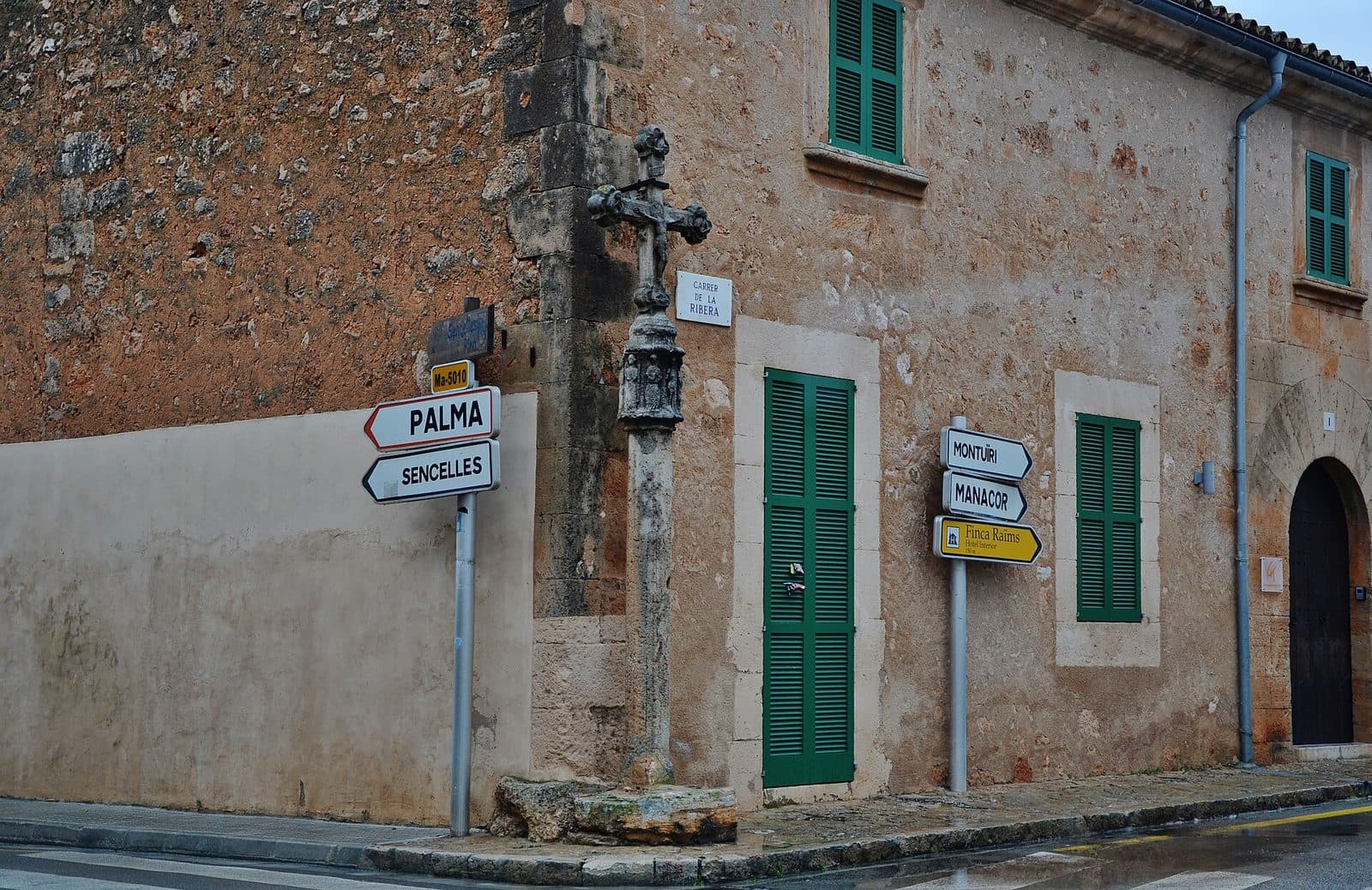
Creu d’en Massot is one of those small historic landmarks that many people initially pass by—yet on closer inspection, it reveals much about Mallorca’s villages. The cross stands in Algaida on Carrer de la Ribera. It is neither a museum nor a monumental structure, but a small religious monument in the organically evolved streetscape of the island’s interior.
Its significance becomes clear primarily through its context. In the early 15th century, when Algaida gained importance over Castellitx and a new parish church was built, several such crosses were erected in the village. Creu d’en Massot is therefore not merely an individual old cross, but part of a historical reorganisation of the village.
Today it is protected as a Bien de Interés Cultural. Anyone interested in the history of Pla de Mallorca, religious symbols in everyday life or the development of Mallorcan villages will find this a brief but rewarding stop. It is particularly worthwhile to visit Creu d’en Massot not in isolation, but as part of a walk through Algaida that includes other surviving crosses. The appeal lies precisely in the modest nature of the site: a historic witness stands where the ordinary life of the village has unfolded for centuries.
History and significance
Towards the end of the 13th century, the population that had previously been scattered across the territory of Castellitx increasingly began to gather in individual settlement centres. Algaida, Pina and Randa gained importance, while other rural settlements such as es Rafalet and Castellitx lost residents. Through this movement, Algaida developed into the most important settlement in the territory at that time.
The new settlement centre became firmly established during the 14th century. At the beginning of the 15th century, a decisive step followed: ecclesiastical precedence shifted from Castellitx to Algaida. In this context, not only was the parish church built in Algaida, but several village and wayside crosses were also erected, including Creu d’en Massot.
A religious symbol in public space
Algaida’s historic crosses were visible religious symbols along roads and at important points in the village. Their impact did not depend on an enclosed sacred space, but on their presence in everyday life. People encountered them while travelling, entering or crossing the village, and following routes between homes, fields and neighbouring settlements.
Creu d’en Massot preserves this original relationship with the street. Its location on Carrer de la Ribera does not separate it from present-day Algaida, but allows it to remain part of the village. This is precisely where its cultural and historical value lies: the monument tells not only of religious devotion, but also of how closely religion, routes and village development were intertwined.
The rise of Algaida
According to its traditional historical classification, the cross was created during a period when Algaida was consolidating its position as the principal settlement. This context is more important for understanding it than the search for an individual patron or an isolated story about its origins. Creu d’en Massot belongs to a broader transformation that took place over several generations: scattered farmsteads and smaller settlements developed into a clearly defined centre with a parish church and religious symbols throughout the village.
The cross is therefore, in a sense, a silent witness to this transition. It recalls the period when ecclesiastical and social focal points shifted and the village centre that remains recognisable today began to take shape. The historical classification does not establish whether every part of the structure visible today dates from that early period; the tradition of the location and the cross is nevertheless associated with this phase.
Protected cultural heritage
Its designation as a Bien de Interés Cultural identifies Creu d’en Massot as protected cultural heritage. This protection applies to a monument whose significance extends far beyond its size. It documents a form of everyday religious culture that was characteristic of many Mallorcan communities and can still be traced at several locations in Algaida.
Small monuments of this kind are particularly sensitive elements of a historic village landscape. Their impact comes not from large interiors or rich collections, but from their location, tradition and relationship with the surrounding streets. Creu d’en Massot makes a chapter of local history visible where it originated: in the heart of the village.
What to see
At first glance, visitors may look for a larger ensemble, but Creu d’en Massot calls for a different kind of observation. The focus is a single historic cross in the streetscape of Carrer de la Ribera. It has no accessible rooms or exhibition; what visitors see is the monument itself and the way it fits into Algaida’s organically evolved structure.
Creu d’en Massot
The word “Creu” refers to the religious cross, while “d’en Massot” clearly distinguishes the site from Algaida’s other historic crosses. This proper name is important for visitors because several individually named crosses have survived within the village and around its outskirts.
At the site, it is worth viewing the monument from more than just the front. Changing perspective reveals how the cross relates to the street and surrounding buildings. Its location forms part of the historic impression: Creu d’en Massot stands on Carrer de la Ribera, where it appears as a landmark within the everyday space of the village.
Because the monument is compact, quiet observation is more rewarding than a quick photo stop. Its overall form and its position within the streetscape are best considered in turn. What matters is not size but legibility: the cross marks a historical layer that continues to exist among today’s houses and roads.
Carrer de la Ribera
Carrer de la Ribera is more than an address. It forms the monument’s immediate setting and explains why a visit differs from one to a church, castle or archaeological site. There is no entrance through a portal and no transition into a museum interior; a walk through Algaida leads directly to the historic object.
This makes Creu d’en Massot especially vivid for travellers who enjoy exploring local history in its original setting. The street shows that such crosses were not created for detached artistic contemplation. They belonged to routes, neighbourhoods and the population’s daily movements. The surroundings remain inhabited and in use today, so visitors should behave respectfully while viewing and photographing the monument.
The crosses of Algaida
Creu d’en Massot becomes easier to understand when viewed as part of a local group. Other surviving crosses in the village include Creu de s’Hostal d’en Gi, also known as Creu dels Traginers, Creu des Colomer and Creu de Can Vicó. Outside the village centre stands Creu de Binicomprat, which is also known as Creu del Cementeri Vell and Creu dels Apestats.
These names reveal how closely the crosses are connected to specific places, routes and local memories. They are not interchangeable decorations. Each has its own local name, while together they tell the story of Algaida’s historical development. Visiting several of them reveals a network of religious symbols that cannot be contained within a single building.
Creu d’en Massot nevertheless remains the main destination of this visit. Comparing it with the other crosses is not intended to replace it, but to sharpen the perception of its individuality. A seemingly inconspicuous stop thus becomes an introduction to the historical topography of the entire village.
Visiting Creu d’en Massot
It is best not to begin the visit expecting a conventional attraction. At Creu d’en Massot, the historic cross on Carrer de la Ribera is the focus. The visit is correspondingly simple: walk to Carrer de la Ribera, view the cross from different perspectives and then continue through Algaida.
A short stop with historical context
The monument alone does not require a long stay. A fixed visit duration would nevertheless be unhelpful because the real value comes from connecting it with the village. Anyone taking only a photograph will finish quickly. Those wishing to understand its relationship with Algaida’s development and the other crosses should instead treat Creu d’en Massot as a stop on a village walk.
It helps to know the basic history before visiting: the concentration of the previously scattered population in larger settlements, Algaida’s consolidation during the 14th century and the ecclesiastical shift at the beginning of the 15th century. With this knowledge, the cross appears not as random street furniture, but as a remnant of a formative era.
Time of day and visitor numbers
There is no documented organised visitor system at Creu d’en Massot involving admission times or guided groups. Nor is there any record of the kind of visitor crowds typically found at the island’s major attractions. The specific time of day is therefore less important than fitting the site calmly into a personal walk through Algaida.
A small monument in a street is naturally easier to view and understand in daylight. Anyone wishing to take photographs should also remember that Carrer de la Ribera is not an open-air museum. Pedestrians, residents and ordinary traffic are part of the setting. Waiting patiently for a brief moment is often more appropriate than expecting the street to remain clear for an uninterrupted photograph.
Opening hours and admission
No reliable opening hours or admission price have been recorded for Creu d’en Massot. Before travelling, visitors should therefore check whether there are any current access notices or temporary restrictions. This is particularly important if the cross is being visited as a specific standalone destination rather than incidentally during a stay in Algaida. The experience depends on personal observation and an understanding of the historical background.
Getting there and parking
Algaida lies in the island’s interior and is easily reached from Palma and the airport via the road network. The stated routes and driving times, however, lead only to Algaida and not directly to Creu d’en Massot. Carrer de la Ribera is the essential destination for the final section.
From Palma
The road distance from central Palma to Algaida is 31 kilometres. The drive takes around 38 minutes via the Ma-15. The actual route may vary depending on the starting point in Palma and current traffic conditions. After arriving in Algaida, follow local directions to Carrer de la Ribera. Vehicles should only be parked where current signs and road markings permit; the cross can then be included in a walk.
From Palma Airport
The road distance from Palma Airport to Algaida is 28 kilometres. The drive via the Ma-5010 takes around 31 minutes. This information also ends in Algaida. Within the village, the final section leads to Carrer de la Ribera and thus into the ordinary streetscape.
The route via the Ma-5010 is especially convenient for travellers heading from the airport into the island’s interior via Algaida. Anyone visiting immediately after arrival should nevertheless allow enough time to find the exact location on foot. The cross is not a large monument visible from afar with its own access road.
By bus
Algaida has several bus stops within the village. From there, the visit continues on foot through the streets. The most suitable connection on the day of travel depends on the starting point and current timetable. Because timetables and routes can change, checking them immediately before travelling is recommended.
Walking to this attraction has a meaningful advantage: it allows Creu d’en Massot to be experienced as part of Algaida. Instead of getting off directly in front of an isolated destination, visitors approach through the village whose historical development the cross documents.
Bus lines to Creu d’en Massot at a glance
| Line | Route | Departures/day | First | Last |
|---|---|---|---|---|
| 403 | Campos - Algaida - Palma | 92 | 06:45 | 21:50 |
| A42 | Cala Bona - Aeroport | 84 | 00:15 | 23:25 |
| 432 | Sineu - Algaida | 72 | 06:45 | 21:55 |
| 401 | Cala Millor - Palma | 42 | 00:50 | 23:52 |
| 431d | Algaida - Llucmajor | 8 | 09:10 | 17:30 |
From the official GTFS feeds (TIB/SFM), no real-time data. The figures cover all stops in the town; weekend and holiday services differ — check with the operator before travelling.
Getting there by bus
Ses Escoles 2 (4016) · 0.3 km as the crow flies
- 403Campos - Algaida - Palma · Daily
- 431dAlgaida - Llucmajor · Mon-Fri
- 432Sineu - Algaida · Daily
Ses Escoles 1 (4020) · 0.3 km as the crow flies
- 403Campos - Algaida - Palma · Daily
S'Hostal 2 (4008) · 0.7 km as the crow flies
- 401Cala Millor - Palma · Daily
- A42Cala Bona - Aeroport · Daily
S'Hostal 1 (4015) · 0.7 km as the crow flies
- 401Cala Millor - Palma · Daily
- A42Cala Bona - Aeroport · Daily
Sa Talaieta (4004) · 1.2 km as the crow flies
- 403Campos - Algaida - Palma · Daily
Alorda (4011) · 1.5 km as the crow flies
- 403Campos - Algaida - Palma · Daily
Timetable data: official GTFS feeds (TIB/EMT), no real-time — check with the operator before travelling.
Nearby places to visit
Algaida is not merely the nearest starting point, but the key to understanding Creu d’en Massot. Since the late Middle Ages, the village developed into the most important settlement centre in the former territory of Castellitx. Its streets, parish church and surviving crosses tell different parts of the same story.
Algaida
A walk through Algaida places the cross in a living context. The village is characterised by traditional houses, narrow streets and a central square. Beyond the more densely built-up streets, the surroundings merge into the rural landscape of the island’s interior, with fields and vineyards.
Creu d’en Massot suits a visit focused not on a series of major attractions, but on details within an organically evolved village. After seeing the cross, the walk can continue to the parish church and through the centre. In this way, the historical shift from Castellitx to Algaida, which is also associated with the erection of the crosses, becomes tangible in the landscape.
The other historic crosses
Anyone wishing to explore the subject further can search the village for Creu des Colomer, Creu de Can Vicó and Creu de s’Hostal d’en Gi, also known as dels Traginers. Creu de Binicomprat lies outside the village centre. A walk of this kind turns several small individual destinations into a connected historical trail.
Creu d’en Massot should not simply be ticked off as a point on a list. Each cross has its own name and refers to a particular place. Only by moving between the locations does it become apparent how historic symbols were distributed throughout the village.
Randa and Pina
In addition to Algaida, the municipality also includes Pina and Randa. Both places developed from the same settlement process in which the population gathered in larger centres towards the end of the 13th century. They are therefore suitable extensions to an excursion focused on the history of the island’s interior.
Near Randa rises Puig de Randa with its religious sites. It provides a far more monumental counterpoint to the small street cross in Algaida. The contrast in scale is particularly revealing: here an inconspicuous religious symbol in the village, there a widely known mountain with sanctuaries. Both belong to the religiously shaped cultural landscape of this region, without reducing Creu d’en Massot to a mere secondary stop.
The place it belongs to
Algaida in the place guidePractical information for your visit
Creu d’en Massot requires no special equipment. What matters more is having realistic expectations: the destination is a single historic cross in a public street. The monument is best experienced as part of a walk through the village.
Respecting the street and residents
Carrer de la Ribera is part of inhabited Algaida. While viewing and photographing the cross, visitors should keep doorways, roads and passageways clear for others. The cross is protected cultural heritage; touching, climbing or leaning against it should be avoided out of respect for the monument.
For children, the visit is most interesting when presented as a small historical treasure hunt. Algaida’s other crosses provide an accessible theme for this. At the same time, Creu d’en Massot is an object beside a street, so younger children should be supervised near traffic.
Clothing and weather
Normal clothing suitable for a village walk is sufficient for a brief look at the cross. Comfortable shoes are advisable for anyone planning to visit several crosses or explore Algaida more extensively. The visit does not take place in an air-conditioned interior, so sun or rain protection should be chosen according to the weather and season.
No reliable information on accessibility at the immediate location has been recorded. People with limited mobility should check the current condition of the access route and pavements in advance rather than assuming that the site has step-free tourist infrastructure.
What not to expect
Creu d’en Massot is not a destination for a standalone visit lasting several hours. Its quality lies in the historical authenticity of its context: a protected religious symbol on a village street, whose origins are explained by Algaida’s rise at the beginning of the 15th century.
Those seeking grand architecture will find it elsewhere. Anyone wishing to understand how history remains visible in Mallorcan villages beyond churches and palaces, however, should make a deliberate stop here. Creu d’en Massot rewards visitors less with spectacle than with a deeper appreciation of Algaida.