
Talaiot de Son Coll Nou near Algaida
.JPG)
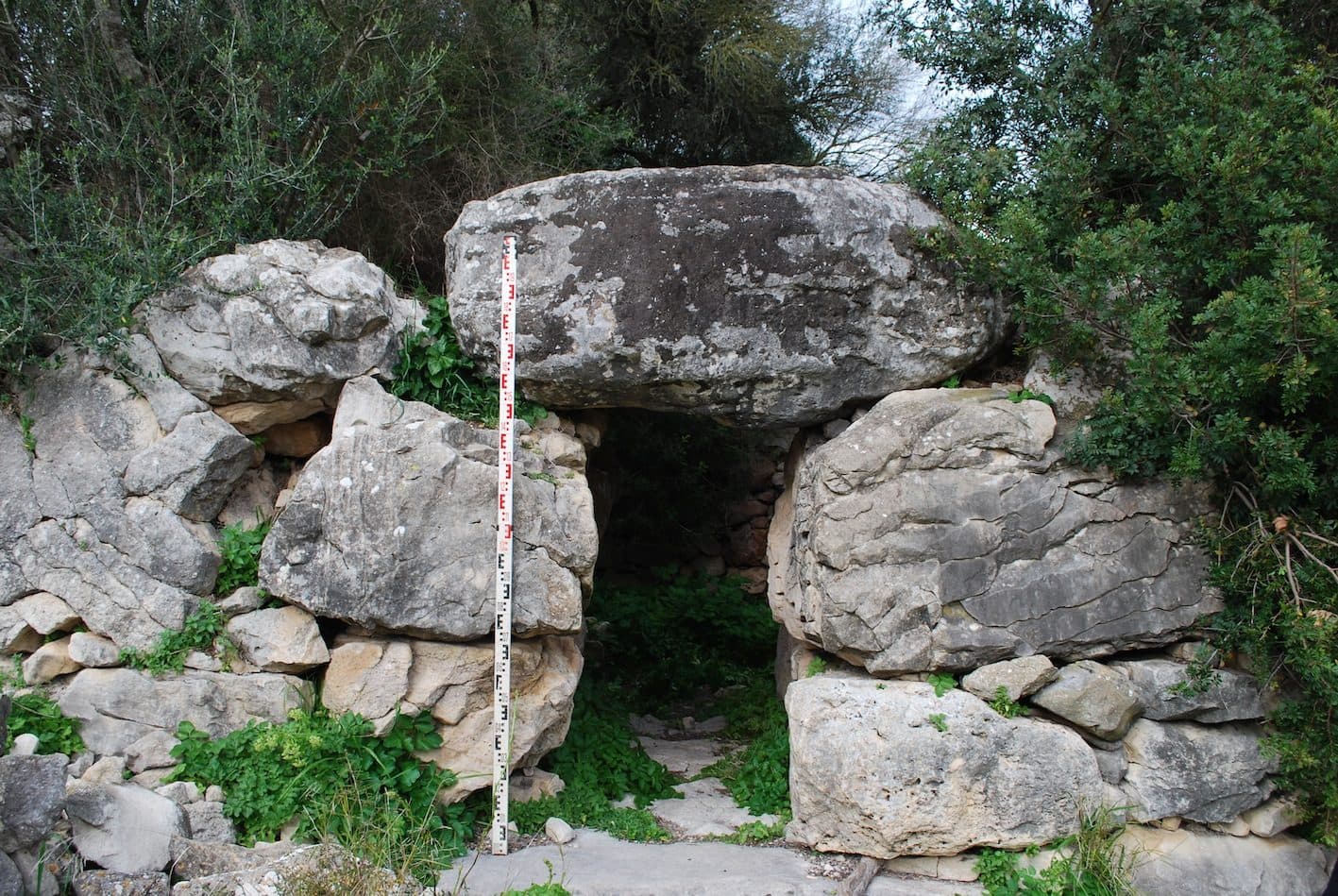
An unusually tall entrance opens between irregular limestone blocks: Talaiot de Son Coll Nou near Algaida is one of those prehistoric structures where Mallorca’s past is not kept behind glass. The massive round tower stands on Camí de la Pau de Castellitx, among holm oaks and immediately beside the remains of a ruined hut. This setting alone makes it clear that this is not a staged museum site, but an archaeological monument in a rural landscape.
Son Coll Nou is particularly worth seeing because of its well-preserved basic form. The roughly truncated-cone-shaped structure, the original portal with its massive lintel, and the tall entrance corridor make the construction surprisingly easy to understand. Beyond lies a chamber that is remarkably spacious for this type of building, although its former central pillar is missing.
The site is especially suitable for travelers who want to explore Mallorca’s interior beyond major museums and restored showpieces. No prior archaeological knowledge is required, but close attention is: much becomes clear through the shape of the wall, the different stone sizes, and the transition from the narrow corridor to the broad interior. Families can also easily include this compact stop in their plans.
Son Coll Nou is not a place for a long list of attractions. Its appeal lies in a single, powerful structure and the opportunity to study its details at leisure. The immediate surroundings appear partly overgrown and poorly maintained. Anyone expecting a developed visitor site may therefore be surprised; anyone seeking an authentic encounter with Mallorca’s prehistory will find that this is an essential part of the experience.
History and significance
The monument’s name reaches deep into the prehistory of the Balearic Islands. “Talaiot” is connected to the Catalan word “talaia,” meaning a watchtower or observation tower. An entire archaeological era took its common name from these monumental stone structures. Scholars broadly place the Talayotic culture of Mallorca and Menorca in the first half of the first millennium BC, between the Late Bronze Age and the Early Iron Age. The communities of that period lived in small settlements and practiced agriculture and livestock farming.
The Talayotic building concept
Son Coll Nou belongs to a building tradition widespread across Mallorca and Menorca, yet highly distinctive to the islands. Large stone blocks were assembled without mortar to form massive walls. Such towers shaped the settlement landscape so strongly that they remain symbols of Balearic prehistory today. Their precise use, however, has not been conclusively established. Research discusses communal gatherings, economic activities, defense, and control of the surrounding territory.
None of these interpretations has been proven with certainty for Son Coll Nou. The structure should therefore not be described too hastily as merely a watchtower, storage building, or ritual site. Its architecture is more revealing: the large interior and enormous wall thickness show that this building was more than a simple utilitarian hut. Its construction required communal organization, experience in positioning heavy stones, and a clear understanding of how to create a durable interior within a massive circular structure.
Later use as a livestock shelter
The end of the Talayotic era did not mean that the structure disappeared from the working landscape. In more recent times, Son Coll Nou was used to shelter livestock. This practical reuse explains why prehistoric monuments in Mallorca are not only archaeological sites but also parts of a cultural landscape farmed over many generations. Old walls provided shelter and continued to be used even after their original purpose had long been forgotten.
The neighboring ruined hut adjoins the talaiot but should not be equated with the prehistoric core structure. When examining the site, it is therefore worth distinguishing between the compact, carefully built talaiot and the attached or neighboring structures.
Research and heritage protection
A scholarly description from 1960 examined Son Coll Nou more closely because of its entrances. In addition to the south-facing main portal, it documented a second passage oriented toward the northeast. This second entrance had been altered in modern times. A resident of the estate at the time reported having helped reconstruct it around 1930; the stones used differed clearly from the older masonry in size, color, and edges.
This observation is particularly important for understanding the site: not every opening visible today necessarily survives unchanged from prehistoric times. The southern portal is regarded as the original entrance, while the northeastern passage bears traces of modern intervention. Today, Talaiot de Son Coll Nou has the status of a Bien de Interés Cultural, meaning it is a protected cultural heritage site.
What to see
The first impression comes not from ornament or decoration, but from sheer mass. Son Coll Nou rises as a circular stone structure that tapers slightly toward the top. It reaches a height of 4.5 meters and has an overall diameter of approximately 13 meters. Yet the outer wall does not resemble the uniform masonry of a modern building, as the individual limestone blocks have irregular shapes and vary greatly in size.
The truncated-cone-shaped round tower
The stones came from the surrounding landscape and, because of their composition, were difficult to shape precisely. The builders solved this problem not by using regular ashlar blocks, but through skillful fitting. Small and large pieces interlock to form the enormous body of the wall. This is one of the site’s most vivid qualities: up close, it becomes clear that stability here depends not on smooth joints but on the selection, placement, and mutual wedging of the stones.
The distribution of the largest blocks is notable. Some are not in the lower part of the wall, as might seem logical in modern planning, but higher up. This has been interpreted as evidence that material was gathered from the surrounding area as construction progressed and used whenever it became available. The wall therefore reveals something about the working process: the talaiot was apparently built stone by stone with material that gradually reached the construction site.
The southern main portal
The original portal faces south. A large stone lintel spans the entrance and forms one of the site’s most striking details. Unlike many low prehistoric entrances, a comparatively tall corridor leads inside here. Adults can pass through without having to bend down significantly. Even so, the transition remains narrow enough to make the wall’s enormous thickness immediately tangible.
The wall structure is approximately 3 meters thick in the talaiot area. Walking through the corridor gives this figure a spatial meaning: between the outer facade and the chamber lies not a thin wall, but a deep mass of carefully set stone. At the portal, it is worth examining not only the lintel but also the supports on either side and the corridor’s alignment. This is the best place to understand how the entrance and wall were conceived as a single load-bearing structure.
The interior chamber
Beyond the corridor, the spacious chamber opens up. It measures 6 meters in one direction and 6.65 meters in the other, giving it a slightly irregular layout. The transition from the confined entrance to this broad interior is one of the visit’s most powerful impressions. From outside, the building appears above all as a compact mass of stone; only inside does it become apparent how much usable space the builders preserved within it.
The chamber is sometimes described as a nave because it feels like a continuous, generously proportioned interior. An original central pillar has not survived; today, the center of Son Coll Nou remains open. This missing structural element should not be confused with an incomplete floor plan: the outer wall and interior are still clear enough to reveal the monument’s construction concept.
The northeastern passage
A second passage is located on the northeastern side. It is archaeologically particularly interesting but should also be viewed with caution. Historical documentation records that this area was reconstructed in more recent times. Different stone colors, other sizes, and sharper edges already made the intervention apparent during the investigation.
For visitors, this offers a small lesson in architectural history: while the southern main portal preserves an original entrance, the northeastern opening shows how later users altered prehistoric fabric. Treating both passages simply as features of the same age would oversimplify the history. Anyone comparing the stone surfaces is looking not only at architecture, but also at different chronological layers of the same structure.
Holm oaks and a ruined hut
The talaiot stands among holm oaks and adjoins a ruined hut. Vegetation can conceal parts of the structure and make the approach seem less clear, although the route to the site is generally straightforward. At the same time, the plants emphasize the rough surface of the limestone and show how closely the monument has become integrated into its present rural surroundings.
The structure itself is considered well preserved, while its immediate surroundings are heavily overgrown and neglected. This affects the visit: instead of an unobstructed panoramic view, visitors encounter changing perspectives between trees, plants, and sections of wall. The southern portal, the circular outer line, and the adjoining hut are the most important reference points for orientation.
Visiting the site
The visit often begins by searching for the structure among the vegetation. Although Son Coll Nou is somewhat hidden, the route there is considered straightforward. Once the circular wall becomes visible, it is best to begin with a slow walk around the outside. This makes it easier to take in the truncated-cone-shaped silhouette, the different stone sizes, and the relationship to the ruined hut before entering through the southern portal.
From the outer ring into the chamber
The clearest way to read the monument begins at the original southern entrance. The large lintel and tall corridor explain the building method more vividly than an immediate view into the chamber. The passage reveals the depth of the wall; a few steps later, the broad interior opens up. The northeastern passage can then be examined from inside and outside, while keeping its modern alteration in mind.
The talaiot itself does not require a long tour. The duration depends more on how closely you examine the wall layers, portal, and interior chamber, and whether the visit forms part of a walk along the routes near Algaida and Castellitx. Anyone seeking only a souvenir photo will finish quickly. Those who compare the stonework and place both entrances in context should allow more time and proceed at a relaxed pace, without turning the stop into a half-day museum visit.
What to expect
Son Coll Nou is an archaeological site without the character of an elaborately presented exhibition. The original structure itself is the main focus. The grounds may be overgrown and show signs of inadequate maintenance, which can obstruct some views. For that reason, it helps to know in advance which details matter most: the circular form, southern portal, corridor, chamber, and missing central pillar.
No regular pattern of large visitor crowds has been documented. The timing of a visit should therefore depend more on visibility, weather, and a current check of access than on supposed peak periods. Because neither fixed opening hours nor admission conditions are reliably recorded, it is advisable to verify current information before setting out. Specific times or costs should not be taken from older directory entries.
Visiting with children
The site is described as suitable for families with children. Its compact form helps: the portal, passage, and interior are immediately understandable without having to read long information panels. The tall entrance corridor also makes access easier than at prehistoric sites with very low passages. A particularly vivid question is how irregular stones could be assembled without mortar to form a wall several meters thick.
Its suitability for families does not mean that the grounds are prepared like a playground. The dense vegetation and ancient masonry require supervision. Visitors should not climb on the stones, and the ruined hut is not a play area. This makes the visit both safer and more respectful of the protected monument.
Getting there and parking
From Palma and the airport, the route first leads to Algaida. It is important to distinguish between the town and the outlying attraction: the recorded distance and travel time end in Algaida, not directly at the talaiot. For the final stretch, current navigation to Talaiot de Son Coll Nou or Camí de la Pau de Castellitx is therefore useful.
From Palma Airport
From Palma Airport, the road distance to Algaida is 28 kilometers. The drive takes around 31 minutes via the Ma-5010. From Algaida, local roads continue toward the site. The talaiot stands beside Camí de la Pau de Castellitx; reaching the rural surroundings is generally straightforward, although the monument itself can seem somewhat hidden among the vegetation.
From central Palma
From central Palma, the road distance to Algaida is 31 kilometers. The drive via the Ma-15 takes around 38 minutes. Again, this time covers only the route to Algaida. The final section to the talaiot leads out of the town into the countryside. For precise navigation, use the exact map location rather than entering only the municipal area as the destination.
The final stretch on Camí de la Pau
The talaiot stands directly beside Camí de la Pau de Castellitx, so it does not require following a difficult mountain trail. Its secluded position among holm oaks may nevertheless mean that the wall only becomes visible at the last moment. Checking the route in advance is more helpful than looking for large tourist signs.
No bus stop is recorded in the immediate vicinity. Without a car, a planned walk from Algaida toward Castellitx is therefore more practical than expecting to get off directly beside the monument.
Nearby
Algaida provides an appropriate setting for the visit. The town lies in Mallorca’s interior, in a landscape where old paths, farmland, and scattered historical remains are found closer together than large tourist facilities. Son Coll Nou therefore feels particularly fitting when it is understood not as an isolated point on a map, but as part of this rural landscape.
Algaida
A stop in the town center can provide a break before or after visiting the talaiot. Algaida is also the logical reference point for the journey: both the route from the airport via the Ma-5010 and the road from Palma via the Ma-15 lead here first. Only then does the local search begin for Camí de la Pau de Castellitx and the monument among the holm oaks.
The contrast between the town and the archaeological site is revealing. Algaida reflects present-day life in Mallorca’s interior; just a few roads away, Son Coll Nou recalls communities that were already using the same landscape in prehistoric times. Linking the two stops does not require an extensive day trip, but it gives the short archaeological visit an understandable landscape context.
Castellitx
Camí de la Pau already includes Castellitx in its name. Walking routes from Algaida connect the talaiot with the area around Ermita de la Pau de Castellitx. The small church is not reliably accessible and may be closed; the combination is therefore best suited to a scenic walk with historical waypoints rather than a firmly scheduled interior visit.
Including Son Coll Nou in such a walking route makes the talaiot feel less like a single object beside the road. The ancient round tower becomes a stop on a route through the countryside around Algaida. Current maps should nevertheless be used when planning, as vegetation and the understated setting can make the monument difficult to spot.
The place it belongs to
Algaida in the place guidePractical information for your visit
The most important item of equipment is not an archaeological guidebook, but sensible footwear. The immediate surroundings can be heavily overgrown. Closed shoes with good grip make it easier to walk around the outer wall and through the corridor. Extra care is always advisable on natural ground after rain.
Finding your way around the structure
The original south-facing portal with its large lintel is the best starting point. From there, the tall corridor leads into the chamber. The second passage lies to the northeast and was altered in more recent times. This simple distinction prevents the most common misreading at the site: assuming that both openings are unchanged prehistoric entrances.
The open center of the chamber should not be mistaken for its original condition, as the central pillar has disappeared. The spacious interior and massive ring wall remain informative. The ruined hut beside the talaiot is likewise not part of the original core of the prehistoric round structure.
Respecting the monument and grounds
Son Coll Nou is protected as a Bien de Interés Cultural. Stones must therefore not be moved or used as seats or climbing aids. This also applies to smaller pieces that appear loose: in dry-stone masonry, an inconspicuous stone may form part of the structural system. The best close-up views are available at the portal and in the corridor without climbing onto the wall.
Vegetation may make access difficult with strollers or other wheeled mobility aids; no definitive accessibility classification has been documented. Anyone who depends on step-free, paved routes should check current conditions in advance. Young children should be closely supervised, especially in areas with limited visibility and beside the remains of the ruined hut.
What not to expect
The talaiot is neither a reconstructed village nor a museum with an extensive exhibition. The main experience is reading the round structure itself. Without preparation, visitors may see only an old stone wall. Those who pay attention to the portal, wall thickness, chamber, and differences between the two passages will discover a multilayered monument: prehistoric construction, later livestock use, and modern alteration in a single place.
Local insider tips
Start at the southern portal
The best starting point is the original south-facing portal. Its large lintel and tall corridor first reveal the enormous wall thickness and then make the surprisingly spacious interior easy to understand.
Compare both passages
The northeastern passage was altered in more recent times. Comparing it with the original southern portal draws attention to differences in stone sizes, color, and edges—a detail that is easily missed without prior knowledge.
Look among the oaks
The talaiot stands beside Camí de la Pau de Castellitx among holm oaks and can seem somewhat hidden despite the straightforward route. Saving the exact map location in advance makes navigation easier.
Combine it with Castellitx
Son Coll Nou can be included in a walk from Algaida toward Castellitx. The Ermita there may be closed; the combination is most rewarding as a route through the historic landscape.
Examine the largest stones
Some particularly large blocks are positioned higher in the wall rather than at the bottom. This unusual detail suggests that building material was gathered as construction progressed.