
Sepulcre megalític de Son Bauló de Dalt: Mallorca’s Early Megalithic Tomb
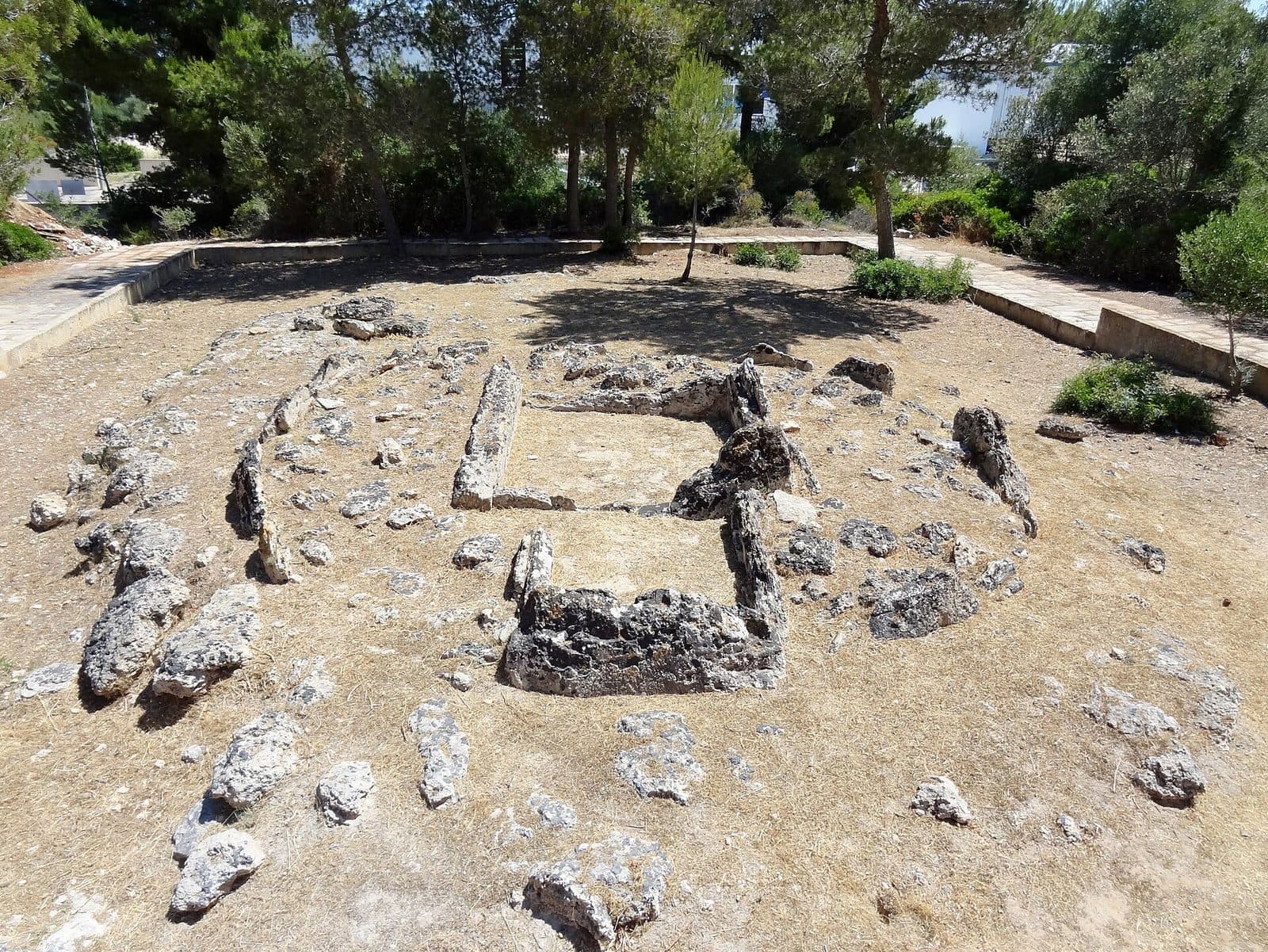

Surrounded by commercial buildings and roads is a prehistoric site you would hardly expect to find in this setting. The Sepulcre megalític de Son Bauló de Dalt is a megalithic tomb near Urbanització Montfarrutx, not far from Can Picafort. No monumental ruin rises into the sky here. Instead, you can see the stone ground plan of a communal tomb whose individual sections can still be distinguished surprisingly well.
This contrast is precisely what makes the visit appealing: on one side is the modern, functional setting of the Son Bauló commercial area, while on the other stands a structure created long before the modern settlements around the bay. Walking slowly around the stones reveals an artificial oval platform, a circle of upright slabs, and the entrance to the burial chamber itself. What first appears to be disordered masonry gradually becomes a legible architectural plan.
The site is particularly worthwhile for travellers who want to explore Mallorca’s prehistory beyond its major museums. It also works well as a short archaeological stop on the way to Can Picafort or Son Real. However, visitors should not expect a reconstructed monument with a complete roof and staged interiors. Its appeal lies in the original remains, the proportions of the structure, and the question of how a community used simple stone slabs to create a lasting space for its dead.
Because the signage within the commercial area is described as inadequate, engaging with the tomb often begins with the search for it. A saved map location is therefore more useful than hoping for a clearly visible access road. Once there, visitors should not focus solely on the central chamber: only a view of the entire oval platform makes it clear that this was not a single stone box but a carefully organised funerary monument.
History and significance
The site’s modern history began not with a major excavation campaign but with the attentiveness of an amateur interested in archaeology. He discovered the structure and published an initial report about it in the middle of the last century in the Bulletin de la Société Préhistorique Française. The tomb was then known to specialists, but a scientific investigation was still some time away.
The first excavations
It was not until the sixties that a team of archaeologists from the Balearic Islands carried out the first systematic excavations. This step was crucial: loosely visible slabs and low stone settings could now be identified as connected parts of a dolmen-like tomb. The platform, outer circle of slabs, passage, and burial chamber could be understood as a planned whole. The excavations thus transformed the inconspicuous site into an important record of Mallorca’s prehistory.
Son Bauló de Dalt is regarded as the first megalithic monument discovered on Mallorca. This classification explains why the site is archaeologically important despite its modest appearance. The discovery revealed a type of tomb on Mallorca in which large slabs formed an enclosed burial space. The monument is therefore not merely another ruin but an early key to researching this building and burial tradition on the island.
A tomb for a community
The inner chamber was used to lay the dead to rest. A narrow entrance led to it, while a ring of upright stone slabs enclosed the core of the structure. This arrangement points to a burial place planned for a community: the space did not emerge by chance among rocks but was deliberately organised through its platform, enclosure, corridor, and chamber.
Today, the Sepulcre megalític de Son Bauló de Dalt is both an archaeological site and a protected cultural monument. It is listed in Spain’s heritage register as a Bien de Interés Cultural. At the site itself, however, its historical significance remains understated, as there is no tall façade or fully enclosed interior to direct the eye automatically. The monument reveals itself through careful observation—and this is precisely what gives it value as an authentic archaeological site.
What to see
First impressions can be deceptive: from a distance, the low structure looks almost like a collection of pale stone slabs. As you walk around it, however, clear geometric forms emerge. Its layout can be read from the outside in: first the artificial platform, then the circular enclosure, and finally the passage and burial chamber. To understand the site, this overall view is more important than searching for a single spectacular stone.
The oval platform
The entire tomb rests on an artificially constructed oval platform. It measures 16 metres in length and 9,5 metres in width. Flat slabs were placed on a layer of natural ground, creating a clearly defined base. The platform was therefore more than incidental foundations: it gave the tomb its own shape and distinguished it from the surrounding area.
At the site, it is worth first looking along the edge of this oval surface. From there, it becomes apparent that the central chamber accounts for only a small part of the complete monument. The builders created not just a container for burials but a complete architectural framework. Its low construction also explains why the tomb can easily be overlooked today: its impact comes from its horizontal form, not its height.
The circle of slabs
On the platform stands a circle of vertically positioned stone slabs. Its diameter is approximately 6 metres. This ring enclosed the corridor and inner chamber, the areas in which the actual burials took place. Some slabs now appear significantly taller than the low courses of stone between them, allowing the former boundary to remain visible.
The circle links the outer platform with the inner burial space. Anyone who looks only at the centre will miss this important arrangement. The best approach is therefore to walk slowly around the structure. From changing viewpoints, the slabs overlap, and individual stones form an imagined continuous line. This makes it possible to understand how clearly the entrance and chamber were once separated from the rest of the monument.
The entrance corridor
A corridor led from outside to the burial chamber. It was not simply a wide opening in the circle of slabs but a controlled entrance into the innermost area. The chamber was reached through a small passage opening. This narrow transition visibly distinguished the route into the monument from the actual burial place.
The corridor is particularly useful for understanding the tomb’s orientation. Instead of moving randomly between the stones, visitors can mentally follow the original route: from the edge of the platform through the enclosure and into the chamber. This perspective conveys more than a view from above because it shows how movement formed part of the architectural plan. The tomb was organised as a sequence of thresholds.
The central burial chamber
At the centre is an approximately square stone cist made from upright slabs. Its area is about 4 square metres. This is where the dead were laid to rest. The chamber’s small size is often surprising because the artificial platform around it is considerably larger. This relationship demonstrates how strongly the burial space itself was emphasised by the additional architectural layers.
The chamber is open today. Rather than looking into a preserved, dark tomb, visitors see its exposed structure. This allows the vertical slabs, the boundary of the interior, and the connection to the passage to be compared directly. Although the lack of enclosure requires imagination, it also offers an advantage: the ground plan can be understood directly from the original remains, without reconstruction or display cases.
The monument as a complete form
The platform, circle, corridor, and chamber should not be viewed in isolation. Together, they form a progression from the broad outer oval to the small inner space. This layered arrangement is the true architectural distinction of Son Bauló de Dalt. It shows that even a megalithic tomb that appears low today was based on a precise spatial concept.
A good route therefore begins outside the platform, continues around the oval, and only then approaches the centre. This makes the scale and layout easier to understand than walking straight to the burial chamber. The site does not reward a quick glance at a single object but reveals itself as an ensemble of lines, surfaces, and passages.
Visiting the site
Finding the site is often the most difficult part of the visit. Access is generally considered straightforward, but the signage within the Son Bauló commercial area is described as poor. The tomb also has no silhouette that stands out from a distance. Saving its location in advance therefore prevents unnecessary detours through the surrounding streets.
From first glance to a readable ground plan
After arriving, it is advisable not to go straight to the centre. From the edge, first take in the oval shape of the artificial platform. Then follow the circle of upright slabs before turning your attention to the corridor and chamber. This order makes the visit easier to understand and prevents the central stone cist from being mistaken for the entire monument.
A walk around the site is manageable, but its length can vary considerably depending on your interest. Anyone seeking only a photographic impression will experience it as a compact stop. Those who trace each line of stones and compare the different construction zones will stay significantly longer. Your own level of attention is what matters.
A quiet archaeological stop
The surviving structure itself is the exhibit. Travellers who enjoy original archaeological remains can get very close to its physical form here. Other visitors may benefit from brief preparation: knowing what to look for in advance makes the platform, enclosure, and burial chamber much easier to recognise.
Its location away from classic monumental architecture creates an unusual contrast. The everyday activity of the modern commercial area reaches a place created for the dead of a prehistoric community. The contrast is not romantic, but it is revealing. It shows how archaeological traces have survived on Mallorca even where the modern surroundings have long served an entirely different purpose.
Check access in advance
Before travelling, check current access and any applicable visitor regulations, as official opening hours and admission arrangements may change.
Adequate daylight is useful for photography and for recognising the low stone settings. It is not possible to identify a reliably quiet time of day. Rather than planning down to the minute, it is more practical to combine the stop with an existing excursion to Can Picafort or Son Real and allow enough time to find the site without rushing.
Getting there and parking
Road directions lead as far as Urbanització Montfarrutx. This is important because the Sepulcre megalític de Son Bauló de Dalt is not signposted like a major tourist attraction within the Son Bauló area. A precise map location is therefore recommended for the final section through the commercial district. Access is considered straightforward, but local signage can make orientation difficult.
From Palma Airport
The road distance from Palma Airport to Urbanització Montfarrutx is 64 kilometres. The journey takes around 64 minutes and follows the Ma-30, then the Ma-13 and the Ma-3400. These directions end in Montfarrutx, not directly at a clearly marked visitor entrance to the tomb. Navigation should therefore remain active for the final streets within the area.
The route initially follows the island’s main traffic arteries and approaches Son Bauló via the regional road network only in its final section. On arrival, it is worth slowing down early and following the saved location rather than looking for a large tourist sign. The monument itself is low and cannot be reliably spotted from a vehicle.
From central Palma
The road distance from central Palma to Urbanització Montfarrutx is 61 kilometres. The journey takes around 69 minutes and follows the Ma-13, Ma-3400, and Ma-3440. Here too, the distance and driving time refer to Montfarrutx. Locating the archaeological site within the built-up surroundings is then a separate, short navigation step.
Anyone travelling from Palma should not head to Son Bauló de Dalt expecting a large-scale programme of monumental sights. It makes more sense to combine it with Can Picafort, the coast, or Son Real. This turns the longer journey into a varied day trip, while the megalithic tomb itself can be experienced as a focused archaeological stop.
Parking and buses
In the commercial surroundings, take care to keep access roads and business premises clear and park only where local regulations allow. As conditions may change, roadside signage takes precedence.
There are several bus stops in the Son Bauló and Can Picafort area. However, precise navigation from there to the archaeological site is still necessary. The stops do not replace directions to the tomb, and sufficient time should be allowed for the final section. Visitors arriving by public transport are best advised to save the site’s location in advance rather than relying solely on the name Son Bauló, as it refers to several different places in the area.
Bus lines to Sepulcre megalític de Son Bauló de Dalt at a glance
| Line | Route | Departures/day | First | Last |
|---|---|---|---|---|
| 324 | Can Picafort - Alcúdia | 339 | 00:06 | 23:54 |
| 302 | Can Picafort - Palma | 229 | 00:07 | 23:56 |
| 315 | Sa Pobla - Badia d'Alcúdia | 210 | 06:23 | 23:57 |
| A32 | Can Picafort - Aeroport | 86 | 00:32 | 23:42 |
| 316 | Son Serra - Inca | 84 | 06:36 | 22:37 |
| 325 | Alcúdia - Cala Rajada | 52 | 08:41 | 22:20 |
From the official GTFS feeds (TIB/SFM), no real-time data. The figures cover all stops in the town; weekend and holiday services differ — check with the operator before travelling.
Getting there by bus
Can Picafort sud 1 (55037) · 1.1 km as the crow flies
- 302Can Picafort - Palma · Daily
- 315Sa Pobla - Badia d'Alcúdia · Daily
- 316Son Serra - Inca · Daily
- 324Can Picafort - Alcúdia · Daily
- 325Alcúdia - Cala Rajada · Daily
- A32Can Picafort - Aeroport · Daily
Can Picafort centre 2 (55036) · 1.5 km as the crow flies
- 302Can Picafort - Palma · Daily
- 315Sa Pobla - Badia d'Alcúdia · Daily
- 316Son Serra - Inca · Daily
- 324Can Picafort - Alcúdia · Daily
Can Picafort centre 1 (55017) · 1.6 km as the crow flies
- 302Can Picafort - Palma · Daily
- 315Sa Pobla - Badia d'Alcúdia · Daily
- 316Son Serra - Inca · Daily
- 324Can Picafort - Alcúdia · Daily
- 325Alcúdia - Cala Rajada · Daily
- A32Can Picafort - Aeroport · Daily
Platja de Can Picafort 1 (55034) · 2.2 km as the crow flies
- 302Can Picafort - Palma · Daily
- 315Sa Pobla - Badia d'Alcúdia · Daily
- 316Son Serra - Inca · Daily
- 324Can Picafort - Alcúdia · Daily
- 325Alcúdia - Cala Rajada · Daily
- A32Can Picafort - Aeroport · Daily
Platja de Can Picafort 2 (55035) · 2.2 km as the crow flies
- 302Can Picafort - Palma · Daily
- 315Sa Pobla - Badia d'Alcúdia · Daily
- 316Son Serra - Inca · Daily
- 324Can Picafort - Alcúdia · Daily
- 325Alcúdia - Cala Rajada · Daily
- A32Can Picafort - Aeroport · Daily
Timetable data: official GTFS feeds (TIB/EMT), no real-time — check with the operator before travelling.
Nearby places
The name Son Bauló appears several times around Can Picafort. Among other things, it refers to a beach, a stream, and other local areas. The Sepulcre megalític de Son Bauló de Dalt, however, is exclusively the archaeological site near Montfarrutx. This distinction is important when planning, because searching only for “Son Bauló” may just as easily lead to the coast.
Urbanització Montfarrutx and Can Picafort
Montfarrutx lies near the holiday resort of Can Picafort in north-eastern Mallorca. A visit to the tomb can therefore easily be combined with time in the town or on the nearby coast. Can Picafort provides a practical contrast to the quiet archaeological site: it has the familiar amenities of a larger resort, while Son Bauló de Dalt remains focused entirely on its archaeological remains.
Platja de Son Bauló lies at the eastern edge of Can Picafort. The Torrent de Son Bauló flows into the sea at one side of the sandy beach, beyond which lies the protected landscape of Son Real. This area is particularly suitable for a combined visit, as a walk along the coast and stream mouth can follow an exploration of the low stone tomb. Despite their shared name, the beach and tomb are two separate destinations.
Son Real
Son Real is the obvious addition for anyone wishing to explore the burial culture of prehistoric Mallorca in greater depth. Another important necropolis lies there. It should not be confused with Son Bauló de Dalt: the megalithic tomb near Montfarrutx has its own architectural form, discovery history, and location, while the necropolis of Son Real is a separate archaeological area on the coast.
This comparison is especially instructive. Son Bauló de Dalt centres on a single, clearly structured funerary monument, while Son Real presents the image of a more extensive burial ground. Seeing both on the same excursion allows for comparison without confusing the sites.
S’Albufera and Platja de Muro
West of Can Picafort are Platja de Muro and S’Albufera Natural Park. Combining them is less about a shared historical theme and more about variety: first an archaeological site, followed by a beach landscape or wetland. For a day trip from Palma or the airport area, this makes more sense than making the long road journey solely for the compact site.
Even when combining several destinations, Son Bauló de Dalt should not be treated as a casual photo stop. A quick look at the centre makes it easy to overlook the artificial platform and outer circle of slabs. It is better to give the tomb its own quiet part of the excursion before continuing to the coast.
The place it belongs to
Urbanització Montfarrutx in the place guidePractical visitor information
Large stone slabs, low settings, and open ground define the site. Sturdy, closed footwear is therefore more practical than beachwear. Anyone combining the visit with Platja de Son Bauló should consider the transition from the beach to the archaeological terrain when choosing clothing, as the site is not a paved museum route.
Finding your way at the site
The most important practical tip is to save the map location in advance. Signage in the commercial area is considered inadequate, and the low monument does not stand out clearly from its surroundings. The full name “Son Bauló de Dalt” should also always be used when searching. Son Bauló alone may lead to the beach, the Torrent, or another part of the locality.
Once the tomb has been found, a simple reading order helps: the oval platform on the outside, the circle of slabs on it, followed by the corridor and finally the square chamber. Although this sequence cannot replace an expert guide, it prevents the structure from looking like a random pile of stones. A photograph or sketch of the ground plan can also make orientation easier.
Visiting with children
Children may find the site exciting if the visit is presented as a search for clues: Where does the oval end, which slabs are upright, where did the passage run, and how small is the chamber compared with the entire platform? Without such an introduction, however, the site lacks the immediate presentation offered by many child-friendly museums.
As this is a protected archaeological monument, the stones are not a climbing course. Adults should supervise children closely and explain that even low courses of masonry are important original parts of the site. Understanding comes from observing and comparing, not from stepping onto the fragile structures.
What not to expect
Son Bauló de Dalt is neither a fully preserved burial chamber nor a spectacularly towering megalithic structure. What can be seen is the exposed stone layout. Visitors who arrive with this expectation will not judge the site by inappropriate standards.
Nor should the modern surroundings be ignored. The site is not isolated in an untouched landscape but lies near a commercial area. This does not diminish its archaeological value. On the contrary, the strong contrast shows how a prehistoric burial place became part of a modern settlement and transport landscape yet survived as a clearly recognisable ground plan.