
Dolmen de Son Real – an unfinished tomb on Mallorca’s coast
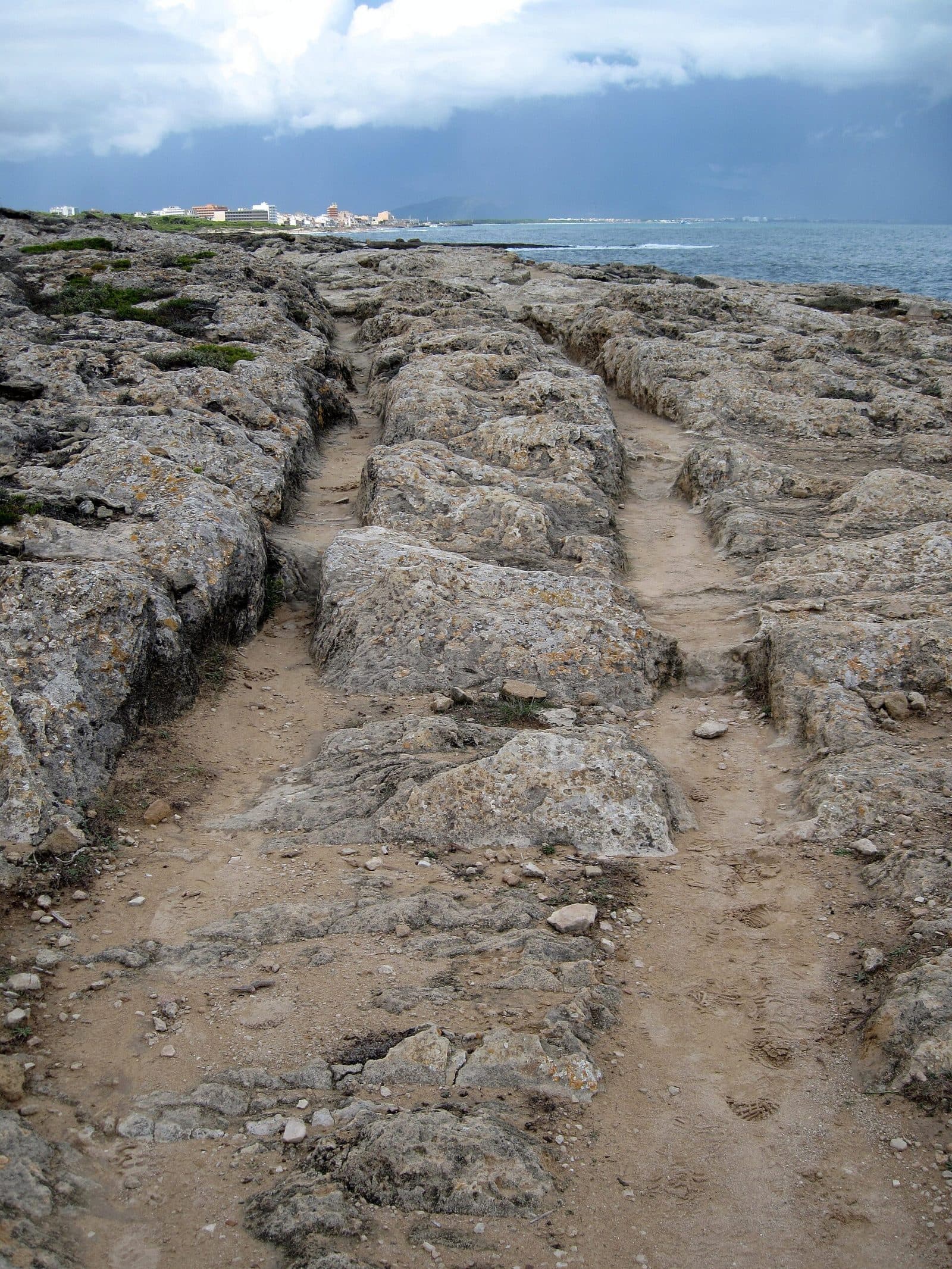

Between the dune system of Son Real, the adjoining pine forest, and the shoreline lies an archaeological site that many walkers overlook: the Dolmen de Son Real. Its low ground plan barely stands out from the terrain. This very restraint makes the site interesting, as it reveals not a completed monument but the beginnings of a burial chamber whose construction was apparently abandoned.
The dolmen belongs to the municipality of Santa Margalida and lies near Urbanització Montfarrutx in northeastern Mallorca. It should not be confused with the better-known necropolis of Son Real. The two sites are close together and share the same historic landscape, but they are archaeologically distinct complexes. Anyone looking only for the necropolis’s striking tombs can therefore easily misinterpret the dolmen’s much simpler stone arrangement.
The site is particularly worth seeing for people who regard archaeology as more than a collection of spectacular walls. A large upright slab, two adjoining side stones, and paving made from flat slabs are enough to make an unfinished burial structure legible here. There is also its unusual position at the meeting point of forest, dunes, and coast, in terrain that was also used to quarry Marès sandstone.
The dolmen can easily be included as the destination of a walk through Son Real, although it requires close attention: without knowing about its unfinished state, the structure initially looks like an inconspicuous remnant among natural and worked stones. Those who walk slowly around it and examine the surviving slabs individually will gradually recognize the beginnings of the rectangular interior.
History and significance
A burial structure under construction
The excavation of the Dolmen de Son Real led to an unusual interpretation: what was uncovered was not a fully completed burial chamber that had merely suffered later damage, but an apparently unfinished funerary structure. The beginnings of a rectangular space could be identified within the planned interior. Construction therefore came to a halt before an enclosed chamber was created.
This makes the dolmen especially revealing from an archaeological perspective. A completed monument usually offers evidence of use, alteration, and decay; at Son Real, the surviving structure also provides insight into an abandoned construction process. The large northern slab and the two adjoining side stones show how the chamber had been started. The surrounding paving of flat stones stabilized the central area and demonstrates that this is not a chance accumulation of rock.
The surviving evidence cannot establish with certainty what specific reasons led to the abandonment or for whom the burial was intended. A cautious interpretation is therefore essential: the dolmen was planned as funerary architecture but was not completed in the form that can still be recognized. This unresolved ending distinguishes it from many archaeological sites whose histories have to be reconstructed primarily from later destruction.
The Talayotic turning point
It is thought that the structure was dismantled as early as the Talayotic period. The reuse of its building material is considered a possible reason. The large slabs would have been valuable for other structures nearby, particularly because worked stone did not have to be quarried and prepared again.
The nearby necropolis and an as yet unlocated Talayotic settlement in the area have been suggested as possible destinations for this reused material. Both remain archaeological hypotheses and should not be confused with verified evidence. What is visible today is primarily the result: only a small part of the structure under construction remained standing, while major components are missing.
This hypothesis connects the dolmen with the coast’s later development without making it part of the necropolis. The distinction is important: the necropolis consists of numerous independent tombs from the Talayotic and subsequent periods; the dolmen is a separate site with its own architectural form and an unfinished rectangular chamber.
Excavation and protection
The dolmen was fully investigated archaeologically and subsequently protected. Its present appearance is therefore not an untouched original state but the result of excavation, documentation, and conservation. Only the excavation revealed how the upright slabs, side elements, and surrounding stone paving belonged together.
Its significance lies less in its size or rich furnishings than in the combination of construction stage and landscape. An unfinished tomb structure at the edge of a historic quarrying area raises questions that a completed monument can barely answer: Where did the chamber begin? Which slabs had already been set? How was the central structure stabilized? And which parts might later have disappeared for reuse as building material? At the site, such questions can be traced directly in the stonework.
What to see
The northern stone slab
The large slab set upright on the northern side is the most prominent feature. It forms the main surviving reference point for the chamber under construction. Anyone first viewing the structure from a short distance should use this stone as a starting point: the planned form is easier to read from here than from close up, where individual slabs can easily blend into the surrounding rock and rubble.
Its upright position is crucial. It shows that the stone was not simply lying flat in the terrain but was deliberately set as a structural element. In a completed monument, it would have formed part of the burial chamber’s wall. Today it appears almost like a marker for a space that was never enclosed.
The two side slabs
Two side stones adjoin the northern slab. Together they outline the beginnings of a rectangular chamber. However, the additional structural elements that would have turned it into an enclosed interior are missing. The visitor therefore encounters not an accessible burial chamber but a few elements connected to form part of a structure.
These junctions in particular reveal the difference between a natural rock formation and a built structure. The slabs are aligned with one another and mark the sides of a planned space. It is worth slowly changing position: from behind, the placement of the large slab is easy to recognize, while from what was probably the entrance side it becomes clearer how narrow and concentrated the chamber under construction was intended to be.
The paving of flat stones
Paving made from flat stone slabs surrounds the central structure. It served to stabilize it and therefore belongs to the dolmen’s architectural concept. This detail is less conspicuous than the upright northern slab but is equally important for understanding the site. The funerary architecture did not consist only of visible wall stones; the prepared foundation also helped secure the central structure.
Visitors should therefore look beyond the center of the complex. The transitions between the paving and the surrounding terrain reveal how the building site was prepared. At a site with exposed rock and traces of historic quarrying, this distinction is particularly illuminating: worked, deliberately placed, and naturally occurring stones lie close together.
The unfinished rectangular chamber
Paradoxically, the most important “structural element” is the space that is missing. The excavation identified the beginnings of a rectangular chamber, but its planned form was never completed. There is no fully enclosed interior and no surviving monumental roof beneath which visitors can stand. Instead, the dolmen can be read as the frozen beginning of a construction project.
This incompleteness explains why the site often appears less impressive in photographs than it does when viewed directly. At the site, the alignments of the slabs can be compared with one another. Anyone who imagines that further wall stones were intended to follow can see a rectangular ground plan emerge from the few remains. Without this information, however, the impression may simply be that of a small stone arrangement.
The Marès quarrying area
The dolmen lies in an area where slabs of Marès, the calcareous sandstone common on Mallorca, were quarried. This material was probably also used for the burial structure. The building site and the source of the raw material were therefore located directly beside one another. The terrain tells not only of burial but also of the selection, extraction, and working of suitable stone slabs.
The quarrying traces should not be confused with parts of the burial chamber. They form the material background of the structure: this was where the stone needed to build it was available. At the same time, the human-worked rocky landscape makes the site difficult to read at first glance. Only the clear arrangement of the surviving chamber slabs and the stabilizing paving distinguish the dolmen from its surroundings.
The transition between dunes, forest, and sea
The site occupies a small coastal promontory at the boundary between the dune system, pine forest, and shoreline. This setting is more than an attractive backdrop because it shapes the entire experience of the visit: vegetation thickens behind the dolmen, the coast opens out in front of it, and sand, flat slabs, and rocky ground alternate underfoot.
The present landscape should not automatically be regarded as an exact image of how the area looked when construction began. Nevertheless, it helps reveal the spatial choice. The burial structure was started not deep in the island’s interior but at a distinctive transition between different landscape zones. From the rear, a modern sighting or alignment tower can also be seen in the background. It does not belong to the dolmen and illustrates how several historical layers meet in the same coastal landscape.
Visiting the site
Read the terrain before the stones
The dolmen cannot be understood at a single glance. It makes sense to begin by taking in the site’s location: forest and dunes on one side, the open coastal zone on the other, and between them terrain shaped by stone slabs and former quarrying. Only then is it worth approaching the structure itself. This makes it easier to understand why individual components almost disappear into their surroundings when viewed from a distance.
The large northern slab provides the main point of orientation. From it, the two side elements and the flat paving can be followed. Visitors can then walk around the structure without entering the archaeological surfaces or climbing onto the stones. The rear view shows the position of the main slab, while the beginnings of the rectangular space are easier to imagine from the opposite side.
Not a conventional monument visit
There are no high walls or fully preserved interior waiting at the dolmen. Nor should the site be confused with the nearby necropolis. Anyone expecting only its more numerous and, in some cases, more clearly shaped tombs might regard the dolmen as a minor detail. In fact, its distinctive character lies precisely in its unfinished construction phase.
Viewing the dolmen itself does not require a long tour through a series of rooms. The time needed for the entire excursion depends instead on which access point is used to reach the site and whether the route is combined with other stops on the public estate. The marked trails through Son Real are suitable for hiking and cycling excursions, but the archaeological remains themselves still deserve a few quiet minutes from several viewing angles.
Visiting times and crowds
No reliable specific opening hours are recorded. Because access, protective measures, and regulations can change, the current conditions should be checked before setting out. The same applies to any admission rules; the available visitor information does not provide a specific price that can be stated reliably.
Reports about Son Real indicate that the area may be busier in summer, while the off-season tends to be quieter. This is particularly relevant to the dolmen because its subtle structural traces benefit more from concentrated observation than from a quick photo stop. However, there is no evidence for a particular time of day when low visitor numbers are guaranteed. In addition to crowds, the exposed coast’s sun and wind and the condition of the paths should be factored into plans.
Getting there and parking
From Palma Airport
The recorded road directions lead from Palma Airport to Urbanització Montfarrutx. The route covers 64 road kilometers, and the drive takes around 64 minutes. It follows the Ma-30, then the Ma-13, and continues on the Ma-3400. These directions explicitly end in Urbanització Montfarrutx and not directly at the stone slabs of the Dolmen de Son Real.
Separate navigation is therefore required for the final section. The dolmen lies in the coastal and natural landscape of Son Real and cannot be approached like an urban attraction directly beside a row of houses. Depending on the chosen starting point, the road journey is followed by a route through the terrain or along the coastal zone. An up-to-date map of the marked routes is more useful for this than the address of the urbanization alone.
From central Palma
From central Palma, the distance to Urbanització Montfarrutx is 61 road kilometers. The drive takes around 69 minutes and follows the Ma-13, Ma-3400, and Ma-3440. These figures also refer only to the stated neighborhood. The dolmen itself lies beyond the built-up area in the archaeological coastal landscape.
Visitors who begin their trip via the public estate of Son Real reach its entrance from the road between Can Picafort and Son Serra de Marina. There is a place to leave vehicles near the estate buildings, from where signposted routes lead through the grounds. Alternatively, Son Real can be included in a longer walk from the coastal side. The more suitable option depends on whether the dolmen is visited on its own or together with the estate and other archaeological stops.
No nearby bus stop
No bus stop is recorded in the dolmen’s immediate vicinity. A bus journey therefore cannot be described as direct transportation to the site. Anyone using public transport must expect a subsequent walk from a more distant starting point and should check the current connection, including the return journey, in advance.
According to the available descriptions, the final paths through Son Real mainly cross flat, easily accessible terrain. However, this does not mean that a vehicle can be driven directly to the archaeological structure. The route is part of the visitor experience: the dolmen’s special location becomes clear only during the transition from the forest and dune landscape to the coast.
Nearby
Urbanització Montfarrutx
Urbanització Montfarrutx is the location listed for the Dolmen de Son Real in the visitor information. The site itself, however, is not situated in an urban square but in the open coastal landscape of the municipality of Santa Margalida. This distinction matters for planning: the location brings travelers to the correct area but does not replace navigation along the final section.
The urbanization lies at the transition to the coastal landscape that extends toward Son Real. Residential areas, beach scenery, and protected nature meet directly here. Food, water, and everything needed for the walk should be organized before setting out for the archaeological site rather than expecting tourist facilities at the dolmen itself.
Finca Pública de Son Real
The public estate of Son Real covers 395 hectares and preserves archaeological, ethnological, and natural heritage. The Government of the Balearic Islands acquired the estate in 2002 to protect these assets. The grounds contain traditional estate buildings, an interpretation center, an archaeological museum, and marked routes through forest, dune, and coastal areas.
The Finca provides the broader historical context for a visit to the dolmen. The route through the estate shows that the small tomb did not stand in isolation in an empty landscape but formed part of an area used over a long period. However, the medieval farm buildings, agricultural traces, and more recent coastal structures belong to other eras and should not be understood as components of the dolmen.
Necropolis of Son Real
The necropolis of Son Real lies near the dolmen, but the two names should not be used synonymously. The necropolis consists of numerous Talayotic and later tombs with different ground plans. The dolmen, by contrast, is the separately investigated, unfinished structure with the beginnings of a rectangular chamber, one large northern slab, and two side slabs.
Combining the two sites is especially rewarding because they demonstrate different forms of prehistoric funerary architecture. At the same time, the comparison helps visitors examine the modest dolmen more closely. The much more extensive necropolis should not overshadow the smaller site; instead, it is its historic neighbor, and material from the dismantled dolmen may have been reused for its structures.
Son Bauló and Son Serra de Marina
The natural and coastal landscape of Son Real lies between Can Picafort with Son Bauló and Son Serra de Marina. From the coastal side, an archaeological visit can be combined with a beach walk. Sufficient time should be allowed for the return journey because the sites are not located directly beside a promenade like museums.
Son Bauló marks the transition from the developed vacation resort to the protected landscape. Son Serra de Marina lies on the other side of the estate and provides another possible starting point for coastal excursions. Both places help establish the location, but the dolmen remains an independent archaeological site within the natural landscape of Son Real.
The place it belongs to
Urbanització Montfarrutx in the place guidePractical visitor information
Footwear and weather protection
The routes through the estate are described as predominantly flat and easy. Nevertheless, closed, sturdy footwear is advisable for the dolmen because the visit follows natural paths and crosses terrain with sand, rock, and flat stone slabs. This is particularly important if the site is visited not as an individual stop but as part of a longer route.
Along the shoreline, there is none of the complete shelter that the pine forest provides on parts of the route. Sun protection, drinking water, and clothing suited to the weather should therefore be part of your equipment. Wind can change the perceived temperature, while the exposed setting also offers little protection from direct sunlight. Current weather and trail conditions should be checked before setting out.
Visiting with children
The routes on Finca Son Real are described as family-friendly and of low difficulty. The dolmen can be made particularly interesting for children by explaining its surviving parts as an archaeological puzzle: Which slab is still standing upright? Where do the sides begin? Where would the chamber have been extended? In this way, an initially inconspicuous stone arrangement becomes a comprehensible ground plan.
However, the site is not a reconstructed visitor attraction. The stones must not be treated as climbing features, and protecting the structure takes priority. For a successful family visit, it helps to combine the dolmen with the nature trail and, where appropriate, the estate’s interpretive facilities rather than expecting the small structure alone to provide an extensive exhibition.
Respecting a protected archaeological site
The dolmen was fully excavated and protected. Stones should neither be moved nor stepped on, artifacts should not be picked up, and vegetation should not be removed. Even small changes can impair the legibility of archaeological remains. The surrounding paving belongs to the structure just as much as the conspicuous upright slab.
Restraint is often an advantage in photography as well. A picture taken from a little farther away shows the relationship between the northern slab, side stones, and paving better than a close-up of individual rock surfaces. The modern sighting tower can also be seen in the background from the rear. It makes an interesting subject but must clearly be understood as a structure from a different period.
What not to expect
The Dolmen de Son Real has no fully enclosed burial chamber, no high façades, and no richly furnished interior documented at the site. Its value lies in the surviving beginnings of a structure. Anyone expecting a monumental ruin may pass the few slabs too quickly; those looking for traces of an abandoned construction process will discover unusually precise archaeological evidence.
Nor should the dolmen be equated with the necropolis. The necropolis’s numerous tombs, miniature forms of Talayotic buildings, and extensive burial evidence do not form part of this dolmen. Keeping the two sites clearly separate does not make the visit less rewarding but more understandable: the focus here is a single, unfinished burial structure.
Local insider tips
Begin at the northern slab
The large upright slab on the northern side is the best starting point for reading the structure. From it, the two side stones and thus the beginnings of the rectangular chamber’s ground plan can be recognized.
Walk all the way around
The structure looks different depending on your viewpoint. From behind, the upright main slab stands out; from the opposite side, the beginnings of the unfinished chamber become clearer. Stay outside the protected stone arrangement while doing so.
Notice the edge of the landscape
The dolmen lies precisely at the transition from the dune system and pine forest to the shoreline. Only from a short distance does it become clear how deliberately the small site occupies the space between these landscape zones.
Keep the dolmen and necropolis separate
The nearby necropolis is a separate archaeological site. At the dolmen, the key features are the unfinished rectangular chamber, the northern slab, two side slabs, and the paving—not the more numerous tomb forms of the neighboring burial ground.
Look back through layers of time
From the rear of the dolmen, a modern sighting or alignment tower appears in the background. The view is appealing as long as the distinction remains clear: the tower does not belong to the prehistoric complex but to a later period.