
Talaiot near Llubí – Mallorca’s Prehistoric Stone Monument
.jpg)
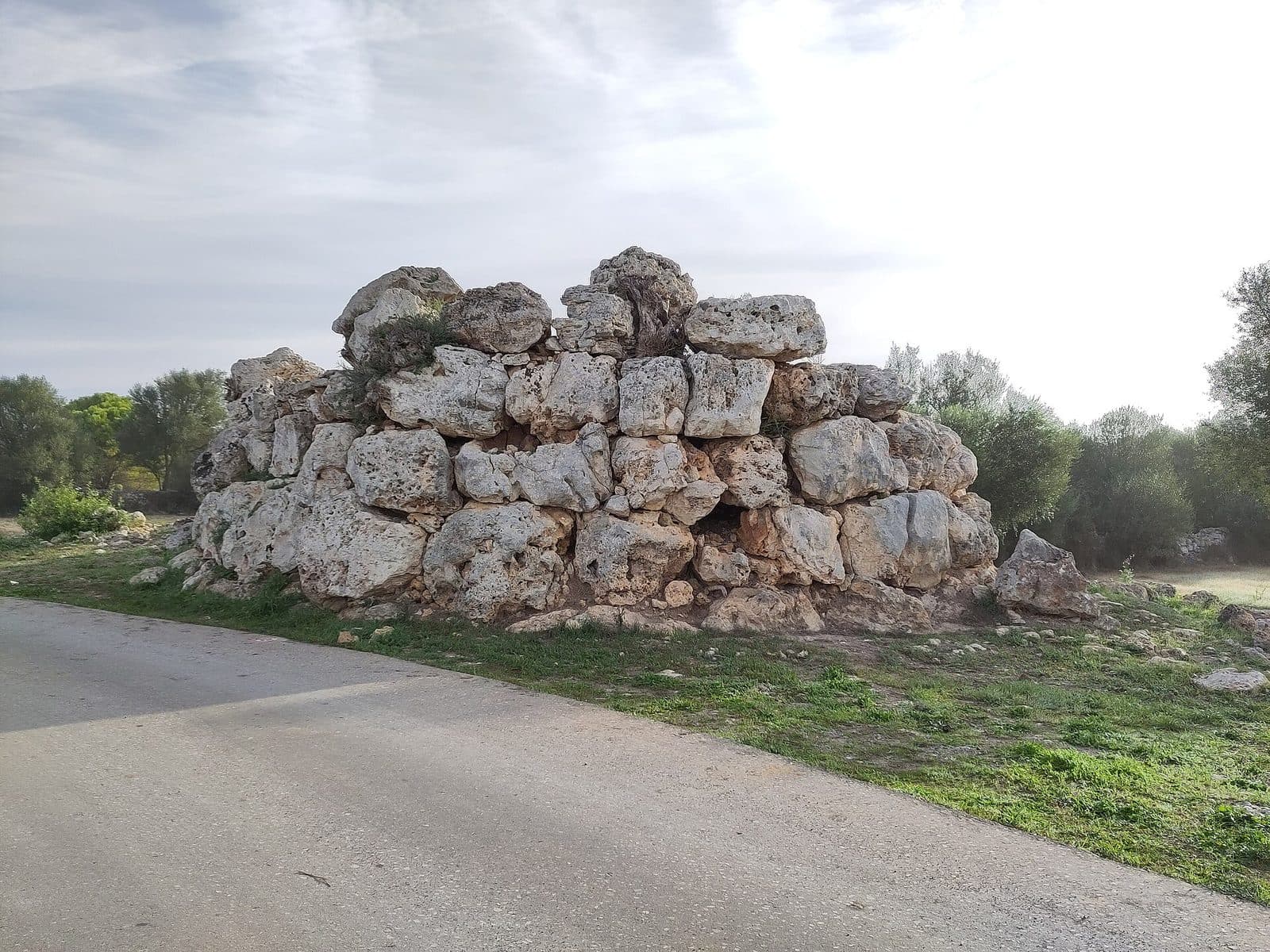
Among the paths and fields of Mallorca’s central interior, the Talaiot near Llubí recalls a time from which neither documents nor inscriptions have survived. Its language consists of large stones: stacked, wedged against one another and assembled without mortar into a massive structure. Those who engage with it will discover not a decorative monument, but one of the characteristic forms of architecture from the Balearic Islands’ prehistory.
The appeal of the site lies precisely in its concentration. Only up close does the organisational and craftsmanship involved in such a structure become clear. Every block had to be selected, moved and positioned so that its weight contributed to the stability of the whole.
The Talaiot is particularly rewarding for travellers who want to discover Mallorca beyond beaches, manor houses and medieval churches. Families can also use the structure as an accessible introduction to prehistory: dry-stone construction, massive wall thicknesses and its unexplained function can all be illustrated directly through the stonework.
The visit becomes more rewarding when it is not treated as a quick photo stop. A slow walk around the monument, alternating between the overall view and close observation, and considering how people built such a tower without modern machinery turn the initially silent walls into a surprisingly vivid historical document.
History and significance
When the Talaiot was built, Mallorca was home to communities that expressed their ways of settlement and economic life through monumental stone structures. The period given in the sources for the construction of the Talaiots dates back roughly 3,000 to 2,500 years. The structures became so defining that they gave an entire era and its inhabitants the name commonly used today: the Talaiotic culture and the Talaiotic people.
The name Talaiot
The Catalan word talaiot is related to talaia, meaning a watchtower or observation tower. The name therefore initially describes the tower-like impression that these massive structures made on later observers. However, it should not be taken as proof that every Talaiot was actually a watchtower. The term arose from the popular perception of the ruins, not from any surviving explanation left by their builders.
Such monuments were not rare, isolated features in the landscapes of Mallorca and Menorca. Hundreds of Talaiots are distributed across both islands. Their prevalence shows that building large stone towers must have held significance for the communities of the time that extended far beyond practical use. A Talaiot required labour, experience and collective action; its construction alone made social organisation visible.
A communal building project
The precise purpose of the Talaiot near Llubí cannot be determined with complete certainty. Several functions are also discussed for this architectural form in general. They may have served as communal spaces where food was processed or distributed within a group. Gatherings of smaller communities are another possibility. Other interpretations emphasise protection, defence or control of the surrounding territory.
These possibilities are not necessarily mutually exclusive. This is precisely why caution is important: a tower-like silhouette alone does not make a fortress, and a chamber proves neither ritual activity nor the storage of supplies. Archaeological interpretation begins here with the structure itself, but it does not end with a single convenient explanation.
A monument without a written voice
The Talaiot belongs to a historical period that is understood in Mallorca primarily through material traces. Stones, walls, entrances, interiors and the location of a structure take the place of the written accounts familiar from later centuries. This makes the visit more demanding, but also more intriguing: much remains open to interpretation, while the technical achievement is immediately visible.
Today, the structure is no longer an observation tower or an inhabited building, but an archaeological monument. Its value lies not only in its age. It preserves a construction method that is particularly characteristic of Mallorca and Menorca and brings the prehistoric history of the island’s interior vividly to life.
What to see
The first impression is defined by weight. A Talaiot does not make an impact through decorative façades or finely worked ornamentation, but through mass, layering and the visible tension between individual stone blocks. The walls are the true attraction. Only through slow observation does it become clear that the structure is by no means an unordered heap of stones.
The megalithic wall
Talaiots were built using cyclopean dry-stone construction. Large stones were stacked without binding mortar. Stability comes from the selection of the blocks, their position, their own weight and the careful filling of gaps.
Up close, it is worth following the joints. Some blocks bear weight across broad surfaces, while others act like wedges that close gaps and prevent movement. The irregular shapes in particular demonstrate the skill of the builders: they did not work with standardised ashlar blocks, but had to find a suitable position for every stone. What appears rough at first proves to be a carefully considered construction.
The wall should not be climbed. Loose sections and inconspicuous filling stones are not meaningless remnants, but parts of the historic structure. A stone that is dislodged or shifted can cause more damage than its size might suggest.
The tower-like structure
Typical Talaiots appear round or angular and often have a truncated-cone silhouette that narrows towards the top. Such monuments generally reach heights of between 3 and 10 metres. When viewing the Talaiot near Llubí, the course of the surviving masonry is therefore more important than any supposed original summit.
A good first circuit should be made from a slight distance. From this perspective, the basic shape, inclination and relationship between height and wall thickness are easier to read. This can then be followed by a closer view. Alternating between the two is important, because from close range the outline and volume disappear behind individual blocks, while from farther away the construction technique becomes difficult to discern.
The tower-like form explains why later generations associated these monuments with observation and guarding. Nevertheless, the external appearance should not be interpreted too hastily as a description of its function. Solidity could equally have expressed permanence, protection or the importance of a communal place.
Chamber and entrance
Many Talaiots on Mallorca have a ground-level entrance and a central chamber. Whether and to what extent these features can be fully identified at the monument near Llubí depends on its state of preservation and the accessible area. During a circuit, it is therefore advisable to look specifically for interruptions in the wall, straight-set stone edges and a possible transition between the outer wall and the interior, without crossing barriers or climbing over unstable sections.
An interior space changes the understanding of the entire structure. The mighty outer wall then no longer appears as a solid block, but as a shell surrounding a deliberately created space.
The setting in the landscape
Talaiots were not perceived solely as isolated pieces of architecture. Their position may have taken account of lines of sight, routes, working land or neighbouring communities. At the Talaiot near Llubí, it is therefore worth looking away from the masonry as well: which parts of the surrounding area are visible, from which direction is the structure most prominent, and how does its silhouette change as you walk around it?
These questions are no substitute for archaeological investigation. They do, however, illustrate why the choice of location is an important part of interpretation. For its builders, the Talaiot was not simply an interior space made of stone. It was also a structure visible from afar and therefore a prominent marker in the landscape of the time.
Visiting the Talaiot
Approaching a Talaiot differs from visiting a museum. The site reveals itself through observation. It is best to begin with a complete circuit of the monument before examining individual stones, joints or possible entrances more closely.
Start with the overall shape
Standing several steps back helps you take in the structure as a whole. Your attention should not focus only on the highest surviving point. The inclination of the outer wall, its transition to the ground and changes in the course of the masonry are also informative. A straighter edge may belong to an entrance or a later alteration.
The same sequence is useful for photography. An overall view records the shape and position in the landscape. Close-ups can then show the block sizes, joints and dry-stone construction. Anyone who photographs only individual stones can easily lose the sense of scale; anyone who shoots only from a distance will miss the structural details.
Then examine the masonry
On the next circuit, the hands of the builders come closer in the imagination. Which stones form the outer shell? Where were smaller pieces used as wedges? Which blocks are visibly bearing weight? This makes the walk slower, but more rewarding. The monument changes from a ruin into a sequence of deliberate architectural decisions.
Comparing the different sides is helpful. Depending on the viewing direction, light and shadow make the joints stand out with varying clarity. A wall that appears solid from one position may reveal its layers from another. This does not mean that a particular time of day is essential; rather, it is worth changing your position several times.
How long to allow and how to structure the visit
It is not useful to specify a fixed duration for visiting the Talaiot. As a focused stop, the monument can be explored relatively compactly. Those who want to study the construction, outline and relationship with the landscape in detail, or talk to children about how the large stones were transported, will stay correspondingly longer.
It is advisable to check current opening times and admission details before travelling. Access to small archaeological sites can change because of conservation work, safety measures or local regulations. The visit should also not depend on every part of the structure being accessible: the external form and masonry technique already tell an essential part of its story.
Protecting the historic fabric
The greatest temptation is also the most damaging: large stones look like natural steps. But climbing historic walls puts pressure on loose blocks, damages joints and increases the risk of accidents. Climbing is unnecessary for a good view in any case. Changing perspective at ground level reveals more of the construction than standing on the wall ever could.
Anyone planning a visit with children can turn this into a small observation exercise: look for the largest visible block, compare different stone shapes or consider why small filling stones were important for stability. This keeps the monument engaging without turning the archaeological fabric into playground equipment.
Getting there and parking
The stated road distances and driving times refer to Llubí, not to the final section leading directly to the Talaiot. This is important for planning because archaeological monuments in the island’s interior are often located away from the major through routes, and the final turn-offs can be much less conspicuous than the main road.
From Palma Airport
The road distance from Palma Airport to Llubí is 39 kilometres. The journey takes around 40 minutes and follows the Ma-3011. This time estimate ends in Llubí; additional time should be allowed to find the way from there to the Talaiot. On the final section, local signs and the exact map location are more helpful than entering only the general place name.
The route leads from the metropolitan surroundings of Palma into the quieter island interior. Shortly before reaching the destination, it is advisable to adjust your speed to local road conditions.
From central Palma
The road distance from central Palma to Llubí is 44 kilometres. The journey takes around 45 minutes and follows the Ma-13, then the Ma-3240. Here too, the distance and driving time apply expressly only as far as Llubí. The final section to the archaeological monument is additional and should be planned using the site’s current location.
The Ma-13 initially provides the fast part of the journey. After turning onto the Ma-3240, the character of the route changes as the road approaches smaller settlements and Mallorca’s agricultural interior. Careful navigation is particularly useful at the final junctions, avoiding the need to turn around unexpectedly on narrow roads.
By bus and on foot
The Llubí 1 and Llubí 2 bus stops are located in Llubí. They are suitable starting points in the village, but the exact route from there to the Talaiot should be checked in advance using an up-to-date map and the current timetable. The bus journey to Llubí is not the only consideration; it is also important to confirm whether the final section follows a suitable walking route.
Anyone travelling without a car should allow sufficient time for the return journey. Small archaeological sites generally do not have their own transport hub. In return, the trip can easily be combined with time in Llubí rather than treating the village merely as a transfer point.
Bus lines to Talaiot at a glance
| Line | Route | Departures/day | First | Last |
|---|---|---|---|---|
| 316 | Son Serra - Inca | 66 | 06:20 | 22:20 |
From the official GTFS feeds (TIB/SFM), no real-time data. The figures cover all stops in the town; weekend and holiday services differ — check with the operator before travelling.
Getting there by bus
Llubí 2 (30002) · 0.9 km as the crow flies
- 316Son Serra - Inca · Daily
Llubí 1 (30001) · 0.9 km as the crow flies
- 316Son Serra - Inca · Daily
Timetable data: official GTFS feeds (TIB/EMT), no real-time — check with the operator before travelling.
Nearby
Llubí provides a fitting setting for the visit. The village lies in the island’s interior, in the rural Pla de Mallorca. Agricultural land, smaller roads and traditional stone buildings shape the surroundings more strongly than the tourist infrastructure of the coastal resorts. In this setting, it becomes clear why prehistoric monuments in Mallorca can easily be overlooked: they do not always stand within enclosed archaeological parks, but form part of a cultural landscape used over long periods of time.
Llubí
A walk through Llubí offers a deliberate contrast with the Talaiot. In the village, more recent architectural history meets daily life, while the prehistoric monument comes from an era without written records. Old natural-stone façades should not be equated with Talaiotic masonry. Instead, the comparison sharpens the eye for different techniques: more regular house walls here, monumental dry-stone architecture there.
A break in the village is particularly worthwhile when arriving by bus or bicycle. It also prevents the Talaiot from being perceived merely as an isolated point on a navigation map. The monument belongs to the history of a landscape that is still characterised by paths, fields and smaller settlements.
The Pla de Mallorca
The flatter island interior is generally well suited to a route that places landscape and archaeology at the centre of the experience. When walking or cycling, however, the route should remain on public and suitable paths. Not every farm track is freely accessible, and the proximity of a historic stone tower does not override private property boundaries.
Anyone familiar with other prehistoric sites in Mallorca can also place the Talaiot near Llubí in a broader context. Some Talaiots belonged to extensive settlements, while others appear as individual monuments. Differences in floor plan, preservation and location show how varied this architectural form was. For the same day, it is enough to select any additional archaeological sites carefully; several rapid stops in succession can easily cause their characteristic details to blur together.
An excursion at a different pace
Combining Llubí and the Talaiot suits travellers who deliberately prefer a slower pace. This is less about ticking off a large number of sights than learning to read a past with few signs or labels. The village provides the modern reference point, the Talaiot the prehistoric one. Between them lies the landscape in which both developed.
It is precisely this contrast that gives the excursion its distinctive character. A short walk through the village, a quiet approach to the monument and close observation of the masonry together create a more complete picture than a single photograph taken through a car window. For travelling onwards to other parts of the island, Llubí’s location in the centre of Mallorca also provides a practical starting point.