
convent dels Mínims in Sineu – Monastery, Church and Baroque Cloister
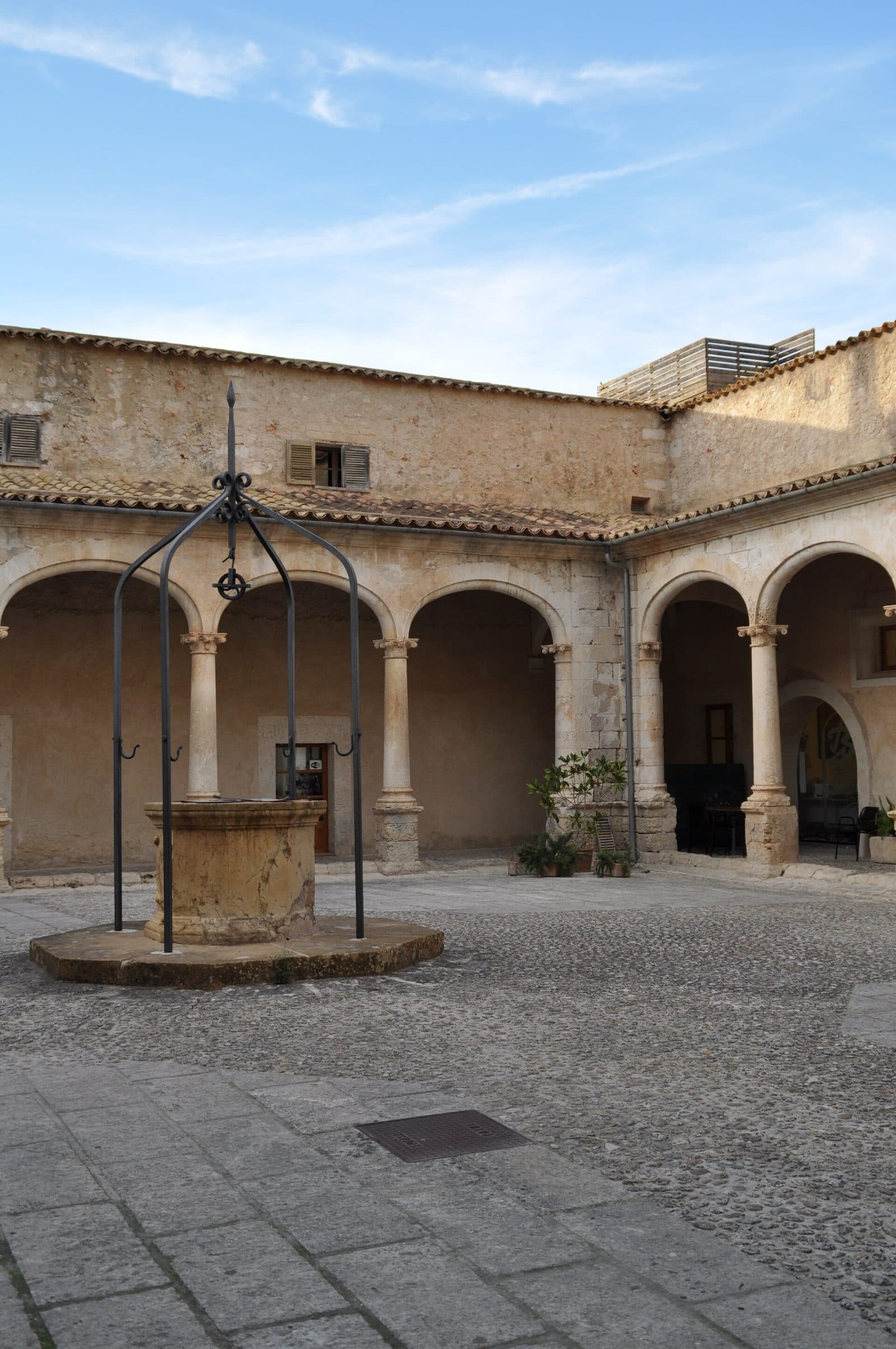

In the heart of Sineu’s historic center, a remarkable piece of monastic history lies hidden behind what is now an entirely secular function: convent dels Mínims has long served as the town hall, yet its Baroque cloister, former monastic enclosure and adjoining church still recall the friars who lived here for generations. This very transition from secluded religious house to municipal center makes the building especially compelling.
The strongest impression awaits inside the complex. Arcades surround a slightly irregular courtyard, with a cistern at its center, while symbols that are easy to overlook appear between the arches: floral ornaments, a miter and a star. A closer look reveals that the cloister was not built in a single phase but bears traces of different periods of construction.
convent dels Mínims is particularly worthwhile for visitors who want to discover more of Sineu than its market. Architecture enthusiasts will find a vivid example of a Baroque monastic courtyard, while history lovers can trace the connection between religious life, confiscation and municipal use. For families, the courtyard can serve as a short discovery stop on a walk through town; however, visitors should not expect a conventional monastery museum with fully accessible cells and long exhibition halls.
Its location is another reason to visit: the building does not stand apart in the countryside but forms part of the historic town center. It can therefore be easily combined with Sineu’s streets, squares and other historic buildings. The character of the former convent is particularly evident on quieter weekdays rather than during the busy weekly market.
History and Significance
The Founding in 1667
When the establishment in Sineu was approved, the Minims had already been living on Mallorca since 1582. After first settling in Portopí, they founded additional houses in Palma and outside the island capital. The friar Miquel Cantallops and Margalida Font de Roqueta played decisive roles in Sineu: she supported the project and provided the young convent with its first house.
The convent was founded in 1667. It was dedicated to the Virgin Mary and the Most Holy Name of Jesus, while the church, consecrated later that same year, was dedicated to Saint Francis of Paola. From the outset, the site was therefore more than simple accommodation: the church and convent buildings formed the religious living environment of a community whose daily routine was shaped by prayer, communal life and the rules of the order. The foundress’s family continued to support the house until the convent was dissolved.
From the First House to the Monastery Complex
The complex took on its present appearance gradually. A major period of construction extended from 1688 to 1704. An extensive redesign introduced new features in the early 18th century, including the cloister. The arcades now regarded as the architectural centerpiece therefore do not belong to the earliest foundation phase but to a later consolidation of the monastery.
The church is also the result of a long development. Most of its later construction work dates from 1793 to 1812. The complex is therefore not a completely uniform building created within a single decade. Instead, the convent wings, cloister and church tell a story of extensions, changing needs and a community that shaped its built surroundings over a long period.
The Dissolution of the Convent
Monastic life ended in 1835 when the state confiscated church property during the disentailment process. The Minims had to leave the house, and the rooms were assigned secular functions. At times, part of the former convent was used by the Guardia Civil, among others. The church later returned to religious use, while the remaining monastery areas followed a different path.
This turning point is still reflected in the site’s function today: the municipal administration now works where the enclosure and monastic administration once stood. As a result, the building did not become an isolated monument but remained part of everyday public life in Sineu. The town hall has been located here since 1877.
Restoration and Its Role Today
The former convent rooms were restored between 2009 and 2010 and now belong to the municipality. The historic building thus continues to serve a practical purpose without having completely lost its monastic structure. Its municipal use also explains why visitors should not expect a monastery arranged entirely as a museum: parts of the building are working spaces for an active administration.
This is precisely where its cultural and historical significance lies. convent dels Mínims preserves more than Baroque forms; it makes several centuries of local history visible in one place. A religious foundation made possible by private patrons became a public building after secularization. The cloister remained the unifying center—once for the community of friars and today as the historic heart of the town hall.
What to See
The Baroque Cloister
The cloister is the part of convent dels Mínims that most rewards close inspection. Its ground plan is almost square but also slightly trapezoidal. Rounded arches open the surrounding galleries onto the courtyard. Almost every side has a sequence of six arches; one side has only five. Visitors who slowly walk all the way around the courtyard can observe this differing arrangement for themselves. The repetition of the arcades creates a sense of calm, yet it is not entirely uniform. This is precisely what makes the architecture more interesting than a facade viewed only from the front.
The cloister is classified as Baroque. Its impact, however, comes less from lavish splendor than from rhythm, proportion and the sequence of pillars, arches and shaded areas.
The Cistern in the Courtyard
A cistern stands at the center of the cloister. Its position also emphasizes the middle of the slightly irregular courtyard. From the arcades, sightlines repeatedly lead back to this central point.
For visitors, the cistern provides a useful point of orientation. Rather than seeing the cloister merely as an attractive backdrop, its spatial system can be understood from here: the open courtyard inside, the sheltered walkway around it and the former convent rooms beyond. This makes it clear why the cloister was the organizational heart of the complex.
Miter, Star and Floral Ornaments
Decorative symbols appear among the architectural forms. They include a miter and a star associated with Bishop Miquel Estela, as well as floral motifs. These details are small enough to disappear during a quick walk-through, yet they are important for understanding the courtyard: the arcades were not merely structural elements but also carriers of a deliberately chosen visual language.
The decoration is best appreciated by examining each side in turn. The motifs vary instead of repeating a single ornament schematically. The appeal lies not in monumental sculptures but in symbols that become recognizable only at close range. Visitors who take just one souvenir photo in the courtyard before moving on can easily miss the very details that distinguish the cloister from an ordinary arcaded courtyard.
The Upper Floor
Above the lower walkway, the architecture continues in a more recent construction phase. Twelve arches were added to the upper section on one side. They date from a later period than the arcades on the lower floor and make the building’s development immediately visible. The courtyard therefore has not only a horizontal structure but also a historical layering that rises upward.
These upper openings alter the proportions of the cloister: the arches below appear sturdier and closer to the viewer, while the sequence above is more finely divided. Looking up from the courtyard reveals that, despite its cohesive overall appearance, the complex arose through several alterations and extensions. In this way, the architecture almost explains its history by itself.
The Barcella of Sineu
An extraordinary object is preserved inside: the Barcella of Sineu. This official grain measure dates from the 12th century and is made of bronze. It is conical in shape and decorated with the coats of arms of Sineu and the Kingdom of Mallorca. The object connects the former monastery with the history of the market and agriculture in the island’s interior.
A Barcella was not a decorative vessel but a binding standard measure for grain. In a region whose economy was closely linked to farming and trade, such a reference measure created reliability. Its preservation in today’s town hall therefore suits the building’s municipal history: the object represents order, oversight and public trust in a shared standard.
Whether the Barcella is accessible during a particular visit depends on how the interior rooms are being used. It should therefore not be assumed to be an exhibit that is freely accessible at all times. Anyone wishing to see it should inquire in advance about current access arrangements.
The Church of Sant Francesc de Paula
The monastery complex includes the church dedicated to Saint Francis of Paola. Its history reaches back to the foundation, but most of the later construction work was completed between 1793 and 1812. Its present character is therefore considerably more recent than that of the earliest convent buildings and the Baroque cloister.
After the monastery was dissolved, the church later returned to religious use. It should therefore not simply be regarded as another wing of the town hall. Within the ensemble, it retains its religious purpose, while the former convent rooms serve municipal functions. This division is essential to understanding the site: today, convent dels Mínims is simultaneously a historic monastery ensemble, a church and the seat of the municipal administration.
Visiting convent dels Mínims
Arriving at Today’s Town Hall
The first important thing to understand before visiting is that the former monastery is not a self-contained museum. Sineu’s municipal administration works in the convent rooms. This keeps the building alive, but access to individual areas may depend on municipal operations. The cloister is the natural focal point of a visit; administrative offices and other interior rooms are not automatically part of an unrestricted tour.
Current opening hours and a confirmed admission charge have not been recorded. Because access may change due to official business, events or other uses, checking immediately before a visit is recommended. This is particularly important if you wish to see not only the cloister but also the Barcella or other interior areas.
Taking Time to Read the Cloister
A fleeting glance through an entrance is not enough for this courtyard. It is better to complete a full circuit along the arcades. First, the irregular ground plan becomes apparent, followed by the differing number of arches. From the center beside the cistern, the relationship between the lower walkway and the more recent upper arcades can then be understood.
The small ornaments deserve a separate inspection. The miter, star and floral motifs are not dominant focal points; they emerge only when each arch is examined individually. This gives the visit a pleasing progression: first the overall impression of the quiet courtyard, then its structural order and finally its details.
Market Day or a Quiet Weekday
Sineu’s weekly market takes place on Wednesdays and brings considerably more activity to the town. Visitors who wish to combine the monastery with market stalls and a lively town center can deliberately choose this day. For a quieter experience of the cloister and a more relaxed walk through the streets, another weekday is preferable.
Its use as a town hall makes it impossible to determine a universally ideal time of day. Choosing the right day and checking access in advance are more important than arriving early or late. Outside Wednesday, the building can generally be experienced more easily as part of a peaceful historical walk through Sineu.
How Much Time Should You Allow?
convent dels Mínims is more of a concentrated attraction than a large museum. Visitors who only wish to see the cloister can include it as a short stop on a walk through town. Architecture enthusiasts will need more time to compare the sequence of arcades, upper floor, cistern and ornaments. Additional time is useful if accessible interior rooms or the Barcella can be included.
The greatest mistake would be to extend the stay artificially while overlooking the site’s true strength. Its appeal lies in a few clearly readable elements and its historical change of use. Together with the church, streets and Sineu’s other monuments, however, it still makes for a rewarding excursion.
Getting There and Parking
From Palma Airport
The stated routes and driving times lead to Sineu, not directly to the entrance of convent dels Mínims. The road distance from Palma Airport is 35 kilometers. The drive takes around 35 minutes and follows the Ma-3011 toward the center of the island. Within the town, the final section leads into the historic center, where the former convent stands on Carrer de Sant Francesc.
After leaving the airport area, the route soon enters the flatter interior of the island. In Sineu itself, following directions toward the center becomes more important than the main road. Because the building now houses the town hall, it is easier to identify locally as a public building than as a secluded monastery.
From Central Palma
The road distance from central Palma to Sineu is 42 kilometers. The journey takes around 43 minutes and follows the Ma-13, then the Ma-3240. These details also end in Sineu. For the final section, follow local directions into the historic center and continue toward Carrer de Sant Francesc.
Anyone arriving by car should bear in mind that the immediate surroundings consist of historic town streets. For the actual tour, it is more pleasant to park the vehicle and walk the final streets. This also makes it easier to appreciate the monastery’s position within old Sineu.
By Public Transport
Several stops are located in the town, including Sineu Estació and Estació Sineu. From this area, the journey to convent dels Mínims continues on foot through town. The attraction is centrally located and can therefore be easily included in a walking route without requiring transport again for every stop.
The specific connection should be checked for the day of travel. The key is to select Sineu as the destination and then head toward the historic center. The final section does not lead to a complex outside the town but to today’s town hall in the center.
Bus lines to convent dels Mínims at a glance
| Line | Route | Departures/day | First | Last |
|---|---|---|---|---|
| 432 | Sineu - Algaida | 142 | 06:20 | 22:20 |
| T3 | Palma - Manacor | 77 | 06:37 | 23:11 |
| 441 | Ariany - Maria - Sineu | 37 | 06:25 | 22:42 |
| 442 | Sant Joan | 32 | 07:00 | 21:57 |
From the official GTFS feeds (TIB/SFM), no real-time data. The figures cover all stops in the town; weekend and holiday services differ — check with the operator before travelling.
Getting there by bus
Sineu Estació (220) · 0.3 km as the crow flies
- T3Palma - Manacor · Daily
Estació Sineu (60005) · 0.3 km as the crow flies
- 432Sineu - Algaida · Daily
- 441Ariany - Maria - Sineu · Daily
- 442Sant Joan · Daily
IES Sineu 2 (60007) · 0.8 km as the crow flies
- 432Sineu - Algaida · Daily
IES Sineu 1 (60006) · 0.8 km as the crow flies
- 432Sineu - Algaida · Daily
Timetable data: official GTFS feeds (TIB/EMT), no real-time — check with the operator before travelling.
Nearby Attractions
Sineu’s Historic Center
The former monastery is best understood in the context of Sineu itself. The town lies on the plains of the Pla de Mallorca, an agricultural landscape characterized by fields, dry-stone walls and traditional windmills. Narrow streets, older houses and significant public buildings cluster in the center. convent dels Mínims forms part of this setting and was never merely an isolated religious house on the outskirts.
Sineu’s history reaches back far beyond the monastery’s foundation. Under Jaume II., the town held particular importance as a royal town. This earlier past explains why several historical layers meet in a comparatively small center. The monastery represents the early modern and Baroque periods, while other buildings recall Sineu’s medieval role.
Market and Town Life
Wednesday changes the atmosphere of the town. The traditional weekly market attracts visitors, the streets become livelier and a walk takes on a much busier character. In this context, the Barcella in the former convent gains additional significance: the historic grain measure directly evokes trade, agriculture and the need for binding standards.
Visitors who combine the market and monastery experience Sineu as an active center of the island’s interior. Those more interested in architecture should choose another weekday. The forms of the cloister and the structure of the old streets then stand out more clearly, without the market setting the pace of the visit.
Other Places to Visit in Town
Nearby additions include the parish church of Santa Maria, the former royal palace, the monument to Sant Marc, and the historic crosses and windmills around the town. They do not need to be treated as an extensive sightseeing checklist. Even a walk between the main squares shows how Sineu’s religious, royal, agricultural and municipal histories have remained visible alongside one another.
A stop at a traditional Celler also suits the character of the excursion. convent dels Mínims provides a calm architectural counterpoint to the market and busier streets. Visitors who see it not as an isolated photo stop but as part of a walking route will more readily understand why this particular former monastery could become the town hall.
Local insider tips
Count the Arches
Almost every side of the cloister has six arches, but one has only five. A full circuit of the courtyard reveals the slightly trapezoidal layout and this small irregularity more clearly than a photo taken from the entrance.
Do Not Miss the Ornaments
Floral motifs and the miter and star of Bishop Miquel Estela appear among the arcades. These symbols are understated and easy to miss during a quick walk-through—so examine each arch individually.
Ask About the Barcella
The bronze Barcella of Sineu is preserved inside the building, a conical official grain measure bearing the coats of arms of Sineu and the Kingdom of Mallorca. Access may depend on how the interior rooms are being used.
Choose Wednesday Deliberately
On Wednesdays, the weekly market shapes Sineu and brings more activity to the town center. It is ideal for a market atmosphere; visitors who prefer a quieter view of the cloister and streets should plan their visit for another weekday.
View from the Cistern
The cloister is easiest to understand as a whole from the cistern in the center of the courtyard: the slightly irregular ground plan, the arcades of the lower walkway and the more recent arches above.