
La Nativitat in Costitx: Mallorca’s Quiet Village Church
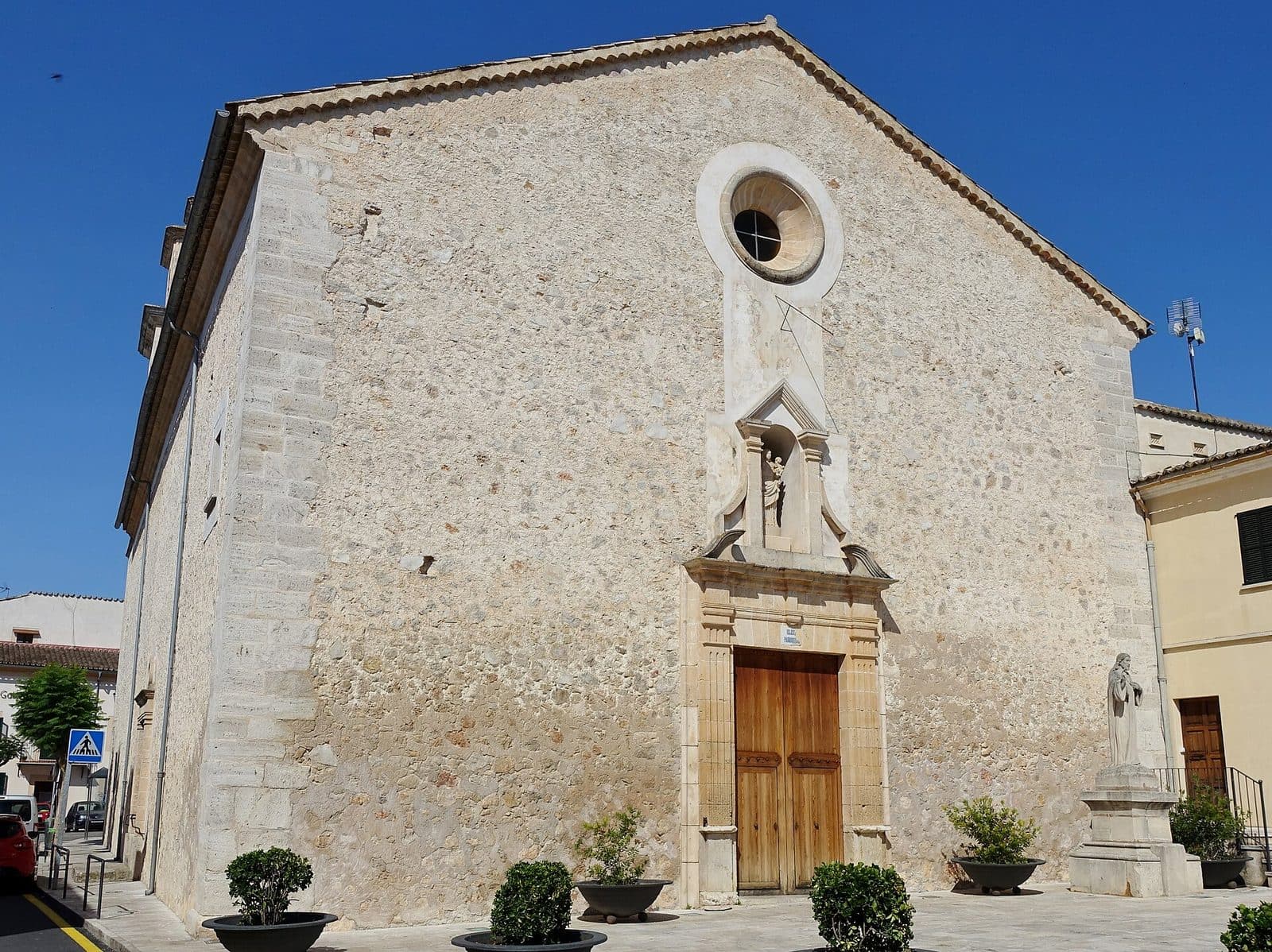

In the heart of little Costitx, la Nativitat tells an unusually long story of faith, growth, and village independence. The parish church is not a monumental visitor attraction, but a place where the development of the community over the centuries can be traced.
Its historical depth is particularly remarkable: a place of worship was established here shortly after the Christian conquest of Mallorca. The present church, however, is considerably younger. It was built when Costitx had enough residents and landowners to gain ecclesiastical independence from Sencelles.
A visit is especially worthwhile for travelers who want to experience Mallorca’s central region as more than just a landscape. The main highlights are the historic altar and the Baroque paintings of the Virgin Mary in the parish house behind the church. Together, they give la Nativitat a more distinctive identity than its understated village setting might initially suggest.
History and significance
The first place of worship
The story begins in 1236. Arnau de Santacília, a cleric from Catalonia, had a church built in Costitx that year. This early place of worship was among the first churches in Mallorca dedicated to the Virgin Mary. Its ecclesiastical independence was short-lived, however: the church was taken out of service as early as 1242 because the territorial organization of the time designated the parish church in neighboring Sencelles as the responsible authority.
Religious life did not disappear from Costitx, but the village remained dependent on an outside parish for a long time. This background explains why la Nativitat later represented far more than merely a new church building. For the growing village community, having its own parish was also an expression of greater self-determination.
An independent parish
In 1695, Costitx became an independent parish. The number of landowners and members of the community had grown, making a larger place of worship necessary. Work on the present church began a year later. Financial difficulties interrupted construction several times, so la Nativitat was not built in a single, continuous phase but according to the funds available at the time.
This building history makes the church a stone testament to local perseverance. What now seems a natural focal point of Costitx had to be developed and financed by the community over a long period. The church therefore also represents the phase in which the village gradually freed itself from its dependence on Sencelles.
Completion and furnishings
Construction of the church was completed in 1772. Shortly afterward, the interior received its most important historic feature: Bartomeu Picornell, a sculptor from Costitx, completed the altar in 1779. Several decades separate the start of construction from this artistic embellishment—an indication of how long the project occupied the village community.
La Nativitat remains the parish church of Costitx today. Its significance therefore lies not only in its age. It connects the early veneration of the Virgin Mary in Mallorca with the history of a small rural community that sought to create an ecclesiastical center of its own.
What to see
The present parish church
When viewing la Nativitat, it helps to make an important distinction: the present building is not the church founded in 1236. It dates from the new construction begun in 1696 after Costitx became an independent parish and completed in 1772. The church therefore primarily documents the village’s development in the early modern period.
Its position within the village is part of the visitor experience. La Nativitat stands in the center of Costitx, where it forms the historical and religious focal point. Instead of an enclosed monastic complex, visitors encounter a parish church directly integrated into the old village center. The building is therefore best appreciated together with the surrounding streets and squares: not as an isolated monument, but as the heart of a small community in the Pla de Mallorca.
The altar by Bartomeu Picornell
Inside the church, attention focuses above all on the altar completed by Bartomeu Picornell in 1779. Picornell was a local sculptor, so the work not only dates from the period in which the present church was created but is also directly connected with Costitx.
The altar marks the conclusion of the long construction and furnishing phase. The interval between the start of construction in 1696, completion of the building in 1772, and Picornell’s work in 1779 reveals how la Nativitat developed step by step. Visitors should therefore not regard this work merely as a decorative backdrop. It is the most visible artistic culmination of a project supported by the community over generations.
The parish house
The parish house stands behind the church. It holds a collection of Baroque paintings of the Virgin Mary. These images extend the Marian dedication of la Nativitat beyond the church interior and are closely connected to the parish church in their subject matter.
This second part is easily overlooked if the tour ends at the church portal. Yet the collection deepens the impression of the site: the veneration of the Virgin Mary, to whom the early place of worship was already dedicated, appears here not only in the church’s name but also in a distinct group of Baroque depictions. Whether the parish house is accessible at the time of a visit should be checked in advance.
Visiting la Nativitat
Start with the church
A well-planned tour begins in front of the parish church, where its central location in little Costitx is easiest to appreciate. Inside, attention then turns to the altar by Bartomeu Picornell. Its date makes it a particularly vivid historical reference point: it was created shortly after construction of the church was completed and therefore forms part of la Nativitat’s historic completion.
The visit is focused rather than extensive. There is no documented large museum route or succession of numerous exhibition rooms. What matters is the building as a parish church, its history, and the surviving religious art. The time required therefore depends mainly on whether you view only the church or can also access the parish house.
As an active religious site, la Nativitat requires visitors to show consideration for services and other religious occasions. A quiet tour cannot reliably be planned around tourist peak times because no fixed visiting windows are recorded. Before traveling, it is therefore advisable to check current access with a local or church authority.
Continue to the parish house
If access is possible, the visit should continue behind the church. The Baroque paintings of the Virgin Mary kept there are not an arbitrary addition; they reflect the dedication to the Nativity or veneration of Mary. They provide a second perspective on the parish’s identity: the altar represents the completion of the new church, while the collection of paintings reflects Marian devotion maintained over centuries.
No extensive preparation is needed for the tour. It is helpful, however, to remember the few key dates and events: the early foundation of the church, the loss of its parish function, ecclesiastical independence, and the later construction of the new building. Against this background, a quiet village church becomes a readable setting for local history.
Getting there and parking
From Palma Airport
From Palma Airport, the drive to Costitx follows the Ma-3011. The road distance is 32 kilometers, and the journey takes around 34 minutes. These details expressly refer to the route as far as Costitx, not to a parking space directly beside la Nativitat. In the village, the final section follows local streets toward the center, where the parish church stands.
Costitx lies away from the large coastal resorts in Mallorca’s agricultural heartland. After leaving the main roads, the route becomes more local in character; for the final section, following directions to the village center is therefore more helpful than looking for a widely signposted tourist complex. La Nativitat belongs to the village center and is not an outlying monastery or pilgrimage site.
From Palma
The road distance from central Palma to Costitx is 35 kilometers. The drive takes around 42 minutes and follows the Ma-19 before continuing along the Ma-3011. This calculated journey time also ends in Costitx. Additional time should be allowed for reaching the church and finding a regular parking space in the village.
Access through the center of a small Mallorcan village may feel narrower than the preceding route. It makes sense to leave your vehicle only where signs and road markings clearly permit parking, then complete the final section on foot. This also makes it easier to appreciate the church’s position within the village center.
By bus
For travel by public transport, the Costitx 1 and Costitx 2 stops provide the main points of reference. Camí dels Horts and Camí de s’Estepar are also located within the village area. From the relevant stop, the final section leads through Costitx to the centrally located parish church. Because timetables and connections may change, the appropriate service should be checked immediately before the excursion.
Bus lines to la Nativitat at a glance
| Line | Route | Departures/day | First | Last |
|---|---|---|---|---|
| 304 | Inca - Sencelles - Palma | 78 | 06:22 | 22:22 |
From the official GTFS feeds (TIB/SFM), no real-time data. The figures cover all stops in the town; weekend and holiday services differ — check with the operator before travelling.
Getting there by bus
Costitx 1 (17007) · 0.1 km as the crow flies
- 304Inca - Sencelles - Palma · Daily
Costitx 2 (17006) · 0.2 km as the crow flies
- 304Inca - Sencelles - Palma · Daily
Camí dels Horts (17002) · 0.9 km as the crow flies
- 304Inca - Sencelles - Palma · Daily
Camí de s'Estepar (17003) · 1.2 km as the crow flies
- 304Inca - Sencelles - Palma · Daily
Camí de Son Ganxó (17004) · 1.4 km as the crow flies
- 304Inca - Sencelles - Palma · Daily
Timetable data: official GTFS feeds (TIB/EMT), no real-time — check with the operator before travelling.
Nearby attractions
Costitx
La Nativitat is best understood as part of Costitx. The small village is closely connected with agriculture; historic wells, water basins, waterwheels, and windmills recall the use of water and grain. Traditional rural estates also once shaped the economic and social life of the surrounding area.
The village’s compact size is well suited to a slow walk. After visiting the church, a stroll through the adjoining streets is often enough to appreciate the contrast with Mallorca’s larger vacation resorts. There is no packed itinerary here. Instead, la Nativitat, the old village center, and reminders of rural work create a compact portrait of the island’s central region.
Son Corró
The prehistoric site of Son Corró is a particularly suitable addition in terms of subject matter. Three bronze bull heads were discovered there and are regarded as important evidence of the bull cult during the late Talayotic period. The originals are no longer in Costitx, but their discovery made the village known far beyond the municipality’s boundaries.
Together with la Nativitat, the site creates a broad historical arc: Son Corró points to the area’s pre-Christian past, while the parish church represents its religious and communal development since the Middle Ages. The two places should nevertheless be regarded as separate attractions.
Planetarium and observatory
Outside the village center, the Mallorca Planetarium and its observatory occupy an elevated point in the surrounding area. They offer a deliberate contrast to the historic church: in Costitx, religious art and local history can be combined with a visit focused on astronomy and the solar system.
This combination is particularly practical for an excursion into Mallorca’s central region because it reveals two very different sides of the small community. Before combining them, access and visiting arrangements for each site should be checked separately.
The place it belongs to
Costitx in the place guidePractical information for your visit
Access and expectations
No reliable general opening hours or current admission information are recorded for la Nativitat. As it is a parish church rather than a museum that remains open throughout the day, accessibility should be checked before traveling. This applies especially to the parish house containing the Baroque paintings of the Virgin Mary, as viewing them is not automatically included with access to the church.
Visitors should expect a quiet religious site with only a few focal points, but ones that can be placed clearly in their historical context. The value of the visit lies not in a large quantity of exhibits but in the connection between the early place of worship, the independent parish, the later new church, and the furnishings created by Bartomeu Picornell.
Clothing and conduct
As a space still used for religious purposes, the church requires appropriate clothing and respectful behavior. Conversations should be kept quiet, and ongoing services, prayers, or church preparations must not be disturbed. For photographs inside the church or parish house, visitors should look for local guidance or ask permission.
Comfortable everyday footwear is sufficient for walking through Costitx. The visit is not designed as a hike; anyone adding Son Corró or the planetarium outside the village should plan them as separate stops and check their respective conditions independently.
Visiting with children
For children, la Nativitat is best suited as a short stop focused on cultural history. Accessible points of interest include the long construction period, the altar by a local sculptor, and the Baroque paintings of the Virgin Mary. An interactive children’s program or extensive museum presentation should not be expected.
Families may therefore wish to combine the visit with another destination in Costitx. The planetarium provides a scientific counterpoint, while Son Corró introduces the area’s prehistory. Inside the church itself, quiet behavior and consideration for its religious use remain essential.
Local insider tips
Look behind the church
The visit does not necessarily have to end at the church portal: the parish house behind la Nativitat holds a collection of Baroque paintings of the Virgin Mary. It is best to check possible access in advance.
Read the altar through its date
The altar by Bartomeu Picornell was completed in 1779, shortly after construction of the church was finished. It is therefore not merely decoration but the artistic culmination of the long building history.
Combine it with Son Corró
Son Corró complements the church’s history with the pre-Christian past of Costitx. The three famous bronze bull heads from the late Talayotic period were discovered there.
A cosmic contrast
The planetarium and observatory outside the village center offer an unusual second stop: first Baroque religious art in la Nativitat, then astronomy.