
Talaiot de Coma-sema – Mallorca’s Prehistory in Stone
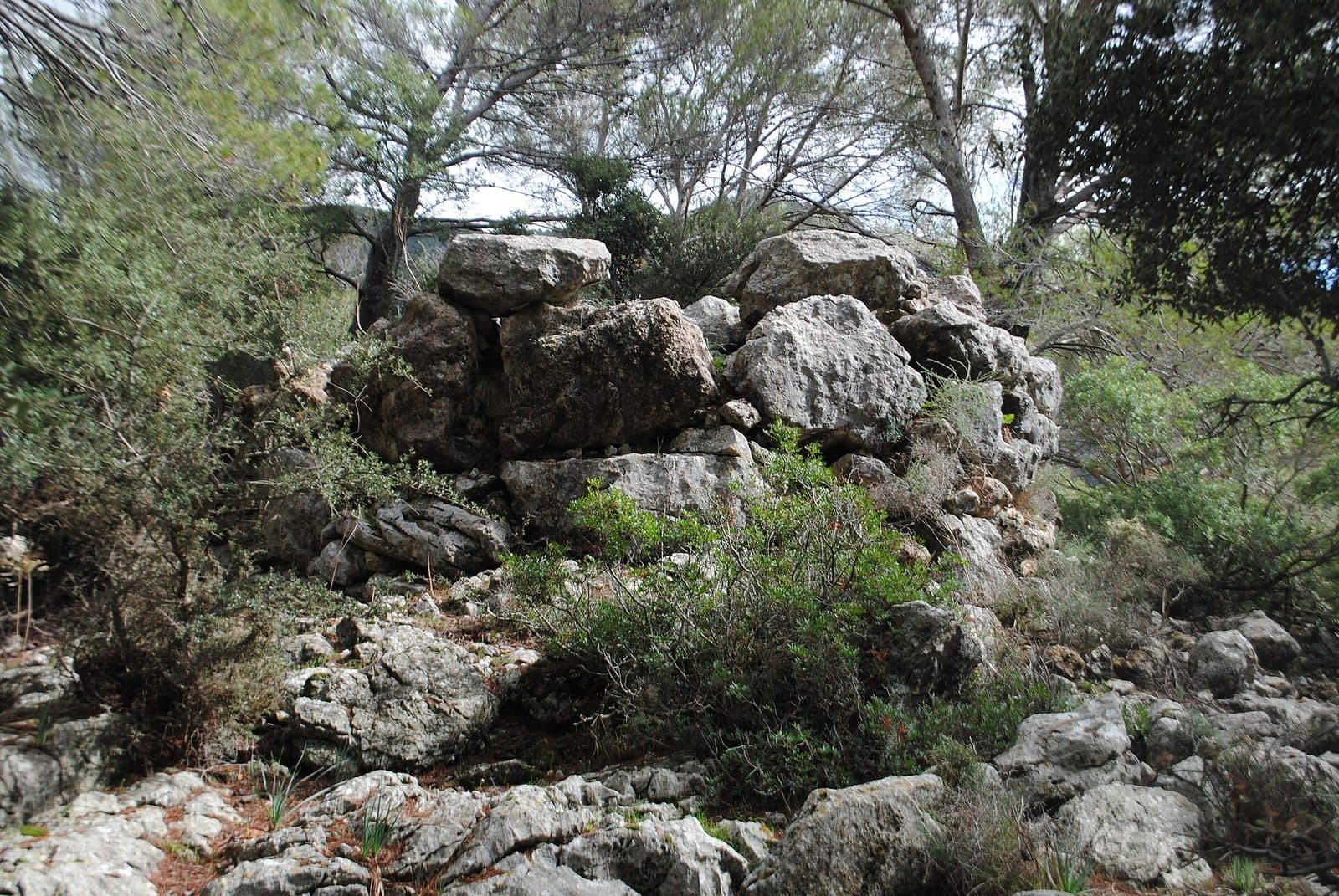

The Talaiot de Coma-sema reaches far beyond the familiar images of natural-stone façades, olive terraces, and mountain villages. This megalithic monument in northwestern Mallorca dates from the Talayotic period and belongs to the prehistoric building culture whose mighty stone towers remain scattered across the island. Anyone interested in archaeology will encounter a tangible remnant of a time without written records.
This very restraint is what makes the site interesting. Its history is examined through the arrangement and mass of the stones, the construction method, and the monument’s position in the landscape. Many questions that arise when viewing it remain scientifically unresolved—not only at Coma-sema, but across this entire category of monument.
A visit is therefore particularly worthwhile for people who enjoy looking closely and do not mistake an archaeological site for a conventional tourist attraction. The destination is a protected cultural monument that is best understood with some prior knowledge of Talayotic culture and enough time for quiet observation. In this way, a seemingly simple stone structure becomes evidence of communal labor.
Careful location checking is essential when planning: the Talaiot is associated with the Fornalutx area in northwestern Mallorca. The stated road distances and driving times lead only as far as Fornalutx and must not be understood as complete navigation to the monument.
History and significance
The Talaiot de Coma-sema is chronologically assigned to the Talayotic period. It is therefore evidence of the prehistoric communities that created the characteristic tower structures on Mallorca and Menorca approximately 3,000 to 2,500 years ago.
The Talayotic period
The name “Talaiot” derives from the Mallorcan Catalan word “talaia,” meaning a watchtower or observation tower. The term arose from the tower-like appearance of the structures; it is not a name handed down by their builders. Hundreds of these monuments are still known on Mallorca. Their distribution shows that the sites were not a rare peripheral phenomenon but formed part of the social and spatial organization of the communities of that time.
The construction of such a structure without modern means of transport, lifting technology, or mortar reveals the immense communal effort involved. Large stone blocks had to be selected, moved, and carefully placed on top of one another. The construction alone required planning, labor, and knowledge shared over an extended period. A Talaiot was therefore more than a randomly piled mound of stones: it was monumental architecture.
A function without a definitive answer
The original purpose of the Talaiots has still not been conclusively established. Because only some of the surviving sites have been systematically investigated by archaeologists, several explanations continue to coexist. Possibilities under discussion include communally used spaces, places for processing and distributing food, meeting points, and a role in defending and controlling the surrounding territory.
For the Talaiot de Coma-sema, none of these individual functions has been proven beyond doubt. For that very reason, the interpretation suggested by its name—that it was purely a watchtower—should not be accepted too hastily as certain. The monument may have combined social, economic, and territorial functions. What now appears to be a single stone structure may once have been a widely understood sign of belonging, organization, or a community’s claim to its surroundings.
From prehistoric monument to protected heritage site
The Talaiot is protected as a Bien de Interés Cultural, meaning a cultural asset of special interest. The specific heritage records give 10 September 1966 as the date of this designation and list the identifier RI-51-0001825. Its protected status emphasizes that these are not merely old stones beside a path, but preserved archaeological remains.
The Talaiot does not provide a continuous chronicle, but it does offer a firm starting point: the site was already part of a landscape used and shaped by people in prehistoric times.
What to see
The first impression comes not from ornamentation or fine stone carving, but from weight. Talaiots were built from large blocks assembled into load-bearing walls without mortar. At the Talaiot de Coma-sema, the masonry itself therefore takes center stage: the irregular surfaces, the closely fitted stones, and the still-visible mass of a structure that required considerable effort.
The megalithic structure
The specific heritage records classify Coma-sema as a megalith. This term describes architecture made from large stones and draws attention to the site’s most important feature. There is no façade here in the later architectural sense. Its outward appearance comes from the layering of the blocks, the relationship between the individual stones and the structure as a whole, and the surviving sections of prehistoric masonry.
When viewing it, it is worth asking not only about the original form. It is equally revealing to consider how the stones bear and transfer loads. Talayotic builders worked without binding mortar; stability came from the selection, position, and weight of the material. Small shifts, gaps, and irregular edges are therefore part of the structure’s appearance, but they should not be mistaken for randomness. The masonry reflects practical construction knowledge that must have been passed down through generations.
Tower form and landscape
Talaiots may have round or square layouts. For Coma-sema, the heritage records consulted provide no reliable detailed description of the floor plan, interior spaces, or original height. A visit should therefore not be based on a predetermined structural plan. What matters are the wall sections that are actually visible and their position in the terrain.
The tower-like appearance gave these monuments their modern name. However, this does not automatically mean that every example served exclusively as an observation post. For numerous Talaiots, archaeologists consider a connection between sightlines, territorial control, and communal use. Coma-sema can be placed within this broader context without attributing an unproven individual function to it.
Details in the masonry
From some distance, a Talaiot can easily appear to be a solid, heavy mass of stone. Viewed more closely, this mass breaks down into numerous decisions: Which broad surface was turned outward? How were gaps closed? Where do larger blocks rest on top of one another, and where were smaller stones placed between them? These observations reveal more about the construction achievement than attempts to interpret every irregularity immediately as a doorway, chamber, or later alteration.
For photography, a slightly angled perspective is usually more informative than a strictly frontal view. It shows not only a wall surface, but also its depth and the transition to other surviving sections. Maintaining a respectful distance remains important, as archaeological masonry is not a viewing platform. Even blocks that appear firmly set can shift under pressure.
What the site reveals
The site demonstrates how archaeology derives knowledge from material traces—and where it must tolerate uncertainty. Anyone standing before the stones therefore sees both a structure and a boundary of knowledge. Its association with the Talayotic period, its megalithic character, and its importance as a protected cultural asset are established. Everything else requires careful investigation. This distinction between observation and interpretation is precisely what makes Coma-sema a good place to discover Mallorca’s prehistory without romantic embellishment.
Visiting the site
A visit is best begun not with a long list of expected rooms, but by orienting yourself within the actual terrain. The Talaiot is an archaeological destination. Attention is focused on the surviving stone structure, its construction, and the question of how the monument may have functioned within the surrounding cultural landscape.
Preparation instead of a fixed route
Before setting out, check the exact location and currently permitted access. The route information leads to Fornalutx and not reliably to the Talaiot. Navigating only by the place name Fornalutx will therefore not reliably lead to the monument.
Viewing from two distances
At the site, begin by looking at the entire structure. From some distance, its volume, position, and tower-like appearance become easier to understand. Only then is it worth examining the masonry more closely. Switching between the overall view and the details prevents the Talaiot from being perceived merely as a collection of individual stones.
There is no useful universal recommendation for the duration of a visit. Someone who simply wants to look at the monument will plan differently from someone who wants to study the masonry techniques, perspectives, and relationship to the landscape. The length of the visit depends on your own archaeological interest. Additional time should be allowed for orientation and the final section of the route.
Quiet observation instead of a visitor program
There is no reliable information about typical peak times. It is therefore not possible to name a supposed “best” time for avoiding crowds with any confidence. It is more practical to avoid visiting under time pressure and to clarify the location in advance. At a place whose appeal lies in close observation, a calm visit is more important than working through numerous stops.
Even without a guide, much can be recognized if you keep the basic questions in mind: How do the blocks support one another? Which side of the structure is particularly well preserved? How does its effect change from different viewpoints? Questions like these turn a short stop into an archaeological observation without reading unsupported stories into the monument.
Getting there
The published route information ends in Fornalutx, not at the Talaiot. From Palma Airport, the route follows the Ma-20 and then the Ma-11. The road distance to Fornalutx is 35 kilometers, and the drive takes around 63 minutes. From central Palma, the route follows the Ma-11, covers 30 road kilometers, and takes around 68 minutes.
As far as Fornalutx
The Ma-11 is the main road connection from the Palma area toward Sóller. From there, the route continues to the mountain village of Fornalutx. The stated driving times cover only this journey to the village. They include neither the location check for Coma-sema nor the final section to the archaeological monument.
This is more than a formal warning: anyone who assumes without checking that the place name is identical to the monument’s exact location risks being directed to the wrong destination. The specific monument location should therefore be used for navigation.
Bus and onward journey
No bus stop is recorded in the immediate vicinity of the Talaiot. A complete journey by public bus therefore cannot be described as a reliable direct connection. Anyone wishing to use public transport must check in advance which accessible place could serve as a starting point and whether the remaining section can be covered along a permitted route.
The lack of a bus stop makes careful planning for the return journey especially important. The route information ends in Fornalutx and not directly at the monument. Only once the destination and return journey have been clarified does a point found on a map become a sensibly planned archaeological excursion.
Nearby places
Fornalutx is worthwhile as a separate destination in northwestern Mallorca. The village lies in the Serra de Tramuntana and is known for its traditional stone architecture, narrow cobbled lanes, and views of the surrounding mountains. Among the houses, it becomes clear how strongly natural stone also shapes Mallorca’s much more recent cultural landscape.
Fornalutx
A walk can take in the Plaça d’Espanya, the church of Sant Joan Baptista, and the historic spring Sa Font des Pla. Gardens and citrus groves surround the village and point to the fertile Sóller valley. This village portion of the day contrasts sharply with the Talaiot: here, streets, fountains, and buildings tell of historically tangible ways of life, while the prehistoric monument leaves many questions unanswered.
Fornalutx is also a starting point for hikes and cycling tours in the Serra de Tramuntana. However, such a combination requires separate route planning. The Talaiot is not described as a stop on a documented circular route from Fornalutx, and the driving information to the village does not replace directions to Coma-sema.
Sóller and Port de Sóller
Sóller is a suitable additional stop in the valley, while Port de Sóller adds the coastal landscape. Both destinations expand an archaeology-focused excursion with local history, cultivated landscapes, and the sea. Anyone combining several stops should allow generous time for the mountain roads and should not treat the Talaiot as a spontaneous detour until the exact access has been clarified.
The place it belongs to
Fornalutx in the place guidePractical information for your visit
The Talaiot de Coma-sema requires careful preparation. Anyone who clarifies the exact position, permitted access, and return journey in advance can focus on what matters at the site: the surviving stone structure and its place within Mallorca’s prehistoric architecture.
Check the location carefully
The most important practical advice is to verify the exact location. The driving information leads only to Fornalutx. For the Talaiot itself, use the archaeological map reference. Similar-sounding place names are no substitute for verified navigation.
Respect access restrictions
A protected cultural asset is not automatically freely accessible at all times. Private tracks, agricultural land, gates, and current notices must be respected. Climbing over walls or bypassing barriers not only jeopardizes access but may also damage archaeological remains. The same applies to climbing on the Talaiot: dry-laid stones may be more fragile than their size suggests.
Set the right expectations
Expect a prehistoric stone monument. A brief overview of Talayotic culture before the visit helps you recognize the masonry as the result of organized communal labor and prevents unanswered questions from being filled too quickly with legends.
The most powerful experience lies in close observation. Large blocks, the absence of mortar, and the still-recognizable structure directly convey what written descriptions can only suggest: several millennia ago, Mallorca’s communities mastered a monumental form of construction whose purpose is still debated. This is precisely why Coma-sema is remarkable—not because it provides every answer, but because the monument preserves the right questions in stone.
Local insider tips
Do not enter only Fornalutx
The driving information leads only to Fornalutx, while the specific heritage records place the Talaiot near Coma-sema in the municipality of Bunyola. Before setting out, check the archaeological destination and permitted access separately.
Start at a distance, then study the details
First view the entire structure from some distance, then study the position of the individual blocks. This makes both the tower-like appearance and the mortarless megalithic construction method easier to understand.
Plan Fornalutx separately
Fornalutx is worthwhile as a separate stop with Plaça d’Espanya, Sant Joan Baptista, Sa Font des Pla, and cobbled lanes. However, the village should not be treated as a reliable starting point for an unchecked walk to the Talaiot.