
talaiot de na Nova near Cala Llombards
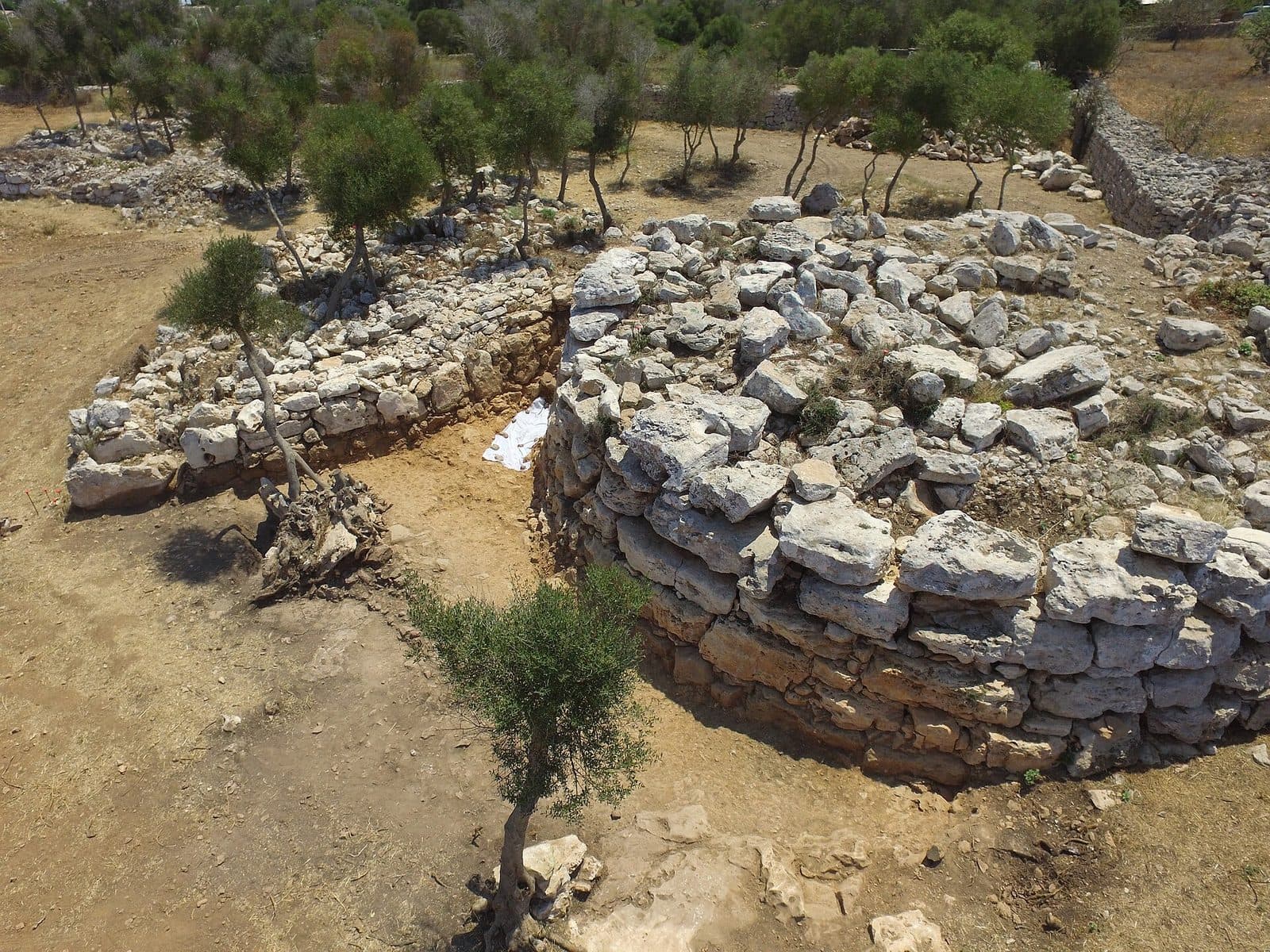

Between the well-known swimming coves of southern Mallorca lies a place that leads into a much older layer of the island’s history: talaiot de na Nova near Cala Llombards belongs to an Iron Age settlement of the Talaiotic culture. At its heart stands a circular tower built from large stone blocks, whose surviving walls still reveal the effort Mallorca’s prehistoric communities invested in such monuments.
Its appeal lies precisely in focusing closely on the original remains: the curve of the outer wall, the different courses of stone, the filled-in interior, and the blocks later incorporated into property walls. Look carefully and you will discover more than an isolated pile of stones: these are traces of a settlement whose visible structures cover an area of approximately 1293 square metres.
A visit is particularly worthwhile for travellers who want to discover Mallorca’s history beyond churches, manor houses, and coastal villages. Even without prior archaeological knowledge, the basic concept of the structure is immediately apparent: a massive circular body dominates the site. At the same time, much remains unresolved. Researchers discuss communal, economic, and defensive roles for talaiots, but no single confirmed function can be assigned to Na Nova either. It is precisely this tension that makes the site interesting: the walls are tangible, heavy, and visible, while the stories that once unfolded inside them must be inferred from excavations, finds, and architectural details. Na Nova therefore requires less time than a large museum, but more attention than a quick photo stop.
History and significance
An Iron Age settlement
Long before roads and holiday homes shaped the landscape around Cala Llombards, communities in southern Mallorca built large stone structures without mortar. Na Nova is classified as a Talaiotic settlement from the Iron Age. The name of its central structure also gave an entire archaeological era its familiar identity: “Talaiot” is connected to the Catalan word talaia, meaning a tower or observation point.
However, the name should not be misunderstood as a definitive explanation. Although talaiots are tower-like monuments, their precise use has not been conclusively established and may not have been uniform. Researchers have considered communal meeting places, spaces for processing and distributing food, and functions involving defence or territorial control. Their use and meaning may also have changed over time. None of these interpretations can be established as the sole answer for Na Nova.
That is precisely why its classification as a settlement matters. The circular talaiot forms the centre of the remains visible today, but historically it did not stand apart from its surroundings. Walls, scattered pottery, and possibly buried building structures point to a larger area used for living and working. The monument was part of a landscape inhabited and used by people, not merely an enigmatic tower without neighbours.
Na Nova, Son Amer, and Talaia d’en Cama
Besides Na Nova, the site is also known as Poblat talaiòtic de Son Amer and Talaia d’en Cama. These variants do not refer to three different attractions, but to the same Iron Age complex in the municipality of Santanyí.
In their own way, these names tell the story of the site’s long history. While the prehistoric significance of the structure faded over the centuries, it remained visible as a striking stone feature within a landscape of agricultural plots. Property boundaries, dry-stone walls, and piles of stones cleared from the fields became part of its later appearance. The site is therefore not only evidence of the Iron Age, but also an example of how prehistoric structures continued to exist within the modern cultural landscape.
Protection and archaeological work
Na Nova was protected as a cultural heritage site by Decree 2563/1966. The site also falls under the Balearic Islands historical heritage law of 1998 and is included in several archaeological inventories and protection catalogues. This status is more than a formal distinction: the surviving walls, loose finds, and potentially still-hidden layers must not be treated like ordinary fieldstones.
The site has been undergoing restoration and archaeological investigation since 2016. Documented campaigns include work carried out in 2019, 2020, 2021, and 2022. These investigations help researchers understand the structure of the talaiot, its relationship to neighbouring remains, and the use of the site more precisely. They also explain why Na Nova should not be regarded merely as a romantic ruin today: every stone may be part of an architectural context, and even inconspicuous pottery fragments can help establish a chronology.
What to see
The circular talaiot
The circular main structure is the first thing to catch the eye. The talaiot has an external diameter of 12 metres, while its interior reaches a diameter of 6 metres. These dimensions immediately convey how massive the wall is: a substantial part of the entire structure consists not of usable space, but of solid stonework.
At its highest surviving point, the masonry rises to 2.1 metres. Five complete courses of stone can be distinguished on the best-preserved side. This section deserves to be examined slowly from slightly different angles. Only then does it become clear how the large blocks were fitted against one another and how the curve was created despite the irregular forms of the individual stones.
Talaiots were built using monumental dry-stone construction. There is no mortar to create visually uniform joints. As a result, the structural achievement remains visible: the weight, selection, and positioning of the stones provide stability. Na Nova therefore does not appear delicate, but distinctly physical. The thickness of its wall is its most striking architectural feature.
The filled-in interior
The outer circle inevitably draws attention towards the interior. Today, this area is filled with stones and deposits. The interior therefore does not appear as a fully accessible chamber in which the original use can simply be read. Its dimensions are nevertheless known and make clear that the relationship between the interior and the outer structure was deliberately chosen.
This condition is revealing to visitors. A talaiot should not be confused with a modern observation tower whose purpose is self-explanatory from its stairs, platforms, and windows. At Na Nova, the monumental ring of masonry is tangible, while the roof design, accessibility, and specific use can only be reconstructed archaeologically. What is missing forms part of the visitor experience: the ruin reveals enough to understand its architectural concept, but not enough to answer every question.
The filled-in chamber also directs attention towards the outer wall. Its construction technique and state of preservation can be studied there more effectively than with a fleeting glance across the centre. Anyone who sees the talaiot merely as a low mound will miss the neatly preserved courses that reveal the difference between a random accumulation of stones and a deliberately constructed monument.
The settlement area
The talaiot is the central but not the only element of Na Nova. The site’s visible structures extend across approximately 1293 square metres. They stand in a flat area at an elevation of about 50 metres. The terrain also explains why a spectacular summit view is not the main reason to visit: Na Nova is understood through its masonry and its position within an old working landscape.
The surviving remains are concentrated in the corner formed by two property walls. These boundary walls contain striking large blocks that most likely originally belonged to the prehistoric structures. This detail is easily overlooked because dry-stone walls are a familiar sight in Mallorca. Here, however, they also provide evidence of the later displacement and reuse of ancient building material.
The result is a multilayered picture: the prehistoric settlement was not simply abandoned and preserved untouched. Agricultural use, stone clearance, and the construction of plot boundaries altered the complex. By letting your gaze move from the circular talaiot to the neighbouring walls, you can recognise the site as a place where different periods lie directly beside one another.
Pottery in the field
Numerous worn pottery fragments have been observed across the plot. They range in date from prehistory to the modern era. Their rounded and displaced appearance is attributed to agricultural cultivation of the soil. The plough therefore moved not only earth, but also traces from different centuries.
Visitors should not regard such fragments as items to collect. Their value lies in their archaeological context, even when an individual piece looks inconspicuous. The broad chronological range also shows that the site did not disappear from the landscape after the end of the Talaiotic period. People continued to use the surrounding area, leaving material behind and repeatedly altering the surface. This pottery makes Na Nova historically more complex than the first view of the talaiot might suggest: the large circular structure belongs to the Iron Age, but the wider site also tells of a long sequence of later activities. The landscape is therefore not a frozen moment, but a place containing overlapping traces of time.
The stone mound to the west
West of the central site, beside a dry-stone wall, stands a more recent terraced pile of stones known in Mallorca as a claper. Archaeologists have not established whether further prehistoric remains lie beneath it. The possibility is nevertheless being considered because the known settlement area may have extended beyond the core that is clearly visible today.
An unusual oral tradition is also associated with this stone mound: it is said to have served as a hiding place for smuggled goods. The story proves nothing about the Iron Age, but it is a remarkable chapter in the site’s later history. The same place where prehistoric walls survived may therefore have been reused much later as a concealed store.
The claper is mainly a detail for attentive observers. It should neither be confused with an excavated Talaiotic structure nor presented as a confirmed part of the settlement. Its intermediate status is precisely what makes it interesting: recent in its present form, possibly built over older remains, and given additional meaning by a local story of smuggling.
Visiting the site
First take in the circle
Na Nova is best explored in two stages. First, take in the circular outline of the talaiot as a whole. Its proportions are clearer from a little distance than when standing directly beside the wall. Then follow the outside with your eyes towards the best-preserved courses of stone. What initially appears to be a shapeless ruined mass is gradually revealed as a clearly constructed ring.
Next, pay attention to the transitions into the surrounding plot. The large blocks in the boundary walls, the talaiot’s position in the corner formed by the walls, and the western stone mound all tell of changes that occurred after prehistory. This is where Na Nova differs from a reconstructed museum site: it shows not only the monument, but also how agriculture and later use can reshape an archaeological site.
No fixed visit length can be derived from this. Anyone who simply wants to see the talaiot can experience it as a compact stop. Those wishing to compare the stone courses, settlement area, and later traces in the landscape should deliberately allow more time and calm. The added value comes not from covering a long distance, but from careful observation.
Visible remains and open questions
What you mainly see is archaeological fabric: the circular talaiot, further wall remains, displaced blocks, and an area of finds whose history only becomes understandable with interpretation. A little preparation therefore changes the impression considerably. Knowing the external and internal diameters and the number of surviving stone courses makes it easier to read the structure.
It is equally important to accept open questions. The exact function of talaiots has not been conclusively established. Describing the structure purely as a watchtower, dwelling, ritual building, or defensive tower would oversimplify the archaeological debate. Na Nova is worth seeing precisely because the monument is large and clearly designed, while everyday life within it can be understood only in fragments.
As no reliable visiting hours or admission conditions have been recorded, the current access rules should be checked before travelling. This is especially important because the site lies within a landscape of individual plots, and archaeological work or protective measures may affect access. The site is protected cultural heritage, not a freely available source of stones: visitors should not climb the walls, move loose pieces, or take pottery fragments away.
Getting there and parking
From Palma Airport
The recorded route from Palma Airport follows the Ma-19 to Cala Llombards. The village is 52 kilometres away by road, and the journey takes around 50 minutes. These figures expressly refer to Cala Llombards, not to a visitor car park directly beside the talaiot. For the final section, use the archaeological map point Na Nova or talaiot de na Nova as your destination rather than relying solely on the name of the coastal village.
The Ma-19 forms the main part of the route into southern Mallorca. Navigation only becomes more local around Santanyí and Cala Llombards. Na Nova lies in the flat landscape of plots near Cala Llombards, so the journey involves leaving the main road for local routes.
From Palma
The distance from central Palma to Cala Llombards is 58 kilometres by road. This route also follows the Ma-19, and the journey takes around 59 minutes. As with the airport route, the measured journey ends in Cala Llombards. It should not be understood as a guaranteed driving time all the way to the archaeological walls.
This distinction is important when planning your journey. An exact map location makes navigation easier on the final section. The route figures do not describe parking conditions immediately beside the site; vehicles should only be left where paths, driveways, and property entrances remain unobstructed.
By bus
The recorded public transport stop for the village is Cala Llombards (57047). From there, the onward route to the archaeological site must be planned separately. The stop serves Cala Llombards but is not necessarily located at the entrance to the talaiot. Before travelling, check the current timetable and the remaining route between the stop and the site.
Bus lines to talaiot de na Nova at a glance
| Line | Route | Departures/day | First | Last |
|---|---|---|---|---|
| 516 | Cala Figuera - Campos | 34 | 06:49 | 22:10 |
| 517 | Santanyí - Colònia de Sant Jordi - Campos | 16 | 08:30 | 23:18 |
From the official GTFS feeds (TIB/SFM), no real-time data. The figures cover all stops in the town; weekend and holiday services differ — check with the operator before travelling.
Getting there by bus
Cala Llombards (57047) · 0.2 km as the crow flies
- 517Santanyí - Colònia de Sant Jordi - Campos · Daily
Cala Santanyí (57028) · 2.2 km as the crow flies
- 516Cala Figuera - Campos · Daily
Son Moja (57055) · 2.3 km as the crow flies
- 516Cala Figuera - Campos · Daily
Timetable data: official GTFS feeds (TIB/EMT), no real-time — check with the operator before travelling.
Nearby places
Cala Llombards
The proximity of the coast creates an appealing contrast. Cala Llombards is best known for its sandy cove enclosed by cliffs, with small boathouses along its sides. Just a short distance inland, Na Nova leads into an era long before today’s coastal settlement. The beach and the archaeology tell completely different stories about the same part of the island.
Combining both destinations works particularly well if the archaeological visit is not treated as a hurried stop. At the talaiot, the focus is on courses of stone, settlement traces, and a flat cultural landscape; at the cove, cliffs, sand, and sea shape the experience. In this heavily visited coastal region, Na Nova offers a quieter counterpoint without being intended as a substitute for a beach day.
Santanyí and Es Llombards
Santanyí and Es Llombards can also be included in an excursion. Santanyí provides the site’s historical and present-day municipal context, while Es Llombards lies between the interior and the coast. A short detour to Na Nova adds a prehistoric perspective to a route through the south without requiring a full day devoted to archaeology.
Caló des Moro and neighbouring coves are also popular destinations along the wider coastline. Their popularity should not, however, distract from the sensitivity of the surrounding environment. When combining them with Na Nova, it makes sense to plan each destination as a separate visit: the archaeological site requires attention to protected remains and property boundaries, while the coves require their own preparation concerning routes and access.
Archaeology beyond a single monument
Visitors whose curiosity about the Talaiotic culture is awakened by Na Nova will find other sites across Mallorca containing circular and square talaiots, residential areas, and excavations at varying stages of progress. Na Nova should not simply be measured against the size of other complexes. Its value lies in the focused encounter with one powerful circular structure and the traces of a settlement area that has been partly reshaped.
The site therefore provides a good introduction to Mallorca’s prehistory. Larger complexes are easier to interpret after a visit: massive walls are no longer merely “old stones,” and reused blocks in later dry-stone walls are easier to recognise. Na Nova sharpens the eye for a cultural landscape in which prehistoric remains often lie closer to everyday life than they initially appear.
The place it belongs to
Cala Llombards in the place guidePractical visitor information
Dimensions of the talaiot
It is helpful to keep the main dimensions in mind: 12 metres outside, 6 metres inside, and 2.1 metres at the highest surviving point. These reference points immediately convey the enormous thickness of the wall. Visitors should only walk on clearly permitted surfaces. Property walls are not viewing platforms, and the best perspective on the courses of stone is obtained from outside rather than by climbing the structure.
Visiting with children
Na Nova can be exciting for children when the visit is turned into a discovery activity: Where does the curve begin? How many complete courses of stone are visible on the well-preserved side? Which blocks in the later boundary walls might have come from older structures? Such specific questions make the construction easier to understand than a lengthy explanation of the Iron Age.
At the same time, the complex remains a protected archaeological site. Loose stones and pottery must not be collected or moved. The filled-in interior is not a climbing area either. Adults should therefore supervise children closely and explain the difference between an archaeological find and an ordinary souvenir.
Respecting inconspicuous traces
The talaiot is the most impressive element, but the smaller clues are equally important archaeologically. Worn pottery, large stones incorporated into boundary walls, and variations in the terrain tell of use, displacement, and later building activity. Anyone seeking only the most rounded photo opportunity will miss an essential part of the site.
It is particularly important not to “uncover” anything. A stone covered by soil must not be pulled out without authorisation, and a piece of pottery loses its archaeological context when removed. Na Nova has been protected since 1966 and is the subject of archaeological work. The appropriate approach is therefore to observe, not alter.