
Sa Porta Murada in Santanyí: The Historic Town Gate
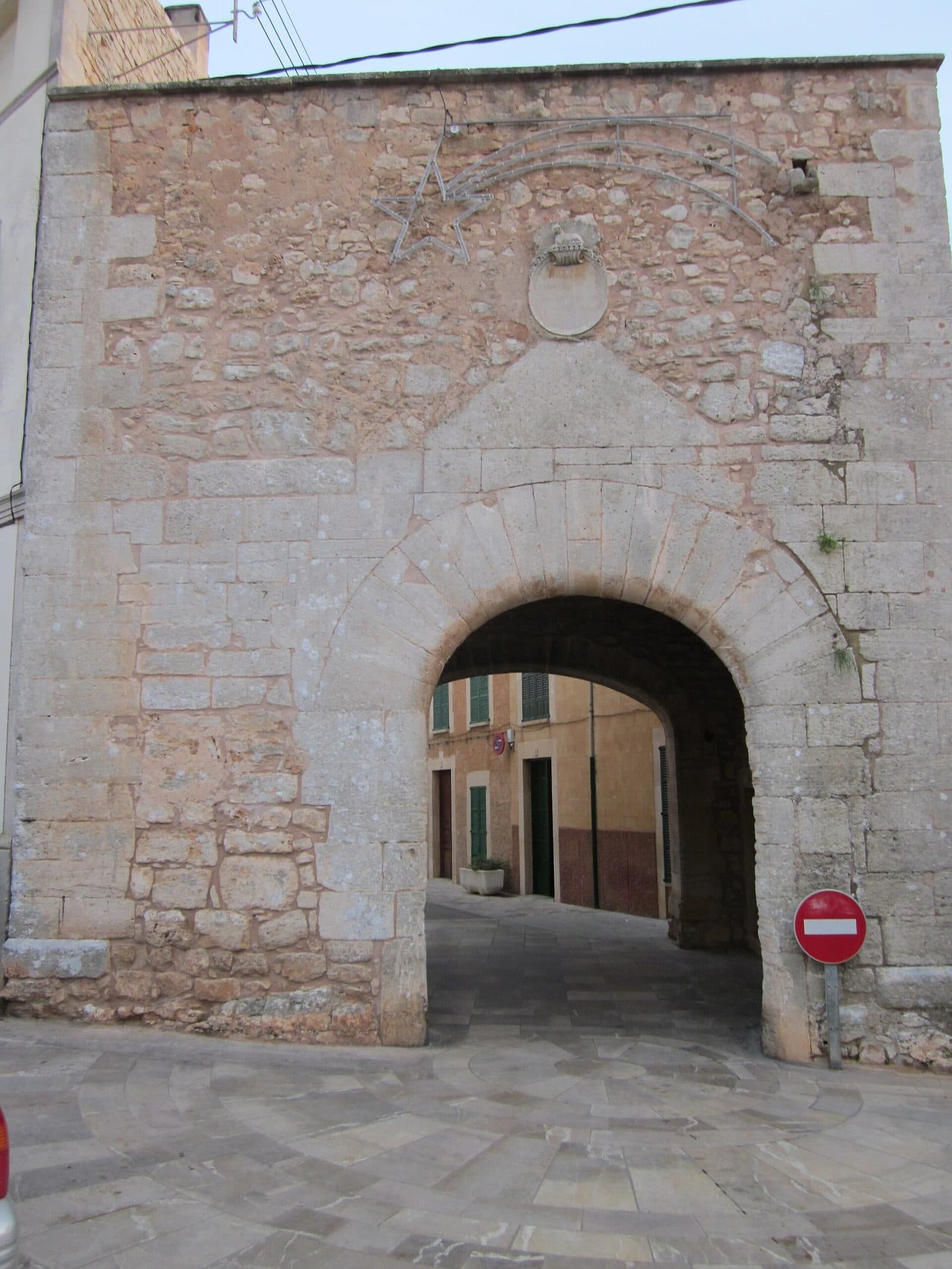

At first glance, Sa Porta Murada looks like a short stone passageway. In fact, the fortified town gate still marks the historic threshold to Santanyí’s old town. Anyone walking from the newer part of town toward the center passes not merely a picturesque backdrop, but a preserved part of the defensive structure built to protect the town from raids originating on the coast.
Its special appeal lies in this concentration: within a small space, local history, defensive architecture, and its later use as a prison come together. The structure consists almost entirely of the pale Santanyí stone quarried in the surrounding area. An old dungeon has survived inside—an unusual detail that turns a town gate into a small but powerful historical site.
A visit is particularly worthwhile for travelers who come to Santanyí not only for its market, shops, or nearby coast. The gate is not an extensive museum. Instead, its appeal emerges on closer inspection: in the strength of the structure, the combination of passageway and guard function, and the thought that this narrow point once controlled who entered the protected settlement.
Sa Porta Murada can easily be included in a walk through the historic town center. On market days, the structure stands amid the lively bustle of Santanyí; outside market hours, its historic form is more apparent. This contrast between an everyday passageway and a centuries-old defensive structure makes the site especially vivid.
History and significance
When Sa Porta Murada was built, Mallorca’s coast was not a distant scenic idyll. Attacks from the sea were among the dangers that towns in the south and southeast of the island had to prepare for. Santanyí responded with fortifications intended to protect its population from raids. The surviving gate therefore arose from a specific threat and was not built as a ceremonial entrance.
The fortification of 1571
The town gate was built in 1571. It was prompted by the frequent Turkish raids of the time, from which the residents of Santanyí needed protection. Its location at the entrance to the old town center was chosen for practical reasons: anyone wishing to reach the fortified area had to pass through a controllable bottleneck. Gate, guard post, and wall formed parts of a shared defensive system.
The term “Porta Murada” still refers to this connection between the gate and the surrounding wall. The structure is described both as a fortified town gate and as a former watchtower within the town wall. This dual description explains its compact shape better than the idea of a freestanding ornamental gateway. Its purpose was not to impress, but to observe, restrict, and protect.
Protection from attacks originating on the coast
The fortification reflects Santanyí’s particular location. The town itself lies inland, but its municipality extends to a section of coastline with numerous coves. These inlets provided access not only for fishermen and merchant ships, but could also serve attackers as landing places. The danger therefore extended into the settlements behind the coast.
Sa Porta Murada makes this historical insecurity tangible. A wall did not have to repel every danger permanently to be useful: it concentrated access points, made surprise incursions more difficult, and gave residents time. The gate was the sensitive point in this system—a necessary passage in daily life and, in an emergency, a place that could be secured.
From defensive structure to prison
After its original defensive function became less important, the structure took on another role that likewise involved control. In the 19th century and during the first half of the 20th century, Sa Porta Murada served as a prison. The dungeon preserved inside recalls this long second phase of use.
A small, uncomfortable prison cell has survived there, allowing part of the building’s history of use to be read directly from the structure. The gate thus represents two forms of government or municipal control—first over access to the town, and later over imprisoned people.
Restoration and monument status
The gate was most recently restored in 1987. Since then, it has been preserved as a historic monument of Santanyí. Its significance lies less in monumental dimensions than in its role as a surviving town gate and former watchtower of the old town wall.
Anyone passing through it still makes the same spatial transition as earlier residents and visitors: from the area outside the fortifications into the historic center. This continuity makes the gate an especially accessible testament to local history.
What to see
The essential view is not from a distance, but directly beside the structure. Sa Porta Murada is compact and integrated into Santanyí’s street layout. Only up close does it become clear that the passageway, tower structure, and former prison room are not separate sights, but elements united within a single fortified building.
The fortified town gate
The passageway is the central element. It leads into the old town center and still shows how effectively a town gate could channel movement. Unlike an open square, such an entrance could be monitored and closed. The architecture narrows the route and forces those arriving to pass beneath and through the massive structure.
It is worth viewing both sides of the gate. From outside, it appears as the boundary of the historic center; after passing through, the perspective changes, and the structure becomes the rear boundary of the entrance. This simple change of position conveys its function better than a single photograph: Sa Porta Murada was both an obstacle and an essential connection.
The former watchtower
The gate is also described as one of the former watchtowers of the fortifications. This classification explains its defensive design: it is not merely a thin opening in a wall, but a structure from which the entrance could be monitored. The guard function was directly connected to securing the gate and therefore to the defense of Santanyí.
The surviving tower and gate structure formed part of the former town wall. It indicates where the historic town center began and how the settlement was protected from the outside. The monument therefore serves as a spatial anchor for the old fortifications.
Santanyí stone
Almost the entire structure consists of locally quarried stone from Santanyí. This material gives Sa Porta Murada pale, warm stone tones, while the enclosed, robust construction emphasizes its strength.
In angled light, joints, edges, and varying surfaces are easier to distinguish than in the harsh brightness of the day. The stone is not merely decorative. The use of a locally available material points to the region’s building practices and gives the monument a visual connection to its surroundings, allowing it to remain part of the townscape despite its defensive function.
The preserved dungeon
The most surprising architectural element lies inside. The old prison room has survived there, recalling the building’s use from the 19th century into the first half of the 20th century. Sources describe it as a small, uncomfortable cell. Its confined space contrasts sharply with the public movement through the gate: outside, the route continues; inside, the same structure meant imprisonment.
The dungeon changes how the entire monument is perceived. Without it, Sa Porta Murada might appear solely as the remains of an early modern fortification. With it, the building also tells how older defensive structures continued to be used long after their original military purpose had faded. Whether the interior is accessible during a particular visit should be checked in advance; regardless, the town gate can still be experienced from outside as a historic transition.
The entrance to the old town
Its most impressive feature is not an individual decoration, but its location. Sa Porta Murada stands on Carrer del Centre and forms the main entrance to the historic center. The gate therefore cannot meaningfully be separated from the lanes behind it. Its urban significance becomes clear when walking through: the older town center begins beyond the former defensive point.
On market days, visitor flows and activity in the adjoining streets attract much of the attention. On quieter days, the threshold can be appreciated more consciously. It then becomes easier to notice how naturally this centuries-old structure is integrated into everyday life—as a monument, passageway, and landmark all at once.
Visiting Sa Porta Murada
A visit usually begins not at a ticket office or exhibition room, but in the street. Sa Porta Murada stands on the route into the old town and can initially be viewed from outside and walked through. This makes the monument an uncomplicated destination, but it also requires some attention: anyone simply following the flow toward the center may quickly pass through the gate without truly understanding its function.
A short stop with two perspectives
A compact sightseeing stop is sufficient for the structure itself. It makes sense to begin by looking at the outside, then walk through the gate and turn around again on the old-town side. This makes the building, passageway, and position within the street network easier to understand. Anyone also interested in its use as a prison and the surviving dungeon should allow more time than for a quick souvenir photo.
Sa Porta Murada is not an extensive castle complex. The visit benefits from its context: the gate forms a strong beginning or end to a walk through Santanyí. Together with the lanes, stone façades, and town center, it becomes easy to see why this particular point was once protected and controlled.
Market day or a quiet day in town
The surroundings change noticeably on market days. Santanyí’s market spreads across the central square and surrounding streets, so the area around the gate can also become lively. Anyone wishing to combine the market and monument will experience Sa Porta Murada as part of a heavily used town center. For an unobstructed view of the structure and a quieter visit, a day without the market is the better choice.
Early arrival is recommended on market days because the market attracts many visitors. This is less about access to the gate than about general crowding in the streets and parking areas. Outside market hours, it is easier to view the architecture from different directions without constantly having to avoid the flow of pedestrians.
Interior and current accessibility
The preserved dungeon is the most important feature inside. As no reliable current opening hours are available, visitors should check before arriving whether and when the interior is accessible. The same applies to any admission rules. Specific times or prices cannot be permanently inferred from the monument’s historical description.
Even when the interior is closed, Sa Porta Murada remains worth seeing as a structure. The fortified passageway, tower-like character, local stone, and location at the entrance to the old town can all be appreciated from outside. Anyone coming specifically for the prison cell, however, should not leave accessibility to chance.
Getting there and parking
The Ma-19 leads south from Palma and onward to Santanyí. The stated driving distances and journey times refer to the town of Santanyí, not to a parking space directly in front of Sa Porta Murada. The final section leads into the historic town center to the gate on Carrer del Centre.
From Palma Airport
The road distance from Palma Airport to Santanyí is 46 kilometers via the Ma-19. The drive takes around 38 minutes. After arriving in town, continue toward the center and old town. Sa Porta Murada marks the historic entrance there and forms part of the town’s street layout; it is not an isolated attraction beside a country road.
From central Palma
From central Palma, the total road distance to Santanyí via the Ma-19 is 52 kilometers. The drive takes around 49 minutes. As with the journey from the airport, this figure ends in the town. Additional time should be allowed for the final local approach, finding parking, and walking to the historic center, especially when the market is taking place.
Parking near the town center
Designated parking facilities are available in town on busy market days, and Sa Porta Murada can be reached on foot from there. In Mallorca, a yellow line along the roadside marks areas where parking is prohibited. Blue markings may indicate paid parking regulations. Local signs always take precedence. Especially around the busy town center, an apparent gap should not be interpreted as permission to park.
By bus
The stops Na Ravandella 1 and Na Ravandella 2, as well as Sa Tanca 1 and Sa Tanca 2, are located within the town. From the relevant stop, continue on foot toward the center. Because routes and timetables can change, the appropriate connection should be checked for the day of the visit. The gate itself is an easily recognizable landmark in the old-town area.
Bus lines to Sa Porta Murada at a glance
| Line | Route | Departures/day | First | Last |
|---|---|---|---|---|
| 516 | Cala Figuera - Campos | 93 | 06:58 | 22:20 |
| 517 | Santanyí - Colònia de Sant Jordi - Campos | 74 | 05:45 | 23:30 |
| 515 | Cala d'Or - Campos | 57 | 06:08 | 22:50 |
| 515e | Cala d'Or - Palma | 10 | 09:40 | 19:55 |
From the official GTFS feeds (TIB/SFM), no real-time data. The figures cover all stops in the town; weekend and holiday services differ — check with the operator before travelling.
Getting there by bus
Na Ravandella 1 (57042) · 0.4 km as the crow flies
- 515Cala d'Or - Campos · Daily
- 515eCala d'Or - Palma · Mon-Fri
- 516Cala Figuera - Campos · Daily
- 517Santanyí - Colònia de Sant Jordi - Campos · Daily
Na Ravandella 2 (57041) · 0.5 km as the crow flies
- 515Cala d'Or - Campos · Daily
- 515eCala d'Or - Palma · Mon-Fri
Sa Tanca 1 (57059) · 0.5 km as the crow flies
- 516Cala Figuera - Campos · Daily
Sa Tanca 2 (57058) · 0.5 km as the crow flies
- 516Cala Figuera - Campos · Daily
Cas Canonge 1 (57057) · 0.6 km as the crow flies
- 516Cala Figuera - Campos · Daily
- 517Santanyí - Colònia de Sant Jordi - Campos · Daily
Cas Canonge 2 (57056) · 0.6 km as the crow flies
- 516Cala Figuera - Campos · Daily
- 517Santanyí - Colònia de Sant Jordi - Campos · Daily
Timetable data: official GTFS feeds (TIB/EMT), no real-time — check with the operator before travelling.
Nearby attractions
Beyond Sa Porta Murada lies not a sealed museum district, but the lively center of Santanyí. This is precisely what makes the location valuable: the defensive gate can be combined with a walk through town without long distances or another car journey between stops. The old town also provides the scale of the area the gate was intended to protect.
Santanyí’s historic town center
The streets of the center are characterized by typical pale stone façades. Among homes, shops, galleries, and restaurants, the historic layout of the town remains recognizable. Sa Porta Murada provides a clear starting point. Continuing from here leads toward the central square and the parish church of Sant Andreu.
To understand the gate, it is worth looking not only at individual façades, but also at street layouts and transitions. The defensive structure stood at the edge of the protected area; today’s walk, by contrast, passes through without any controls. This natural openness makes it clear how fundamentally the function of the site has changed.
Santanyí market
The weekly market takes place in the center on Wednesdays and Saturdays. Its stalls spread across the main square and adjoining lanes. Products include fruit, vegetables, cheese, cured meats, olives, baked goods, plants, clothing, handicrafts, and other regional produce. The market attracts many visitors and also shapes the atmosphere around Sa Porta Murada on those days.
The combination is particularly vivid: the gate that once regulated access becomes a passageway for market visitors. Anyone primarily wishing to take photographs or view the masonry in peace should choose another day. Those who want to experience Santanyí in motion can deliberately include the monument in their market walk and later view it again from a quieter position to the side.
Church and central squares
The parish church of Sant Andreu is one of the prominent buildings in the center and makes a suitable next landmark after passing through the gate. Together with the main square, surrounding lanes, and Sa Porta Murada, it creates a compact walk through the town center. The town gate remains the place where Santanyí’s former defenses are most clearly visible.
Such a walk is more meaningful than driving to Sa Porta Murada and immediately continuing onward. The gate explains the town, while the town in turn explains the significance of the gate. Only when walking into the center does it become clear why this particular entrance was fortified.
Coast and nature
Santanyí is also a good starting point for destinations on the southeastern coast. Cala Figuera, Cala Santanyí, Cala Llombards, and Mondragó Natural Park are among the well-known options for a subsequent trip. However, they should be planned as a separate part of the itinerary: Sa Porta Murada lies in the inland town of Santanyí and should not be confused with the similarly named Cala Murada.
Combining the historic town center and coast can make for a varied day. The coastal location is even historically relevant to understanding the town gate, as the fortification was built in response to attacks originating from the sea. The monument itself, however, remains unmistakably part of Santanyí.
The place it belongs to
Santanyí in the place guidePractical information for your visit
Sa Porta Murada requires no special equipment. Comfortable shoes are nevertheless useful for the subsequent walk through the streets of Santanyí. Anyone wishing to photograph the structure should avoid standing in the middle of the passageway, instead finding a safe position on one side before changing perspective.
What to expect from the monument
Expect a compact historic town gate, not a walkable fortress complex with long wall walks, towers, and viewing terraces. The preserved dungeon is an important detail, but its current accessibility should be checked in advance. If the interior is not open, the visit focuses on the structure, stone material, and function as an entrance to the old town.
Precisely because of its manageable size, a little preparation is worthwhile. Anyone who knows that the gate was built in 1571 to defend against attacks and later used as a prison will recognize more in the massive structure than a picturesque passageway. Its history is conveyed not through numerous rooms, but through a few clearly legible elements.
Visiting with children
The gate can easily be included in a walk with children because there is no long sightseeing route to complete. Particularly vivid questions include who was once allowed to pass through the controlled entrance, how a town gate could be closed, and why a prison cell was later located in the same structure. Attention is required in the busy street environment, however, especially during the market.
The surviving cell can offer older children a tangible way to engage with history, provided it is open. For younger visitors, passing through the gate itself remains the most accessible experience: first standing outside the former wall, then walking through the bottleneck into the old town.
Sun, crowds, and photography
Much of the visit takes place outdoors and in a public street. Sun protection is therefore particularly useful when Sa Porta Murada is combined with a longer walk through town or a visit to the market. On market days, people and stalls can sometimes obstruct the view; on a quieter day, it is easier to see the gate straight on and from both directions.
For photographs of the masonry, light falling from the side works better than the harsh brightness around midday because it makes joints and surfaces stand out more clearly. The key is less a spectacular viewpoint than changing sides. A photograph from outside documents the gate as a boundary, while another from the historic center shows its role as an exit back toward the newer part of town.
Local insider tips
View the gate twice
Do not move on after the first photograph: view Sa Porta Murada from outside, pass through the gateway, and turn around on the old-town side. Only this change of perspective reveals its former role as a controlled threshold.
Notice the stone
Almost the entire structure consists of locally quarried Santanyí stone. In side lighting, joints, edges, and surfaces stand out more clearly, allowing the defensive structure to be compared with the town’s pale stone façades.
Ask about the dungeon
A small former prison cell has survived inside. Because its current accessibility is not reliably known, checking in advance is especially worthwhile for anyone who wants to see more than the exterior town gate.
Choose quiet or market bustle
The weekly market shapes the town center on Wednesdays and Saturdays. On those days, you experience the gate amid local life; for an unobstructed view and a quieter visit, however, a day without the market is the better choice.
Start your old-town walk here
Sa Porta Murada makes a suitable starting point for the walk to the center and the church of Sant Andreu. This turns a short stop into an accessible route from the former edge of the fortifications into the protected town center.