
Mirador des Pontàs: Mallorca’s Rock Arch near Cala Santanyí
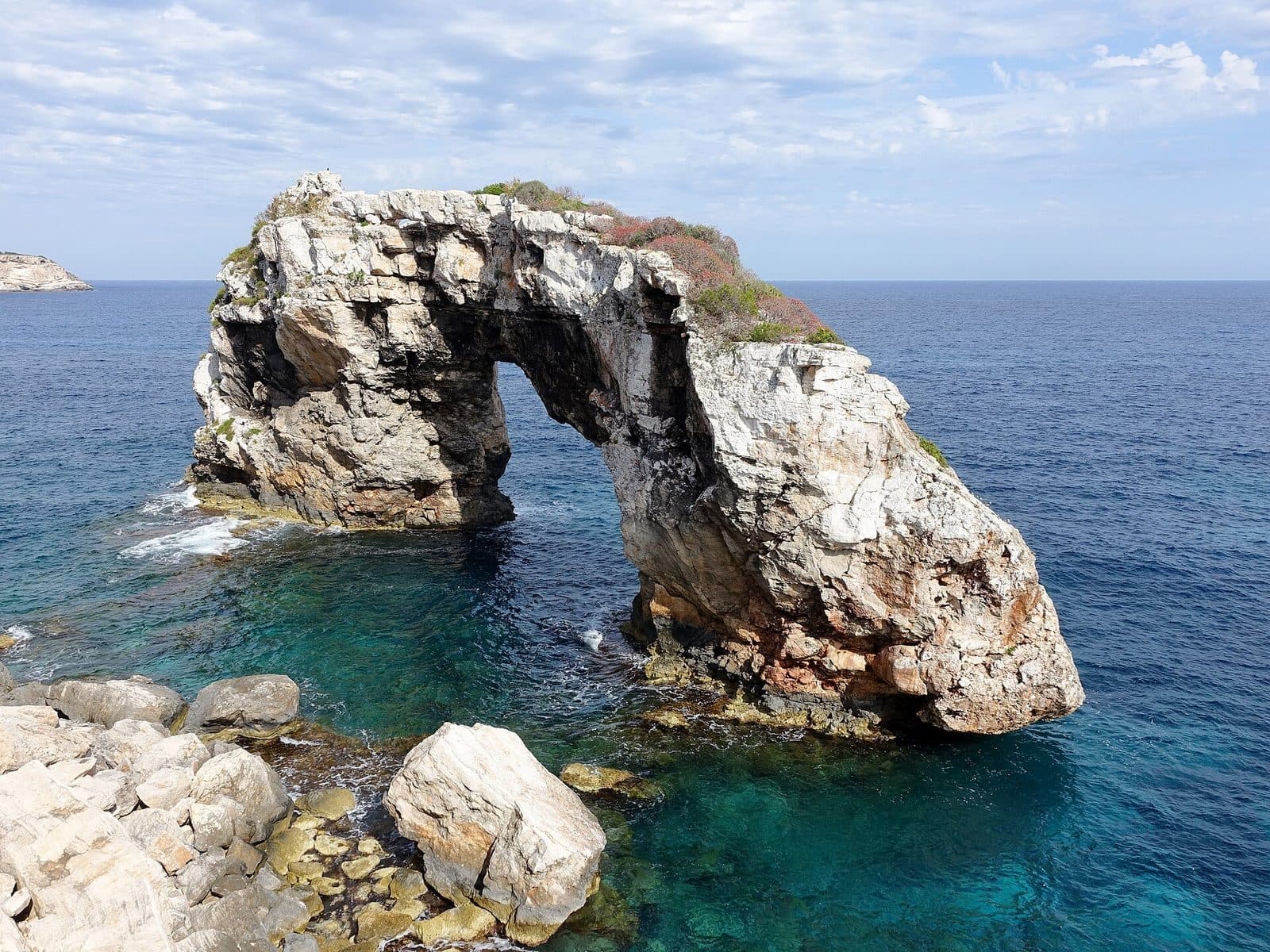

The first glimpse looks almost like an optical illusion: a massive rock rises off the coast, with the sea visible through its center. Mirador des Pontàs offers the best view of this natural rock arch between Cala Santanyí and Cala Llombards. The viewpoint is not on a grand promenade but at the edge of a rugged coastal landscape where rock, water, and the horizon take center stage.
The name Es Pontàs roughly means “the great bridge.” The arch surrounded by water does indeed resemble a gigantic bridge pier, although it was never built by human hands. The natural formation is around 70 meters wide and has become one of Mallorca’s scenic landmarks. Its shape is much easier to appreciate from the Mirador than from the beach: the arch stands clear against the sea, while its opening can look almost like a second, framed horizon depending on the light.
The visit is especially worthwhile for travelers who want to experience a characteristic stretch of the southeast coast with little effort. Photographers will also find a subject that changes constantly with the light. No long hike is required. A short route leads from the beach at Cala Santanyí to the viewpoint, although the rocky and occasionally steep ground demands more attention than the short distance might suggest.
Es Pontàs is both a natural monument and the setting for an extraordinary chapter in climbing history. With luck, you may spot a deep-water solo climber on the rock above the open water. For most visitors, however, this remains a spectacle viewed from a safe distance: the Mirador is the place to watch, not an access point onto the rock arch.
History and Significance
Es Pontàs as a Work of the Coast
The history of Es Pontàs begins not with a builder but with the slow work of the sea and weathering. The rock was once part of the coastline before natural processes hollowed out the stone and formed the arch visible today. A rock mass eroded by the water gradually took on the silhouette of a bridge—hence its Mallorcan name. The Mirador, in turn, owes its significance to precisely this juxtaposition: the viewpoint itself is not the main attraction, but rather the natural formation out at sea.
The rock arch lies directly off the coast between Cala Santanyí and Cala Llombards. This location explains why it can be seen from different directions, although Mirador des Pontàs is regarded as the preferred vantage point. From here, the arch and the coastal rocks overlap less; the opening remains clearly visible, and the rock’s distinct shape stands out. What appears on a map as little more than a small dot off the coast gains spatial depth when seen in person.
Today, Es Pontàs is one of Mallorca’s most recognizable landscape motifs. Its impact comes not from size alone but from its clear, almost graphic form: a massive stone arch, water below it, and the open sea beyond. This simple composition has made it a frequently photographed subject and a natural landmark of the municipality of Santanyí.
Es Pontàs in Art
The rock arch also found its way into artistic depictions of Mallorca. The Argentine painter Francisco Bernareggi, who was closely associated with the island, included Es Pontàs among his Mallorca subjects. This is hardly surprising: the formation’s appearance changes dramatically with the light. Harsh sunlight emphasizes the pale mass of stone and its shadowed areas, while lower light softens the contours and makes the arch appear more sculptural.
This artistic perspective can also enrich a visit today. It is worth looking beyond the familiar overall view and paying attention to the relationship between the opening, the surface of the water, and the horizon. Even a slight change in position shifts these lines against one another. The Mirador is therefore less a place for a fleeting glance than a natural stage for images, where seeing itself begins to slow down.
Es Pontàs and Psicobloc
A second and entirely different form of fame began with climbing. Es Pontàs is used for deep water soloing, usually called Psicobloc on Mallorca: climbing without a rope above deep water. A total of nine such routes are known on the rock. This transformed the rock arch from a photographic subject into an international reference point for one of climbing’s most spectacular disciplines.
The route also named Es Pontàs is particularly famous. The American climber Chris Sharma completed it for the first time in summer 2006; it was graded 9a+. By 2021, it had been repeated only three times and was considered the world’s most difficult deep-water solo route. The film King Lines introduced a wider audience to the attempts and the eventual successful ascent. Seen from the Mirador, the rock thus gains a second dimension: its overhanging sections are not merely features in the stone but parts of a route where elite climbers have tested their limits.
What to See
The Es Pontàs Rock Arch
The freestanding rock arch dominates the view. From a distance, its roughly 70-meter-wide form appears solid and monumental, yet the large opening removes any sense of heaviness. The sea remains visible beneath the arch. Depending on the movement of the water and the light, the opening may appear dark like a gateway or bright like a framed piece of the horizon.
The description “bridge” fits the silhouette remarkably well. Two massive sections of rock support a natural arch whose top has no connection to the land. It is precisely this separation from the coast that makes Es Pontàs unmistakable. This is not a cave visible in a cliff face from the viewpoint but an independent formation standing in the sea.
A longer look reveals that the famous outline is only one part of the scene. Across the rock, smooth surfaces simplified by distance alternate with rough edges and darker recesses. The waterline defines its lower edge, while the color of the sea continues through the opening. In calm water, the formation appears almost static; when the sea is rougher, it becomes clear that the coast is still shaping it.
The Opening in the Rock
The true center of the image is not the stone but the empty space within it. Through the opening, the water and horizon appear as though enclosed by a natural frame. This effect explains why the Mirador has become the established photographic viewpoint. An image of Es Pontàs depends on the balance between its massive exterior and the bright view through the arch.
Its form changes with your position. Moving just a few steps to the side can make one pillar appear broader or shift the visible horizon within the arch. A rewarding visit therefore involves more than stopping at the first open spot. Within the safe area, it is worth comparing different perspectives without approaching the unsecured edges.
The lower section deserves particular attention. This is where rock and sea meet directly. Even from a distance, it is possible to understand why the site is famous among climbers: the walls rise straight out of the water, with no artificial connection or walkway leading to the rock. The arch is separated from the land and remains a wild coastal formation.
The Coast Between Cala Santanyí and Cala Llombards
Es Pontàs does not stand in isolation within an empty expanse of water. The Mirador also reveals part of the rocky coastline between Cala Santanyí and Cala Llombards. The coves themselves lie outside the central view, but they define its geographical setting: the rock arch marks the stretch of coast between two well-known bathing coves.
The surrounding rocks add depth to the view. In the foreground lies the irregular edge of the viewpoint terrain, followed by the sea and finally Es Pontàs. This layering is important because it makes the formation appear more three-dimensional than in many close-up images. Anyone who zooms in exclusively on the arch misses an essential part of the place: the rugged coast from which it emerged.
The light also transforms the coastal view. When the sun is low, the stone takes on a warmer tone, while shadows separate the opening and the rock contours more distinctly. Sunset is therefore often recommended as an especially atmospheric time to visit. This does not mean that it is the only worthwhile moment. In higher light, the color of the water and the rock surfaces stand out more clearly, while evening emphasizes silhouette and contrast.
The Climbing Lines
Without prior knowledge, the nine deep-water solo routes cannot be identified as marked lines. Even so, it is worth looking more closely at the overhanging sections facing the water. This is where the climbing that made Es Pontàs internationally famous takes place. The fall zone is the sea; ropes and permanently installed access points are not part of the usual scene.
If climbers are on the rock, they should be watched only from a distance. Psicobloc is not a spontaneous swimming adventure but a demanding sport for people with the necessary experience, local knowledge, and ability to assess the conditions. Chris Sharma’s famous route ranks among the world’s elite climbing challenges and is certainly not an indication that the arch is easily accessible to visitors.
Mirador des Pontàs
The viewpoint itself is simple. It does not compete with the landscape through a large structure or a staged visitor facility. Its value lies in its position opposite the rock arch. A wooden bench mentioned in sources provides an opportunity to take in the view for longer, but the open coastal terrain remains the defining feature.
Anyone expecting a platform with extensive tourist facilities will misunderstand the character of the Mirador. The place works more like a short coastal detour: arrive, choose a suitable and safe position, view the arch from different angles, and return along the same route. Its appeal lies precisely in this simplicity. There is no exhibition, no interior, and no tour through a building—the landscape itself is the exhibit.
Visiting Mirador des Pontàs
The Short Walk from Cala Santanyí
Mirador des Pontàs can be reached from the beach at Cala Santanyí on a short walk of about ten minutes. Its brief duration should not be mistaken for a fully developed promenade. The route is described as having steep sections, rocks protruding from the ground, and places without railings. Closed shoes with good grip are therefore more suitable than loose beach footwear.
The route is marked but requires concentration, especially in windy conditions, on uneven ground, and near exposed edges. The aim is not to venture as far out onto the rocks as possible. The characteristic view of the arch is already available from the viewpoint. Access may be challenging for people who are afraid of heights or have limited sure-footedness.
Time at the Viewpoint
For the basic detour, allow for both walks of about ten minutes each, plus the time spent at the Mirador. The length of the visit depends mainly on your interest in the subject. Anyone looking for only a quick view and a souvenir photo will stay for a correspondingly short time. Photographers and coastal scenery enthusiasts may spend considerably longer waiting for changing light and exploring different compositions.
There is no conventional sightseeing route with a fixed starting point, circuit, and exit. Nor are there any documented interiors or exhibition areas. The visit is open and focused entirely on the landscape. This makes it easy to combine with time in Cala Santanyí, but it also requires more personal responsibility than a secured observation balcony.
Light and Crowds
Sunset is considered particularly appealing because warm, softer light falls across the coast and rock. Es Pontàs then becomes more of a silhouette, while the opening stands out as a bright window. Naturally, this time of day also attracts people seeking the same photograph. For a quieter experience, it is therefore advisable not to arrive only for the widely promoted evening moment.
At other times of day, the setting appears more neutral but no less interesting. Brighter light makes it easier to see the rock’s structure, the waterline, and its physical separation from the coast. Particular caution is required in strong winds because parts of the approach have no railings. The weather and your own secure footing take priority over the perfect photograph.
Specific opening hours and admission arrangements have not been reliably documented. As local access conditions may change, current information should be checked before visiting. Regardless of this, it is advisable to plan the visit with sufficient daylight so that the uneven return route remains clearly visible.
Getting There and Parking
From Palma Airport to Cala Santanyí
From Palma Airport, the drive follows the Ma-19 to Cala Santanyí. The road distance is 49 kilometers, and the journey takes around 44 minutes. These details apply specifically to Cala Santanyí, not directly to the Mirador. The final section is completed on foot from the town and beach area; the short walk from the beach takes about ten minutes.
The Ma-19 covers most of the journey toward the south or southeast of the island. Only around Santanyí does the route continue along the local road network toward the coast. For navigation, Cala Santanyí is a more reliable starting point than assuming that you can drive directly to the rock arch. Es Pontàs itself stands in the sea, and the Mirador is also a destination for pedestrians.
From Palma to Cala Santanyí
From central Palma, the route via the Ma-19 covers a total road distance of 55 kilometers to Cala Santanyí. The journey takes around 54 minutes. Here too, the measured route ends in the coastal settlement. It is followed by the short approach to the viewpoint across uneven ground.
Anyone combining the visit with time at the beach can plan the drive around Cala Santanyí and include the Mirador as a walking detour. Sources describe a starting point around the parking area or beach. This does not indicate a guaranteed number of available parking spaces, so allowing additional time to find parking is sensible during busier periods.
By Bus to Cala Santanyí
The Cala Santanyí stop is listed as the nearest public transport access point. Other documented stops in the surrounding area are in Son Moja and Cala Llombards. The most suitable connection depends on your departure point and the current timetable. After arriving in Cala Santanyí, the route continues on foot toward the viewpoint; no bus travels directly to the rock arch.
Because the final section is rocky and steep in places, the return journey should not be scheduled so tightly that the path must be covered under time pressure. After a sunset visit in particular, remember that the return route crosses uneven ground. Timetables and current local access conditions should therefore be checked in advance.
Bus lines to Mirador des Pontàs at a glance
| Line | Route | Departures/day | First | Last |
|---|---|---|---|---|
| 516 | Cala Figuera - Campos | 34 | 06:49 | 22:10 |
| 517 | Santanyí - Colònia de Sant Jordi - Campos | 16 | 08:30 | 23:18 |
From the official GTFS feeds (TIB/SFM), no real-time data. The figures cover all stops in the town; weekend and holiday services differ — check with the operator before travelling.
Getting there by bus
Cala Santanyí (57028) · 0.6 km as the crow flies
- 516Cala Figuera - Campos · Daily
Son Moja (57055) · 1.3 km as the crow flies
- 516Cala Figuera - Campos · Daily
Cala Llombards (57047) · 1.7 km as the crow flies
- 517Santanyí - Colònia de Sant Jordi - Campos · Daily
Timetable data: official GTFS feeds (TIB/EMT), no real-time — check with the operator before travelling.
Nearby Places
Cala Santanyí
Cala Santanyí is the natural starting point for a visit. The sheltered cove provides a clear contrast with the exposed coastal scene at the Mirador: here are the beach and access to the water; there are the rocky edge and freestanding arch in the sea. Anyone already swimming or taking a break in the Cala can add Es Pontàs to the day without a long additional hike.
This combination is precisely what makes the viewpoint so practical. It is not an isolated destination that necessarily requires an entire day trip. The walk from the beach takes about ten minutes but calls for suitable footwear. Visitors should therefore not simply make the trip barefoot or in loose sandals between swimming and the Mirador.
Cala Llombards
Cala Llombards lies on the other side of this stretch of coast. The cove helps place Es Pontàs geographically because the rock arch stands between it and Cala Santanyí. Visiting both coves can be combined with the viewpoint for a day on the coast without reducing Es Pontàs to a mere stopover.
However, no documented, comfortable promenade leads directly through the terrain from the Mirador to Cala Llombards. For practical planning, the places should therefore be treated as separate destinations. The attraction of combining them lies in their contrasting coastal scenery: a bathing cove, a rocky landscape, and a natural gateway in the sea.
Santanyí
The main town of Santanyí provides a cultural counterpoint to the coast. After the pared-back landscape experience at the Mirador, visitors will find stone-lined streets, squares, and the parish church of Sant Andreu. A detailed tour of the town is an activity in its own right; for a combined visit, the simple idea of contrasting the coast with an inland island town on the same day is enough.
Es Pontàs lies within the municipality of Santanyí and is one of the defining sights of this part of Mallorca. This gives the excursion a clear connection: first the coastal landscape, then the town after which the municipality is named. Cala Figuera and Es Llombards are also possible destinations in the region, but they should not be squeezed into an already short Mirador visit.
The place it belongs to
Cala Santanyí in the place guidePractical Visitor Information
Footwear and Terrain
The most important practical difference from an urban observation platform lies beneath your feet. The approach includes steep and rocky sections, with stones that may protrude from the ground. Closed shoes with a grippy sole provide considerably more security than flip-flops or smooth sandals. This remains true even when the Mirador is visited directly before or after time at the beach.
The same terrain must be crossed again on the return journey. Anyone staying until sunset should therefore allow enough daylight for the walk back. A short route does not automatically remain easy in poor visibility.
Wind, Sun, and the Coastal Edge
Parts of the path and viewpoint terrain are not protected by railings. In windy conditions, it is important to keep additional distance from the edge. Moving closer to a drop for a photograph offers no necessary advantage: the best view of Es Pontàs is already available from the Mirador, not from risky positions outside the safe standing area.
Direct sunlight should also be expected along the exposed coast. This is not a museum visit with air-conditioned rooms and continuous shade. Water, sun protection, and planning appropriate to the weather are therefore basic necessities, especially when waiting longer for good photographic light.
Visiting with Children
The short route is generally manageable with children, but its brief duration should not obscure the exposed and uneven sections. Close supervision is required on steep passages, around protruding rocks, and near unsecured areas. The Mirador is not a place where children should run freely near the coastal edge.
For families, combining the visit with Cala Santanyí is an obvious choice: the viewpoint becomes a short nature detour rather than a long hike. The key is to set the pace according to the least confident member of the group and respond appropriately to windy conditions.
What the Visit Does Not Include
There is no walkway to Es Pontàs and no normal footpath leading onto the rock arch. Climbing and jumping into the water are not part of an ordinary visit. The form of deep water soloing practiced on the rock requires experience, skill, and professional assessment of the conditions.
Visitors should likewise not expect a large visitor facility, exhibition, or architecturally designed observation tower. Above all, the Mirador provides a perspective: an unobstructed view of one of Mallorca’s best-known natural coastal landmarks. Those who come for precisely this and give the place some time will experience it at its best.
Local insider tips
Frame the Horizon
Do not photograph only the entire rock arch: moving a few steps to the side changes the position of the horizon within the opening. The strongest composition often appears when the water and distant view are cleanly enclosed by the natural stone frame.
Arrive Before the Evening Light
Es Pontàs is visited and photographed especially often at sunset. Anyone hoping to experience the warm light should arrive earlier, compare different vantage points, and begin the rocky return walk while there is still sufficient daylight.
Change Out of Beach Shoes
Although the walk from Cala Santanyí takes only about ten minutes, it crosses rocky and occasionally steep sections. Closed shoes with a grippy sole are more suitable for this short detour than flip-flops.
Look for the Climbing Wall
Nine deep-water solo routes run across the rock. With a little luck, climbers may be visible above the water. The Mirador remains the correct place to watch; Es Pontàs has neither a walkway nor a normal access route.
Combine It with the Cala
The Mirador is particularly easy to include as a short nature detour from Cala Santanyí. The beach and sheltered cove form an appealing contrast with the open sea and the freestanding rock arch.