
Cala Llombards – Coastal Village and Beach in Southern Mallorca
.jpg)
Places to stay in Cala Llombards
AdTo load the accommodation map by our partner Stay22, we need your consent for marketing cookies. Your consent applies to all marketing content on mallorca.com.
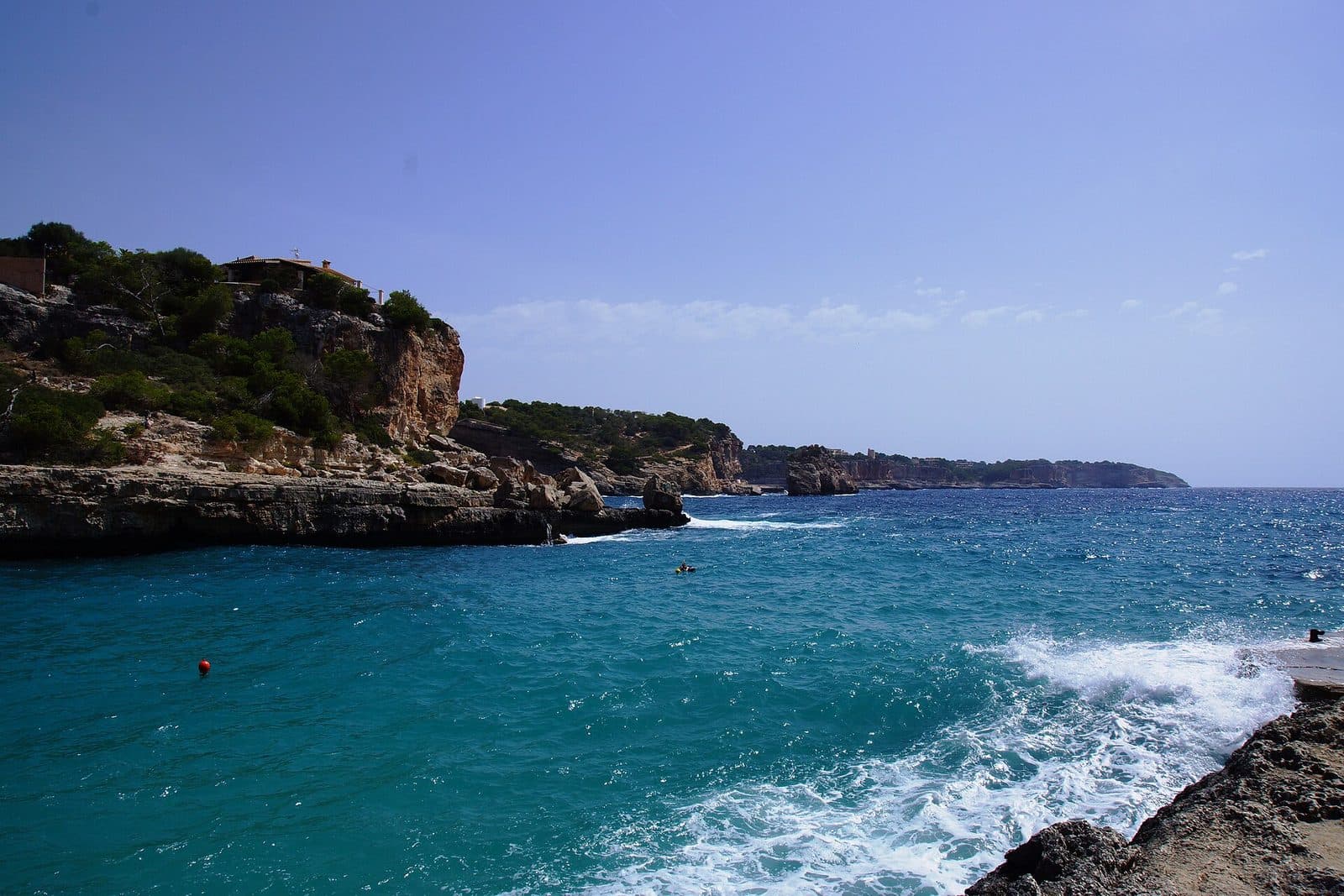
Cala Llombards refers both to a small settlement and to the bathing cove cut deep into Mallorca’s southeastern coast below the village. The beach is the clear focal point: pale sand, sheltered water, rocky sides and old boathouses shape a coastal scene that feels far less developed than the island’s large holiday resorts. A quiet residential and holiday-home development extends above it.
For visitors, Cala Llombards is especially worthwhile as a swimming destination and a base for exploring the coves around Santanyí. The sea, rocks, pines and paths along the coast define a stay here. In summer, the easily accessible cove is correspondingly popular.
As a place to live, Cala Llombards also follows a different logic from Santanyí or even inland Es Llombards. Holiday rentals shape the local offering. It is therefore particularly attractive to people who want to live near the sea, seek peace and quiet, and are prepared to organise shopping, administrative errands and many everyday journeys outside the village.
The location is well suited to a trip where Palma is not the main focus every day. Cala Santanyí, Cala Figuera, Caló des Moro, Es Llombards, Santanyí and Mondragó Natural Park provide enough options nearby for beach days, coastal walks and short excursions. Regular journeys to the island’s capital, by contrast, involve a considerably longer distance.
Things to See in Cala Llombards
The sights of Cala Llombards are not individual monumental buildings. What is worth seeing is the interplay of the bathing cove, cliffs, vegetation and traces of traditional use by fishermen. Anyone who stays only on their beach towel misses an essential part of it. The sides of the cove and the higher access points provide a better impression of its narrow, deeply cut shape.
Platja de Cala Llombards
The sandy beach lies at the inner end of a cove protected by rock walls. The sandy seabed makes the water appear bright turquoise in the sun, while the surrounding cliffs visually shelter the beach from the open coast. During calm summer periods, waves are generally small, although easterly winds can alter conditions.
Compared with many small rocky coves in the southeast, access is straightforward. An access road leads through the settlement down close to the beach, so no long walk across rough terrain is required. In summer, however, this accessibility is precisely why the small cove fills up early.
Fishermen’s Huts and Boathouses
Low fishermen’s huts and boathouses stand directly on the rocky shore along one side of the cove. They are a reminder that such inlets along the coast were used not only as bathing spots but also as sheltered moorings for small boats. The simple buildings and boats in front of them give Cala Llombards a different character from a fully developed hotel beach.
Respect for private areas and for the use of access points is therefore more important than finding the perfect photo spot. The combination of rock, water and buildings can be viewed especially well from the paths along the sides.
Cliffs and Pine Trees
The cove is framed by rocky slopes covered with pine trees and low Mediterranean vegetation. The rocks make Cala Llombards appear more enclosed than a view of the open sea might suggest. At the same time, the edges offer a variety of perspectives: from the sand towards the boathouses, from the rocks at the sides back to the beach and from higher points across the entire inlet.
Smooth rock, unprotected edges and wet entry points require suitable footwear and caution. Jumping from the rocks should not be regarded as a normal part of a beach visit, even if certain spots are used for it. Water depth, currents and the seabed cannot be assessed reliably from the shore.
Torrent de Son Amer
Cala Llombards lies at the mouth of the Torrent de Son Amer.
For visitors, the torrent is mainly noticeable as part of the terrain. After unusually heavy rain, the condition of the access road, beach and water should be checked before swimming.
View over the Cove
The higher roads and access points above the beach offer the most comprehensive view of Cala Llombards. From there, the narrower opening to the sea, the broad sandy area at the end of the cove and the buildings on the slope can all be seen together.
When taking photographs, the roadway should be kept clear. The settlement is not simply a viewpoint but a residential area with property entrances and ongoing traffic to the beach. Anyone wishing to enjoy the view in peace should choose a safe spot away from the road, driveways and unprotected cliff edges.
Sights in Cala Llombards
Food and Drink
Cala Llombards is not a culinary destination with a long-established restaurant strip. Its food and drink options primarily reflect beach activity and the use of many houses as holiday accommodation. Some planning is therefore advisable for a full beach day, especially outside the main season or if a particular venue is meant to be a fixed part of the day.
Chiringuita Cala Llombards
The chiringuito on the beach is the venue most directly associated by name with the cove. Its purpose is straightforward: drinks and a break right by the water without having to leave the cove. Its character is closer to a beach bar than a restaurant for a long culinary evening. The season, weather and level of beach activity can affect whether it is open and the extent of its service.
Precisely because the beach is small and the options are limited, the chiringuito should not be relied on as the sole source of all refreshments. Water and a small personal supply are sensible for longer stays. Rubbish should be taken away or placed in the designated bins; the enclosed shape of the cove makes discarded waste particularly visible.
Forn des Molí
For a meal away from the immediate beach area, inland Es Llombards is the obvious alternative. Forn des Molí is among the named venues there. Moving from the cove to the village also changes the atmosphere: instead of swimwear and beach activity, the focus is on a more rural setting between fields and the coastal road.
The venue should not be confused with an establishment located directly in the Cala Llombards settlement. Anyone wishing to combine the beach with a meal should deliberately include the drive via Es Llombards in the day’s schedule. This helps avoid having to look for an improvised solution only when the most popular dining time has arrived.
Perna Negra Grill and Sa Fona
Perna Negra Grill and Sa Fona are also listed for Es Llombards, not for the beach at Cala Llombards. Both names illustrate that the gastronomic options in the immediate area are spread more across the village and Santanyí than within the small coastal settlement itself. Cala Llombards remains primarily a place for swimming and living.
For residents, this distribution matters more than it does for day visitors: restaurant visits, larger shopping trips and other errands usually involve a drive. For holidaymakers, that can be part of the appeal, as a beach day can be combined with a detour to a well-established village. Without a vehicle, however, this combination is less spontaneous.
Eating, drinking and staying in Cala Llombards
The best-rated businesses from our directory, ordered by Google rating — not by advertising.
Activities and Excursions
The strength of Cala Llombards lies in the coastal landscape of southeastern Mallorca. Swimming and snorkelling begin directly in the cove; further beaches, viewpoints and fishing villages lie throughout the Santanyí region. Because many destinations are small and heavily visited during the season, choosing a few is usually more rewarding than trying to tick off as many coves as possible in one day.
Swimming at Cala Llombards
The sandy entry and water sheltered during calm periods make the cove a pleasant place to swim. Families will find access easier here than at purely rocky coves, but the sheltered location is no substitute for supervision. Children should be accompanied by the water, and extra caution is necessary in wind, waves or when the seabed is not visible.
The beach is better suited to a deliberately relaxed half or full day of swimming than to a long walk beside the water. The cove is compact, and the real experience comes from alternating between swimming, looking towards the rocky sides and spending time on the sandy beach.
Snorkelling along the Rocky Edges
The rocky sides of Cala Llombards offer more interesting structures than the open sandy area. When the water is clear and calm, fish and the transition between rocky and sandy seabeds can be observed there. Snorkellers should remain within sheltered areas, keep their distance from boats and always be able to complete the return journey under their own power.
Water shoes can be helpful at rocky entry points. Ladders and individual access points along the sides should not obscure the fact that these are not supervised or conveniently developed swimming spots everywhere. In easterly winds or rough seas, the sandy beach is the more sensible choice.
Es Pontàs
The natural rock arch Es Pontàs is one of the area’s best-known landscape features. It can be combined with an excursion from Cala Llombards but should not geographically be considered part of the cove itself.
A visit is more worthwhile for the view than as an additional swimming stop. Sturdy shoes are useful on rocky ground, and a safe distance should be kept from the edges. Combining Cala Llombards and Es Pontàs reveals two different forms of the same coastal landscape: the sheltered sandy cove and the freestanding rock arch in the sea.
Caló des Moro and Cala s’Almunia
Caló des Moro and Cala s’Almunia are among the well-known coves south of Cala Llombards. Their scenery is impressive. Caló des Moro in particular is small, so a visit should not come with expectations of a spacious, fully equipped family beach.
Anyone wishing to explore the shapes of the southern coast can plan the coves as separate stops.
Cala Figuera
Cala Figuera is an old fishing harbour. The village provides an appealing contrast to Cala Llombards: the focus here is not a sandy beach but the harbour landscape with boats and waterfront paths. For a late-afternoon excursion, Cala Figuera is therefore often a more worthwhile addition than another bathing cove.
Respect for private access points and ongoing harbour operations should be part of any walk around the area.
Mondragó Natural Park
Mondragó Natural Park is one of the excursion destinations in the surrounding area. It adds a much stronger hiking and nature component to a stay in Cala Llombards. While Cala Llombards is concentrated around a single compact cove, Mondragó offers more opportunities to spend time on foot.
A clear decision is advisable for an excursion: either Cala Llombards as the main beach and Mondragó as a walking destination, or the other way around. Trying to fit two complete beach days into one itinerary usually leads to more time spent looking for parking rather than greater relaxation during the high season.
Santanyí
Santanyí is the cultural and everyday centre of the surrounding area. Its old town, with sandstone façades, shops, cafés and large weekly market, offers precisely the urban density that Cala Llombards lacks. A visit combines particularly well with shopping or a meal before or after the beach.
Santanyí is considerably busier than usual on market days. The market spreads around Plaça Major and the adjoining streets. Anyone driving to Cala Llombards afterwards should bear in mind that many other visitors will also be heading towards the coast.
Beaches in Cala Llombards
2 beaches and coves with their own page belong to Cala Llombards.
Getting There and Getting Around
Cala Llombards lies away from the major holiday routes in southern Mallorca but can be reached by car without difficult mountain roads or gravel tracks. The main approach follows the Ma-19 towards Campos and Santanyí. From Santanyí, the regional road network continues towards the coast; within the settlement, signs point towards the beach or Platja.
From Palma Airport
From Palma Airport, the journey via the Ma-19 covers a total of 52 kilometres by road. The drive takes around 50 minutes. In practical terms, this means Cala Llombards can also be reached on an arrival or departure day, but it cannot be considered a beach immediately beside the airport. For the final section, navigation should be set to the beach or the specific accommodation, as Cala Llombards refers to both the settlement and the cove.
From Palma
From central Palma, the route also follows the Ma-19. The distance is 58 kilometres by road, and the drive takes around 59 minutes. Occasional visits to the city are perfectly manageable; daily commuting, however, requires careful time planning. On days with heavy excursion traffic, time spent looking for parking and the slower drive along the final roads to the coast must also be considered.
Parking by the Beach
There is a parking option close to the beach, reached via the access road through the settlement. Its proximity to the sand is an advantage over coves that can only be reached by longer walks.
Driveways, turning areas and narrow sections of road must be kept clear. An early visit is therefore advisable not only for a more pleasant place on the beach but also for a less stressful parking situation. Anyone parking above the cove should allow for the uphill return walk and the heat.
Bus and Train
Cala Llombards is connected to the regional bus network; current stops and services are displayed separately on this page. Anyone travelling from Palma without a car must therefore plan around bus services and, where necessary, a change.
This can work for a single beach day, provided the outward and return journeys are coordinated in advance. For visiting several coves in one day, shopping in Santanyí or reaching more remote coastal access points, a car is considerably more flexible. Outside the season, particular attention should be paid to the last return service.
Bus lines to Cala Llombards at a glance
| Line | Route | Departures/day | First | Last |
|---|---|---|---|---|
| 516 | Cala Figuera - Campos | 34 | 06:49 | 22:10 |
| 517 | Santanyí - Colònia de Sant Jordi - Campos | 16 | 08:30 | 23:18 |
From the official GTFS feeds (TIB/SFM), no real-time data. The figures cover all stops in the town; weekend and holiday services differ — check with the operator before travelling.
Getting there by bus
Cala Llombards (57047) · 0.9 km as the crow flies
- 517Santanyí - Colònia de Sant Jordi - Campos · Daily
Cala Santanyí (57028) · 2.4 km as the crow flies
- 516Cala Figuera - Campos · Daily
Son Moja (57055) · 2.7 km as the crow flies
- 516Cala Figuera - Campos · Daily
Timetable data: official GTFS feeds (TIB/EMT), no real-time — check with the operator before travelling.
Living in Cala Llombards
As a place to live, Cala Llombards is strongly defined by its coastal location and small-scale settlement pattern. The houses are spread above the cove and along quiet streets; there is no compact village centre with extensive infrastructure. Holiday rentals are particularly prominent in the local business profile, creating a mix of permanently occupied homes and accommodation used only at certain times.
Everyday Life and Local Amenities
For everyday needs, Cala Llombards cannot be compared with Santanyí. Santanyí is the practical reference point for larger shopping trips and many services; Es Llombards also plays a role in local daily life through its village amenities.
A car therefore makes life considerably easier. This applies not only to major shopping trips but also to appointments, restaurant visits and journeys outside beach hours. Before moving, the actual route to every regularly required facility should be checked rather than relying solely on how close places appear on the map.
Living above the Cove
Proximity to the sea is the most important residential advantage of Cala Llombards. Depending on the street, properties differ in their position on the slope, views, proximity to beach access and exposure to summer through-traffic. Houses on the access road to the cove experience more vehicles and pedestrians during the bathing season than homes on quieter roads set farther back.
For a property used throughout the year, the view and terrace are therefore not the only considerations; shade, ventilation, structural condition and practical everyday access also matter.
Summer and Winter
In summer, the beach sets the rhythm. Day visitors arrive in the morning, parking areas fill up and holiday homes are used more intensively. Anyone living directly on an access route feels the season more strongly than residents of quiet side streets.
Cala Llombards can be attractive to people seeking peace and quiet who are able to organise their journeys by car. Anyone expecting spontaneous social contact, many open venues and a lively village centre will find better conditions in Santanyí.
Commuting to Palma
The journey to central Palma via the Ma-19 covers 58 kilometres by road and takes around 59 minutes. Occasional appointments in the capital can therefore be planned easily. For daily commuting, however, the distance adds up considerably, especially as the journey first follows regional roads to the main route.
Cala Llombards is therefore better suited to location-independent work, employment in the south and southeast, or people who need to travel to Palma only occasionally. Anyone working in the capital at fixed times every day should assess the entire commuting routine, including parking at the destination and the return journey. In everyday life, the scenic appeal of the coast is no substitute for a short connection.
Living without a Car
A bus stop in the village provides a basic connection, and additional stops are located in Cala Santanyí and Son Moja. Nevertheless, Cala Llombards is not an ideal base for a completely car-free lifestyle. Timetables then dictate shopping trips, appointments and leisure journeys, and several remote coves cannot be combined at will.
For people who only wish to drive occasionally, a mixture of bus, bicycle and car can work. Summer heat, road layout and the return journey after dark must all be considered. Anyone permanently dependent on public transport should place greater importance on living near the bus stop than on a sea view or immediate proximity to the beach.
Practical Information for Your Visit
Cala Llombards does not require complicated expedition planning, but the small beach is sensitive to large crowds. The key decisions therefore concern arrival time, parking and whether the day should be devoted solely to the cove or combined with another destination.
Best Time of Day
On warm summer days, early morning is the most practical time. The beach is then less crowded, parking is easier to assess and the sun is not yet as strong. Later in the day, shaded areas along the rocky sides can change with the position of the sun. Anyone mainly interested in photography benefits from seeing the cove in different light conditions.
Outside the high season, Cala Llombards can be experienced more quietly, although water conditions and available beach services require closer attention. A scenic visit is worthwhile even without swimming; for a simple walk around the settlement, however, the village offers only a limited programme.
How Much Time to Allow
At least half a day should be allowed for the beach, swimming and a brief look at the boathouses. Anyone who only wants to see and photograph the cove will need considerably less time but will miss its essential character as a swimming destination. A full day is worthwhile when the focus is on relaxation, snorkelling and longer breaks.
Driving to several small coves in succession may sound efficient, but in summer it often results in repeated searches for parking. A better option is to combine Cala Llombards with a destination of a different character, such as the fishing harbour of Cala Figuera or the old town of Santanyí.
Facilities and What to Bring
During the season, facilities mentioned at the beach include lifeguards, sun loungers, parasols, showers and a small beach bar. This infrastructure should not be assumed to be available without checking outside the main bathing season. Drinking water, sun protection and everything children require should therefore always be brought along.
Normal beach shoes are sufficient for the sand, while closed shoes are safer for rocky edges and viewpoint access. Shade from pine trees and rocks is not available in the desired spot at every time of day. Bringing personal sun protection is particularly advisable for families.
Suitable Combinations
Santanyí fits well before a beach visit, especially if shopping or the weekly market is part of the day. Cala Figuera is a good option for a walk around the harbour after swimming. Es Pontàs provides a short scenic addition, while Mondragó is better planned as a separate focus with walking and nature observation.
Caló des Moro and Cala s’Almunia are not simply substitute beaches if Cala Llombards is full.
What Cala Llombards Does Not Offer
Cala Llombards is neither a destination for extensive shopping nor for museums, major sights or nightlife. A long beachfront promenade lined with restaurants is not part of the picture either. The visit is worthwhile because of the cove itself and the way it sits within the rocky coast.
This clear focus helps with planning: anyone who wants to swim, snorkel and experience a distinctive cala will find a suitable destination. Anyone expecting a varied city stroll should combine the beach with Santanyí or choose a different itinerary.
Local businesses and services
The best-covered sectors in our directory for Cala Llombards — each with address, contact details and opening hours.
Run a business here? Add it to the directory for free and be found on this page. Add your business
Upcoming dates
Latest news from Santanyí
- €5.9m targets Mallorca water pipes in Migjorn
- 45 migrants found off Mallorca and on Formentera
- Mallorca police pool fills 88 posts, average wait five days
- 58 people in five migrant boats reach Balearics