
Creu des Traginers – Historic Wayside Cross in Algaida
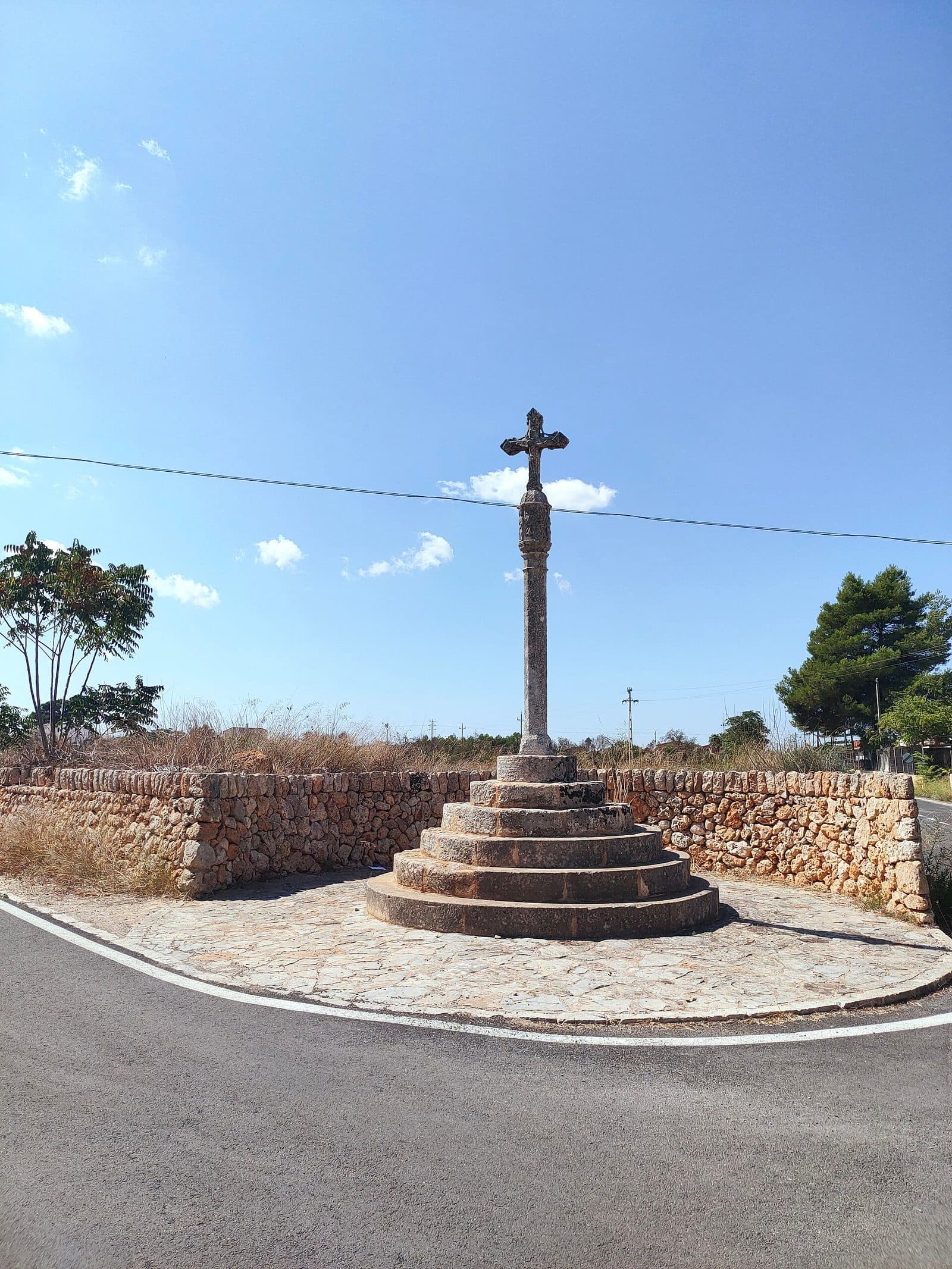

On the road from Algaida to Pina, Creu des Traginers is a small monument that tells far more than its unassuming location might initially suggest. The historic cross belongs to a group of religious local landmarks created as Algaida became established in the late Middle Ages. Anyone interested in Mallorca’s villages, their roads, and the development of their settlements will find this a noteworthy stop.
Creu des Traginers is a historic cross on the road to Pina. Its appeal lies in its context: the cross, the road, the neighboring traditional inns, and the connection to Pina form a historic streetscape. The monument is therefore best understood by looking not only at the cross itself but also at its location.
In historical sources, the cross appears as Creu de s’Hostal d’en Gi or Creu dels Traginers. Both names refer to the same historic landmark near Algaida and preserve different memories of its surroundings. A visit is especially worthwhile as part of a walk through Algaida or as a short cultural and historical stop on the way to Pina and Randa. For families, walkers, and travelers interested in everyday history, the cross offers a vivid introduction to an era when religious village crosses were erected.
History and significance
The history of Creu des Traginers does not begin with a single recorded event, but with the reorganization of an entire landscape. Toward the end of the 13th century, the population of what was then the territory of Castellitx was still widely scattered. Gradually, people concentrated in agricultural settlements and groups of farmsteads. Algaida developed into the most important center; Pina and Randa also remained established settlements, while others lost population.
The establishment of Algaida
During the 14th century, Algaida increasingly took shape as a permanent local center. A collection of farms and rural settlement sites became a village with its own religious and social heart. Various village crosses were erected as religious symbols within this historical context.
At the beginning of the 15th century, ecclesiastical importance also shifted from Castellitx to Algaida. During this period, the parish church of Algaida was given a more prominent role. The construction of the church and the various village crosses is associated with the same historical development. Creu des Traginers therefore belongs to the era in which Algaida consolidated its position as the principal settlement and made that development visible through permanent landmarks along its roads.
The cross on the road to Pina
Its location on the route from Algaida to Pina is crucial to understanding the monument. Historical sources place the cross on the road from Algaida to Pina, and the name Creu dels Traginers has been preserved for this historic landmark. Whether the name refers to a specific event is not recorded. However, the cross’s connection with the traditional Hostals and the road to Pina is documented.
A religious symbol in everyday surroundings
Creu des Traginers was one of several crosses in and around Algaida. Comparable sites included Creu d’en Massot, Creu des Colomer, Creu de Can Vicó, and Creu de Binicomprat outside the village, which is also known as the cross of the old cemetery or of the plague victims. Together, these monuments traced a network of historic roads and village boundaries.
Even in the 20th century, Algaida’s crosses were recognized in literature as typical religious symbols of the village. In a work from 1955, they appear in connection with a walk through the settlement. Creu des Traginers is explicitly located near the traditional Hostals. This shows that the cross not only survived as an old architectural landmark but continued to be seen as a recognizable point in the village landscape.
What to see
The first impression may be surprising: Creu des Traginers is a historic landmark within an active village and roadside setting. Its essential meaning emerges from the relationship between the cross, the road to Pina, and the area around the old Hostals. Anyone who looks only briefly at the monument therefore misses part of its significance.
Creu des Traginers
The cross itself is the main feature. Its historical classification as a Creu de terme and its location on the road to Pina are documented. Unlike a devotional image inside a church, such a landmark addresses everyone passing by: it stands outdoors and belongs to the shared space of the village.
The monument rewards close observation. What matters is not a sequence of spectacular architectural elements but the way the cross highlights an otherwise ordinary point along the road. This is precisely where its historical value lies: a place where traffic now passes as a matter of course was permanently marked by a religious symbol.
S’Hostal d’en Gi
An alternative name is Creu de s’Hostal d’en Gi. The name directly connects the cross with the area of a traditional Hostal, since historical sources locate it near the traditional Hostals. When visiting, it is therefore worth treating the name as more than a simple variant: Creu des Traginers and Creu de s’Hostal d’en Gi tell two sides of the same place.
The road to Pina
The route from Algaida to Pina provides the spatial key to understanding the cross. From here, the road leads from the principal settlement to another community within the municipality, and the monument stands along this connection. By stepping back and considering the course of the road, visitors can understand the site better than they can from close range. Through its location, Creu dels Traginers therefore tells of the connection between the two places while the landmark itself remained in position.
The crosses of Algaida
Creu des Traginers should be understood as part of a local group. The other documented crosses are distributed along roads, at junctions, and around the edge of the historic settlement area. Each has its own name, but together they illustrate how Algaida marked its roads and approaches with religious monuments.
For a walking route, this comparison is more revealing than searching for a single monumental highlight. Creu d’en Massot stands on Carrer de la Ribera, Creu des Colomer on the street of the same name, and Creu de Can Vicó at the junction of Carrer de Palma and sa Quarterada. Creu de Binicomprat, located outside the village, adds another historic boundary point to the picture. Within this network, Creu des Traginers marks the connection to Pina.
Visiting Creu des Traginers
A visit begins by looking at the cross itself. Its meaning then becomes clearer by considering the road to Pina and the area around the traditional Hostals.
A short stop with historical context
Anyone who only takes a souvenir photo and immediately moves on will need little time but will absorb little of the site’s history. It is more rewarding to use the monument as a starting point for a walk through Algaida, since the village streets and the other historic crosses add to the historical context.
It therefore makes little sense to prescribe a fixed visit duration. As an individual monument, Creu des Traginers can be viewed quickly. Combined with the village center, the other crosses, or a detour to Pina, it becomes part of a longer cultural and historical walk. The time required depends primarily on whether the cross is visited merely as a waypoint or as part of this broader story.
Observe rather than tour
The value of the visit comes from careful observation: Where does the monument stand in relation to the village center? In which direction does the road lead? Which names for the cross have been preserved? Questions like these reveal historic structures that are easily overlooked in an apparently ordinary roadside setting.
Creu des Traginers is therefore particularly suitable for travelers who appreciate small traces of old Mallorca and want to interpret evidence of religion and local development. Here they will find an unusually concentrated example.
Current visiting conditions
No confirmed opening hours or admission information are recorded. Because accessibility and local conditions may change, it is advisable to check current details before visiting. This is particularly important when Creu des Traginers is being approached as a specific excursion destination rather than encountered incidentally during a stay in Algaida.
Daylight is useful for viewing the site because not only the cross but also its surroundings form part of the attraction. No reliable information is available about typical peak times. Rather than assuming there is a supposedly perfect time to visit, the stop can easily be included in an already planned walk through Algaida.
Getting there and parking
Algaida lies in the center of the island, or in its southeastern interior, and is easily accessible from Palma and the airport via the main road network. The stated distances and driving times lead to Algaida, not directly to Creu des Traginers. For the final section, its historic location on the road from Algaida to Pina is the key reference point.
From Palma Airport
The road distance from Palma Airport to Algaida is 28 kilometers. The drive takes around 31 minutes via the Ma-5010. After reaching the village, follow the direction toward Pina for the final section. Creu des Traginers is located there in the area also associated with the traditional Hostals.
Because the cross forms part of the local streetscape, arriving here should not be confused with driving into a large visitor complex. It makes sense to navigate first to Algaida and then carefully follow the road out toward Pina. This keeps it clear that the measured driving time applies only to the journey as far as Algaida.
From central Palma
The road distance from central Palma to Algaida is 31 kilometers. The drive takes around 38 minutes via the Ma-15. This information also ends in Algaida. Within the village, continue toward the road to Pina and the historic Hostal area.
The route is well suited to an excursion into the island’s interior that combines several stops. Anyone traveling solely for the cross should remember that it is a brief historic stop. Combining it with a walk through Algaida or continuing to Pina and Randa creates a more coherent itinerary for the day.
By bus and on foot
Several bus stops in Algaida are located near the historic village area. Current routes, departure times, and walking directions should be checked immediately before traveling. From a bus stop, the final section is best reached via the local street network toward Pina.
When walking, it is important to understand the names correctly. References to Creu dels Traginers or Creu de s’Hostal d’en Gi indicate the same destination. These name variants are especially helpful when Catalan names are used locally.
Arriving by car
For parking, follow local signs in Algaida and leave the car only in officially designated or otherwise permitted spaces. From a suitable parking place in the village, the historical context is usually easier to appreciate on foot than during a quick photo stop from the car.
Bus lines to Creu des Traginers at a glance
| Line | Route | Departures/day | First | Last |
|---|---|---|---|---|
| 403 | Campos - Algaida - Palma | 92 | 06:45 | 21:50 |
| A42 | Cala Bona - Aeroport | 84 | 00:15 | 23:25 |
| 432 | Sineu - Algaida | 72 | 06:45 | 21:55 |
| 401 | Cala Millor - Palma | 42 | 00:50 | 23:52 |
| 431d | Algaida - Llucmajor | 8 | 09:10 | 17:30 |
From the official GTFS feeds (TIB/SFM), no real-time data. The figures cover all stops in the town; weekend and holiday services differ — check with the operator before travelling.
Getting there by bus
S'Hostal 2 (4008) · 0.6 km as the crow flies
- 401Cala Millor - Palma · Daily
- A42Cala Bona - Aeroport · Daily
S'Hostal 1 (4015) · 0.6 km as the crow flies
- 401Cala Millor - Palma · Daily
- A42Cala Bona - Aeroport · Daily
Ses Escoles 1 (4020) · 0.7 km as the crow flies
- 403Campos - Algaida - Palma · Daily
Ses Escoles 2 (4016) · 0.7 km as the crow flies
- 403Campos - Algaida - Palma · Daily
- 431dAlgaida - Llucmajor · Mon-Fri
- 432Sineu - Algaida · Daily
Sa Talaieta (4004) · 1.6 km as the crow flies
- 403Campos - Algaida - Palma · Daily
Alorda (4011) · 1.8 km as the crow flies
- 403Campos - Algaida - Palma · Daily
Timetable data: official GTFS feeds (TIB/EMT), no real-time — check with the operator before travelling.
Nearby places to visit
For Creu des Traginers, Algaida is not merely the nearest settlement but its historical setting. The cross was created during the era when Algaida became established as the principal settlement in the former territory of Castellitx. A walk through the village therefore reveals what the individual monument can only suggest on its own.
Algaida
In the village center, visitors can trace the development from the medieval settlement to the present-day small town. The parish church represents the shift of the ecclesiastical center to Algaida. Other historic crosses stand along streets and at junctions, while traditional houses and lanes preserve the rural character of the island’s interior.
A short route to the other village crosses is an especially natural choice. Creu des Traginers should not be treated as an interchangeable example: its particular connection is with the road to Pina, the Hostals, and its preserved name. Only comparison reveals the different settings of the crosses.
Pina
Pina was one of the settlements where the previously scattered population concentrated toward the end of the 13th century. The road leading there forms part of the geography that explains the location of Creu des Traginers. Continuing to Pina follows the direction marked by the cross.
For an excursion, it is enough to include Pina as a quiet counterpart and a second historic settlement within the municipality. The cross then becomes a link between two places rather than an isolated photo subject.
Randa and Puig de Randa
Randa was also among the settlements that endured during the medieval reorganization. The village and Puig de Randa are suitable additional stops when a visit to Creu des Traginers forms part of an excursion through the municipality. The sanctuaries there have a different emphasis but continue the area’s religious history.
This combination is particularly suitable for travelers who want to discover Mallorca’s interior beyond major standalone attractions. Algaida’s roadside cross stands on the road to Pina, while Randa represents religious retreats and an elevated landscape. Both perspectives can be combined during a day trip without presenting Creu des Traginers as a larger attraction than it actually is.
The place it belongs to
Algaida in the place guidePractical information for your visit
The essential point can be summed up in one sentence: expect a historic cross within a roadside setting. Almost all practical advice follows from this classification. The visit requires awareness of traffic, routes, and the understated details of the surroundings.
Clothing and footwear
Anyone combining the stop with a walk through Algaida or visits to the other crosses will be better served by comfortable shoes. The value of the visit comes precisely from walking between the individual historic points and changing perspective on roads, junctions, and village exits.
Because the monument stands outdoors, the visit should be adapted to the weather. Daylight makes it easier to recognize the course of the road to Pina and the relationship between the cross and its surroundings. Protection from sun or rain is particularly useful when planning a longer walk through Algaida.
Visiting with children
For children, the stop can be interesting if presented as a small discovery task: Where does the road lead, what is the cross called, and what other historic crosses are found in Algaida? This turns an initially quiet monument into an accessible introduction to the history of the village.
Because of its location beside a road connection, attention must be paid to traffic. Especially with younger children, the cross should not be viewed only from close range. A safe position from which the monument and the course of the road can be seen together is better suited to explaining the site in any case.
Understanding the names correctly
Different names may appear in sources and texts. Creu des Traginers, Creu dels Traginers, and Creu de s’Hostal d’en Gi all refer to the same historic cross on the road from Algaida to Pina. Knowing these variants prevents confusion with one of the municipality’s other crosses.
It is equally important to distinguish the site from similarly named structures elsewhere in Mallorca. The Creu des Traginers described on this page is exclusively the historic village and wayside cross near Algaida. Hotels, towers, or crosses in other municipalities are not part of this attraction.
What not to expect
The historical significance of Creu des Traginers lies in its location and its preserved names. Visitors who engage with these details will discover a piece of local history that is easily missed when passing by.
The visit is therefore most rewarding with a little preparation. Algaida’s medieval development, the location on the road to Pina, and the group of other village crosses provide the necessary background. With this knowledge, the monument appears not as a random roadside feature but as a preserved religious landmark from Algaida’s history.