
Torre de Son Durí – Mallorca’s Pirate Watchtower near Sa Ràpita
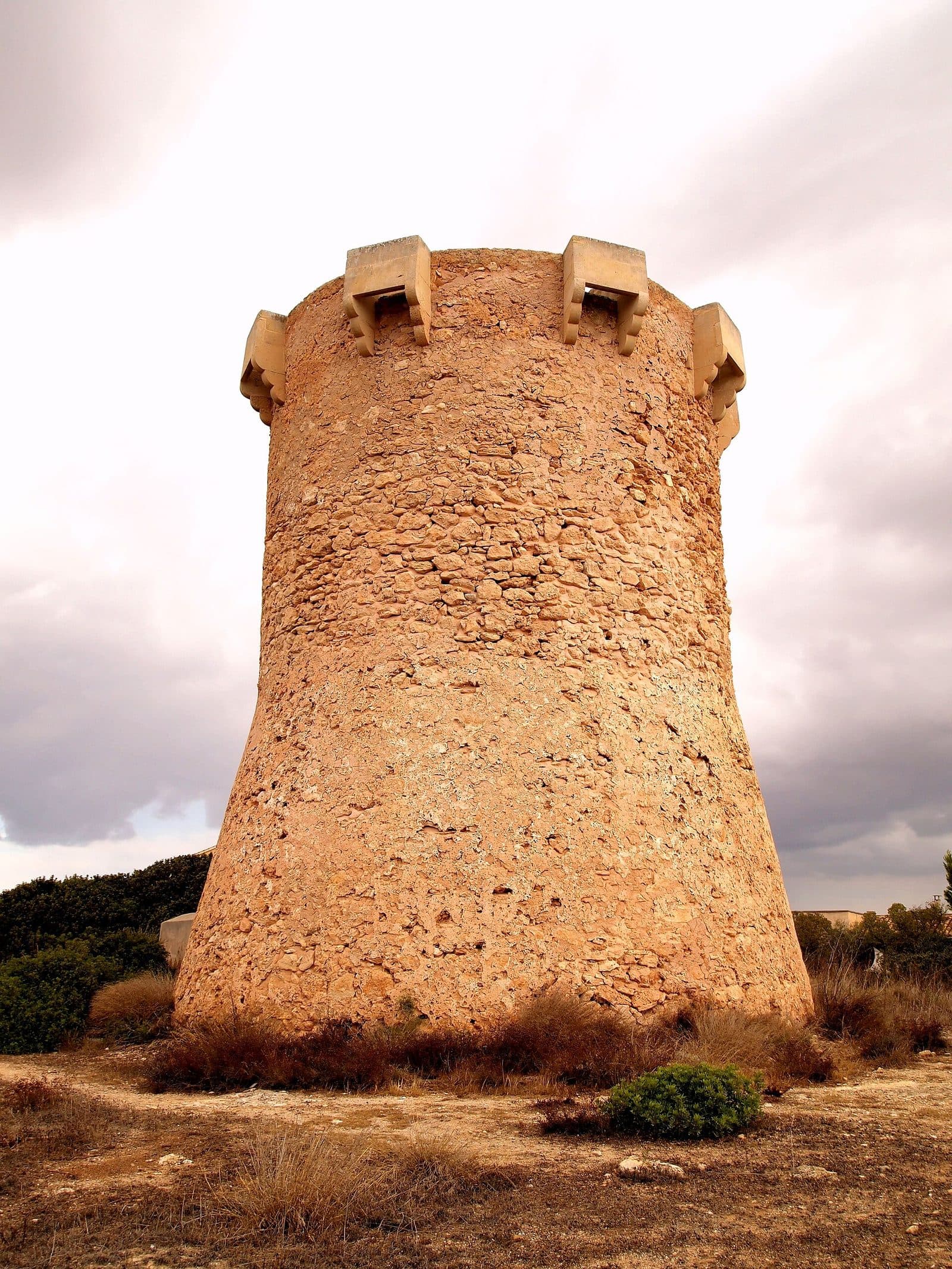

At the edge of the coast, Torre de Son Durí recalls a time when a sail on the horizon could mean danger. The historic watchtower near Dalt Sa Rapita stands at the entrance to Sa Ràpita and close to today’s harbor. Set between the town, the sea, and leisure boats, it initially appears to be a compact relic. Its location, however, immediately explains why it was built here: this point offered a view over the open stretch of coastline.
Torre de Son Durí formed part of the network of observation posts designed to warn Mallorca of pirates and corsairs during the early modern period. Smoke rose during the day, while fire could be seen from far away at night. In this way, a warning traveled from tower to tower until places farther inland also knew that a suspicious ship was approaching.
Today, Torre de Son Durí is worthwhile less as an extensive sightseeing attraction than as a focused insight into the coastal history of southern Mallorca. The structure is modest in scale, but its history is immediately understandable. Anyone interested in historic defenses, old cultural landscapes, or the development of Sa Ràpita will find this a brief but rewarding stop. A visit is particularly effective when combined with the harbor and coast. The tower then appears not as an isolated monument but as part of a landscape that was observed, protected, and used for centuries. Families can also explore a vivid chapter of island history here without a long museum tour.
History and significance
In the late 16th century, Mallorca’s coast was regularly threatened by pirates, Turkish corsairs, and raiders from North Africa. The wide-open bays in the south offered little natural protection. For residents, a sighting at sea therefore meant danger not only to ships: settlements, farms, and people inland could also become targets of an attack.
Built in 1595
Torre de Son Durí was built in 1595 on land belonging to the Son Durí estate. Its construction thus took place during the reign of Philip II, when numerous coastal posts on Mallorca were expanded or newly established. The defensive strength of an individual tower was not the only important factor, because the system’s real strength lay in the chain: each post watched a section of the sea and communicated with neighboring watchtowers by means of signals.
Torre de Son Durí was primarily an atalaya, meaning an observation and warning post. Its purpose therefore differed from that of a large fortress designed to withstand prolonged fighting or accommodate numerous soldiers. The priority here was early detection: the sooner suspicious movement at sea was reported, the more time people on land had to prepare.
The two tower guards
At times, two tower guards were responsible for duty, appointed by the former University of Campos. They kept watch, maintained the post, and had to trigger the warning signal in an emergency. This was precisely where their responsibility lay: ships had to be detected early and assessed correctly, because a delayed warning could weaken the entire system.
Smoke, fire, and cannon
When a ship was sighted, the guards alerted the next tower. Historical accounts describe the use of smoke as a signal during the day and fire at night. The neighboring post passed the warning onward, allowing the message to spread along the coast. This simple method required neither roads nor fast messengers and made use of exactly what the elevated lookout points provided: an unobstructed view.
Torre de Son Durí was also equipped with a permanently mounted cannon. This shows that the post was not used only for passive observation. Even so, the structure should not be imagined as a mighty artillery fortress: two guards and a single weapon indicate a small, purpose-built coastal post whose warning function remained its main role.
From watch post to cultural monument
The tower has survived as a visible witness to that era. On 30 November 1993, Torre de Son Durí was entered as a monument in Spain’s register of Bienes de Interés Cultural. This protected status emphasizes that not only the masonry but also the memory of Mallorca’s early modern coastal defenses should be preserved.
The tower has particular significance for Sa Ràpita. Anyone standing before it today is therefore looking not at a romantic backdrop but at a former link in a functioning communications network.
What to see
The tower is approximately five meters wide and ten meters high. Its proportions suit a small watch post: high enough to overlook the coast, yet compact enough to be maintained and defended by only a few men.
The tower structure
Torre de Son Durí was an observation and warning post where two guards performed their duties. Its equipment included a permanently mounted cannon.
The upper platform
The guards’ essential workplace was at the top. From there, they had to survey the sea and produce a signal. The elevated position turned a small tower into a far-reaching observation point, meaning that its military effectiveness depended less on size than on visibility.
The present-day surroundings still make this logic easy to understand. The coast lies on one side, while the approach to the town and inland areas lies on the other. Even without climbing the tower, it is possible to see why this particular location was chosen. Anyone who lets their gaze move from the masonry to the horizon mentally repeats the same movement that once defined the tower guards’ working day.
The location by the harbor
The contrast between the old watch post and the modern harbor is one of the most striking aspects of a visit. Where every unknown ship once had to be observed critically, leisure boats and the facilities of Club Nàutic now shape the coastline. The tower has not survived in an isolated landscape of ruins but in the middle of an area that continues to be defined by the sea.
That is precisely why the surroundings should be included when viewing the monument. From the water, its watch function becomes clear; from the town, so does its role as an advance warning post. Torre de Son Durí effectively marks the threshold between the open sea and inhabited land.
Traces of its historic use
The structure was intended for two guards and a permanently installed cannon. This limited equipment helps place its dimensions in the proper context. There was no extensive barracks behind the walls, and the tower was not a residential castle. It was a specialized workplace whose crew was expected to observe, warn, and intervene to a limited extent when necessary.
The name “Atalaya de La Rápita,” by which the tower is also known, leads directly to this function. An atalaya depends on its view and its connection to other observation points. Its most important invisible component was therefore the clear line of sight along the coast, because smoke and fire could serve their purpose only if the next post recognized the signal.
The monument in today’s townscape
Torre de Son Durí is not an extensive archaeological complex. Its impact comes from the clear, almost pictorial juxtaposition of tower, sea, and harbor. The tower now stands near the harbor on the coast, and this location makes it clear how closely its appearance is connected to the coastal setting. Anyone who takes only a quick photograph may therefore easily overlook the fact that the location itself tells most of the story.
Visiting Torre de Son Durí
Torre de Son Durí does not require a long tour. Its scale is manageable, and the essential context becomes clear simply by examining the structure and its coastal location. As a destination in its own right, it is especially suitable for travelers who enjoy looking closely at historic places without setting aside half a day for an excursion.
First the tower, then the horizon
It makes sense to examine the tower first and then deliberately turn your gaze toward the sea. Only in this order does it become clear that the structure is interesting not because of its interiors or decorative features but because of its role within a larger warning system.
The modern harbor can then be included in the interpretation. Today’s use of the coast provides a strong comparison: ships still form part of the scene, but they are now observed for entirely different reasons. The tower thus becomes a fixed point between a historic zone of danger and a present-day leisure area.
A short stop that requires preparation
No reliable opening hours or admission conditions have been recorded for the tower. Anyone traveling specifically in the hope of accessing the structure should therefore check the latest information immediately before visiting. Regardless of access, the exterior view and the tower’s place within the coastal landscape remain the core of the experience.
The appropriate length of a visit depends on how deeply you engage with its history and location. A brief stop is enough for a photograph; anyone exploring its history and coastal setting will stay correspondingly longer.
Part of a day on the coast
Torre de Son Durí works best as a historic introduction to or conclusion of a stay in Sa Ràpita. The tower stands near the harbor and coast, so there is no need to create an artificial sightseeing itinerary around it. After seeing the monument, visitors can continue to the water, the harbor area, or farther toward the beaches.
During the warmer months, the coast attracts particularly large numbers of visitors. The tower nevertheless remains a clearly defined sightseeing stop. Anyone who sees it not merely as a backdrop but studies its location can gain a coherent understanding of its former purpose even during a short visit.
Getting there and parking
Torre de Son Durí stands on the coast at the entrance to Sa Ràpita, near the harbor. The stated road routes initially lead to Dalt Sa Rapita. From there, continue through the local area toward the coast and Club Nàutic; current local signs or navigation should be used for the final section.
From Palma Airport
The road distance from Palma Airport to Dalt Sa Rapita is 38 kilometers. The journey takes around 40 minutes and follows the MA-6015. This information explicitly ends in Dalt Sa Rapita and not directly at the tower. For the remaining route, continue toward Sa Ràpita, the harbor, and the coastline.
The route leads out of the Palma metropolitan area and into the more rural south. Shortly before the destination, the character of the drive changes: instead of major roads, the approach to the coastal town and its local streets determine the route. The tower is not in the historic center of a town but where the settlement meets the harbor and sea.
From central Palma
The road distance from central Palma to Dalt Sa Rapita is 44 kilometers. The journey takes around 50 minutes. First follow the Ma-19 and then change to the MA-6015. Here too, the distance and journey time refer to Dalt Sa Rapita; the final section to Torre de Son Durí continues toward the coastal and harbor area of Sa Ràpita. Local signs, access regulations, and marked spaces should be followed when looking for parking.
By bus
Several bus stops are located in the wider harbor and Sa Ràpita area. These include Club Nàutic sa Ràpita 1 and Club Nàutic sa Ràpita 2, as well as Escorball and Av. Miramar 2. The stops at Club Nàutic are particularly useful reference points for reaching the tower because the monument stands in the harbor area.
Timetables and suitable connections should be checked before departure. After leaving the bus, the route does not lead to a remote mountain or hiking destination but toward the coast and harbor. The name Son Durí here specifically refers to the historic tower near Sa Ràpita, not to accommodation with the same name or another property on Mallorca.
Bus lines to Torre de Son Durí at a glance
| Line | Route | Departures/day | First | Last |
|---|---|---|---|---|
| 508 | Sa Ràpita - Palma | 100 | 06:25 | 23:05 |
| 518 | Sa Ràpita - Campos | 28 | 08:55 | 21:03 |
From the official GTFS feeds (TIB/SFM), no real-time data. The figures cover all stops in the town; weekend and holiday services differ — check with the operator before travelling.
Getting there by bus
Club Nàutic sa Ràpita 2 (13005) · 0.2 km as the crow flies
- 508Sa Ràpita - Palma · Daily
- 518Sa Ràpita - Campos · Daily
Club Nàutic sa Ràpita 1 (13006) · 0.2 km as the crow flies
- 508Sa Ràpita - Palma · Daily
- 518Sa Ràpita - Campos · Daily
Escorball (13026) · 1.0 km as the crow flies
- 518Sa Ràpita - Campos · Daily
Av. Miramar 2 (13003) · 1.2 km as the crow flies
- 508Sa Ràpita - Palma · Daily
Av. Miramar 1 (13004) · 1.2 km as the crow flies
- 508Sa Ràpita - Palma · Daily
Timetable data: official GTFS feeds (TIB/EMT), no real-time — check with the operator before travelling.
Nearby attractions
Torre de Son Durí belongs to Sa Ràpita, a coastal town in the municipality of Campos. The sea shapes not only the view but also the history: the coast once had to be watched, and the same stretch later developed into a harbor and holiday destination. The tower is the most visible link between these eras.
Dalt Sa Rapita and Sa Ràpita
Torre de Son Durí stands on the coast near the harbor. For visitors, this distinction is particularly important when navigating: according to the route information, the road journey ends in Dalt Sa Rapita; from there, continue toward the sea to reach the monument.
The name Sa Ràpita is often traced back to the Arabic word “ribat,” which could describe a fortified religious complex or defensive post. However, no structure from the Muslim period has been documented in the area. The surviving Torre de Son Durí is considerably more recent and clearly belongs to Mallorca’s early modern system of coastal watchtowers.
Sa Ràpita harbor
The harbor is the most obvious addition to a visit to the tower. Without traveling far, visitors can see how completely the relationship with the sea has changed. Armed vigilance has given way to leisure boats and civilian shipping, while the tower continues to stand above this stretch of coast.
The harbor also helps with orientation. The stops at Club Nàutic and the coastal location lead to the correct area. Anyone viewing the tower in relation to the harbor should not regard it merely as a modern backdrop: it demonstrates that this stretch has long been a point of contact between land and sea.
S’Arenal de Sa Ràpita and Es Trenc
A visit can easily be combined with the beaches near Sa Ràpita. S’Arenal de Sa Ràpita adjoins the coastal town, while the well-known natural beach of Es Trenc lies farther along the coast. Both destinations give the historic stop a scenic setting without reducing the tower itself to a mere secondary attraction.
The best order depends on the day’s itinerary. Before visiting the beach, Torre de Son Durí provides historical context for the open coastal landscape. After learning about the watchtower, the broad shoreline no longer appears merely idyllic: it also explains why this stretch was once considered vulnerable and had to be monitored from a watch post.
Campos and southern Mallorca
Campos can also be included as a cultural counterpoint to the coast. The municipality’s main town lies in an agricultural inland area, which also depended on warnings from the coastal guards for protection. A journey between Campos and Sa Ràpita therefore connects the two spaces that the historic signal system was intended to link: observation by the sea and timely warnings inland.
For a longer excursion through the south, Torre de Son Durí therefore provides a useful thematic anchor. It does not require an extended block of time but adds historical depth to the route between town, harbor, and beach. This manageable scale is precisely what makes it a worthwhile stop rather than a competitor to the day’s other destinations.
The place it belongs to
Dalt Sa Rapita in the place guidePractical visitor information
Torre de Son Durí is a historic coastal watchtower, not a large castle complex. A visit should therefore be planned with the expectation of a focused exterior viewing. The site’s value lies in its preserved structure, its position beside the sea, and its easily understood function within the former warning system.
Access and visiting the site
Because no reliable visiting hours or admission conditions have been recorded, any possible access should be checked in advance using current information. Even without entering, visitors can understand the tower’s historic location and function from the outside. It is worth viewing the structure together with the coastline.
The monument is not a destination that requires a long hike but lies within the town and harbor area. Even so, visitors should pay attention to local traffic routes, property boundaries, and notices at the structure. Historic masonry should be viewed only from accessible public areas.
Visiting with children
The tower’s history is easy to explain to children: two guards searched the horizon for ships and passed on warnings with smoke or fire when danger appeared. The idea of a message traveling from tower to tower along the island’s coast makes its function more vivid than a simple list of construction dates.
The visit is short enough to combine with the harbor and beach. The usual care is required near the water and in the traffic areas around the harbor. The appeal lies in interpreting the authentic historic setting.
How to understand the monument
The most important detail is the relationship between height and field of view. Anyone who mentally scans the horizon from the tower and then turns their gaze inland will understand the principle of the warning post. This small exercise makes the site understandable even without a guided tour.
For photographs, both the seaward side and perspectives including the harbor are effective. The former shows the original observation area, while the latter illustrates how the coast has changed. In both cases, Torre de Son Durí remains the historic focal point—a small structure with a task that extended far beyond its immediate location.
Local insider tips
Read the horizon
Do not photograph only the masonry: first look from the tower toward the open sea and then inland. This sequence immediately explains how the post detected ships and warned coastal residents.
Change perspective at the harbor
The clearest context emerges between the tower and Club Nàutic. On the same stretch of coast, the old warning post and today’s leisure boats show how fundamentally Mallorca’s relationship with shipping has changed.
Visit before the beach
Torre de Son Durí makes a good historic introduction before S’Arenal de Sa Ràpita or Es Trenc. After learning about the watchtower, the open coast appears not only beautiful but also as an area that was once difficult to protect.
Imagine the signal system
Mentally add smoke by day and fire by night at the top of the tower: only then does the individual structure become part of a communications chain that passed warnings from one coastal post to the next.