
Tren de Sóller – Ride Mallorca’s Historic Tramuntana Train
.jpg)
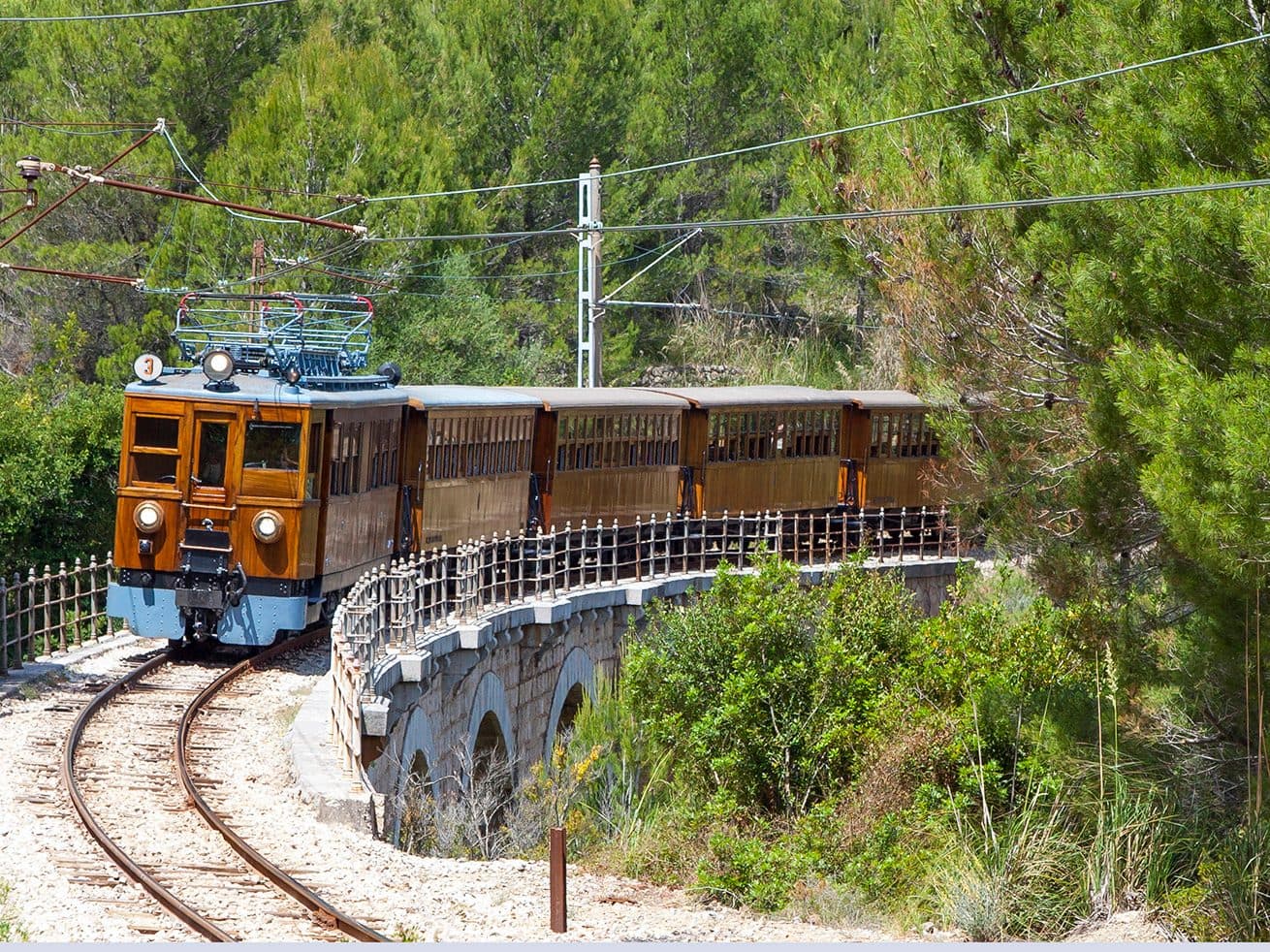
Even before the Tren de Sóller starts moving, the journey back in time begins: varnished wood, brass-colored fittings, sliding windows and the heavy sound of the old electric railcars set the scene. Then the train rolls out of Palma, crosses the island’s interior near Palmanyola and Bunyola, and finally disappears into the Serra d’Alfàbia. The Sóller Valley awaits on the other side.
The railway is not a museum backdrop but a working connection between Palma and Sóller that remains in operation today. This dual character is precisely what makes it special: You travel on a historic train while experiencing the very landscape whose mountains made the route necessary in the first place. Fields and settlements give way to rock faces, cuttings and tunnels; afterward, the view opens onto a valley shaped by orange and olive groves. For railway enthusiasts, the appeal lies in the rolling stock, stations and engineering structures. Anyone wishing to discover Mallorca through its landscapes gets a slow cross-section from Palma’s outskirts to the Tramuntana. Families can also enjoy the journey because it does not merely lead from one destination to another—it is the experience itself.
An important point regarding Palmanyola: The Tren de Sóller is a moving attraction, not a single structure with a continuously accessible visitor area. Palmanyola lies along the route, but the regular departure points for the train journey described here are Palma, Bunyola and Sóller. The historic tram from Sóller to Port de Sóller is a separate form of transport that connects with the train and should not be confused with the railway between Palma and Sóller.
History and significance
The story began not with a nostalgic excursion but with a very real transport problem. At the start of the 20th century, Sóller had a thriving economy and was known for its orange groves. The surrounding mountains, particularly the Serra d’Alfàbia, made it difficult to transport people and goods to Palma and its port. While the rest of Mallorca was already being opened up by a growing rail network, the valley behind the mountain barrier remained difficult to reach.
Jeroni Estades and the first plan
The entrepreneur and provincial representative Jeroni Estades took up the call for a rail connection. Initially, a route from Palma via Valldemossa and Deià to Sóller was studied; the concession was requested in 1893. High costs caused this project to fail. Only a more direct concept via Bunyola and through the Serra d’Alfàbia put the project on a path that could actually be implemented.
The later railway therefore represents more than technical daring: It also tells the story of a town whose economic development was limited by its geographical location. The train was not intended to present the valley more attractively but to overcome its isolation. That travelers now enjoy the very mountains, tunnels and cultivated landscapes that once formed the obstacle is one of the appealing twists in this story.
Construction through the Serra d’Alfàbia
Work began simultaneously from Palma and Sóller on 3 June 1907. After one year, the crew coming from Palma reached Bunyola. The most difficult task awaited there: A 2856-meter tunnel had to pass beneath the Serra d’Alfàbia. Further tunnels, deep cuttings and the routing of the line through terrain far more challenging for a railway than the plain around Palma added to the undertaking.
A small steam locomotive played a special role during construction. The contractor Luis Bovio had acquired the engine, built in England in 1891, from the Ferrocarriles de Mallorca. Named “María Luisa” after his daughters, it was used for construction and shunting work. In the railway’s history, it remains associated with the arduous work on the line—a small locomotive as the leading character in a major infrastructure project.
From a symbol of progress to a historic railway
The train opened in 1912. At the time, the connection gave Sóller access to Palma, the port and the rest of the island’s rail network. It facilitated both passenger travel and the exchange of goods and was a visible sign that the mountain location no longer had to mean complete isolation.
Today, a preserved electric railway with a historic appearance operates on the route. Its significance has shifted without its original function disappearing entirely: A project designed to promote economic development has also become one of the most vivid ways to experience Mallorca’s transport and landscape history. The Tren de Sóller does not preserve this history behind glass—it carries it forward on rails.
What to see
The Tren de Sóller’s most important exhibition space moves. While the flat interior of the island gives way to the Tramuntana slopes outside, hardly any detail inside the carriage feels neutral: Wooden surfaces, windows, fittings and reversible seats recall a time when travel was organized differently. At the same time, the tunnels, cuttings and stations are not decoration but parts of a technical ensemble that still functions.
The historic carriages
Passengers board via two steps and a glazed door. Inside, varnished wood on the floor, walls and ceiling, sliding windows, gold-colored lamps, and leather and metal seats combine to create a consistent historic appearance. In first-class carriages, sofas replace the usual seats. It does not feel like a themed railway created afterward but like a means of transport maintained with care over many years.
The reversible seat backs are a particularly practical detail. They can be positioned so passengers face one another or look in the direction of travel. Anyone wishing to watch the landscape should consider this option when boarding. The large windows turn the carriage into a moving viewpoint; depending on the section of the route, fields, settlements, mountain slopes, olive trees and the vegetation of the Sóller Valley appear immediately beside the tracks.
The sounds of operation are also part of the atmosphere. Even on the platform, you can hear coupling maneuvers, signals from the staff and the deep tones of the old railcars. On board, these are joined by the steady rolling, the pounding of the wheels and the abrupt change in acoustics when the train enters a tunnel. Precisely because the railway continues to operate, the historic impression is created not through staging but through movement and use.
Palma station
In Palma, the Tren de Sóller has its own station near Plaça d’Espanya. The ensemble consists of a modernist building with three sections, the sheds and the track area. Beneath the platform roof, visitors can watch the train being prepared while sheltered from the weather. Those who arrive early may be lucky enough to see a railcar coupled to the other carriages—an event that provides a better start to the visit than rushing aboard shortly before departure.
The “50 Landscapes of Mallorca” exhibition is also housed in a former shed. It brings together artistic views of the island’s natural environment by local and visiting artists. The exhibition fits the character of the journey well: First Mallorca is viewed in pictures, then the real landscape passes by the train window.
Palmanyola and the island’s interior
After leaving the urban area, the railway runs through the island’s interior toward Palmanyola and Bunyola. This section is easily underestimated because the dramatic mountains still lie ahead. However, it is important for understanding the route: Here, the transition from the metropolitan area around Palma to the agricultural landscape at the foot of the Tramuntana becomes visible.
Palmanyola is primarily part of the spatial experience of the route rather than the classic center of a railway visit. The journey gains its appeal from the sequence: Settlements and more open areas pass by, the mountain front draws closer, and only gradually does it become clear what a natural barrier the historical planners had to overcome.
Bunyola and the ascent
Bunyola is the intermediate stop where the character of the journey changes. Beyond the town begins the section of the line defined by its engineering and landscape. The track follows the terrain, runs through cuttings and heads toward the Serra d’Alfàbia. Anyone who has mainly been looking at the carriage until this point now turns almost automatically toward the windows.
The railway gains its appeal here not through speed but through proximity to the landscape. Rock, embankments and vegetation come close to the windows. Curves repeatedly alter the direction of view, creating not one single panorama but a sequence of brief scenes. The train reveals the Tramuntana piece by piece, as it were.
The main tunnel through the Serra d’Alfàbia
The 2856-meter main tunnel is the key engineering structure on the route. It made a direct crossing of the mountain barrier possible. During the passage, the landscape is replaced by darkness and the amplified sound of the wheels. This interruption makes the change afterward especially striking.
Beyond the tunnel lies a different topographical world. The railway reaches the Sóller Valley side, follows the difficult terrain through more tunnels and cuttings, and reveals changing views of mountains, terraces and cultivated land. Here, engineering cannot be separated from the landscape. Every curve and every opening in the rock shows how precisely the route had to be adapted to the terrain.
The Sóller Valley
After crossing the mountains, the destination does not immediately appear as a complete townscape. At first, the valley defines the journey: Olive and orange groves, slopes and surrounding ridges form the landscape whose economic use once helped prompt the railway’s construction. The historical narrative thus gains a visible counterpart. The orange groves are not merely an attractive addition but part of the valley’s history.
The view changes according to the side of the carriage, the curve and the vegetation. It is therefore worth avoiding focusing on a single window for the entire journey. Depending on the route, the windows opposite offer additional perspectives. Consideration for others is more important than the supposedly perfect photo.
Sóller station
At the destination, the historic experience continues inside the station. On the ground floor are two art rooms dedicated to Pablo Picasso and Joan Miró. The Picasso exhibition displays 50 ceramic works from the period between 1947 and 1971, including mythological subjects, female figures and bullfighting scenes.
The Miró exhibition includes 35 prints from the “Gaudí” series of 1979 and “Lapidari” of 1971. Miró’s connection to Sóller also extends through his family: His maternal grandfather came from the town. A traditional anecdote also links Miró and Picasso—during a visit to Paris in 1920, Miró is said to have brought Picasso a Mallorcan ensaimada. The station thus brings railway history and art together in one place.
Visiting the Tren de Sóller
A successful visit begins before departure. Anyone who arrives at the station in good time can examine the train at leisure, watch the shunting and find a suitable seat. The journey between Palma and Sóller takes about one hour. Considerably more time should therefore be allowed for a return trip; anyone including Sóller, the station exhibitions or the onward tram journey should plan a longer excursion.
Before departure
Timetables, operating days and ticket conditions may change and should be checked directly with the operator before visiting. Reliable current opening hours and admission prices are deliberately not reproduced here. The trains can be in high demand, so arriving spontaneously carries the risk of not securing a seat on the desired service. Advance booking is especially advisable if the day’s schedule depends on a particular journey.
On the platform, it is worth resisting the urge to head immediately for the first available door. First determine which carriage is accessible and how the seats are positioned. Anyone mainly interested in taking photographs will benefit from a window seat. For groups, the reversible seat backs are practical because they allow passengers to form a seating group without changing places during the journey.
During the journey
The route can be divided into three experiences: the open interior of the island, the ascent near Bunyola and crossing of the Serra d’Alfàbia, and the entry into the Sóller Valley. This sequence is more helpful than trying to photograph every minute. The transitions in particular tell the railway’s story: first the approach to the mountain wall, then the long tunnel, and finally the unexpected opening of the landscape on the other side.
The old carriages are part of the appeal, but they provide a different visitor experience from a modern excursion train. Passengers board via steps, the furnishings are historic, and the soundscape is a noticeable part of the ride. Anyone sensitive to train movement should choose a secure seat and avoid standing unnecessarily in the carriage on winding sections.
Arrival in Sóller
There is no need to leave the station immediately after arrival. The Picasso and Miró rooms add a cultural element that is easily missed when all passengers head directly toward the town center. Afterward, Sóller can be explored on foot, or the journey can continue toward Port de Sóller on the historic tram.
The train and tram should be treated separately when planning. The Tren de Sóller connects Palma, Bunyola and Sóller; the tram runs from Sóller to the port. Anyone combining both needs sufficient time between the individual sections. An overly tight schedule removes the sense of calm from a journey whose quality lies in the slow changes of landscape.
Crowds and planning your day
There is no universally best time of day because the timetable and demand depend on the date of travel. A firm reservation and early arrival at the departure station are more effective against crowds than relying on a supposed secret hour. Before departure, it is also easier to examine the carriages and details while the platform is not yet completely dominated by boarding groups.
About one hour of train time is sufficient for the one-way journey itself. As a complete excursion, however, the Tren de Sóller should not be squeezed between two tightly scheduled activities. The station, journey and art rooms alone justify additional time; Sóller and a possible onward trip to the port come afterward.
Getting there and parking
The special nature of this attraction means that getting there requires some explanation: A railway line does not have just one entrance. The listing places the Tren de Sóller near Palmanyola, but a regular journey requires one of the designated stations in Palma, Bunyola or Sóller. Simply traveling to Palmanyola does not automatically bring visitors to a boarding point for the historic train.
From the airport to Palmanyola
From Palma Airport, the road route initially follows the Ma-20 and then the Ma-11. Palmanyola is 20 road kilometers away, and the drive takes around 25 minutes. This information expressly ends in Palmanyola, not at the station in Palma, Bunyola or Sóller. Before the train journey, visitors should therefore decide in advance at which station they intend to board.
Anyone wishing to drive a rental car directly to the railway after landing should not select only the attraction’s name in the navigation system. It is more sensible to set the actual departure station as the destination. Otherwise, the location marker near Palmanyola may lead to a section of the route where trains pass but regular boarding is not available.
From Palma to Palmanyola
From central Palma, Palmanyola is 15 road kilometers away via the Ma-11. The drive takes around 30 minutes. This distance and travel time also refer to Palmanyola. Anyone wishing to experience the entire historic route should instead begin at the Tren de Sóller’s own station near Plaça d’Espanya and, if possible, leave the car out of the rest of the excursion logistics.
Starting in Palma has a thematic advantage: The landscape changes completely before passengers’ eyes, from the urban surroundings through Palmanyola and Bunyola to the mountain crossing. Boarding in Bunyola omits the first section but places the focus immediately on the ascent into the Tramuntana.
Parking and bus connections
Parking options depend on the chosen departure point and should not be confused with the general Palmanyola location. In Palma, the station is centrally located near Plaça d’Espanya. Local traffic and parking regulations apply in Sóller; visitor parking is mainly situated along the access roads, while parts of the center have restrictions.
Palmanyola and the neighboring area are served by public bus stops. However, these bus connections provide transport to the locality and do not replace a ticket for the Tren de Sóller. Before traveling, check whether the selected bus connection actually leads to a regular station or merely close to the railway line.
Bus lines to Tren de Sóller at a glance
| Line | Route | Departures/day | First | Last |
|---|---|---|---|---|
| 205 | Bunyola - Palma | 232 | 06:35 | 22:38 |
| 204 | Port de Sóller - Palma | 152 | 00:15 | 23:50 |
| 303 | Bunyola - H. Joan March - Palma | 111 | 06:58 | 21:50 |
From the official GTFS feeds (TIB/SFM), no real-time data. The figures cover all stops in the town; weekend and holiday services differ — check with the operator before travelling.
Getting there by bus
Urb. sa Coma 2 (10050) · 0.3 km as the crow flies
- 205Bunyola - Palma · Daily
- 303Bunyola - H. Joan March - Palma · Daily
Urb. sa Coma 1 (10049) · 0.3 km as the crow flies
- 205Bunyola - Palma · Daily
- 303Bunyola - H. Joan March - Palma · Daily
Raixa 2 (10026) · 0.4 km as the crow flies
- 204Port de Sóller - Palma · Daily
- 205Bunyola - Palma · Daily
- 303Bunyola - H. Joan March - Palma · Daily
Raixa 1 (10046) · 0.5 km as the crow flies
- 204Port de Sóller - Palma · Daily
- 303Bunyola - H. Joan March - Palma · Daily
Hospital Joan March (10012) · 0.6 km as the crow flies
- 205Bunyola - Palma · Daily
- 303Bunyola - H. Joan March - Palma · Daily
Pla de sa Coma (10044) · 0.8 km as the crow flies
- 205Bunyola - Palma · Daily
- 303Bunyola - H. Joan March - Palma · Daily
Sa Font Seca 2 (10008) · 1.3 km as the crow flies
- 205Bunyola - Palma · Daily
Sa Font Seca 1 (10007) · 1.4 km as the crow flies
- 205Bunyola - Palma · Daily
Clavells 2 (10019) · 1.8 km as the crow flies
- 205Bunyola - Palma · Daily
Clavells 1 (10020) · 1.8 km as the crow flies
- 205Bunyola - Palma · Daily
Son Amar 1 (10047) · 2.2 km as the crow flies
- 204Port de Sóller - Palma · Daily
- 205Bunyola - Palma · Daily
Son Amar 2 (10048) · 2.2 km as the crow flies
- 204Port de Sóller - Palma · Daily
Timetable data: official GTFS feeds (TIB/EMT), no real-time — check with the operator before travelling.
Nearby places
Palmanyola lies at the transition between the greater Palma area and the foothills of the Tramuntana. For the Tren de Sóller, the locality is less a classic excursion destination than a geographical section of the journey: The city is already behind you here, while the mountain front increasingly defines the horizon. This intermediate position explains why the railway is associated with Palmanyola even though the actual visitor experience extends across the entire route.
Bunyola
Bunyola is the obvious addition when the focus is on the railway’s mountain section. The station marks the transition from the more open island interior to the technically challenging ascent through the Serra d’Alfàbia. From here, it is particularly easy to understand why tunnels and cuttings were indispensable for the connection to Sóller.
Sóller
Sóller is the natural destination of the journey. From the station, the route leads into the old town around Plaça de la Constitució, where urban life centers on the church, historic façades and cafés. The station itself deserves attention for the Picasso and Miró exhibitions before the walk into the center begins.
The town can be understood through its railway history: Its mountain location made the valley difficult to reach for many years, while orange cultivation, trade and industry created the need for a better connection. What first appears from the train window as a cultivated landscape continues in Sóller as the town’s history.
Port de Sóller
From the urban area of Sóller, the historic tram continues to Port de Sóller. It is the classic extension of the excursion to the sea but operationally and geographically belongs to a different section from the train out of Palma. This distinction is important when planning time: Arrival on the Tren de Sóller does not automatically mean that the onward journey to the port connects immediately.
Anyone combining the train, Sóller and the port experiences three different aspects of the northwest: the railway journey through the mountains, the town in the valley and the sheltered bay on the coast. For a relaxed schedule, each part should be treated as a separate component of the visit rather than simply checking off as many stops as possible.
The place it belongs to
Palmanyola in the place guidePractical visitor information
The Tren de Sóller is a historic means of transport in active operation. That may sound obvious, but it changes expectations: There is no freely accessible path along the entire route, no viewpoint from which all the important engineering structures can be seen at once, and no arbitrary boarding point near Palmanyola. The experience comes from the station, carriage and journey.
Clothing and luggage
Hiking equipment is not required for the train journey. Comfortable shoes are nevertheless useful because passengers board via two steps, and an excursion usually includes walks through Sóller or a transfer to the tram. Light luggage makes boarding easier and prevents the historic carriage areas or passageways from being blocked unnecessarily.
At Palma station, the platform roof provides protection from the sun and weather. During the journey, the amount of light depends heavily on the carriage, side of the seat, tunnels and mountain slopes. For photographs, paying attention to reflections in the window is more helpful than constantly changing seats.
Photography
The best pictures are not found exclusively in the dramatic mountain scenery. In Palma, the coupling of the carriages, the fronts of the railcars and the wooden details provide calm subjects. Along the way, the approach to the Serra d’Alfàbia and the transition from the island’s interior into the Sóller Valley also tell the story of the route. Consideration is required inside the carriage as well: Doors, platforms and passageways are not photo spots that can be permanently reserved.
Visiting with children
For children, the journey is more vivid than an ordinary train ride because the tunnels, old carriages and visible operating procedures constantly provide new impressions. At the same time, it remains a moving means of transport. Passengers board via two steps; on winding sections, remaining seated is the calmer option.
A one-way journey of about one hour is easy to explain as a clearly defined part of the day. If the tram to the port is also included, the transport portion of the day becomes considerably longer. Breaks in Sóller prevent the special train experience from becoming merely a sequence of transfers.
What should not be confused
The Tren de Sóller and the tram to Port de Sóller are often grouped together under the same excursion name. In fact, the railway journey from Palma ends in Sóller. Only there does the onward tram journey to the port begin. Tickets, departures and time buffers should therefore be checked separately.
Likewise, Palmanyola is not an alternative name for Sóller station. The place name describes the area in which the attraction is located on this page; the defining experience remains the journey on the historic route. Anyone expecting only a stationary train to inspect misses the essential point: The Tren de Sóller reveals itself only when the carriages, engineering structures and landscape begin moving together.