
Tramuntana Building Regulations Mallorca: What You Can Build, Renovate and Buy in the UNESCO World Heritage Site
The Serra de Tramuntana is far more than a backdrop: since 2011, this mountain range in the north-west of Mallorca has officially held UNESCO World Heritage status, awarded on the basis of criteria ii, iv and v for its centuries-old cultural landscape of dry-stone walls, terraced fields and Arab irrigation systems. For you as a buyer, developer or renovator, this means thatTramuntana building regulations Mallorcafollow their own rules, which are considerably stricter than elsewhere on the island. This guide explains the protection categories that exist, what you need to obtain planning permission for, how the new legalisation amnesty works, what pitfalls to watch out for when buying, and what you can do in practical terms — before you sign.

Are you planning to buy or renovate a property in the Tramuntana?
- 📩 Submit a personal enquiry— we will connect you with vetted lawyers and architects experienced in the Tramuntana
- Everything about buying property in Mallorca
What the UNESCO designation means in concrete planning-law terms
The Serra de Tramuntana was inscribed by the UNESCO World Heritage Committee in 2011 as a cultural landscape (Decision 35 COM 8B.34). The protected status is based on three criteria:
| Criterion | Justification according to UNESCO |
|---|---|
| (ii) | An outstanding example of Arab irrigation systems adapted to an island landscape with scarce water resources |
| (iv) | A remarkable testimony to the history of human settlement in the Mediterranean region |
| (v) | A traditional agricultural cultural landscape defined by terracing and dry-stone construction |
UNESCO status does not in itself create a direct planning-permission requirement, but it does oblige Spain towards the international community to preserve the Outstanding Universal Value of the site. This is reflected in Balearic and municipal planning instruments that are considerably more restrictive for the area than elsewhere on Mallorca.
Please note:UNESCO protection applies to the entire cultural landscape — not just to individual monuments, but to the terraces, dry-stone walls, water channels and the skyline of the mountain villages as a whole. Any construction measure that alters this appearance is in principle subject to planning permission.
The most important protection instruments and who is responsible
In the Tramuntana, several planning levels overlap. Put simply: the closer a measure is to the core of the World Heritage site, the more authorities need to give their approval.
| Level | Instrument | Responsible authority |
|---|---|---|
| European/International | UNESCO World Heritage status | Monitoring by UNESCO Paris |
| National | Ley de Patrimonio Histórico Español | Ministerio de Cultura, Madrid |
| Balearic | Plan Territorial de Mallorca (PTM), Catàleg de Paisatge | Govern de les Illes Balears |
| Island Council | Pla Especial de Protecció de la Serra de Tramuntana | Consell de Mallorca |
| Municipal | PGOU of the respective municipality | Ayuntamiento (e.g. Sóller, Valldemossa, Deià) |
For construction projects in the Tramuntana, you will generally need both the municipal building permit (licencia de obras) and the approval of the Consell de Mallorca if your project affects the protection plan. For listed buildings, authorisation from the heritage authority is also required.
Building in Rural Areas: What Is Permitted on Suelo Rústico
The majority of the Tramuntana is classified as rural land (suelo rústico). Restrictive rules apply here as a matter of principle:
What is generally permitted:
- Repair and careful renovation of existing, legally built structures
- Restoration of dry-stone walls and traditional water systems (often actively encouraged and subsidised)
- Replacement or modernisation of technical installations within existing buildings (heating, plumbing, electrics) – provided the external appearance remains unchanged
- Photovoltaic installations on existing roof surfaces, as long as they do not visibly protrude above the ridge line (planning permission is still required, → more on this: Registering photovoltaic systems in Mallorca)
What is generally not permitted:
- New construction of residential buildings on undeveloped land
- Extension of existing buildings beyond their approved dimensions
- Alteration of the external volume (adding storeys, annexes)
- Demolition and rebuilding in a different form
- Filling in terraces or altering the ground profile
Please note: Whether a straightforward licencia de obras menores (minor building permit) suffices for a specific measure or whether a full licencia mayor with architectural plans is required depends on the municipality and the nature of the work. If in doubt, submit an enquiry to the relevant Ayuntamiento before you begin.
Step by Step: How to Apply for a Building Permit in the Tramuntana
Anyone wishing to build or carry out extensive renovation work in the Tramuntana should expect a lengthier process than elsewhere on Mallorca. The following sequence is typical for projects on rural land:
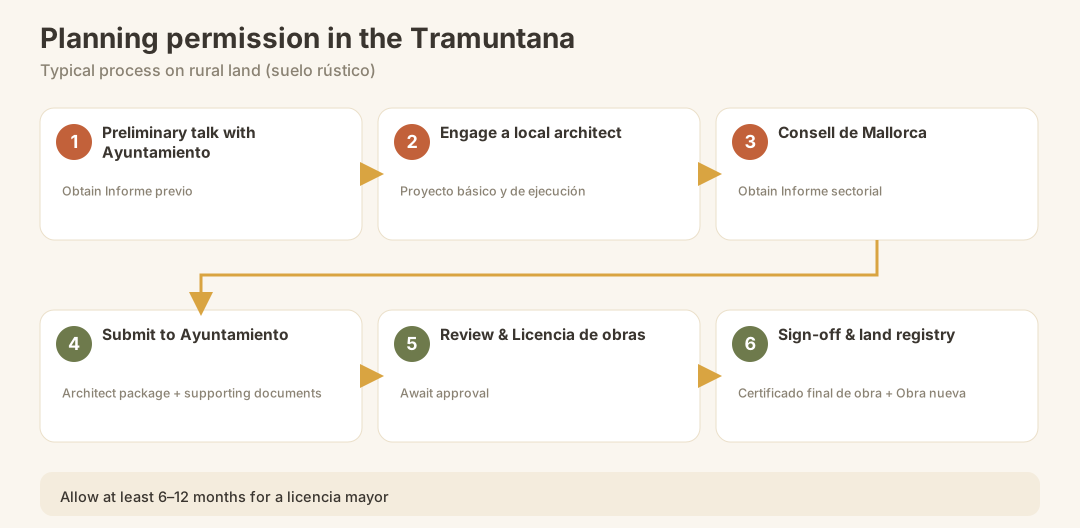
- Preliminary discussion with the Ayuntamiento – Obtain a prior report (Informe previo); clarify whether the plot is buildable at all and which protection categories apply
- Engage a local architect – Ideally one with Tramuntana experience; they prepare the project (proyecto básico y de ejecución)
- Pre-coordination with the Consell de Mallorca – For projects within the protected plan area, an Informe sectorial from the Consell is required
- Submission to the Ayuntamiento – Complete architect's package, cadastral extract, land registry extract, proof of the legality of the existing structure
- Review by the municipality and, where applicable, the Consell – Can take several months depending on the municipality
- Granting of the licencia de obras – Construction may only begin once this has been issued; the start of works must be notified
- Completion inspection and Certificado final de obra – Sign-off by the architect and technical engineer
- Entry in the land registry – Update of the Obra nueva, important for sale and financing
Please note: In the Tramuntana, planning approval procedures typically take longer than in coastal areas. As a rule, allow at least 6–12 months for a licencia mayor — and considerably longer for listed properties.
Renovation: what is possible, what is not — and what you need to document
Particularly for Germans buying an old finca or a mountain village house, the question of what can be renovated is crucial. The basic rule is: as long as you stay within the existing structure and do not materially alter the external appearance, you have significantly more flexibility than with new builds.
| Measure | Approval requirement | Notes |
|---|---|---|
| Interior fit-out (floors, walls, ceilings) | Obra menor / notification may be required | No structural alteration |
| Façade restoration using original materials | Obra menor, heritage authority may be involved | Colour and materials must be typical of the local area |
| New windows / doors (same format) | Obra menor | Check listed building status |
| Roof renovation (same form, same material) | Obra menor to mayor, depending on the municipality | Traditional materials (terracotta, natural slate) often required |
| Installation of a pool / swimming pond | Licencia mayor required | In many areas only permitted under strict conditions |
| Air conditioning (outdoor unit) | Licencia menor or notification obligation | Visibility is the decisive factor (→ Installing air conditioning in Mallorca) |
| Garage / carport | Licencia mayor depending on the municipality | Frequently only permitted as a subordinate outbuilding |
| Erecting/restoring a dry-stone wall | Generally no permit required | In some cases even publicly subsidised |
What you need to demonstrate at the time of purchase: For every structural measure you intend to carry out after the purchase, you must provide evidence that the existing building is legal. This means: the planning permission (licencia de obras original), the completion certificate (certificado final de obra), and the land registry entry (obra nueva) must all be on file without any gaps for every part of the building.
Buying in the Tramuntana: the most important due-diligence points
Sóller, Port de Sóller, Deià, Valldemossa, Fornalutx, and Banyalbufar in particular are especially popular with German buyers. At the same time, the risk of acquiring a 'problem property' is particularly high here – because decades of unregulated building practice have left behind what the Spanish describe as alegalidad : built, not approved, statute-barred – but without any legal certainty.
Checklist before purchase:
- Check the land registry extract (Nota Simple) for encumbrances and correct floor areas (→ Checking the Spanish land registry)
- Cross-reference the cadastral extract with the land registry: do the floor area, built structures, and location match?
- Request planning permissions for all parts of the building – not just the main house, but also pools, outbuildings, and terraces
- Check whether the building is listed (Bien de Interés Cultural, BIC, or Catàleg municipal)
- Clarify the protection category of the plot under the Pla Especial de la Tramuntana
- Water rights and cistern/well: Are existing water supply installations legalised? (→ Legalising wells in Mallorca)
- Check access rights and right-of-way easements – often unclear on remote fincas
- Energy certificate in place? (→ Energy certificate Spain)
Note: Have the checks carried out by an independent lawyer (Abogado) without fail – not just by the estate agent. In the Tramuntana this is not an optional luxury but an absolute must. A detailed overview of the entire purchase process can be found under Legal process for buying property in Mallorca.
The legalisation amnesty 2024/2025: an opportunity for unauthorised buildings
Since May 2024, Mallorca has activated an extraordinary regularisation opportunity based on Decreto-Ley 3/2024 and the subsequent Gesetz 7/2024. It allows buildings on rural land to be legalised where the planning law limitation periods have already expired – in other words, buildings that can no longer be demolished but which were previously in a legal grey area.
| Island | Start of period | End of period (3 years) |
|---|---|---|
| Mallorca | 15. Februar 2025 | 15. Februar 2028 |
| Menorca | 25. März 2025 | 25. März 2028 |
| Ibiza | 3. April 2025 | 3. April 2028 |
| Formentera | following separate publication | depending on announcement |
What the amnesty means in practice:
- First-time granting of a municipal licence for buildings that were previously not formally recognised
- Associated with this: connection to public utility networks (water, electricity, fibre optic)
- Legal basis for renovations and conversions
- Possibility of clean registration in the Land Registry
What the amnesty does not cover:
- No automatic legalisation – the process requires documentation, an architect's input and official review
- No free pass for all unauthorised buildings: structures in certain protected zones or on protected land are expressly excluded
- No retrospective effect on demolition orders already in force
Please note: The amnesty can in principle also be applied for in the Tramuntana – but this is precisely where the exceptions are particularly relevant. Whether a building is eligible for amnesty must be assessed on a case-by-case basis by an architect and a lawyer. More on this in the guide Legalising an unauthorised building on Mallorca.
Holiday lettings in the Tramuntana: what you need to know
Anyone wishing to let a Tramuntana property as holiday accommodation will encounter an additional layer of regulation. New ETV licences (Estancias Turísticas en Viviendas) are heavily restricted across large parts of Mallorca. The Consell de Mallorca has opened a new quota call for 1.069 places – but the Tramuntana municipalities are among the most tightly regulated areas.
Before buying a property in Deià, Sóller or Banyalbufar with the aim of holiday letting, you must clarify:
- Does the property already hold a valid ETV licence?
- Is the building in a zone that is even eligible for new licences?
- Alternatively: is long-term letting the better option? (→ Long-term letting on Mallorca)
More details on the current licensing situation can be found in the guide ETV licence Mallorca.
The most common mistakes when buying and building in the Tramuntana
These are the mistakes we encounter time and again in our advisory work – and some of them are extremely costly:
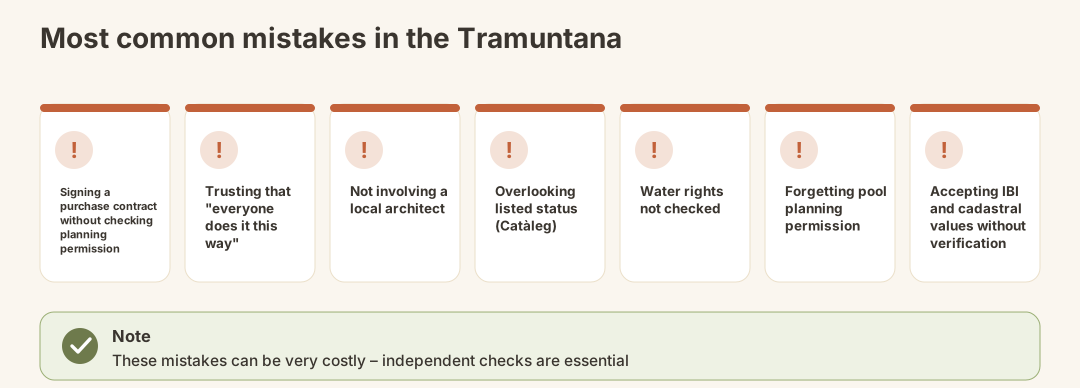
- Signing the purchase contract without a thorough review of planning permissions – Particularly with older fincas, permissions for extensions built decades ago are often missing. Whoever signs takes on the problem.
- Relying on the fact that "everyone does it this way" – The expiry of the limitation period for a planning infringement does not mean the building is legal. The new owner cannot be compelled to demolish, but they also cannot carry out renovations or alterations.
- No local architect involved – Anyone planning with an architect from Palma or even from Germany will often overlook the specific Tramuntana requirements of the relevant municipality.
- Heritage classification overlooked – Many mountain village properties are listed in the municipal catalogue (Catàleg). This considerably restricts renovation work and lengthens the planning approval process.
- Water rights not checked – The Tramuntana has a complex system of spring rights, cisterns and old rights of way for water pipes. Not everything is recorded in the land registry.
- Pool permit forgotten – Many fincas have pools without planning permission. This must be checked when purchasing, as the new owner will need to either legalise the pool or have it removed.
- Accepting IBI value and cadastral value without verification – If the building is registered in the cadastre as smaller than it actually is, this is an indication of non-legalised floor space. (→ IBI Tax Spain)
What comes after the purchase? Taxes, costs, obligations
Even after a successful purchase, there are a number of planning law and tax matters to bear in mind:
| Topic | Special considerations in the Tramuntana |
|---|---|
| ITP (Property Transfer Tax) | Applies as elsewhere in the Balearic Islands; no special regulation for the Tramuntana |
| IBI (Property Tax) | Calculated on the basis of the cadastral value – non-legalised floor space may result in a reassessment |
| Licencia de primera ocupación | Often missing for existing buildings – check whether it can be obtained retrospectively |
| Maintenance obligations | Dry-stone walls and terraces: the owner is responsible for their upkeep |
| Energy certificate | Required for sale and rental (→ Energy Certificate Spain) |
You can find a complete overview of the purchase ancillary costs in Mallorca at Purchase Ancillary Costs Mallorca.
Checklist: buying and building a Tramuntana property
Before the purchase:
- Clarify the protection category of the plot in the Pla Especial de la Tramuntana
- Obtain and compare the Land Registry entry (Nota Simple) and cadastral extract
- Check all planning permissions and completion certificates for all parts of the building
- Clarify listed building status (BIC, Catàleg municipal)
- Check water rights and well/cistern
- Clarify access and right-of-way easements
- Check ETV licence if holiday rental is planned
- Instruct a lawyer (Abogado) to carry out independent due diligence
For building projects and renovations:
- Obtain an informe previo from the Ayuntamiento
- Engage a local architect with Tramuntana experience
- Check whether an informe sectorial from the Consell de Mallorca is required
- If unauthorised construction is suspected: have amnesty eligibility assessed (until Feb. 2028)
- Begin construction work only after written approval has been granted
- Final inspection (certificado final de obra) and land registry entry upon completion
Conclusion: The Tramuntana is not a normal property market
The Serra de Tramuntana is one of the most fascinating residential areas in Europe – and at the same time one of the most legally complex. The UNESCO status is not a marketing label; it translates into concrete planning instruments that almost entirely exclude new construction, regulate renovations, and compel buyers to look very carefully before committing.
Anyone buying an old finca or a mountain-village house here acquires something irreplaceable – but also a responsibility. The legalisation amnesty that began on 15 February 2025 on Mallorca and runs until February 2028 offers some properties a genuine opportunity to achieve legal certainty for the first time. Make use of it if it applies to your property.
Do not be dazzled by beautiful photographs and low prices: an independent legal and architectural assessment is not optional in the Tramuntana – it is an absolute prerequisite for a secure investment.
📩 Submit an enquiry now – we will help you find the right specialists.
Official sources
- UNESCO World Heritage Centre – Cultural Landscape of the Serra de Tramuntana: https://whc.unesco.org/en/list/1371
- UNESCO Decision 35 COM 8B.34 (inscription decision 2011): https://whc.unesco.org/en/decisions/4305
- Consell de Mallorca – Pla Especial de Protecció de la Serra de Tramuntana: https://www.conselldemallorca.cat
- Govern de les Illes Balears – Decreto-Ley 3/2024 and Ley 7/2024 (Regularisation of Rural Land): https://www.caib.es
- BOIB (Butlletí Oficial de les Illes Balears): https://www.caib.es/govern/sac/fitxa.do?lang=ca&coduo=2&codi=2290
- Agència Tributària de les Illes Balears (ATIB) – Tax information for the Balearic Islands: https://www.atib.es
- Catastro España – Cadastral enquiries: https://www.sedecatastro.gob.es