
Fuera de ordenación in Mallorca: what planning law (LUIB) allows
Anyone who buys or owns a finca, country house, or extension in suelo rústico in Mallorca will sooner or later come across the term fuera de ordenación mallorca. It sounds technical, but it has very concrete consequences: it determines whether you're allowed to extend or renovate, whether a bank will finance the property at all, and whether your insurance will pay out in the event of a claim. In this guide you'll learn how the Ley de Urbanismo de las Illes Balears (LUIB) defines the status, what three subcategories exist, how the extraordinary legalisation from 2025 to 2028 works – and what you specifically need to watch out for when buying, financing, and insuring such a property.

What does "fuera de ordenación" mean in Mallorca?
Fuera de ordenación is not a synonym for "illegal", but nor is it a legal grey area. Under Spanish building law there is no category of "alegal" — every construction is either compliant with current planning (legal) or it isn't (illegal). Fuera de ordenación refers to a special sub-case: a building that does not comply with the current development plan, but where — because the planning violation has expired under the statute of limitations, or because the building is subject to future expropriation — a demolition order can no longer be, or is not intended to be, enforced.
The legal basis is the Ley 12/2017 de urbanismo de las Illes Balears (LUIB), in particular Article 129. The LUIB first distinguishes between three types of land — urbano, urbanizable, and rústico (Art. 18 and 21 LUIB) — and then regulates in Art. 129 how existing buildings that no longer conform to current planning should be handled.
Note: This status doesn't only affect remote fincas inland. Houses near the coast can also end up in a similar situation due to the Ley de Costas or subsequent development plans. You can read more about this in our guide to the Ley de Costas Mallorca.
The three categories under Article 129 LUIB
The LUIB first distinguishes "inadecuadas" (inappropriate but fundamentally compatible buildings) from buildings actually classified as "fuera de ordenación". This isn't mere semantics — the legal consequences differ significantly, especially regarding permitted renovation work.
| Category | Legal basis | Typical characteristic | Permitted work |
|---|---|---|---|
| Inadecuada | Art. 129.1 LUIB | Legally built under an old plan, no longer complies with the current plan, no expropriation/demolition planned | Hygiene, safety, repair, consolidation, refurbishment, rehabilitation, energy modernisation |
| Fuera de ordenación a) | Art. 129.2.a LUIB | Building affected in future by expropriation, gratuitous transfer, or demolition | No consolidation, no increase in volume, no modernisation |
| Fuera de ordenación b) | Art. 129.2.b LUIB | Built without a licence, restoration obligation time-barred | Strongly restricted, interpreted differently depending on the municipality |
| Fuera de ordenación c) | Art. 129.2.c LUIB | Originally legal, then extended or altered without authorisation | Only affects the unauthorised part, the rest remains regularly usable |
Important for buyers: A survey report or a designation as „fuera de ordenación" alone says nothing about which sub-case applies. You need to have this checked in detail before signing a reservation contract.
Bestandsschutz vs. legalisation: the crucial difference
In the German-speaking community, people often speak of „Bestandsschutz" (grandfathering) when the limitation period for a building irregularity has expired. This means: the administration can no longer order demolition. However, it does not mean that the building automatically becomes legal.
- Limitation (Prescripción): The authority may no longer demand restoration measures – but the building remains formally illegal.
- Legalisation (Legalización): Only a formal procedure – in suelo urbano the regular Licencia de Legalización, in suelo rústico the extraordinary procedure – actually makes a building legal.
In suelo urbano, the municipality can grant a Licencia de Legalización if an „as-built" project is submitted and the overall building meets current requirements. If it does not meet them, the property remains permanently irregular. In suelo rústico, legalisation was until recently practically impossible – only buildings from before 1956 could be recognised through exceptional procedures. This is exactly what has changed with the new law.
The extraordinary legalisation 2025–2028: deadlines and costs
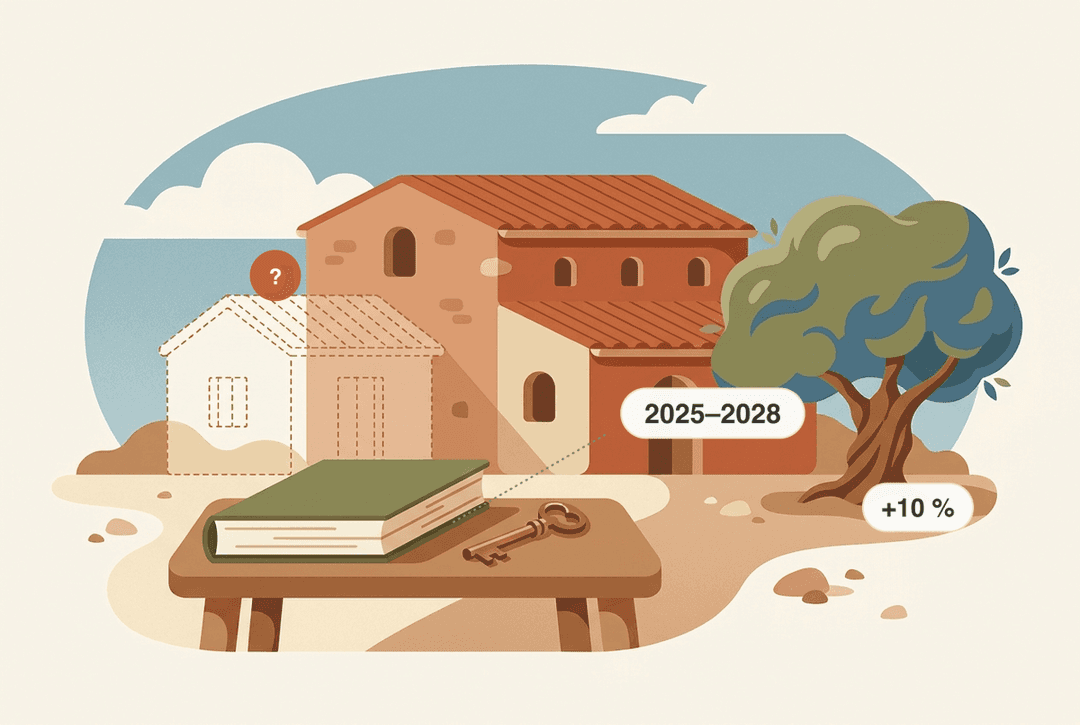
With the Decreto Ley 3/2024 of 24 May 2024 and the subsequent legal confirmation (with the seventh additional provision, Disposición Adicional Séptima, DA7ª), the Balearic legislator created a time-limited window to retroactively legalise certain buildings in suelo rústico común. The Consell de Mallorca even had to pass the implementation procedure in plenary session twice, because the DA7ª was amended in the meantime – the final version was adopted on 13 February 2025.
| Event | Date | Significance |
|---|---|---|
| Decreto Ley 3/2024 | 24.05.2024 | Legal basis for the extraordinary legalisation created |
| Renewed plenary resolution of the Consell de Mallorca | 13.02.2025 | Procedure finally adopted after adjustment of the DA7ª (Conseller Fernando Rubio) |
| Publication in the BOIB | 15.02.2025 | Start of the three-year period for Mallorca |
| End of Phase 1 (most favourable surcharge) | 16.02.2026 | 10 % of the current building value as surcharge |
| Phase 2 | from the 2nd year onwards | the percentage rises noticeably – ask your local town hall for the current rate |
| end of the entire procedure | 15.02.2028 | After that, participation in the extraordinary legalisation is no longer possible |
Please note:Anyone who misses the first, cheaper phase will pay a significantly higher surcharge from the second year onwards. The press reported at the beginning of 2026 on a veritable rush on the authorities shortly before 16 February 2026 – in Pollença alone, around 300 applications were submitted, which noticeably delayed the processing of other building permits in the municipality.
Requirements and exclusions: who is allowed to legalise?
Not every property in suelo rústico can benefit from the procedure. The most important requirements:
| Requirement | Explanation |
|---|---|
| Location in suelo rústico común | Only "ordinary" rural land – not suelo rústico protegido |
| No valid building permit | The building was constructed without a licence or with one that was later annulled |
| Bestandsschutz (grandfathering) has taken effect | The obligation to restore has lapsed (Prescripción) |
| No ongoing sanction proceedings | There must be no open proceedings for a building regulation violation |
| Technical documentation | Evidence of environmental compatibility, safety and energy efficiency from an architect/engineer |
Plots in suelo rústico protegido, i.e. specially protected zones such as ANEI or ARIP, are excluded. In some municipalities this accounts for a significant proportion of the area – in Calvià, for example, more than 80% of the suelo rústico lies within such protected zones. It is best to clarify early on whether your plot is affected; more on this in the guide ANEI & nature conservation.
Buying a fuera-de-ordenación property: opportunities and risks
Fincas with fuera de ordenación status are often offered more cheaply – for good reason. Legally speaking, these are buildings whose renovation options are restricted and whose non-compliance with current regulations can significantly reduce the property's value. Before buying, you should therefore clarify:
- Which of the three sub-categories under Art. 129.2 LUIB does the building actually fall into?
- Is the statute of limitations actually running, or is there still an open sanction procedure?
- Is the plot located in suelo rústico común or protegido?
- Is participation in the extraordinary legalisation procedure by 2028 realistically possible?
- What requirements (Cédula de Habitabilidad, energy requirements) exist independently of the building law status?
Note: Always check the status before signing the reservation agreement, not just at the notary. Details on the usual procedure can be found in the guide Reservation Agreement Spain and on the general purchase process at Property Purchase: Process.
Renovation and Refurbishment: What's Allowed, What's Not?
The permissible scope of works depends directly on the category your building falls into:
- Inadecuada (Art. 129.1): Repair, consolidation, reform, rehabilitation and energy modernisation are generally permitted.
- Fuera de ordenación a) (Art. 129.2.a): No consolidation, no increase in volume, no modernisation – the administration wants the building to disappear in the long term.
- Fuera de ordenación b) and c): The scope is narrow and is often interpreted differently by the respective municipality.
For every measure, the general approval system of the LUIB also applies: larger interventions require a Licencia Urbanística (Art. 145/146 LUIB), while smaller measures can be declared via a simplified Comunicación Previa (Art. 145/148 LUIB). Important: even after a successful extraordinary legalisation, the procedure does not automatically replace every future building permit – for renovations, you still need to go through the regular route via the municipality. More on this in the guide Building Permit Mallorca.
Financing and Insurance: What Banks and Insurers Look At
The fuera de ordenación status affects two areas in practice that are easily underestimated when buying:
Financing: Banks generally assess properties with limited renovation and rebuilding capacity more cautiously, because a possible loss of value – for example due to missing expansion options or a looming demolition order for category a) – reduces the mortgage lending value. Before agreeing to a loan, clarify explicitly with your bank or financing advisor whether, and under what conditions, a property with this status can be financed at all. Background on mortgage lending to non-residents can be found in the guide Mortgage Non-Resident Spain.
Insurance: Insurers, too, often ask about the building law status when concluding a contract. Particularly for buildings in category fuera de ordenación a) – for which no consolidation or modernisation is permitted – a full rebuild can become problematic in the event of damage if it goes beyond the existing structure. Discuss the status openly with your insurer before taking out a policy; details on insuring residential property in Spain can be found in the guide Home Contents Insurance Spain.
Process of Extraordinary Legalisation: Step by Step
- Status check: Clarify whether the building is located in suelo rústico común and which sub-case under Art. 129.2 LUIB applies.
- Proof of grandfathered status: Prove that the restoration obligation has expired under the statute of limitations and that no sanction procedure is underway.
- Prepare technical documentation: An architect or engineer draws up evidence regarding environmental compatibility, safety and energy efficiency.
- Submit the application to the responsible Ayuntamiento: Ideally within the more favourable first phase (until 16.02.2026).
- Pay the surcharge: In Phase 1 usually 10 % of the current building value, higher thereafter.
- Await the decision and update the registration: After a positive decision, have the cadastral entry and, if applicable, the land registry entry adjusted.
Note: Due to the high volume of applications (as in Pollença with around 300 cases), processing times at the municipalities may increase – allow sufficient lead time before 16.02.2026.
Most common mistakes
- Confusing grandfathered status with legality: Just because a demolition claim has expired does not automatically make the building legal or freely convertible.
- Missing the deadline: Anyone who misses the first phase by 16.02.2026 will pay a higher surcharge from the second year onwards.
- Not checking the subcategory: A "fuera de ordenación a)" building allows significantly less than an "inadecuada" property.
- Overlooking protected zones: In suelo rústico protegido (ANEI, ARIP), extraordinary legalisation is generally excluded.
- Converting without a permit: Even after successful legalisation, any further construction work requires a regular Licencia or Comunicación Previa.
- Clarifying financing only after the reservation: Banks should be informed of the status early on to avoid surprises when the loan is approved.
What happens after 2028?
If the three-year deadline expires on 15 February 2028 without a legalisation application having been submitted, the affected building will permanently remain in fuera de ordenación status – with all restrictions on conversion, financing and resale. A renewed chance for a comparable procedure is currently not foreseeable.
You should also know: a lawsuit against the legal basis of the amnesty regulation is pending before the Spanish Constitutional Court (Tribunal Constitucional), which was admitted for review in June 2025. The outcome of these proceedings is uncertain and could affect the long-term legal certainty of properties already legalised – all the more reason to seek legal advice for larger investments.
Checklist: checking Fuera de Ordenación before purchase
- Land classification checked: suelo urbano, urbanizable or rústico (Art. 18/21 LUIB)?
- Subcategory identified according to Art. 129 LUIB (inadecuada or fuera de ordenación a/b/c)?
- Location on suelo rústico común or protected (ANEI/ARIP) clarified?
- Grandfathering (Bestandsschutz) proven, no open sanction proceedings?
- Deadline for the extraordinary legalisation (until 15.02.2028) kept in mind, ideally Phase 1 by 16.02.2026?
- Bank/financing partner informed about the status and mortgageability clarified?
- Insurer informed about the planning/building law status?
- Necessary documents such as Cédula de Habitabilidad or energy certificate available?
Conclusion
Fuera de ordenación is a precise legal term on Mallorca with three sub-cases under Art. 129 LUIB – not a vague grey area. Anyone buying, renovating, financing or insuring such a property should know the exact status before any money changes hands. The extraordinary legalisation until 15 February 2028 offers many owners a real chance at legal certainty – but only if location, category and deadlines are carefully checked. Those who act now secure the more favourable conditions of the first phase and avoid unpleasant surprises with banks and insurers.
Official sources
- Consell de Mallorca – Approval of the extraordinary legalisation of dwellings fuera de ordenación on suelo rústico: https://www.conselldemallorca.es/es/inicio/-/asset_publisher/qELvW1t0wwOd/content/el-consell-de-mallorca-aprova-en-sessio-plenaria-la-legalitzacio-extraordinaria-d-habitatges-fora-d-ordenacio-en-sol-rustic/695139
- Consell de Mallorca – Urban planning, procedure for extraordinary legalisation on suelo rústico: https://www.conselldemallorca.es/es/urbanismo/-/asset_publisher/asVZYj6xCSW6/content/el-consell-de-mallorca-acorda-implantar-el-procediment-de-legalitzacio-extraordinaria-d-edificacions-de-construccions-d-instal-lacions-i-d-usos-en-sol-rustic-fora-d-ordenacio/695139
- LUIB Art. 129 – Inadequate buildings and constructions and those fuera de ordenación (Ley 12/2017 de urbanismo de las Illes Balears): https://www.oarcoaib.org/arquitectos/edificios-existentes-uso-residencial/construcciones-inadecuadas-y-construcciones-fuera-de-ordenacion